USA:
USA:  India:
 The Problem Most Businesses Misdiagnose
When businesses start noticing weak website performance, the first reaction is usually predictable.
They assume the issue is traffic.
So they invest more into ads, SEO campaigns, social media visibility, or content promotion, expecting better results to follow naturally once more visitors arrive.
But in many cases, the real problem starts much earlier in the journey.
The website itself is underperforming.
Not visually. Not technically on the surface. But structurally.
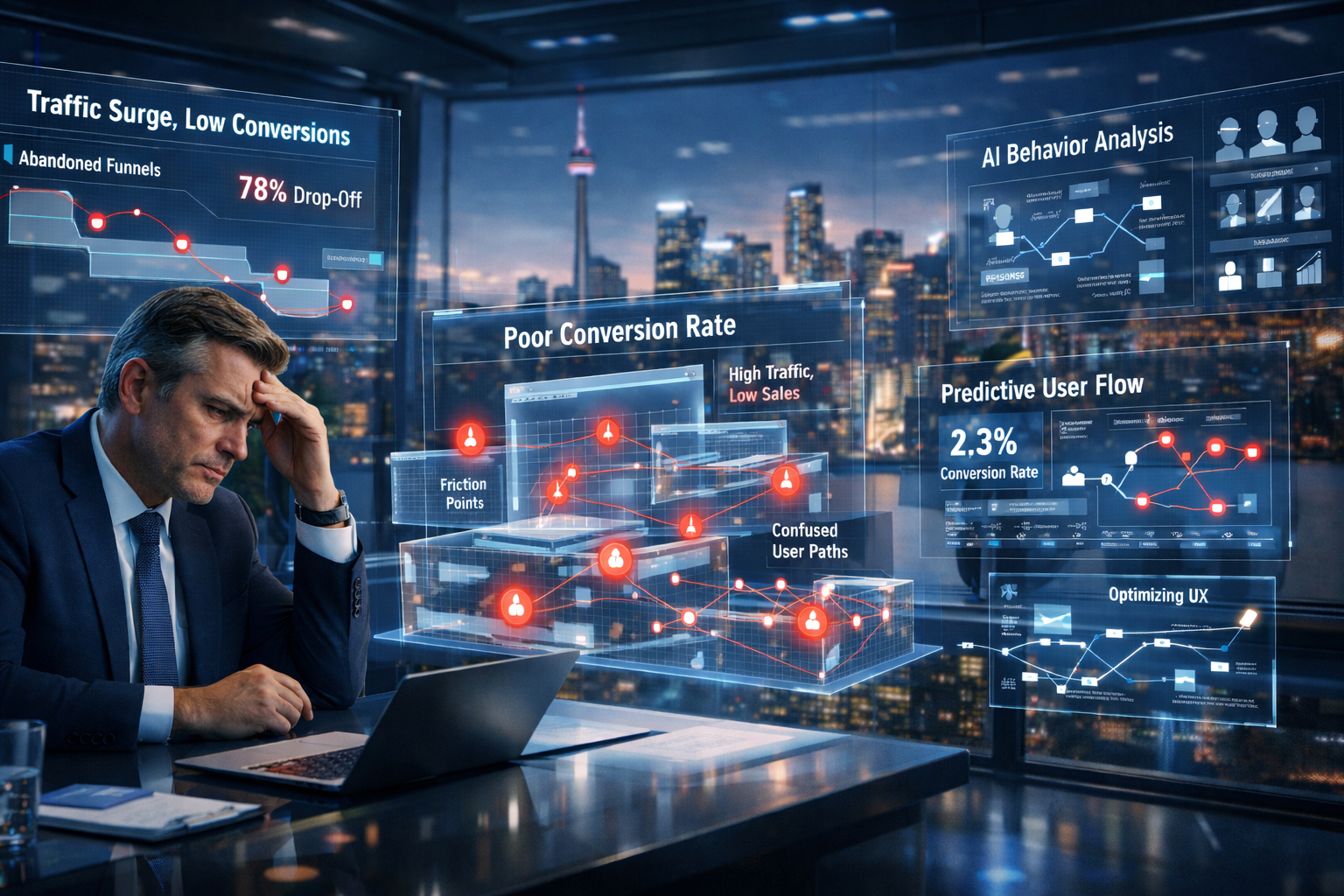
Users arrive, browse for a while, hesitate during decision points, and quietly leave without taking meaningful action. The traffic exists, but the movement toward conversion feels inconsistent and difficult to explain.
This is where the conversation around AI website optimization services becomes much more important than most businesses initially realize.
Because optimization today is no longer just about improving loading speed or fixing isolated technical issues. It is increasingly about improving how the entire digital system behaves when real users interact with it.
And that changes the discussion completely.
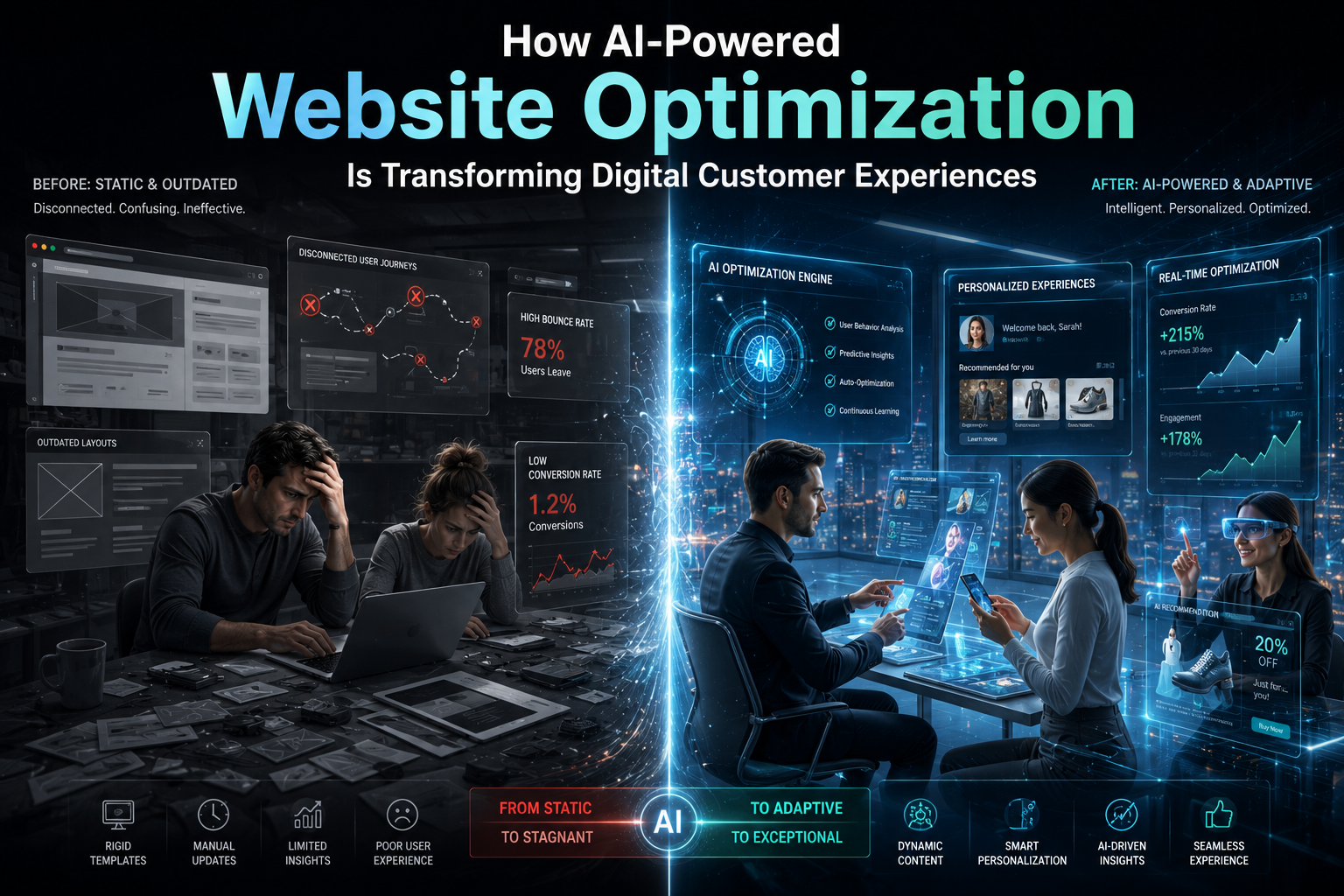
Why Traditional Website Optimization Is No Longer Enough
For years, website optimization followed a relatively straightforward formula.
Improve page speed. Adjust SEO structure. Compress images. Refine layouts. Reduce bounce rates.
While these areas still matter, they no longer solve the deeper performance problems modern businesses face online.
The reason is simple.
User behavior has changed much faster than traditional optimization strategies.
People now expect websites to feel responsive, intuitive, and frictionless almost immediately. They do not want to search endlessly for answers or navigate through disconnected experiences.
If the interaction feels slow mentally, not just technically, they disengage.
This is where many websites quietly lose business opportunities without fully recognizing it.
The issue is not visibility alone.
It is digital inefficiency.
The Hidden Cost of Digital Inefficiency
Most businesses measure website cost based on development budgets or marketing spend. Very few measure the hidden operational cost created by inefficient digital systems.
But those costs accumulate constantly.
A visitor who cannot find clarity quickly becomes lost traffic.
A lead form that creates hesitation becomes a missed opportunity.
A confusing user path increases advertising waste because more traffic is required to achieve the same outcome.
Over time, these inefficiencies compound quietly in the background.
This is why many businesses experience a frustrating cycle where marketing investment continues increasing, yet conversion growth remains unpredictable.
The website may technically function, but it is not functioning intelligently.
And this is precisely where AI website optimization services are beginning to reshape how performance is approached.
What AI Website Optimization Services Actually Change
A common misconception is that AI optimization simply means adding automation tools or chatbots to a website.
In reality, the more meaningful shift happens at the behavioral level.
AI website optimization services focus on understanding how users interact with digital systems and then improving those interactions dynamically rather than statically.
This creates several important changes.
Instead of every visitor experiencing the exact same structure, the system begins adapting based on behavior patterns.
Instead of relying entirely on manual updates, repetitive optimization processes become automated.
Instead of forcing users through rigid pathways, the experience becomes more responsive and personalized.
The website gradually shifts from being a passive platform into an adaptive performance system.
That distinction matters far more than most feature lists ever will.
Cost Saving and Growth Acceleration Are No Longer Separate Conversations
One of the biggest misconceptions surrounding AI website optimization services is the assumption that businesses must choose between reducing operational costs and pursuing aggressive growth.
The reality is more interesting.
The strongest optimization systems accomplish both simultaneously.
AI reduces operational inefficiencies by automating repetitive processes, minimizing manual intervention, and improving scalability without constant redesigns.
At the same time, it improves growth potential by increasing engagement quality, strengthening user journeys, and improving conversion pathways.
This creates a very different business equation.
The value of optimization is no longer measured only by what it saves.
It is measured by what it unlocks.
Why Many Websites Still Underperform Even After “Optimization”
One of the more overlooked realities in the current market is that many websites already claim to be optimized.
They have fast loading speeds. They are mobile responsive. They include modern design elements and technical SEO improvements.
Yet performance still feels inconsistent.
Why?
Because optimization has often been treated as a technical checklist rather than a behavioral system.
A website can load quickly and still confuse users.
It can rank on search engines and still struggle to convert visitors.
It can look modern and still create friction during decision-making moments.
This is why traditional optimization methods often reach a plateau.
They improve surface-level performance while deeper interaction problems remain unresolved.
AI website optimization services become valuable when they move beyond technical enhancement and start improving the decision flow itself.
The Shift From Static Websites to Adaptive Digital Systems
The most important transformation happening right now is not a visual redesign.
It is a structural adaptation.
Traditional websites are built around fixed assumptions. Designers predict how users might behave and then create static journeys around those predictions.
AI-driven systems behave differently.
They observe, learn, and refine interactions continuously based on actual behavior patterns.
This means the website gradually becomes more efficient over time instead of becoming outdated shortly after launch.
Content pathways improve. Interaction bottlenecks become visible. User engagement patterns reveal themselves more clearly.
The system evolves rather than stagnates.
That is where long-term digital performance starts becoming sustainable.
Why Canadian Businesses Are Paying More Attention to AI Optimization
Across Canada, businesses are facing growing pressure to compete in increasingly crowded digital environments.
Customer expectations are rising. Advertising costs continue increasing. Competition for attention is becoming more intense across nearly every industry.
In this environment, simply having a professional-looking website is no longer enough.
Businesses need systems that actively support growth rather than merely represent the brand online.
This is why AI website optimization services are gaining traction among Canadian businesses that are focused on long-term scalability rather than short-term appearance upgrades.
The conversation is shifting away from:
“How modern does the website look?”
Toward:
“How effectively does the website perform under real conditions?”
That is a much more strategic question.
What Performance-Driven Optimization Actually Looks Like
A performance-driven optimization system usually reveals itself through subtle but important improvements.
Users move through the website with less hesitation.
Navigation feels clearer without becoming oversimplified.
Interactions happen faster and more naturally.
Decision points become easier to understand.
The experience feels smoother because friction has been reduced intelligently.
Behind the scenes, automation begins handling repetitive tasks that previously consumed time and operational effort.
Behavioral insights become actionable rather than informational.
Instead of simply collecting analytics, the system starts using data to improve outcomes continuously.
This is where optimization evolves into operational intelligence.
Why “More Features” Is Often the Wrong Direction
Many businesses assume optimization means adding more tools, integrations, or AI features.
But excessive complexity often creates the opposite effect.
Too many disconnected tools can create fragmented experiences, slower systems, and inconsistent user flows.
The strongest AI website optimization services usually focus less on feature quantity and more on structural clarity.
The objective is not to overwhelm the system with technology.
The objective is to remove inefficiency without increasing confusion.
That requires strategy, not just implementation.
Where ZTS Infotech Pvt Ltd Fits Into This Shift
As businesses in Canada increasingly look for AI website optimization services that balance performance with long-term efficiency, the focus naturally shifts toward providers that approach optimization as a structured system rather than a collection of tools.
ZTS Infotech Pvt Ltd approaches website optimization with an emphasis on scalable digital engineering, behavioral performance improvement, and practical AI integration.
Key strengths include:
- Over 15 years of experience in web development and digital solutions
- 350+ global clients across multiple industries
- ISO 9001 and ISO 27001 certified workflows
- Focus on scalable, performance-oriented website systems
- AI integration is designed to improve usability, automation, and long-term efficiency
- Balanced approach between cost optimization and sustainable growth
Rather than treating optimization as a one-time technical adjustment, the approach focuses on creating systems that continue improving as business requirements evolve.
The Future of AI Website Optimization Services
The future of optimization is moving toward systems that are increasingly adaptive, predictive, and self-improving.
Websites are gradually evolving into environments capable of:
- adjusting content dynamically
- identifying friction points automatically
- optimizing interaction pathways in real time
- personalizing experiences based on user behavior
In many ways, websites are becoming operational ecosystems rather than standalone digital assets.
This shift will likely redefine how businesses think about digital performance over the next several years.
Because eventually, optimization will no longer be considered an additional service.
It will become part of the core infrastructure behind digital growth itself.
Frequently Asked Questions (FAQ)
What are AI website optimization services?
They use AI to improve website performance, user experience, automation, and conversions.
How are AI website optimization services different from traditional optimization?
Traditional optimization focuses on speed and SEO, while AI optimization improves user behavior, personalization, and interaction flow.
Can AI website optimization services improve conversions?
Yes. They help reduce friction and guide users more effectively toward action.
Are AI website optimization services suitable for small businesses?
Yes. They help small businesses improve efficiency, scalability, and digital performance.
How do AI website optimization services reduce costs?
They automate repetitive tasks, improve efficiency, and reduce the need for constant redesigns.
Why do some optimized websites still underperform?
Because many focus only on technical fixes and ignore user behavior and conversion flow.
What should businesses look for in AI website optimization services?
Look for scalability, automation, behavioral optimization, and long-term performance focus.
How does ZTS Infotech Pvt Ltd approach AI website optimization?
ZTS Infotech Pvt Ltd focuses on scalable, performance-driven AI systems designed for long-term growth and efficiency.
Final Perspective
AI website optimization services are often positioned as either a cost-saving strategy or a growth accelerator.
But that framing is becoming too limited.
The most effective systems reduce inefficiency while simultaneously improving scalability, engagement, and performance outcomes.
In other words, they lower operational friction while expanding growth potential at the same time.
And that is precisely why businesses are beginning to view optimization differently.
Not as maintenance.
Not as a technical enhancement.
But it is a strategic growth system that directly shapes how effectively a business performs online.
Before Making Your Next Digital Decision
Before investing in redesigns, new campaigns, or additional traffic generation, it is worth evaluating how efficiently your current website actually performs.
Not only from a technical standpoint, but from a behavioral and operational perspective.
- Is the system helping users move forward clearly?
- Is it reducing friction or creating it?
- Is it evolving with user behavior, or remaining static?
Those questions often reveal far more than analytics dashboards alone.
If you want to explore how structured AI website optimization can improve long-term digital performance, you can learn more here.
Because today, optimization is no longer just about improving websites.
It is about improving how digital systems support business growth over time.
-

Writen by Anirban Das