USA:
USA:  India: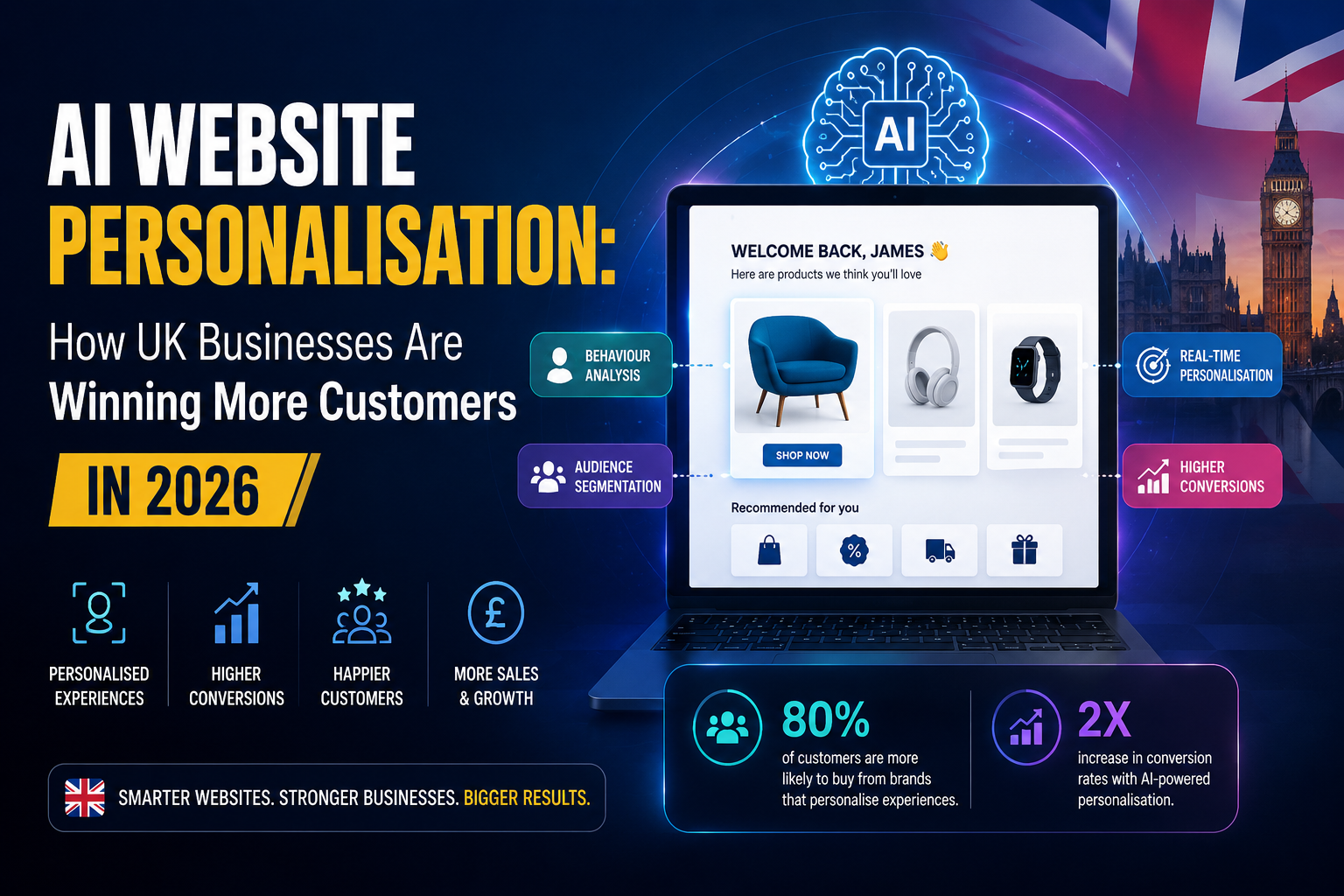
AI Website Personalisation: How UK Businesses Are Winning More Customers in 2026
Picture this: a visitor lands on your website. Within seconds, the homepage rearranges itself to show them exactly what they came looking for — the right product, the right message, the right offer. They don't bounce. They buy.
This isn't science fiction. In 2026, it's the competitive standard for UK businesses serious about growth.
AI-powered website personalisation has moved from a luxury reserved for enterprise giants to an accessible, commercially transformative tool for startups, ecommerce brands, and service companies across the UK. And if your website still shows every visitor the same static experience? You're already leaving money on the table.
This article breaks down exactly how AI personalisation works, why UK businesses are adopting it at pace, and what it means for your bottom line — with actionable insights you can act on today.
What Is AI-Powered Website Personalisation?
At its core, AI-powered website personalisation means using machine learning and real-time data to dynamically adapt your website's content, layout, offers, and messaging to each individual visitor — automatically and at scale.
Rather than a one-size-fits-all webpage, you get an intelligent website that behaves differently depending on who's visiting, what they've done before, where they came from, and what they're likely to want next.
This is fundamentally different from basic segmentation or A/B testing. Traditional personalisation says: "Show Version A to users from London." AI-powered personalisation says: "This specific visitor — based on their behaviour, device, referral source, previous sessions, and purchase history — is most likely to convert if shown this particular hero image, this CTA, and this pricing tier."
The distinction matters enormously for conversion rates.
How Does It Actually Work?
The engine behind AI-driven personalisation combines several technologies working in concert:
Behavioural Tracking and Pattern Recognition
Every click, scroll, hover, and session duration generates data. Machine learning models analyse these patterns to predict intent. If a user spends 40 seconds on your pricing page before leaving, that's a signal. If they've returned three times in a week, that's another. The AI builds a predictive profile in real time.
Natural Language Processing (NLP)
Intelligent websites can adapt their copy and tone based on visitor context. A first-time visitor gets a welcoming, informative tone. A returning customer sees tailored recommendations and loyalty messaging. This isn't manual rule-setting — the system learns what works and refines continuously.
Predictive UX and Dynamic Content Delivery
Once the AI understands a user's likely intent, it modifies the experience accordingly. This could mean:
- Swapping the homepage hero banner to reflect the product category they browsed last visit
- Surfacing a discount offer precisely when a user's engagement signals hesitation
- Reordering navigation to prioritise the services most relevant to their industry sector
- Personalising checkout flows based on their payment preferences
Real-Time Decision Making
Unlike scheduled campaigns, AI personalisation operates in milliseconds. The entire experience is shaped before the page fully loads — invisible to the user, but deeply impactful on their journey.
Why UK Businesses Are Adopting AI Web Development in 2026
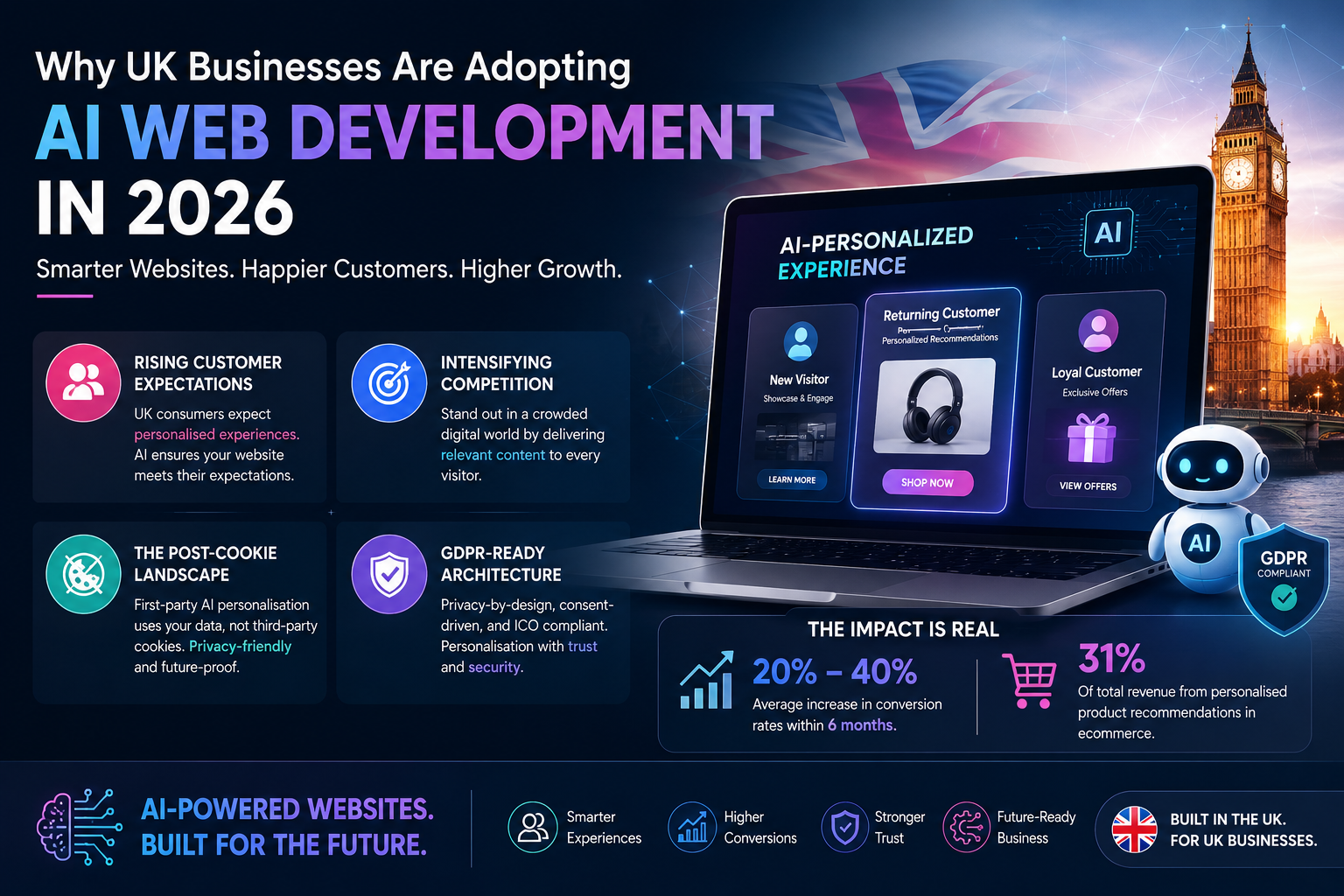
The numbers tell a compelling story. According to recent industry analysis, UK businesses that deploy AI-driven web personalisation see average conversion rate improvements of between 20% and 40% within the first six months of implementation. For ecommerce brands specifically, personalised product recommendations alone can account for up to 31% of total revenue.
But the shift goes beyond statistics. Several factors are accelerating adoption across the UK market specifically:
Rising Customer Expectations
UK consumers have been conditioned by Amazon, Netflix, and Spotify. Personalised experiences aren't a bonus — they're expected. Visitors who land on a generic website experience a jarring disconnect that erodes trust and increases bounce rates. A custom AI website development approach ensures your digital presence matches the sophistication your customers already encounter elsewhere.
Intensifying Competition for Digital Attention
The average UK adult now encounters over 4,000 digital touchpoints daily. Standing out requires relevance. An AI web development agency can help you build a site that speaks directly to each visitor's context, rather than broadcasting the same message to everyone and hoping it sticks.
The Post-Cookie Landscape
Third-party cookie deprecation has fundamentally changed targeting. UK businesses can no longer rely on offsite behavioural data from ad platforms. First-party AI personalisation — driven by on-site data your business owns — has become the strategic alternative. It's privacy-compliant, robust, and increasingly powerful as your dataset grows.
GDPR-Ready Architecture
The best AI web development companies in the UK build personalisation systems that are privacy-by-design from the ground up — anonymised profiling, consent-driven data collection, and full ICO compliance. This protects businesses from regulatory risk while still enabling sophisticated personalisation.
The Conversion Rate Impact: What UK Brands Are Seeing
Let's move past generalities and look at realistic outcomes by business type.
Ecommerce Brands
For UK online retailers, AI ecommerce personalisation typically delivers improvements across three key metrics: average order value, repeat purchase rate, and cart abandonment recovery. Personalised product recommendations based on browsing history and purchase patterns routinely lift AOV by 10–25%. Behavioural triggers — such as exit-intent overlays with personalised offers — recover between 5% and 15% of otherwise-lost sessions.
B2B Service Companies
For professional services firms, law practices, and SaaS businesses, personalisation operates differently but with equally powerful results. Adapting case studies, testimonials, and service descriptions to match a visitor's industry sector — inferred from company size signals, referral source, or previous page engagement — dramatically improves lead quality and form completion rates.
Startups and Scale-Ups
Growing UK businesses with limited marketing budgets benefit disproportionately from AI-driven UX because it multiplies the impact of every acquisition pound spent. If you're paying to drive traffic through PPC or content marketing, personalisation ensures more of that traffic converts — reducing your effective cost per acquisition without increasing spend.
Challenges UK Businesses Face — and How to Overcome Them
Adopting AI-powered personalisation isn't without friction. The most common challenges businesses raise are worth addressing directly.
"We don't have enough data yet."
This is the most common concern — and also the most often overstated. Modern machine learning models, including those deployed by a quality AI web development company, are designed to work with cold-start data. They begin making useful predictions quickly and improve continuously. You don't need years of data to begin; you need a system that learns from day one.
"The setup feels too complex."
It can be, if you attempt to build it in-house without the right expertise. This is precisely where partnering with an experienced AI web development agency changes everything. The right partner handles architecture, integration, and model training — your team focuses on business objectives, not technical implementation.
"How do we measure ROI?"
Credible personalisation platforms and agencies provide attribution frameworks that connect personalisation variants to conversion outcomes. The metrics to track include conversion rate by segment, revenue per visitor, engagement depth, and return visit rate. When properly instrumented, the ROI case becomes clear within weeks.
"What about data privacy?"
Legitimate concern for any UK business operating under GDPR. The answer lies in choosing affordable AI web development services that are built with privacy-compliant data architectures — on-site behavioural data, explicit consent mechanisms, and no reliance on third-party data brokers. UK businesses that get this right gain both competitive advantage and customer trust.
The Role of a Specialist AI Web Development Agency
Not all web development companies are equipped to deliver genuine AI personalisation. The gap between a firm that adds a "personalisation plugin" and one that engineers an intelligent website from the ground up is enormous — and the results reflect it.
A specialist AI web development company UK brings:
- Machine learning model integration — not just rule-based logic, but adaptive systems that improve with every interaction
- Custom data pipelines — built to capture the specific behavioural signals relevant to your business model
- A/B and multivariate testing infrastructure — to validate personalisation hypotheses before full deployment
- Cross-channel personalisation — ensuring consistency between your website, email communications, and retargeting campaigns
- Ongoing optimisation — because AI personalisation isn't a set-and-forget installation; it requires continuous refinement
This is why businesses seeking the best AI web development company in the UK are increasingly looking beyond generalist agencies towards specialists with demonstrable expertise in intelligent web engineering.
Future Trends in AI Web Development UK Businesses Should Watch
The trajectory of AI-powered personalisation points towards even more sophisticated capabilities over the next 18–36 months.
Multimodal Personalisation
AI systems will increasingly adapt not just text and imagery, but video content, interactive elements, and voice interfaces — delivering a genuinely immersive personalised experience across every dimension of a website.
Hyper-Contextual Experiences
Beyond visitor history, future systems will factor in real-time context: weather, local events, economic conditions, and even news sentiment. A financial services firm could serve different messaging on a day of market volatility versus a period of market stability — automatically, without manual intervention.
Autonomous Optimisation
The next generation of AI web engineering will see systems that not only personalise but autonomously propose and test layout changes, copy variations, and journey modifications — essentially acting as a continuous conversion optimisation engine running 24/7.
Deeper CRM and ERP Integration
AI websites will increasingly connect directly with business data systems, enabling personalisation that reflects not just web behaviour but actual customer relationship data — account status, purchase history, support interactions — creating a genuinely unified experience.
For UK businesses investing now in custom AI website development, these future capabilities will be natively accessible through systems built on the right architecture from the outset.
Conclusion: The Personalised Web Is the Profitable Web
The UK digital marketplace in 2026 is more competitive, more sceptical, and more saturated than it has ever been. Generic websites — regardless of how beautifully designed — are losing ground to intelligent, adaptive digital experiences that make every visitor feel understood.
AI-powered website personalisation isn't a technical experiment. It's a commercial strategy. Businesses that implement it thoughtfully, with expert support and the right technology foundation, are seeing measurable gains in conversion rates, customer lifetime value, and brand perception.
The question isn't whether to invest in AI-powered website development services UK — it's how quickly you can move before your competitors do.
FAQ Section
Q1: What is AI-powered website personalisation and how does it work?
AI-powered website personalisation uses machine learning algorithms to analyse visitor behaviour in real time and dynamically adapt the website experience — including content, layout, offers, and messaging — to each individual user. It works by collecting first-party behavioural data (clicks, time on page, referral sources, device type) and using predictive models to determine what content or journey a visitor is most likely to engage with. The result is an intelligent website that improves conversion rates by showing each visitor the most relevant experience for them specifically.
Q2: How much can AI personalisation increase conversion rates for UK businesses?
Conversion rate improvements vary by industry and implementation quality, but UK businesses typically see between 20% and 40% uplift in conversion rates within the first six months of deploying AI personalisation. Ecommerce brands often report even higher gains — up to 31% of revenue attributable to AI-powered product recommendations. B2B companies tend to see improvements in lead quality and form completion rates when content is dynamically tailored to visitor industry and intent signals.
Q3: Is AI website personalisation GDPR-compliant for UK businesses?
Yes — when implemented correctly. GDPR-compliant AI personalisation relies on first-party data collected with explicit consent, anonymised behavioural profiles, and transparent data usage policies. A reputable AI web development agency UK will build personalisation architecture that is privacy-by-design, ensuring ICO compliance without compromising the quality of the personalised experience. Businesses should avoid personalisation systems that rely on third-party data sources or that lack robust consent management.
Q4: What is the difference between a standard web development company and an AI web development agency?
A standard web development company builds functional, well-designed websites. An AI web development agency goes further — integrating machine learning models, behavioural data pipelines, predictive UX systems, and autonomous optimisation engines into the website's core architecture. The result is a site that doesn't just look good but actively adapts to drive conversions. For UK businesses with serious growth ambitions, the distinction is commercially significant.
Q5: How long does it take to see results from AI-powered website personalisation?
Initial results — such as reduced bounce rates and improved engagement metrics — are typically visible within 4–8 weeks of deployment as the AI system begins accumulating behavioural data. Measurable conversion rate improvements generally emerge within 8–16 weeks. The system improves continuously over time as the machine learning models are trained on a growing dataset, meaning ROI typically increases month-on-month rather than plateauing.
Q6: Are affordable AI web development services available for UK startups and SMEs?
Absolutely. The perception that AI web development is exclusively for enterprise budgets is outdated. A growing number of specialist agencies — including those offering affordable AI web development services UK — now provide scalable solutions that fit SME budgets without compromising on technical quality. The key is to work with an agency that builds modular, scalable architecture from the outset, allowing you to start with core personalisation features and expand capability as your business grows.
Q7: How does AI personalisation work for B2B versus B2C websites?
For B2C and ecommerce brands, AI personalisation focuses primarily on product recommendations, dynamic pricing displays, abandoned cart recovery, and promotional targeting based on purchase history and browsing behaviour. For B2B websites, the approach shifts towards adapting case studies, service descriptions, social proof, and CTAs based on inferred visitor industry, company size, and funnel stage. Both approaches use the same underlying technology; the personalisation logic is calibrated to the respective buying journey.
Ready to Turn Your Website Into a Conversion Engine?
If you're a UK business owner, ecommerce brand, startup, or enterprise decision-maker who's serious about growth in 2026, your website can no longer afford to be passive.
ZTS India's AI Website Engineering services for the UK are specifically designed to help ambitious businesses build intelligent, personalised web experiences that convert more visitors into customers — backed by robust machine learning architecture, GDPR-compliant data practices, and a team with deep expertise in AI-driven web development.
Whether you're looking to rebuild from the ground up with custom AI website development, or layer intelligent personalisation onto an existing platform, ZTS India delivers results that justify the investment.
Explore ZTS India's AI Website Engineering Services →
Get in touch today for a no-obligation consultation. Discover exactly what AI-powered personalisation could mean for your conversion rates, your customer experience, and your revenue.
-

Writen by Anirban Das