USA:
USA:  India:
 What Does eCommerce Website Development Cost in Riyadh?
eCommerce website development in Riyadh starts at 749 SAR for a small-catalogue WooCommerce build and 999 SAR for a more complete store with bilingual Arabic-English setup, Mada payment integration, and SEO configuration. Mid-market Shopify builds with custom theme development, the full Saudi payment stack (Mada, Tabby, Tamara, SADAD), Aramex and SMSA logistics integration, and ZATCA Fatoora Phase 2 compliance typically range from 5,500 to 16,000 SAR depending on customisation depth and catalogue size. Fully custom eCommerce platforms — B2B portals, marketplace builds, or large-catalogue custom applications — are scoped individually and commonly run from 28,000 SAR to 130,000 SAR. A standard retail eCommerce store for the Riyadh market is typically live within six to eight weeks of a signed brief.

Riyadh's eCommerce Market: What Business Owners Need to Understand in 2025
Riyadh is not just the capital of Saudi Arabia — it is the commercial centre of one of the fastest-growing eCommerce markets in the Arab world. With a population exceeding seven million, a GDP per capita that ranks among the highest in the region, and a consumer base that is young, urban, and among the most digitally engaged anywhere, Riyadh represents a significant and increasingly competitive retail opportunity. Businesses that have built proper eCommerce infrastructure in the city are compounding that advantage month over month. Those still operating without a functional online store are ceding ground to competitors who do.
The commercial reality for Riyadh retailers in 2025 is that the decision to launch or upgrade an eCommerce platform is no longer a growth strategy consideration — it is a baseline commercial requirement in most product categories. Fashion, electronics, home goods, groceries, health and beauty, sports equipment, and furniture have all crossed the threshold where a significant proportion of Riyadh consumer purchasing happens online. Categories that were almost entirely offline five years ago are now seeing meaningful eCommerce adoption driven by Vision 2030's infrastructure investment and the consumer behaviour shifts that accelerated after 2020.
What makes eCommerce development for Riyadh specifically different from a generic online store build is the market's particular requirements. Riyadh consumers expect Arabic-first interfaces — not Arabic as an afterthought translation. They pay with Mada, Tabby, and Tamara. They expect same-day or next-day delivery from Aramex and SMSA. They receive ZATCA-compliant VAT invoices. And they browse and buy predominantly on Android mobile devices on 4G and 5G connections that load-test your store's performance in real market conditions every day.
This guide covers what eCommerce development in Riyadh actually requires, how to select the right platform and architecture, what the realistic cost and timeline ranges are, and what separates a store built for the Riyadh market from a generic template that fails against these specific requirements.
Business Problem to eCommerce Outcome: Riyadh Scenarios
Scenario One: Riyadh Fashion Retailer Losing Sales to Online Competitors
A fashion and lifestyle retailer with two stores in Al Olaya and Riyadh Park has seen walk-in traffic decline over eighteen months. Younger Riyadh consumers — their primary demographic — increasingly discover and purchase fashion online, and the retailer's current digital presence is a static Instagram account with a DM-for-pricing enquiry flow. Two direct competitors launched Shopify stores in the past year and are visibly gaining the online market share that was previously captured through physical footfall.
The appropriate eCommerce solution is a Shopify build with a custom theme developed to their brand identity, an Arabic-first storefront with English toggle, Mada and Tabby payment integration, a structured product catalogue with size-colour variants and stock availability display, Aramex shipping rate calculation at checkout, and a product photography workflow that meets the visual standards Riyadh fashion consumers compare against established Saudi brands. The conversion architecture — how the mobile homepage surfaces new arrivals and bestsellers, how the product page handles Arabic size guides, how the checkout flow minimises drop-off on Android — is where the commercial return is created or lost. Timeline is six to eight weeks from signed brief to live launch.
Scenario Two: Riyadh B2B Distributor Moving from Phone Orders to an Online Portal
A building materials distributor operating from a warehouse in the Second Industrial City of Riyadh supplies contractors, fit-out companies, and facilities management firms across the capital. Their entire ordering process runs through phone calls, WhatsApp, and faxed purchase orders. They process forty to sixty orders per day, each requiring manual entry into their accounting system, a manually generated invoice, and a manually booked delivery with their logistics partner.
A WooCommerce B2B eCommerce portal with custom PHP development eliminates the majority of this manual overhead. The portal gives trade account buyers: self-service ordering from a structured product catalogue with company-account-specific pricing, minimum order quantity enforcement, purchase order reference fields in checkout, credit account management, automated ZATCA-compliant B2B invoice generation on order confirmation, and Aramex API integration for delivery booking and tracking. The business case is not primarily about revenue growth — it is about operational efficiency and the elimination of order processing errors that currently create customer service issues. Timeline for a B2B portal of this scope is nine to thirteen weeks.
Scenario Three: Riyadh Electronics Retailer Migrating from a Non-Performing Store
An electronics retailer in Riyadh has a WooCommerce store that was built two years ago by a freelancer. The store loads slowly — over four seconds on mobile — has no Arabic content despite 70 percent of visitors browsing in Arabic, does not support Mada payments, and has a checkout abandonment rate above 85 percent. The store receives traffic from organic search and paid Google campaigns but converts at less than 0.8 percent, significantly below the electronics retail category benchmark in Saudi Arabia.
The issue is not that they have WooCommerce. The issue is that the store was built without KSA market requirements as the baseline. A migration to a properly built Shopify store — with Core Web Vitals performance targets met, Arabic product descriptions, Mada and Tabby payment integration, correct VAT display at 15 percent, and a mobile checkout flow designed for one-handed Saudi Android usage — addresses the conversion architecture failure. The migration also includes Google Analytics 4 enhanced eCommerce configuration with full funnel visibility so that post-launch optimisation decisions are driven by actual user behaviour data rather than assumptions. Timeline for the migration is six to nine weeks including product catalogue migration and redirect mapping to preserve existing search equity.
Scenario Four: Riyadh Multi-Brand Retail Group Building a Unified Online Destination
A retail group in Riyadh operates four consumer brands across sportswear, outdoor equipment, premium homewares, and health supplements. Each brand has a distinct identity, separate supplier relationships, and different target customer demographics. The group wants a unified eCommerce destination where each brand has its own storefront experience, product catalogue, and promotional calendar, but all share a single checkout, a unified loyalty programme, and a consolidated customer data platform.
This is a custom eCommerce development project — a multi-brand marketplace architecture on a Laravel backend with a headless frontend. The platform requires brand-level revenue attribution, separate vendor inventory management, a unified cart that handles multi-brand orders, and a loyalty engine that awards and redeems points across all four brand storefronts. Timeline for a platform architecture of this complexity is fifteen to twenty weeks, with an MVP delivering two brand storefronts and the core loyalty infrastructure in the first phase.
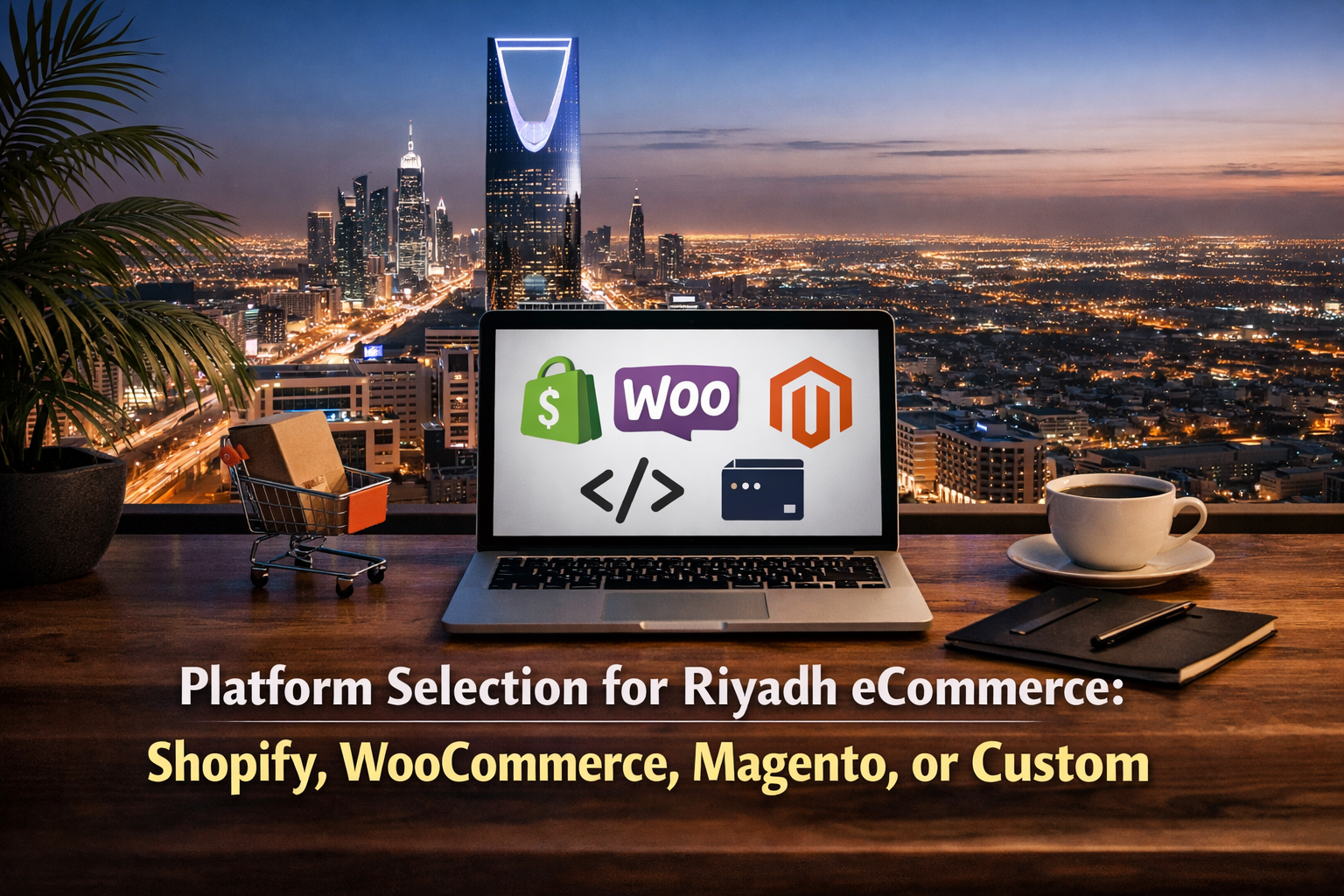
Platform Selection for Riyadh eCommerce: Shopify, WooCommerce, Magento, or Custom
Shopify eCommerce Website Development in Riyadh
Shopify is the most practical choice for Riyadh retail businesses launching their first eCommerce store or migrating from a non-performing platform, where time-to-market and operational reliability are higher priorities than deep customisation. Shopify's hosted infrastructure eliminates server management overhead, and the platform's Saudi payment gateway support — Mada, Tabby, Tamara, SADAD, PayTabs, and Moyasar — is either native or accessible through the Shopify App Store without custom development.
The Shopify limitation for Riyadh businesses becomes relevant when the commercial requirement involves pricing logic, inventory architecture, or buyer account management that exceeds what Shopify's API exposes. B2B distributors with customer-specific pricing matrices, retailers with complex multi-warehouse routing, or businesses requiring deep ERP integration will encounter Shopify's ceiling at a point where the cost of maintaining workarounds exceeds the cost of a custom alternative. For standard retail, Shopify's ceiling is rarely encountered.
WooCommerce on WordPress — For Content-Commerce Integration
WordPress website development in KSA with WooCommerce is the appropriate choice for Riyadh businesses where content and commerce are strategically integrated — a brand that publishes Arabic-language editorial content, product guides, and category education alongside a product catalogue, where the content drives organic search traffic that converts into product purchases. WooCommerce provides full control over the data model, no per-transaction Shopify fees, and a plugin ecosystem that covers Mada integration, ZATCA compliance, Arabic RTL configuration, and Aramex API connection.
The WooCommerce constraint for Riyadh operators is hosting and performance. A WooCommerce store on underpowered shared hosting loading in five seconds is not competitive with a well-configured Shopify store loading in two seconds on Riyadh mobile networks. The platform is technically capable — the hosting configuration and performance engineering are what determine whether it performs to standard. A properly hosted and configured WooCommerce store with Redis object caching, a CDN with a Middle East edge node, and optimised database queries meets Riyadh mobile performance expectations.
Magento for Enterprise eCommerce in Riyadh
Magento (Adobe Commerce) is appropriate for large Riyadh retail operations — national retail chains, large distributors, or multi-channel retailers — managing complex catalogue architecture, multiple storefronts serving different market segments, and B2B buyer portal requirements that WooCommerce cannot serve at scale. The implementation cost and ongoing infrastructure overhead of a properly delivered Magento build are substantially higher than Shopify or WooCommerce. For most Riyadh SMEs and mid-market businesses, Magento is over-specification. For large enterprises with genuine Magento-scale requirements, it warrants evaluation.
Custom eCommerce Development for Riyadh
Custom eCommerce development on Laravel, Node.js, or another backend framework is appropriate for Riyadh businesses with commercial models that no packaged platform handles natively: multi-vendor marketplaces, grocery and on-demand delivery platforms, B2B procurement portals with complex approval workflows, or rental and service booking platforms with time-based availability logic. The development investment is higher than any packaged platform. The return is a platform precisely fitted to the business model, unconstrained by platform vendor feature decisions and capable of being extended as the business evolves.
Riyadh-Specific eCommerce Requirements: What Every Saudi Store Must Get Right
Payment Gateway Integration — The Riyadh Consumer Stack
Riyadh's consumer payment behaviour is well-established and non-negotiable for any eCommerce store expecting meaningful conversion rates. Mada — the Saudi domestic interbank debit network — is the payment method that a significant proportion of Saudi consumers use for online transactions. A Riyadh eCommerce store without Mada support is structurally excluding a large segment of its target market at the checkout. Tabby and Tamara buy-now-pay-later integration has become effectively standard in Riyadh fashion, electronics, and home goods categories where average order values make instalment options commercially significant for buyers. Apple Pay and Google Pay are growing in adoption among Riyadh consumers who prioritise frictionless mobile checkout. SADAD handles bank transfer preferences for higher-value purchases and B2B transactions.
ZATCA Fatoora Phase 2 Compliance
Every VAT-registered Riyadh business with an eCommerce store generating taxable transactions must implement ZATCA Fatoora Phase 2 e-invoicing compliance on a schedule determined by their annual revenue and sector. Phase 2 compliance requires XML invoice generation to UBL 2.1 ZATCA schema, ECDSA cryptographic signing of each invoice using a ZATCA-issued certificate, QR code generation to ZATCA encoding specification, and API integration with the Fatoora portal for clearance of B2B invoices and reporting of B2C invoices. An eCommerce platform operating in Riyadh without this compliance is exposed to ZATCA penalties. The implementation must be tested in ZATCA's compliance sandbox environment before the store goes live, not added as a post-launch task.
Riyadh Logistics Integration — Same-Day and Next-Day Delivery Expectations
Riyadh consumers increasingly benchmark delivery expectations against major regional and global retailers. Same-day delivery within Riyadh city limits and next-day delivery to wider Riyadh governorate locations are competitive expectations in fast-moving consumer goods, fashion, and electronics. Aramex, SMSA, and Naqel Express all offer strong Riyadh domestic delivery coverage. Integration for a Riyadh eCommerce store covers real-time shipping rate calculation at checkout based on the buyer's Riyadh district, automated shipment creation on order confirmation, tracking number injection into order confirmation emails, and delivery status updates through webhook or polling. The logistics provider mix appropriate for a Riyadh store depends on the product category — temperature-sensitive goods, large furniture, and high-value electronics have different logistics requirements from standard packaged retail.
Arabic RTL eCommerce Design for Riyadh Users
Arabic is the primary browsing and purchasing language for the majority of Riyadh eCommerce users. Pro-level website design in KSA for eCommerce means designing Arabic-first rather than translating from an English template. The layout differences between an Arabic RTL eCommerce interface and an English LTR one are significant: navigation menus, product card alignment, filter and sort controls, cart and checkout flow direction, form field placement, and promotional banner text orientation all change. Arabic typeface selection for eCommerce — choosing a typeface that is readable in product description body text at small sizes as well as in heading and promotional contexts — is a design decision that affects perceived quality directly. Riyadh users have a visual reference point set by established Saudi retail brands with well-designed Arabic eCommerce interfaces, and stores that fall below that standard are perceived as not built for the local market.
Saudi VAT at 15 Percent and ZATCA Invoice Format
Saudi VAT at 15 percent applies to most retail goods sold through Riyadh eCommerce stores. Platform VAT configuration must handle: correct 15 percent calculation by product category with zero-rating applied accurately for exempt goods; VAT-inclusive price display for B2C customers with VAT amount disclosed on order summary and invoice; VAT-exclusive display with separate tax line for B2B account buyers; and invoice format that meets ZATCA's requirements for both the customer-facing PDF and the electronic XML submitted through the Fatoora portal. Incorrect VAT configuration affects compliance, creates customer trust issues when checkout totals do not match browsing prices, and produces inaccurate VAT return data for the business's accounting function.
AI-Powered eCommerce for Riyadh Retailers: Practical Deployments
AI-driven merchandising capabilities that were previously accessible only to large-scale retailers are now deployable on Shopify and WooCommerce stores at cost points that Riyadh mid-market businesses can justify based on measurable commercial outcomes.
Product recommendation engines personalising the Riyadh shopper's homepage and product page experience based on their browsing and purchase history are deployable through Shopify app integrations and WooCommerce plugins without custom development for most standard retail use cases. For Riyadh stores with sufficient transaction volume — typically 400 or more orders per month — personalised recommendation logic produces measurable improvements in average order value and cross-category discovery.
Smart search handling Arabic-English mixed queries, Arabic synonym matching, and semantic intent rather than keyword matching is one of the highest-return AI investments available to a Riyadh eCommerce operator. Algolia integration with Arabic analyser configuration or Elasticsearch with Arabic language indexing delivers a search experience that dramatically outperforms the default search in Shopify and WooCommerce for Riyadh customers who search in Arabic, English, or a combination. The improvement in search-to-purchase conversion is typically visible within the first analytics review period after deployment.
Predictive analytics built on GA4 enhanced eCommerce tracking gives Riyadh store operators actionable data: which product categories drive the highest conversion rates among Arabic-browsing users versus English-browsing users, which Riyadh districts have the highest average order values and lowest return rates, which traffic sources produce customers who make repeat purchases within ninety days. Most eCommerce stores ZTS India audits have misconfigured or absent analytics that produces data too incomplete to drive commercial decisions. Correctly configured analytics is not a technical luxury — it is the feedback mechanism through which the post-launch investment in optimisation compounds into improving commercial performance.
eCommerce Development Services for Riyadh Businesses: What ZTS India Delivers
Shopify eCommerce Development for Riyadh
ZTS India delivers Shopify eCommerce website development for Riyadh businesses as a full engagement covering: custom theme development to brand standards, Arabic-English bilingual storefront configuration, the full Saudi payment gateway stack, Aramex and SMSA logistics integration, ZATCA Fatoora Phase 2 compliance, Saudi VAT 15 percent configuration, mobile-first UX design optimised for Riyadh Android users, SEO technical architecture targeting Riyadh commercial intent keywords in Arabic and English, and GA4 enhanced eCommerce analytics configuration. Shopify builds at ZTS India are not template installations with a logo swap — they are custom-developed storefronts built against a documented brief.
WooCommerce and WordPress eCommerce Development in Riyadh
WordPress website development in KSA with WooCommerce at ZTS India covers the full WooCommerce build lifecycle for Riyadh businesses: custom theme development, Mada payment plugin integration, ZATCA compliance plugin development where no adequate plugin exists, Arabic RTL storefront configuration, B2B account management for trade buyers, product catalogue import and optimisation, and performance engineering on managed hosting with Redis caching and CDN configuration for Riyadh network conditions. Custom PHP web development for WooCommerce covers functionality that no available plugin provides, including ZATCA Phase 2 integration and B2B-specific pricing architecture.
Custom eCommerce Platform Development
For Riyadh businesses with commercial models that exceed packaged platform capability, ZTS India delivers fully custom eCommerce applications on Laravel and Node.js backends. This covers multi-vendor marketplace builds, B2B procurement portals, subscription eCommerce with dynamic fulfilment logic, and rental or service booking platforms with availability management. Custom eCommerce builds include the full Riyadh integration stack — ZATCA, Saudi payment gateways, Aramex and logistics APIs — as standard components of the architecture rather than afterthought additions.
eCommerce Migration for Riyadh Businesses
Platform migration — from a non-performing WooCommerce store to Shopify, from Shopify to a custom platform, or from an outdated custom build to a modern stack — is a common engagement type for Riyadh businesses that built their first online store without adequate KSA-market requirements and are now experiencing the commercial cost of that gap. Migration scope covers product catalogue export and import, customer account data migration, order history transfer where the target platform supports it, URL redirect mapping to preserve organic search equity, and full KSA integration reconfiguration on the new platform.
eCommerce Mobile App Development for Riyadh Retailers
Riyadh retail businesses with established eCommerce stores and growing repeat purchase rates benefit commercially from a companion React Native app — iOS and Android — that extends the store to a native mobile channel with push notification re-engagement, one-tap checkout with saved payment methods, and a home screen presence that keeps the brand visible between purchase occasions. ZTS India delivers eCommerce app development for Riyadh as a combined web-and-app engagement, with the app connected to the Shopify or WooCommerce backend through the respective platform API without duplicating product or order management infrastructure.
How a Riyadh eCommerce Development Project Works: Process Transparency
Discovery and Requirements — Week 1
eCommerce discovery for Riyadh businesses covers: product catalogue structure and volume, variant complexity, pricing model (B2C, B2B, or hybrid), required payment gateways, logistics providers and delivery model, ZATCA compliance scope, bilingual Arabic-English content requirements, integration dependencies (ERP, POS, WMS), and the commercial KPIs that define launch success. The output is a documented requirements brief and phased delivery plan agreed before development begins.
Arabic-First UX Design — Weeks 1 to 3
eCommerce UX design for Riyadh users at ZTS India begins with the Arabic mobile experience — the primary interface context for the majority of Riyadh eCommerce shoppers. Arabic and English storefronts are designed in parallel in Figma. Navigation architecture, product discovery flows, cart and checkout sequences, and promotional layout are designed for both language contexts as primary design outputs, not one language with the other translated from it after approval.
Development, Integration, and Catalogue Import — Weeks 3 to 7
Platform build or custom development, payment gateway integration, logistics API connection, ZATCA compliance implementation, VAT configuration, and product catalogue import run in parallel on a staging environment. Product content import — data cleaning, Arabic description review, image optimisation — is managed as a parallel workstream against the client's content schedule. Staging UAT by the client team precedes any production deployment.
Performance Optimisation and Pre-Launch Testing — Weeks 7 to 8
Responsive website development and performance engineering targeting Core Web Vitals in the Good range — LCP under 2.5 seconds on a Riyadh 4G connection — is conducted before launch. Checkout flow testing across all payment methods, ZATCA invoice generation testing against the ZATCA compliance sandbox, cross-browser rendering validation including Samsung Internet (a significant browser share in Saudi Arabia), and Arabic RTL layout verification across device sizes are all completed before the go-live date is confirmed.
Post-Launch Analytics and Conversion Optimisation
The first sixty to ninety days post-launch are the highest-value optimisation window. GA4 enhanced eCommerce data from live Riyadh user sessions identifies where buyers are abandoning the purchase funnel and what UX, content, or checkout changes are likely to improve conversion. eCommerce stores treated as finished products after launch consistently underperform stores where the operator iterates based on real user behaviour data from the target market.
Pricing: What eCommerce Development Costs in Riyadh
eCommerce development pricing for Riyadh businesses varies significantly based on platform choice, catalogue scope, KSA integration count, bilingual requirements, ZATCA compliance, and whether a mobile app is included.
Entry-level builds start at 749 SAR for a small WooCommerce store with up to fifty products, single language, one payment gateway, and standard shipping. The 999 SAR entry point covers a more complete build: bilingual Arabic-English setup, Mada and Tabby payment integration, Aramex shipping, ZATCA configuration, and basic SEO for a catalogue of up to 150 products.
Mid-market Shopify builds with custom theme development, the full Riyadh consumer payment stack, logistics API integration, ZATCA Fatoora Phase 2 compliance, bilingual storefront, and a catalogue of up to 500 SKUs typically run from 5,500 to 16,000 SAR depending on customisation depth and integration scope.
Custom eCommerce builds — B2B portals, marketplace architectures, subscription eCommerce platforms, or Magento enterprise implementations — are scoped individually and commonly range from 28,000 SAR to 130,000 SAR. Multi-brand marketplace builds with mobile app inclusion exceed this range.
Factors that drive Riyadh eCommerce project cost upward:
- ZATCA Fatoora Phase 2 compliance implementation and ZATCA sandbox testing
- Full Saudi payment gateway stack — each gateway adds integration and testing scope
- B2B buyer account management with custom pricing, credit terms, and PO workflow
- Catalogue volume above 500 SKUs with complex variant and attribute architecture
- Multi-vendor or marketplace architecture requiring vendor portal and revenue settlement
- Mobile app development alongside the web store
- ERP, POS, or WMS integration requiring custom API development
- Same-day Riyadh delivery logic with real-time inventory sync
- Custom AI merchandising — recommendation engine, smart search, predictive analytics
What helps keep cost closer to the entry point:
- Clean, structured product data with complete Arabic and English content provided before development
- Standard catalogue without unusual variant complexity
- Defined scope with a single client-side decision-maker and minimal mid-development change requests
- Phased launch — core catalogue in Phase 1, advanced features in Phase 2
Evaluating an eCommerce Development Partner for Your Riyadh Business
Riyadh and KSA Integration Experience — Ask for Specifics
The most commercially important technical differentiator for a Riyadh eCommerce development partner is specific experience with Saudi market integration requirements — not a general eCommerce portfolio. Ask directly: have they integrated Mada in a production Shopify or WooCommerce store? Have they delivered ZATCA Fatoora Phase 2 compliance in a live Riyadh eCommerce platform? Do they have experience with Aramex or SMSA API integration including same-day delivery logic for Riyadh zones? Can they show examples of Arabic RTL eCommerce builds with production-level bilingual design? Specific answers with verifiable production references distinguish genuine KSA experience from general eCommerce capability.
Mobile Performance as a Primary Delivery Standard
A Riyadh eCommerce store that loads in four seconds on a Samsung Galaxy A-series device on Riyadh 4G is commercially underperforming regardless of how it looks on a desktop browser in a development environment. Ask explicitly how the team approaches mobile performance for Riyadh deployments: what their target Core Web Vitals thresholds are, what hosting configuration they use for WooCommerce or custom builds, whether they configure a CDN with a Middle East edge presence, and how they test performance on Saudi mobile device profiles and network conditions. A development partner who discusses mobile performance proactively has a different commercial orientation from one who only addresses it when asked.
Conversion Architecture Orientation — Beyond Visual Design
The real commercial value in Riyadh eCommerce development is not the visual design — it is the conversion architecture: how the store is structured to move a Riyadh mobile user from product discovery to completed checkout with minimum friction. Ask how the team approaches checkout flow optimisation for Saudi mobile users, how they handle Arabic product page layout for conversion rather than just translation, what their process is for post-launch analytics configuration and conversion funnel analysis. A partner who understands conversion architecture as a core deliverable — not a post-launch add-on — produces stores that generate revenue rather than traffic.
Ownership, IP Transfer, and Hosting Transparency
Confirm that the developed Shopify theme code, WooCommerce plugin code, or custom application codebase is fully owned by the client at project completion. All code should be in a client-owned repository. Hosting should be on client-owned accounts — Shopify merchant account, managed WordPress hosting, or cloud infrastructure account. A development partner who retains ownership of any project component beyond the engagement period creates a structural risk to the client's business continuity. ZTS India transfers full IP ownership at project completion and builds on client-owned accounts from project initiation as standard contract terms.
Why Riyadh Businesses Choose ZTS India for eCommerce Development
ZTS India (ztsindia.com) is a full-stack digital engineering firm delivering eCommerce development for Riyadh and KSA businesses as part of a broader practice covering website design in KSA, WordPress development, React Native mobile app development, custom PHP and Laravel development, and AI-powered platform engineering. Our eCommerce capability connects to the full digital stack — most Riyadh eCommerce clients work with us on a web store and a companion app, or a web store and an internal operations tool, within the same engagement or extended relationship.
For Riyadh clients specifically, our eCommerce delivery capability includes:
- Mada, SADAD, PayTabs, Moyasar, Tap Payments, Tabby, and Tamara payment gateway integration across Shopify, WooCommerce, and custom builds
- ZATCA Fatoora Phase 2 compliance — UBL XML invoice generation, ECDSA cryptographic signing, QR code production, and Fatoora portal API integration
- Saudi VAT 15 percent configuration with product-category exemption handling and B2B/B2C invoice format switching
- Aramex, DHL, SMSA, and Naqel logistics API integration with real-time Riyadh zone rate calculation and automated shipment creation
- Bilingual Arabic-English storefront development with RTL-native UX design and Arabic product content management
- AI-powered smart search with Algolia and Elasticsearch with Arabic language analyser for Riyadh users
- Mobile-first eCommerce design optimised for Riyadh Android and iOS device profiles and Saudi 4G network conditions
- Industry-specific eCommerce solutions for Riyadh retail, B2B distribution, healthcare, hospitality, and real estate
- GA4 enhanced eCommerce analytics configuration with full conversion funnel visibility and Riyadh user segment analysis
- Post-launch CRO retainer services — conversion funnel analysis, A/B testing, Arabic UX optimisation
- Full IP ownership transfer and client-owned hosting accounts from project initiation
Our Riyadh and KSA eCommerce clients include retail brands across fashion, electronics, home goods, and specialty categories; B2B distributors across industrial, healthcare, and professional supplies; and hospitality and service businesses adding digital commerce channels to existing operations. Most come through referrals from existing clients or from businesses that discovered the limitations of their current platform and needed a partner with genuine Saudi market delivery experience.
Frequently Asked Questions
How long does eCommerce development take for a Riyadh business?
A standard Shopify or WooCommerce retail store for the Riyadh market — with a catalogue of up to 300 products, the full Saudi payment gateway stack, Aramex logistics integration, ZATCA compliance, bilingual Arabic-English storefront, and mobile performance optimisation — typically takes six to eight weeks from signed brief to live launch. B2B eCommerce portals with custom account logic run eight to thirteen weeks. Custom eCommerce builds — marketplace architectures, subscription platforms, or builds requiring ERP integration — run fourteen to twenty-four weeks depending on scope. The factors that most commonly extend timelines are: product data that requires cleaning or Arabic content writing, ZATCA compliance testing cycles, payment gateway merchant account approval processes (which are outside the developer's control), and client-side approval delays on design and UAT.
Which payment gateways should a Riyadh eCommerce store support?
At minimum, a Riyadh eCommerce store should support Mada (Saudi domestic debit), Visa and Mastercard international card processing, and at least one BNPL option — Tabby or Tamara, or both for higher average order value categories. Apple Pay and Google Pay are growing in adoption among Riyadh consumers who prioritise frictionless mobile checkout and should be included for stores targeting smartphone-first buyers. SADAD is relevant for stores serving higher-value B2C transactions and all B2B buyers who prefer bank transfer. The specific payment stack depends on the product category, average order value, and whether the store is B2C, B2B, or both.
Is ZATCA Fatoora Phase 2 compliance required for Riyadh eCommerce stores?
Yes, for VAT-registered Riyadh businesses whose annual revenue meets the ZATCA Phase 2 threshold applicable to their business size and sector. ZATCA's Fatoora e-invoicing mandate has been rolling out across Saudi businesses in implementation waves since January 2023, with each wave covering a lower revenue threshold. All VAT-registered businesses will eventually be required to comply. An eCommerce platform generating taxable invoices without Phase 2 compliance — electronically signed XML invoices cleared through the Fatoora portal — is exposed to ZATCA penalties. We recommend confirming your specific Phase 2 obligation date with a Saudi VAT consultant and ensuring platform compliance before that date, not after.
Can you migrate my existing Riyadh eCommerce store to a new platform?
Yes. Platform migration is a common engagement — from WooCommerce to Shopify, from an outdated custom build to WooCommerce or Shopify, or from Shopify to a custom platform when platform limits have been reached. Migration scope includes product catalogue export and import (with data cleaning for incomplete or incorrectly structured data), customer account migration, order history transfer where supported, 301 redirect mapping to preserve the organic search equity the existing store has built, and full KSA integration reconfiguration on the new platform including Mada, ZATCA, and logistics APIs. The cost and timeline of a migration depend primarily on catalogue size, the completeness of existing data, and whether the URL structure changes significantly enough to require extensive redirect work.
Do you provide ongoing maintenance for eCommerce stores after launch?
Yes. Post-launch maintenance for Riyadh eCommerce stores covers platform and plugin updates, payment gateway API monitoring for changes that affect integration, ZATCA certificate renewal management (ZATCA certificates have a defined validity period requiring renewal before expiry), promotional configuration, product catalogue updates, analytics review and performance reporting, and security monitoring. For Shopify stores, the hosted infrastructure handles the majority of platform security and performance maintenance, but theme code and app integrations still require oversight. For WooCommerce and custom builds, PHP version management, WordPress core and plugin updates, and hosting infrastructure monitoring are additional requirements. ZTS India offers documented monthly maintenance retainers for all eCommerce platforms covering these requirements with defined scope and response time commitments.
Can you build a mobile app alongside the Riyadh eCommerce store?
Yes. A companion React Native app for Android and iOS is an available addition to any eCommerce store development engagement at ZTS India. The app connects to the Shopify Storefront API or WooCommerce REST API, extending the same product catalogue, inventory, and order management to a native mobile channel with push notifications, one-tap checkout, and a home screen presence that drives repeat engagement. The app and the website do not require separate backend infrastructure — the existing eCommerce platform serves both channels from the same product and order data. The app development runs as a parallel workstream on the same project team, with a combined delivery timeline of twelve to sixteen weeks for a web store plus companion app.
Conclusion: eCommerce Development in Riyadh Is a Revenue Infrastructure Investment
A properly built eCommerce store for the Riyadh market is commercial infrastructure — the system through which your business captures, processes, and retains customers in Saudi Arabia's largest and most competitive commercial city. The quality of that infrastructure determines your conversion rate against Riyadh's mobile-first consumer behaviour, your payment completion rate with the Saudi payment methods Riyadh buyers actually use at checkout, your compliance posture with ZATCA's mandatory e-invoicing requirements, and your ability to scale the operation without rebuilding the platform two years after launch.
Riyadh's eCommerce market rewards businesses that have invested in platforms purpose-engineered for the market — Arabic-first interfaces that do not feel like translated English sites, payment options that match Riyadh consumer behaviour, logistics integrations with Saudi delivery providers that meet local delivery expectation standards, and ZATCA compliance that does not create operational and financial liability. A platform that meets these requirements acquires and retains Riyadh customers. One that does not, regardless of how it presents in a desktop browser preview, underperforms those standards in production.
ZTS India works with Riyadh and KSA businesses across the full eCommerce development lifecycle — from initial platform selection and launch through platform migration, capability expansion, mobile app addition, and ongoing conversion optimisation. If you are planning an eCommerce development project for your Riyadh business and want a partner with direct Saudi market delivery experience across ZATCA compliance, payment integration, Arabic RTL design, and logistics infrastructure, we are available to discuss your specific requirements.
-

Writen by Anirban Das