USA:
USA:  India:
 What Does It Cost to Hire a PHP Developer in Saudi Arabia?
Hiring a dedicated PHP developer in Saudi Arabia typically ranges from 2,800 SAR to 8,500 SAR per month depending on seniority, framework expertise (Laravel, WordPress, Magento, Symfony), and whether the developer is part of a full-stack delivery team. Project-based PHP engagements — custom web applications, Laravel portals, WordPress builds, WooCommerce stores — are scoped by functional complexity and KSA integration requirements. Entry-level website builds with PHP/WordPress start at 749 SAR. Mid-market custom PHP applications typically run 8,000 to 35,000 SAR. Complex Laravel platforms, enterprise eCommerce builds, or multi-system integrations are scoped individually and commonly range from 30,000 SAR to 100,000 SAR and above. ZTS India provides fixed-scope project quotes and monthly dedicated developer arrangements for Saudi and GCC clients.

Why PHP Development Remains Central to KSA Digital Infrastructure
Despite a proliferation of newer backend languages and frameworks, PHP continues to power a significant portion of the web's commercial infrastructure — and the KSA digital market is no exception. WordPress, which runs on PHP, accounts for a substantial share of business websites across Saudi Arabia. WooCommerce, Laravel, Magento, and Drupal — all PHP-based — underpin a wide range of Saudi eCommerce platforms, enterprise portals, and custom web applications. The practical implication for a KSA business owner is that PHP developers represent the largest and most accessible pool of web development talent for the kinds of projects that most Saudi businesses actually need.
PHP's relevance in Saudi Arabia is not about legacy systems clinging to outdated technology. Laravel, the dominant PHP framework for custom application development, is a mature, actively maintained framework with an architecture that supports scalable, secure, and well-tested applications. WordPress with modern development practices — custom block themes, REST API integration, WooCommerce extension development — is a different product from the WordPress of ten years ago. The PHP ecosystem has kept pace with the requirements of modern web application development, and the talent availability and cost profile of PHP development make it a practical choice for Saudi businesses at most budget levels.
Most companies that approach ZTS India about PHP development fall into three categories. The first group needs a WordPress website or WooCommerce store — either a new build or a significant upgrade to an existing site. The second group needs a custom web application that exceeds what any CMS can provide: a customer portal, an operations management tool, a B2B ordering system, or a SaaS product built on Laravel. The third group has an existing PHP application — often inherited from a previous developer — that needs refactoring, security hardening, or extension to support new business requirements.
This guide addresses what hiring a PHP developer in Saudi Arabia involves across these three scenarios, what the KSA-specific technical requirements are that distinguish a PHP developer with genuine Saudi market experience from one without it, and how to evaluate a development partner's real capability before committing to an engagement.
Business Problem to PHP Solution: KSA Development Scenarios
Scenario One: Riyadh Professional Services Firm Needing a Custom Client Portal
A management consulting firm in Riyadh manages ongoing client engagements across ten active accounts. Their current client communication runs through email and shared drives. They need a client portal where each account can access their engagement documents, review project status updates, submit feedback, download deliverables, and communicate with the project team through a structured interface rather than ad-hoc email.
A custom Laravel application is the appropriate solution. The portal requires role-based access control — client users see only their account data, internal consultants see all accounts, engagement managers see assigned accounts — structured document management with version control, a task and milestone tracking module, and an audit log of all client interactions. WordPress with plugins cannot provide this level of access control and data architecture cleanly. A Laravel build with a Vue.js frontend delivers the required functionality with a maintainable codebase that can be extended as the firm's requirements evolve. Timeline for a portal of this scope is ten to fourteen weeks.
Scenario Two: Jeddah Distributor Launching a B2B eCommerce Platform on WooCommerce
A wholesale distributor in Jeddah supplies restaurant equipment and commercial kitchen supplies to hospitality businesses across Saudi Arabia. Their current ordering process is phone and WhatsApp-based, which limits their capacity and introduces order errors. A WooCommerce-based B2B eCommerce platform would allow trade buyers to place orders independently, access their account history, download VAT invoices, and manage delivery scheduling.
WooCommerce with custom PHP development covering B2B-specific functionality is the appropriate approach: company account registration with trade licence upload, customer-group-specific pricing visible only after login, minimum order quantity enforcement, purchase order reference fields, ZATCA Fatoora Phase 2 invoice generation for every B2B transaction, Mada and bank transfer payment options, and Aramex API integration for freight rate calculation. Custom PHP development for WooCommerce means building functionality that no existing plugin provides cleanly — the B2B pricing architecture and ZATCA integration in particular require custom plugin development rather than plugin configuration.
Scenario Three: Dammam Real Estate Company Building a Property Management System
A real estate company in Dammam manages a portfolio of 200 residential and commercial units. Their property management currently runs across spreadsheets, a basic accounting system, and manual lease agreements. They need a PHP-based property management system: tenant onboarding with digital lease signing, rent payment processing and tracking, maintenance request submission and assignment, unit availability management, and a financial reporting module that produces ZATCA-compliant rental invoices.
A Laravel application with a React frontend is the appropriate architecture. The system requires: a tenant-facing portal for payments and maintenance requests, an owner-facing dashboard for financial reporting, an operations panel for the property management team, integration with Saudi payment infrastructure for rental collection, and ZATCA e-invoicing for commercial lease invoices. This is a twelve to eighteen week engagement depending on the complexity of the financial reporting requirements and whether integration with an existing accounting system is in scope.
Scenario Four: KSA Healthcare Provider Extending a WordPress Website with Custom Functionality
A private clinic group in KSA has an existing WordPress website that was built two years ago. The site needs significant extension: an online appointment booking system that connects to their clinic management software via API, a patient resource portal with PDPL-compliant access control, a bilingual Arabic-English interface upgrade, and improved mobile performance to meet Core Web Vitals benchmarks for Saudi mobile users.
This is a custom PHP development engagement on WordPress — not a rebuild. The appointment booking system requires a custom WordPress plugin that integrates with the clinic's existing HIS via REST API. The patient portal requires a role-based access system built on top of WordPress user management. The bilingual upgrade requires WPML configuration combined with custom Arabic RTL theme adjustments. The performance work involves database query optimisation, object caching setup, and image delivery through a CDN. An experienced PHP WordPress developer handles all four workstreams as a single engagement; a developer who only knows WordPress theme configuration handles none of them.
PHP Framework and Platform Selection: Laravel, WordPress, Magento, or Plain PHP
Laravel — Custom Application Development and API Backends
Laravel is the appropriate choice for custom web applications that require a structured, maintainable codebase with clear separation of business logic, data access, and presentation layers. Its Eloquent ORM handles complex relational data models elegantly, its built-in authentication and authorisation scaffolding reduces the security implementation overhead for protected portals and APIs, and its queue and job system handles asynchronous processing cleanly. For KSA projects, Laravel's mature package ecosystem covers the integration requirements that Saudi businesses commonly encounter: payment gateway API clients, PDF generation for ZATCA-compliant invoices, Arabic text handling libraries, and cloud storage integration for document management.
Custom PHP web development in KSA at the application level almost always means Laravel in practice. The framework's developer adoption, the availability of trained talent, and the maturity of the package ecosystem make it a significantly lower-risk choice than alternative PHP frameworks or plain PHP for applications expected to be maintained and extended over a multi-year horizon.
WordPress — Content-Driven Sites and Extended CMS Applications
WordPress website development in KSA is appropriate across a wider range of project types than its reputation as a blogging platform suggests. A properly engineered WordPress build with custom plugin development, a well-structured custom theme, and a REST API backend is a fully capable platform for business websites, content-heavy portals, and mid-market eCommerce via WooCommerce. The WordPress REST API allows WordPress to serve as a headless CMS backend for React or Vue.js frontends, giving it flexibility that extends well beyond traditional page-based websites.
WordPress is not appropriate when the application logic is the primary function of the system — when the database schema needs to represent complex business entities that the WordPress post and meta table architecture cannot serve cleanly, or when the user and permission model needs multi-dimensional role hierarchy beyond what WordPress roles provide. At that point, a Laravel application is the more appropriate architectural choice.
Magento — Enterprise PHP eCommerce
Magento (Adobe Commerce) is the appropriate PHP eCommerce platform for large retail operations with complex catalogue architecture, multiple storefronts, and B2B buyer portal requirements that WooCommerce cannot serve at scale. The total cost of a properly delivered Magento build — development, hosting, extension licences, and ongoing maintenance — is substantially higher than WooCommerce or Shopify. For Saudi enterprise retailers and distributors with genuine Magento-scale requirements, that cost is justified. For businesses specifying Magento without genuine scale requirements, WooCommerce with custom PHP development is a more appropriate and cost-effective choice.
Plain PHP and Symfony — When Specific Requirements Justify Them
Plain PHP or the Symfony framework is appropriate for specific use cases: lightweight API microservices, legacy application maintenance where introducing a new framework creates more risk than continuing with the existing codebase, or projects where Symfony's more structured dependency injection architecture is specifically required. For new project development in the KSA market, Laravel covers the vast majority of custom PHP development requirements with better developer availability and a lower learning curve than Symfony.
KSA-Specific PHP Development Requirements Every Saudi Project Must Address
ZATCA Fatoora Phase 2 Integration in PHP Applications
PHP applications generating invoices for VAT-registered Saudi businesses require ZATCA Fatoora Phase 2 compliance. The implementation in PHP involves: XML generation libraries to produce UBL 2.1 invoice documents to ZATCA's schema specification; PHP's OpenSSL or equivalent for ECDSA cryptographic signing of each invoice using the ZATCA-issued certificate; QR code generation libraries for the ZATCA Base64-encoded QR content; and Guzzle or cURL for REST API calls to the Fatoora portal for clearance and reporting. Laravel applications use the same PHP libraries with a service class architecture that makes the ZATCA integration testable and maintainable. ZTS India has implemented ZATCA Phase 2 in both Laravel custom applications and WooCommerce plugin builds for KSA clients.
Saudi Payment Gateway Integration in PHP
PHP payment gateway integration for Saudi eCommerce and custom applications covers: PayTabs, Moyasar, Tap Payments, and HyperPay REST API integration for card processing including Mada domestic debit; Tabby and Tamara PHP SDK or REST API integration for BNPL instalment plans; and SADAD payment integration for bill payment and bank transfer flows. Each gateway has specific PHP integration requirements — webhook verification, idempotency key handling, and error response parsing — that differ from international gateways and require Saudi-market-specific implementation knowledge.
Arabic Language and RTL Handling in PHP Applications
Arabic text in PHP applications requires explicit handling at multiple points: database storage using utf8mb4 collation for full Unicode Arabic character support including emoji; string functions using mb_ multibyte equivalents rather than standard PHP string functions to handle Arabic character counts correctly; PDF generation for Arabic invoices and documents requires RTL-capable PDF libraries with Arabic font embedding; and email templates containing Arabic content need HTML direction attributes and Arabic-capable font declarations. PHP applications that handle Arabic data without these specifics produce incorrect output — truncated strings, mis-sorted results, and poorly rendered Arabic documents — that requires significant rework to correct in production.
PDPL Compliance in PHP Applications
Saudi Personal Data Protection Law compliance for PHP applications involves architectural decisions that cannot be retrofitted easily after development is complete. PDPL requirements that affect PHP application design include: explicit consent collection and storage with timestamp for each data processing purpose; data minimisation — collecting only what is functionally necessary; data subject access and deletion request handling — building the mechanism to respond to PDPL data requests into the application data model from the start; audit logging of data access and modification events; and encryption of sensitive personal data fields at rest. Laravel's built-in encryption, observer pattern for audit logging, and policy system for access control make PDPL-compliant architecture more achievable than plain PHP, but the design decisions need to be made at the specification stage.
PHP Development Services: What ZTS India Delivers for KSA Clients
Custom PHP Web Development and Laravel Applications
ZTS India's custom PHP web development service covers the full application development lifecycle for Laravel builds: discovery and technical specification, database and API architecture design, backend and frontend development, third-party integration, security review, testing, deployment on KSA-appropriate cloud infrastructure, and post-launch maintenance. Custom PHP applications delivered by ZTS India include customer and partner portals, B2B ordering systems, property management platforms, HR and payroll tools, logistics management systems, and SaaS products targeting Saudi enterprise buyers.
WordPress Development Services in Riyadh and Across KSA
WordPress development services at ZTS India cover the full range of WordPress project types: custom theme development built to brand standards (not template customisation), custom plugin development for functionality that no existing plugin provides, WooCommerce builds with Saudi-specific configuration including Mada payment integration and ZATCA compliance, REST API development for headless WordPress configurations, and performance engineering for WordPress sites that need to meet Core Web Vitals benchmarks on Saudi mobile networks. Bilingual Arabic-English WordPress builds with WPML are a standard capability, not a specialist add-on.
eCommerce Development — WooCommerce and Custom PHP Stores
eCommerce development in KSA at ZTS India using PHP covers WooCommerce builds on WordPress and custom PHP eCommerce applications. WooCommerce builds include Mada, Tabby, Tamara, and SADAD payment integration; Aramex, SMSA, and DHL logistics API integration; Saudi VAT 15% configuration with product-level exemption handling; ZATCA Fatoora Phase 2 compliance; bilingual Arabic-English storefront; and B2B account and pricing architecture where required. Custom PHP eCommerce builds on Laravel cover marketplace architectures, B2B procurement portals, and subscription eCommerce models that WooCommerce cannot serve cleanly.
PHP Application Audit and Legacy Code Refactoring
A significant proportion of PHP engagements at ZTS India involve inherited applications — platforms built by previous developers that have accumulated technical debt, security vulnerabilities, undocumented code, and absent test coverage. Our PHP application audit service produces a documented assessment of the application's technical state: security vulnerability identification, dependency version status, architectural issues affecting maintainability, performance bottlenecks, and PDPL compliance gaps. The audit output is a prioritised remediation plan with realistic cost and timeline estimates. We do not quote for inherited PHP application work without conducting an audit first, because the variability in what we may find is too significant to price without examination.
Full-Stack PHP Development With Modern Frontend Frameworks
Full-stack web development at ZTS India that uses PHP backends commonly pairs Laravel with React, Vue.js, or Inertia.js on the frontend. This gives clients the stability and ecosystem maturity of Laravel on the backend with a modern, reactive frontend experience. For mobile, the same Laravel API backend serves a React Native app through well-defined REST or GraphQL endpoints. This full-stack architecture — Laravel API, React or Vue.js web frontend, React Native mobile app — is a common delivery pattern for Saudi businesses that need web and mobile coverage from a single backend.
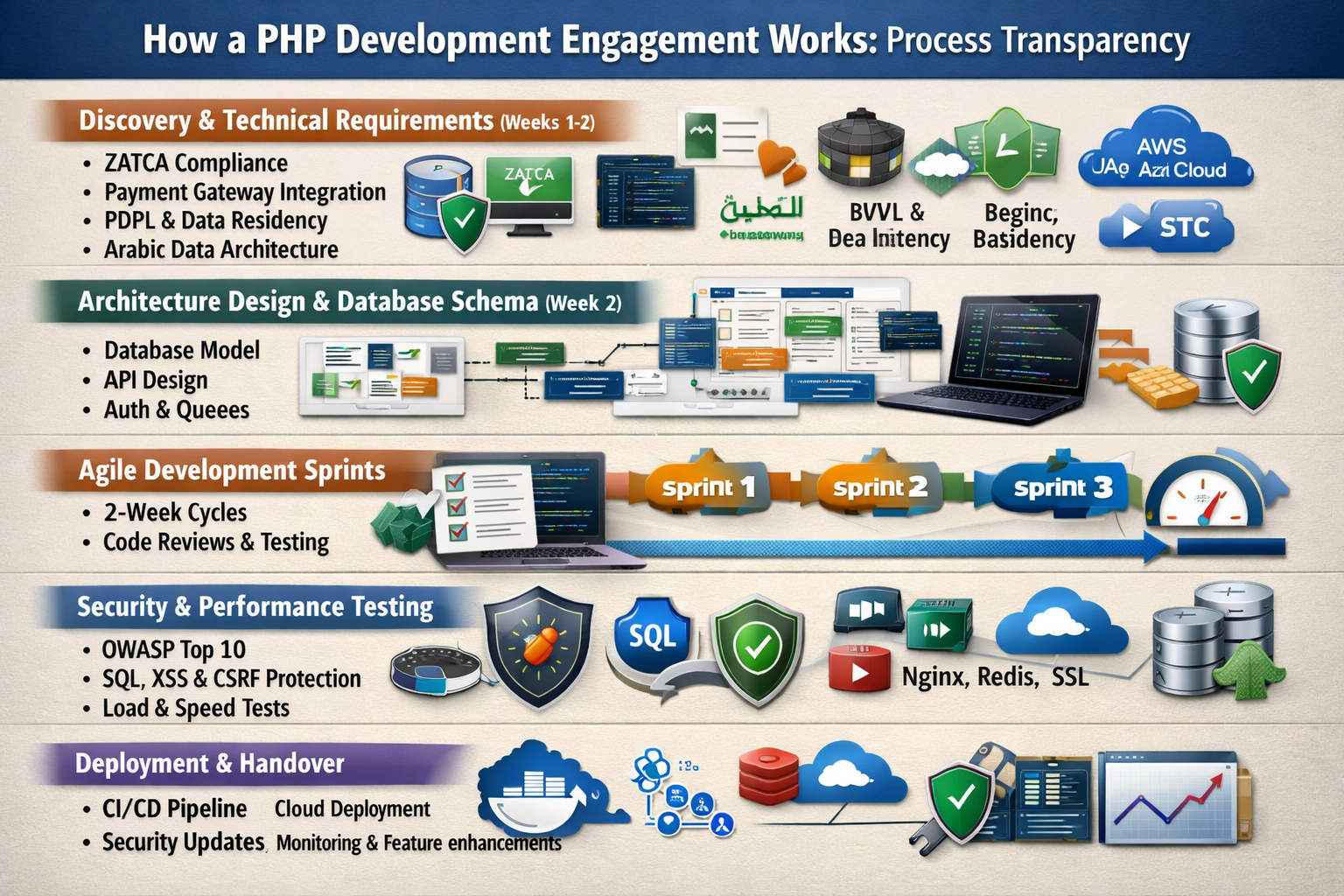
How a PHP Development Engagement Works: Process Transparency
Discovery and Technical Requirements Definition — Weeks 1 to 2
PHP development engagements begin with a technical discovery that produces a documented requirements brief and a data entity model. For KSA projects, the discovery explicitly addresses: ZATCA compliance scope and implementation approach, payment gateway selection and integration model, PDPL data handling requirements, Arabic language data architecture, hosting and data residency requirements (AWS Bahrain, Azure UAE, or STC Cloud), and the phased delivery plan. The requirements brief is the contract against which development is assessed throughout the project.
Architecture Design and Database Schema — Week 2
For Laravel and custom PHP projects, the application architecture is designed and documented before development begins. This covers the database schema, API endpoint design, authentication and authorisation model, service class structure, queue and job design for asynchronous processing, and caching strategy. For WooCommerce projects, this phase covers plugin architecture for custom functionality and the integration dependency map. Architecture decisions made at this stage directly affect the long-term maintainability and scalability of the application — deferring them to mid-development produces codebases that are difficult to test, extend, and hand over.
Development — Sprints With Fortnightly Client Reviews
PHP development at ZTS India follows a sprint-based workflow with two-week cycles. Each sprint delivers tested functionality against the agreed specification. Code is written to PSR-12 standards, reviewed on every pull request by a senior PHP engineer, and accompanied by feature and unit tests using PHPUnit or Pest. For WordPress projects, WordPress Coding Standards compliance is maintained throughout. Staging environment builds are available to the client team at the end of each sprint for functional review.
Security Review and Performance Testing
Before any production deployment, PHP applications undergo a security review covering OWASP Top 10 web application vulnerabilities: SQL injection prevention across all database interactions, XSS protection in all output, CSRF protection on all state-changing requests, authentication security including session management and brute force protection, and dependency vulnerability scanning using Composer audit. Performance testing for KSA deployments validates response time under representative Saudi network conditions, with page speed optimisation targeting Core Web Vitals thresholds appropriate to the application type.
Deployment, Handover, and Post-Launch Support
Production deployment uses a CI/CD pipeline (GitHub Actions or Bitbucket Pipelines) deploying to cloud infrastructure on client-owned accounts. For PHP applications, this includes PHP version configuration, web server setup (Nginx or Apache), database server configuration, Redis for caching and session management, and SSL certificate installation. Deployment documentation, environment variable management guide, and a maintenance runbook are delivered as part of the project handover package. ZTS India offers post-launch support retainers covering security patches, PHP and dependency updates, performance monitoring, and ongoing feature development.
Pricing: What PHP Development Costs in Saudi Arabia
PHP development pricing in Saudi Arabia spans a wide range because PHP is used across project types of vastly different complexity — from a small business WordPress website to an enterprise Laravel application with complex KSA integrations.
Entry-level WordPress builds start at 749 SAR for a small business site with up to five pages, single language, basic contact form, and standard SEO configuration. The 999 SAR entry point covers a more complete build: bilingual Arabic-English setup, multiple pages, Mada payment integration, and SEO technical architecture for a business website or small WooCommerce store.
Mid-market custom PHP and WooCommerce projects — a Laravel portal with defined scope, a WooCommerce store with full KSA payment and logistics integration, ZATCA compliance, and bilingual configuration — typically range from 8,000 SAR to 35,000 SAR. ZATCA integration, B2B account functionality, and custom plugin development are the primary cost drivers in this tier.
Enterprise PHP builds — complex Laravel applications, Magento implementations, multi-system integrations, or large-scale custom eCommerce platforms — are scoped individually and commonly run from 35,000 SAR to 100,000 SAR and above depending on application complexity, integration scope, and compliance requirements.
Factors that drive PHP project cost upward from the entry point:
- ZATCA Fatoora Phase 2 compliance implementation and sandbox testing
- Saudi payment gateway integration count — each gateway adds integration and testing scope
- Custom plugin development for WordPress beyond available plugin functionality
- B2B eCommerce architecture — account management, tiered pricing, credit terms, PO workflow
- Multi-language support beyond standard WPML configuration for complex bilingual requirements
- PDPL-compliant data architecture — consent management, audit logging, encryption, deletion handling
- Third-party system integration — ERP, HIS, POS, WMS, government API connections
- Legacy code refactoring scope in inherited PHP applications
- High availability and performance requirements — load balancing, Redis clustering, CDN
Factors that reduce PHP project cost and timeline:
- Complete, documented functional requirements provided before engagement begins
- Clean data migration assets for content or product imports
- Standard KSA integration stack (Mada, Aramex, ZATCA) with no unusual gateway or logistics requirements
- Single decision-maker point of contact reducing approval cycle delays
Evaluating a PHP Developer or PHP Development Team in Saudi Arabia
Framework Depth Versus Surface-Level Familiarity
PHP is one of the most widely adopted web languages in the world, which means the range of developer quality is exceptionally broad. The critical differentiator is not whether a developer knows PHP — it is whether they write code that is maintainable, testable, and secure. Ask to review code samples or documentation from previous projects. Look for evidence of separation of concerns, test coverage, and service-layer architecture rather than controller-level business logic. A developer whose portfolio consists of template installations and plugin configurations is a different resource from one who architects custom Laravel applications with documented APIs and test suites.
KSA Integration Track Record — Ask for Specifics
ZATCA Fatoora Phase 2 implementation in PHP, Saudi payment gateway integration across Mada, Tabby, and Tamara, and PDPL-compliant data architecture are specific technical capabilities that not every PHP developer has implemented in production. Ask directly which payment gateways they have integrated in PHP or Laravel in KSA-live applications, whether they have delivered ZATCA Phase 2 compliance in a WooCommerce or Laravel build, and how they approach Arabic data handling across PDF generation, database storage, and email templates. Specific technical answers with production references indicate real experience. Vague affirmations do not.
Security Engineering Approach
PHP has a historically poor security reputation that is attributable to poor coding practices rather than the language itself. A PHP developer who implements prepared statements consistently, validates all input, sanitises all output, manages CSRF tokens correctly, and conducts dependency audits is delivering secure code. Ask explicitly how the team approaches OWASP Top 10 compliance, what their process is for dependency vulnerability management, and how they handle sensitive data storage in PHP applications. The absence of specific answers to these questions is a meaningful risk signal for any Saudi application handling customer data, payment information, or health records.
WordPress-Specific Quality Indicators
For WordPress-specific PHP engagements, the quality differentiators are: custom theme development versus template customisation, custom plugin development capability versus plugin configuration, WordPress Coding Standards compliance, proper use of WordPress hooks and filters rather than core file modification, and familiarity with WordPress performance optimisation including object caching, database query optimisation, and image delivery. A WordPress developer who modifies core files is creating maintenance and security debt. One who builds properly with hooks, filters, and custom plugins is creating a maintainable platform.
Why KSA Businesses Choose ZTS India for PHP Development
ZTS India (ztsindia.com) is a full-stack digital engineering firm delivering PHP development — Laravel, WordPress, WooCommerce, and custom PHP applications — as part of a broader practice that covers eCommerce development in KSA, Shopify development, React Native mobile apps, and AI-powered platform engineering. PHP development at ZTS India is not isolated from the broader digital stack — for most clients, the PHP backend connects to a React or Vue.js frontend, a mobile app, or an existing platform that requires integration.
For KSA clients specifically, our PHP delivery capability includes:
- ZATCA Fatoora Phase 2 compliance in Laravel and WooCommerce — UBL XML generation, ECDSA signing, QR code production, and Fatoora portal integration
- Saudi payment gateway integration in PHP: PayTabs, Moyasar, Tap Payments, HyperPay, Mada, Tabby, and Tamara
- Arabic RTL handling in PHP applications — multibyte string functions, Arabic PDF generation, RTL email templates, Arabic database collation
- PDPL-compliant PHP application architecture — consent management, audit logging, data encryption, deletion request handling
- WordPress development services in Riyadh and across KSA — custom theme development, plugin development, WooCommerce builds, REST API configuration
- Laravel custom application development — portals, B2B platforms, SaaS products, API backends
- PHP application audits for inherited codebases — security assessment, technical debt analysis, PDPL gap review
- Data residency configuration on AWS Bahrain, Azure UAE, and STC Cloud
- PSR-12 and WordPress Coding Standards compliance with PHPUnit test coverage as delivery standard
- Client-owned repositories and cloud accounts from project initiation
- Post-launch maintenance retainers with defined PHP version update and security patch management
The majority of our KSA PHP clients come through referrals from existing clients or from businesses where web and app projects evolve into longer-term development relationships. That continuity reflects what the practical outcome of delivering reliable PHP applications in the Saudi market context actually looks like over a multi-year horizon.
Frequently Asked Questions
When should a KSA business hire a PHP developer versus using a platform like Shopify?
A platform like Shopify is the right choice when the business requirement is standard retail eCommerce — product catalogue, cart, checkout, order management — and the priority is reaching market quickly without custom development overhead. A PHP developer is the right choice when the business requirement exceeds what any packaged platform handles natively: custom business logic, complex B2B account architecture, proprietary application functionality, integration with Saudi-specific systems that platform apps do not support, or a data model that requires a custom database schema. The decision follows the functional requirements, not a preference for one technology approach over another. For businesses currently on WordPress or WooCommerce, a PHP developer who specialises in the WordPress platform is almost always more appropriate than a platform migration.
What is the difference between a PHP developer and a Laravel developer?
All Laravel developers are PHP developers, but not all PHP developers are proficient with Laravel. Laravel is a PHP framework with its own architecture conventions, ORM, CLI tooling, and ecosystem. A developer who has only worked with plain PHP or older PHP frameworks will lack familiarity with Laravel's service container, Eloquent relationships, queue system, and testing conventions — all of which affect the quality and maintainability of a Laravel application. For custom application development, a developer with specific Laravel experience is a meaningfully different resource from a general PHP developer. For WordPress development, the relevant specialisation is WordPress-specific PHP — hooks, filters, plugin architecture, and the WordPress REST API — rather than Laravel.
Can a PHP developer handle ZATCA Fatoora Phase 2 integration?
Yes, provided they have specific implementation experience with the ZATCA Fatoora Phase 2 requirements. The PHP implementation involves UBL 2.1 XML generation, ECDSA cryptographic signing using PHP's OpenSSL extension with the ZATCA-issued certificate, QR code generation to ZATCA's encoding specification, and REST API integration with the Fatoora portal. These are well-documented requirements, and the PHP libraries needed are available and mature. The practical differentiation is whether the developer has actually implemented this in a production Saudi application — ZATCA sandbox testing reveals edge cases that theoretical familiarity does not. ZTS India has delivered ZATCA Phase 2 integration in both Laravel and WooCommerce applications for KSA clients.
How do you handle Arabic content in PHP and WordPress applications?
Arabic content handling in PHP requires specific implementation choices at multiple points. Database tables must use utf8mb4 character set and utf8mb4_unicode_ci collation to store Arabic characters correctly and sort Arabic text properly. All string operations on Arabic text must use PHP's mbstring multibyte functions rather than standard string functions, which produce incorrect results with multi-byte Unicode characters. PDF generation for Arabic documents requires a library that supports RTL text direction and includes Arabic font embedding — TCPDF and mPDF both handle this with correct configuration. WordPress WPML handles bilingual content management across Arabic and English, and custom RTL theme development ensures the Arabic interface is designed for right-to-left reading flow rather than mirrored from the English layout.
What is a PHP application audit and when does a KSA business need one?
A PHP application audit is a technical assessment of an existing codebase, typically one inherited from a previous developer or built without adequate quality standards. The audit covers: security vulnerability identification across OWASP Top 10 categories; Composer dependency version status and known CVE exposure; architectural issues affecting maintainability — business logic in controllers, absent service layer, undocumented APIs; test coverage gaps; PDPL compliance status for applications handling Saudi personal data; and ZATCA compliance gaps for applications generating invoices. The output is a prioritised remediation plan with cost and timeline estimates. A KSA business needs a PHP application audit when: they have inherited a codebase from a previous development team, they are experiencing unexplained performance or reliability issues, they have not received adequate technical documentation for a delivered project, or they need to extend an application significantly and want to understand the risk before committing to the work.
Do you provide ongoing PHP maintenance after project delivery?
Yes. Post-delivery PHP maintenance at ZTS India covers: PHP version update management as older PHP versions reach end-of-life and hosting providers enforce upgrades; Composer dependency security patch application; WordPress core, plugin, and theme updates for WordPress projects; ZATCA certificate renewal management for applications with Fatoora integration; payment gateway API version updates when Saudi gateways deprecate older integration patterns; performance monitoring and query optimisation as application data volumes grow; and ongoing feature development under retainer or change request scope. PHP applications that are not actively maintained accumulate security debt — outdated dependencies, unpatched vulnerabilities, and end-of-life PHP versions — that represents genuine operational risk for Saudi businesses handling customer data and financial transactions.
Conclusion: Hiring a PHP Developer in Saudi Arabia Is a Technical Infrastructure Decision
The decision to hire a PHP developer or engage a PHP development team for a KSA project is a decision about the technical infrastructure your business will depend on for the next three to five years. The WordPress website that serves as your primary customer acquisition channel, the WooCommerce store processing Saudi payment transactions, the Laravel portal managing your B2B client relationships — these are commercial infrastructure, not website projects. The quality of the PHP engineering behind them directly affects your conversion rate, your compliance posture, your operational reliability, and your ability to extend the platform as your business grows.
Saudi Arabia's digital economy creates specific PHP development requirements that generic experience from other markets does not cover. ZATCA Fatoora Phase 2 integration is a Saudi-specific compliance obligation. Mada, Tabby, and Tamara payment integration requires Saudi-market payment gateway knowledge. PDPL data compliance requires architectural decisions specific to Saudi data protection law. Arabic RTL PHP application development requires explicit technical handling that is easy to get wrong and expensive to correct after the fact. A PHP development partner with direct KSA market experience addresses these requirements at the specification stage. One without it discovers them progressively through production failures.
ZTS India works with Saudi and GCC businesses across the full PHP development lifecycle — from initial WordPress builds and WooCommerce stores at entry-level pricing, through to complex Laravel applications and custom eCommerce platforms for mid-market and enterprise clients. If you are planning a PHP development engagement and want a partner with direct experience in the technical requirements of the Saudi market, we are available to discuss your project.
-

Writen by Anirban Das