USA:
USA:  India:
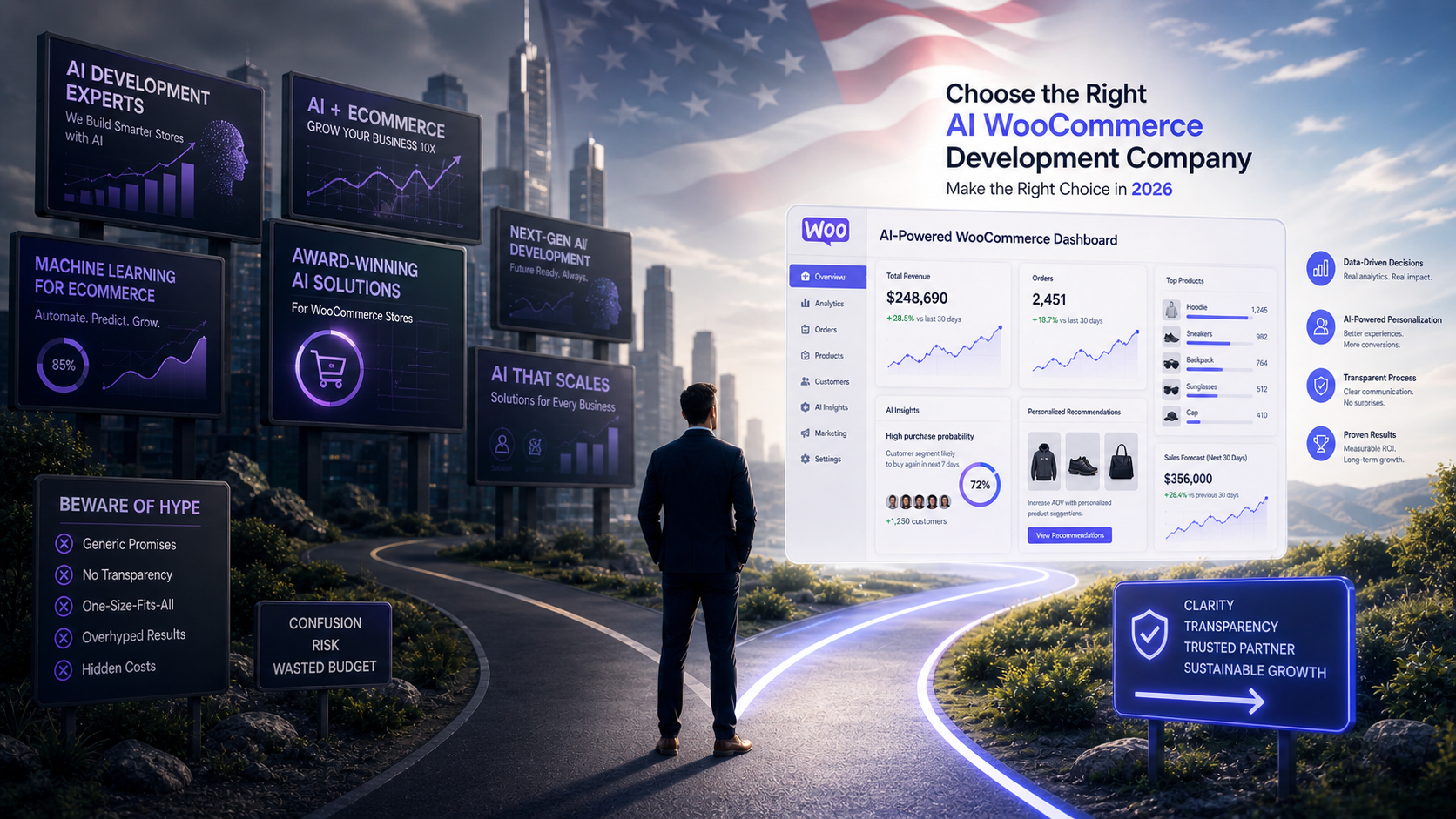
How to Choose the Right AI WooCommerce Development Company in the USA in 2026: A No-BS Buyer's Guide
So you Googled "AI WooCommerce development services USA" and ended up drowning in a sea of agency websites that all look... exactly the same. Same stock photos of people in meetings. Same hollow promises about "delivering results." Same completely useless taglines that say nothing about what they actually do.
Been there. And honestly? It's exhausting.
Here's the thing — finding a solid development partner for an AI-powered WooCommerce project isn't impossible, but it's trickier than it should be. Not because good companies are hiding. But because the not-so-good ones have gotten really good at looking the part. This guide exists to cut through all of that. No fluff, no agency-speak — just a straight look at how to actually make this decision without getting burned.
Why AI WooCommerce Development Services Are a Serious Investment in 2026
Let's start with the honest version of why this matters — not the pitch version.
WooCommerce runs something like 37% of all online stores on the planet. It's open-source, incredibly flexible, and for a lot of businesses, it just works. But here's what nobody tells you when you first set it up: out of the box, it's pretty passive. It doesn't learn anything about your customers. It can't figure out what someone's about to buy, warn you when a product's about to go out of stock at the worst possible time, or shift pricing based on what's actually happening in the market.
That's where AI changes things. Not in a science-fiction way — in a pretty practical, measurable way.
Think smarter search that understands what shoppers actually mean (not just what they literally typed), product recommendations that feel relevant instead of random, customer segmentation that runs itself, fraud detection that catches what your team would miss at 11pm on a Tuesday. Real stuff that shows up in real numbers — fewer abandoned carts, higher order values, customers who actually come back a second time.
In 2026, this isn't a nice-to-have anymore. Shoppers have been trained by Amazon and Netflix to expect things to feel personal. When your store doesn't deliver that, they notice — even if they can't articulate why. That makes choosing the right AI WooCommerce development services provider one of the bigger calls your business will make this year. Worth getting right.
What to Actually Evaluate When Vetting a Company
Most businesses shopping for AI WooCommerce development services in the USA hit the same wall — every agency looks credible until you start asking real questions. Here's what to actually dig into.
1. Do They Actually Know AI, or Just the Word?
This one's easier to test than you'd think. A surprising number of agencies describe themselves as "AI specialists" and then, when you push a little, it turns out they've configured a recommendations plugin. Which — fine, plugins have their place. But that's not AI development. That's installation with a markup.
Ask them directly: Are you building custom models, or connecting to third-party APIs like OpenAI or Google Vertex AI? Both approaches can be valid depending on your budget and goals — but you deserve a clear answer. Then ask to see something they've actually shipped. Not a mockup. Not a slide deck. A live store, with a real explanation of what they built, why they built it that way, and how it's performing now.
If things get vague here, that tells you everything.
2. WooCommerce Experience — Specifically
WordPress development and WooCommerce development are not the same job. I know that sounds like a minor distinction, but it really isn't. WooCommerce has its own hook system, its own REST API quirks, its own way of handling product variations and large catalogs — and developers coming from a pure WordPress background often underestimate the difference until something breaks in production.
Ask about specific WooCommerce problems they've actually dealt with. How do they handle database performance when the catalog hits 10,000+ SKUs? Have they worked on headless WooCommerce setups? What do they do when a plugin conflict takes down checkout at midnight? Their answers will tell you whether they've genuinely been in the weeds on this, or just skimmed the docs.
3. Look at Their Portfolio Differently
The reflex is to count logos. Big brands, lots of names, impressive-looking screenshots. But a long logo list means almost nothing on its own — it could just mean fifteen shallow projects and a handshake goodbye each time.
What you actually want is depth. Find one or two projects they can walk you all the way through — the original problem, what they proposed, how they built it, what happened post-launch, what they'd do differently with hindsight. The agency that tells you a complete, slightly imperfect story about past work is almost always more trustworthy than the one with fifty logos and zero details. Real work has rough edges. Polished case studies with no setbacks are a yellow flag.
4. Watch How They Talk About Money
Budget conversations are awkward. But how a company handles them early is a reliable preview of how they'll handle tough conversations when you're already three months into a project.
A good partner will give you a realistic range upfront — not a suspiciously precise number, and not a complete dodge either. They'll tell you how they scope work, what's typically in versus out, and where costs tend to grow past initial estimates (because they always do something). If you're getting vague non-answers, or a detailed quote arrives in your inbox within hours of your first call without any real back-and-forth, something's off. Either they're guessing, or they've pre-packaged something that won't actually fit your needs.
5. Communication Before the Contract Is a Preview
This gets dismissed as soft. It isn't.
You're looking at a project that could run three to six months. The company you hire will be in your inbox, on your calls, flagging issues, asking for decisions — for a long time. How they handle communication before you've even signed anything is essentially a trial run.
Did they respond to your inquiry in a reasonable window? Was their proposal specific to your situation, or did it feel like someone found-and-replaced your company name in a template? Did they ask smart questions about your business, or did they just start talking about themselves? Small signals, but they compound.
Red Flags You Should Not Ignore in 2026
Some of these are obvious in theory and surprisingly easy to overlook when a proposal lands well.
They promise specific results before seeing your store. Any company guaranteeing a specific conversion lift or revenue figure — before doing any kind of technical review — is either wildly overconfident or not being straight with you. Nobody knows what AI will do for your store until they've actually looked at your store.
A fixed-price quote shows up before a real conversation. If a detailed proposal arrives within 24 hours of your first contact and nobody's asked meaningful questions about your setup yet, they've either guessed at your scope or they're selling a templated package dressed up as custom work. Neither is what you want.
"AI", that's just a plugin. Worth saying plainly: tools like YITH, Beeketing, or similar products can be useful. But they are not AI WooCommerce development. If an agency is charging development rates to install and configure off-the-shelf plugins, that's a mismatch you'll figure out the hard way.
Undisclosed offshore teams. Plenty of US-facing agencies do their actual development work abroad — and to be clear, that's not automatically a problem. Genuinely talented developers exist everywhere. But when companies hide that fact and pretend otherwise, they're not being straight with you from day one. Just ask where the work gets done and who's doing it. A confident, clear answer is a good sign. Evasion is not.
Zero clarity on handoffs and documentation. Happens more often than it should. The build gets done, you launch, and then the developer relationship quietly ends — and the next person who has to touch your codebase is piecing things together from scratch. Ask specifically how they handle documentation and project handoffs. If they brush past it, that's going to be your headache down the road.
Questions Worth Asking Before You Sign Anything
Keep these handy. Some of them will make a mediocre vendor uncomfortable, which is actually useful information.
- Walk me through an AI feature you built for a WooCommerce store that's been live for at least a year. What worked? What needed adjusting?
- Which AI frameworks or APIs do you typically work with, and what's the reasoning behind those choices?
- Customer behavioural data is sensitive — how do you handle privacy compliance when AI features are involved?
- What does QA actually look like for AI-driven features, which can behave unpredictably with real user data?
- Scope creep happens. How do you manage it — and what does that usually mean for the budget?
- When the project wraps up, who owns the code and intellectual property?
- What does post-launch support actually include, and what's the cost structure?
You're not being difficult. Any company worth hiring will answer these without breaking a sweat.
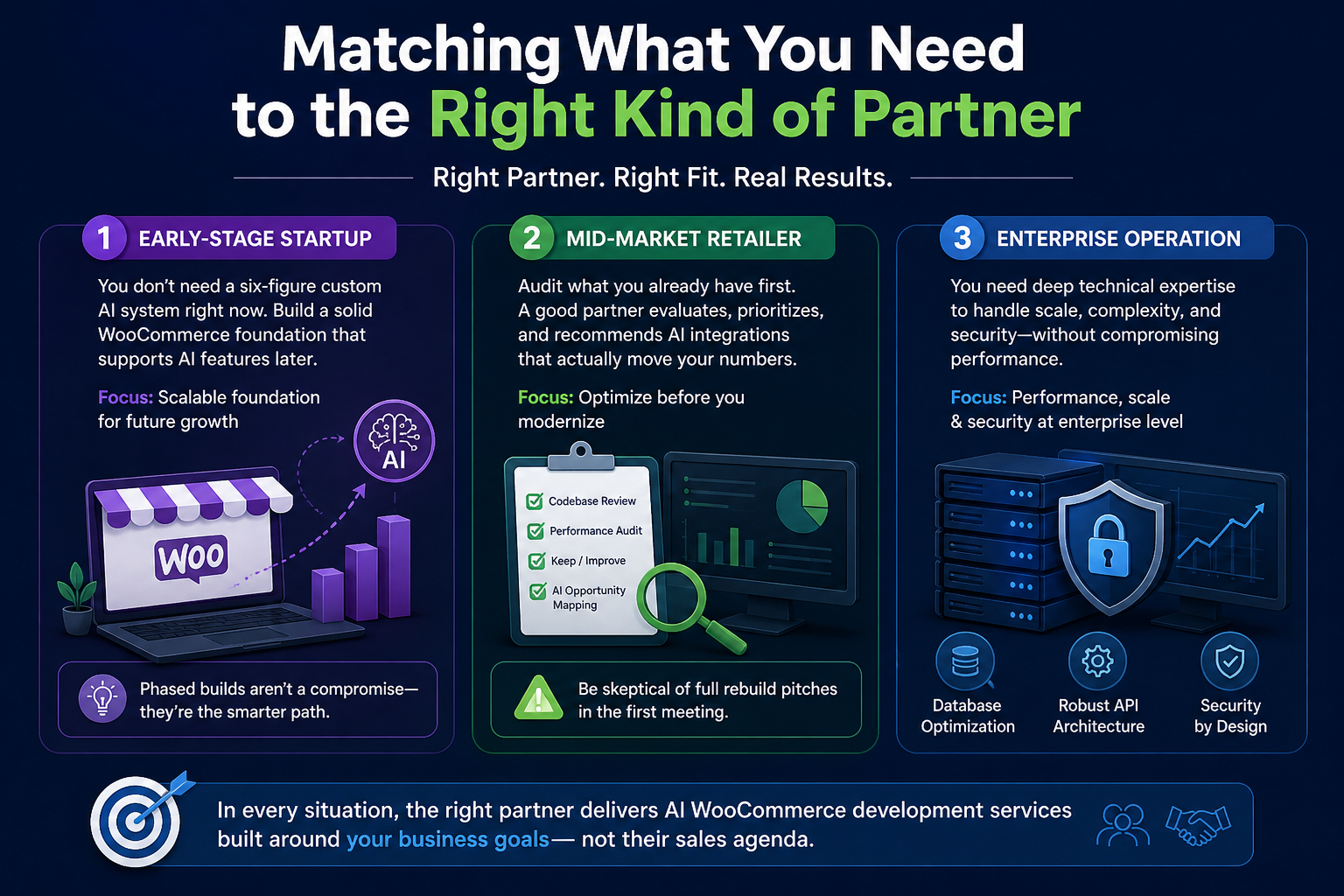
Matching What You Need to the Right Kind of Partner
Not every business is in the same situation, and the wrong match — even with a genuinely good company — can go sideways fast.
Early-stage startup: You probably don't need a six-figure custom AI system right now, and if someone's pitching you one, that's a flag. What you need is a solid WooCommerce foundation built to support AI features later, once you have enough real customer data to make them actually useful. Phased builds aren't a compromise — for most startups, they're just the smarter path.
Mid-market retailer with an existing store: Before anyone recommends touching anything, they should be auditing what you already have. A good partner comes in, looks at your current setup honestly, and tells you what's worth keeping, what needs attention, and where AI integrations would actually move your numbers. Be skeptical of companies that float a full rebuild idea in the first meeting, before they've even seen your codebase.
Enterprise eCommerce operation: You need someone with genuine backend depth — database optimization for large catalogs, API architecture built to handle real traffic spikes, security treated as a requirement not an afterthought. Ask about the most technically complex WooCommerce project they've shipped. The answer should feel earned, not rehearsed.
In all cases, look for a provider who'll shape their AI WooCommerce development services around what your business actually needs — not around whatever's easiest for them to sell.
A Resource Worth Checking Out
If you're specifically looking for AI-powered WooCommerce development for a US-based business, it's worth spending a few minutes on ZTS India's AI website engineering services for the USA market. They cover custom AI integrations, WooCommerce development, and broader eCommerce engineering — and they're transparent about how they work and what they use, which honestly puts them ahead of a lot of agencies in this space. Worth putting on your shortlist while you're researching.
The Bottom Line
The best AI WooCommerce development company for your business isn't necessarily the biggest name or the one with the slickest website. It's the one that asks smart questions about your actual situation, is upfront about what's realistic, and can point you to real work they've shipped — not just describe it in a discovery call.
Take the vetting process seriously. Do reference calls if you can swing it. Have someone technical glance at code samples if that's an option. Make sure the contract is specific on IP ownership, what post-launch support actually covers, and how scope changes get handled. These things feel like details when everything's going smoothly. They become the whole conversation when it isn't.
The companies that are genuinely good at this won't rush you. If anything, they'll push back — flag things they're not sure about, ask harder questions than you expected, tell you when something you're asking for doesn't quite make sense for your situation. That's not a problem. That's exactly what you want.
Start with an honest picture of what your business needs. Let that guide the filtering. That's how you avoid the wrong hire — and land on the one that actually moves things forward.
Frequently Asked Questions
Q1: What's the difference between a regular WooCommerce developer and an AI WooCommerce developer?
A standard WooCommerce developer handles the core store work — product catalog setup, payment gateway integration, theme customization, plugin configuration, checkout flows, all of that. An AI WooCommerce developer covers the same ground, but they also know how to build intelligent systems on top of it. Recommendation engines that actually learn from behavior. AI-powered search that handles the weird, messy queries real shoppers type. Predictive inventory tools. Customer segmentation that updates itself.
The skill sets overlap more than you'd think. But the AI layer requires either genuine data science experience or solid familiarity with integrating and tuning machine learning APIs inside WooCommerce's architecture. Not every store needs both at once — but knowing the difference makes it a lot easier to hire for what you actually need, rather than paying developer rates for someone who's really just configuring plugins.
Q2: How much do AI WooCommerce development services in the USA typically cost in 2026?
Wide range, and anyone who gives you a flat number without knowing your scope is guessing. A focused integration — connecting an AI recommendations API to an existing store, for example — might run somewhere between $5,000 and $20,000 depending on catalog complexity and how much custom work is involved. A fully custom build with proprietary models, data pipelines, and deep WooCommerce integration can push well past $100,000 for the right use case.
The mistake most buyers make isn't picking the wrong budget tier — it's comparing proposals that are scoping completely different things. A $15K quote and a $60K quote might both be entirely fair for what each company is actually offering. Always understand what's included before you compare the numbers.
Q3: Can AI features be added to my existing WooCommerce store, or does everything need to be rebuilt?
In most cases, no rebuild needed. Most AI WooCommerce development services are designed to integrate with existing store setups through APIs, custom plugins, or lightweight extensions. You don't scrap what you've built just to add smarter features.
That said — if your store is running on an outdated PHP version, has a theme that's been heavily modified over the years and is basically held together with tape, or relies on plugins nobody's updated since 2020, there may be some cleanup required before AI layers can go in without issues. A good developer will tell you this after actually reviewing your setup. If someone recommends a full rebuild without having looked at anything yet, that's worth questioning.
Q4: How long does a typical AI WooCommerce project take to complete?
Depends almost entirely on scope. A targeted integration on a healthy, well-maintained store — adding AI-powered search or a recommendations widget — is often doable in four to eight weeks. A more complex project involving custom model training, data pipeline setup, and significant WooCommerce customization? That's realistically three to six months of real work.
Be careful with anyone promising a complex AI build in a few weeks. Either they're dramatically underscoping what you've asked for, or they're planning to ship something that barely qualifies. Also, build breathing room into your timeline for QA — AI features can behave in unexpected ways when they first hit real user data, and that's when you want time to tune things, not pressure to go live immediately.
Q5: Which AI features are worth investing in for a WooCommerce store?
The ones with the most consistent ROI are smarter product recommendations (especially on the product page and at checkout), AI-powered site search that handles real-world messy queries, and personalized abandoned cart recovery that goes beyond a generic reminder email.
Dynamic pricing and inventory forecasting are also genuinely valuable — but they tend to deliver better results once you have meaningful historical data behind them. If your store is still building that data history, start with search and recommendations. Results show up faster, they're easier to tune as you go, and you'll gather the behavioral data you need for the more sophisticated features along the way.
Q6: How do I know if a company genuinely understands AI, or if it's just a marketing angle?
Ask them to explain — in plain, straightforward language — how a specific AI feature they've built actually works. Not what it does for the user. How it functions technically. Where does the training data come from? How often does the model get updated? What happens when it makes a bad call? How was data privacy handled?
Developers who actually built the thing can walk you through this without breaking stride. And here's a useful secondary test: ask what they'd advise against using AI for in your specific situation. A team that genuinely understands the technology knows its limits as clearly as its strengths. If every answer sounds like a sales pitch, you've learned something important.
Q7: Is hiring a non-US company for AI WooCommerce development services in the USA actually risky?
Not inherently — strong development teams exist outside the US, and plenty of American businesses work with them successfully. The real risks are communication friction, time zone gaps, and the murkiness around accountability when something goes wrong mid-project.
Most of that is manageable with the right groundwork: a contract governed under US law (or with clear dispute resolution terms), defined communication windows that work for both sides, and a scope document detailed enough that "we misunderstood the requirement" doesn't become an excuse later. Geography matters less than transparency. Ask directly where the work gets done, who's doing it, and how quality gets checked throughout the build. How confidently — and specifically — they answer that tells you more than the country of origin ever will.
Final Thought
Nobody really warns you about this part: the process of finding the right AI WooCommerce development company is kind of the whole job. Most businesses that end up with a bad outcome — blown budgets, features that don't work, a store that somehow runs slower than before — made their hiring decision in a rush. A proposal looked polished. The price seemed fair. Someone on the team liked the vibe of the call. And then two months in, things quietly started falling apart.
The filtering process isn't that complicated once you know what to look for. Ask real questions. Require actual evidence. Notice how they treat you before a contract gets signed. And be honest with yourself about what your business genuinely needs right now — not the most ambitious version, not the thing that sounds impressive in a board meeting, just what would actually move the needle.
AI WooCommerce development done well compounds over time — smarter search, better personalization, fewer lost customers. Done badly, it drains your budget and leaves behind a codebase no one wants to inherit. That outcome almost always traces back to a hiring decision that got made too quickly, with too little digging.
Take your time with this one.
-

Writen by Anirban Das