USA:
USA:  India:
 A website that shows the same experience to every visitor is quickly becoming a competitive disadvantage.
Modern users interact with digital platforms differently than they did even a few years ago. They expect websites to respond intelligently, understand intent faster, reduce unnecessary friction, and deliver experiences that feel relevant from the very first interaction.
At the same time, businesses are dealing with a different kind of pressure.
Traffic acquisition costs are increasing. User attention spans are shrinking. Competition across digital industries is becoming more aggressive. And simply launching a visually attractive website is no longer enough to sustain long-term engagement or conversion growth.
This is exactly why AI website personalization services are becoming one of the most important developments in modern web design.
Businesses are no longer investing in static digital platforms that remain unchanged after launch. They are moving toward intelligent website systems capable of learning from user behavior, adapting experiences dynamically, and optimizing engagement continuously.
And this shift is fundamentally changing how digital experiences are designed, delivered, and optimized.
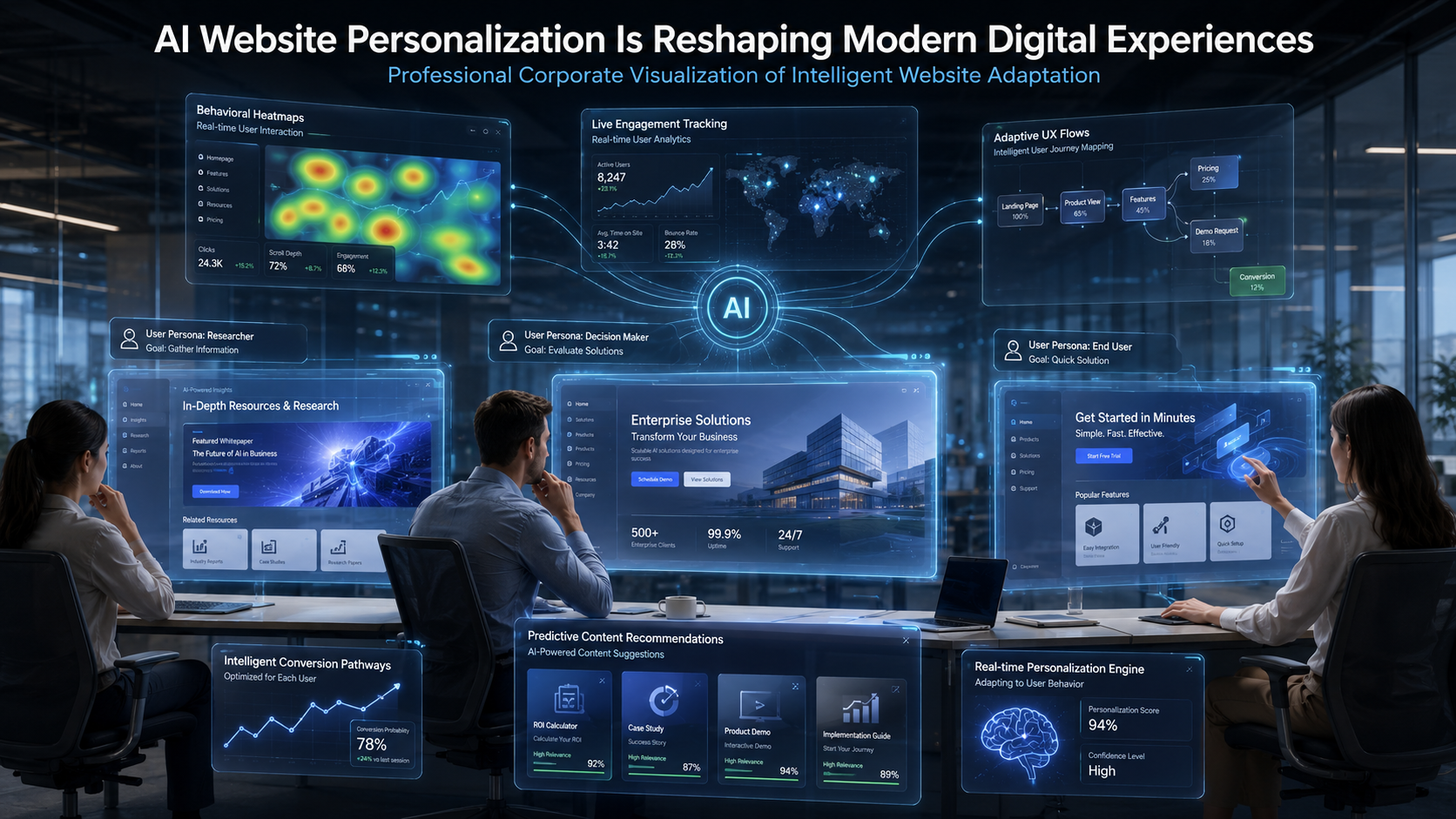
AI website personalization services use behavioral intelligence, machine learning, adaptive UX systems, and real-time engagement analysis to create personalized digital experiences based on user actions, preferences, and interaction patterns.
Instead of showing every visitor the same website journey, AI-powered personalization helps businesses create adaptive digital systems that continuously improve relevance, engagement, and conversion performance.
Why Traditional Website Experiences Are Losing Effectiveness
For many years, websites followed a relatively fixed structure.
A business would:
- launch a website
- create standard user journeys
- use the same layouts for all visitors
- manually update content occasionally
That approach worked when digital competition was lower and customer expectations were simpler.
But today’s users expect websites to behave more intelligently.
Modern consumers interact daily with platforms powered by:
- AI recommendations
- adaptive interfaces
- predictive content systems
- personalized experiences
As a result, generic digital experiences now feel increasingly outdated.
When users encounter websites that:
- feel repetitive
- lack relevance
- ignore intent
- create unnecessary friction
engagement begins dropping almost immediately.
This is one of the biggest reasons businesses are beginning to rethink website personalization entirely.
Because the future of digital performance is no longer centered around static interfaces.
It is centered around adaptive digital intelligence.
The Shift From Static Websites to Intelligent Experience Systems
One of the biggest misconceptions businesses still have is assuming personalization only means changing small visual elements on a website.
In reality, AI website personalization services are transforming the entire structure of digital interaction.
Modern AI-driven websites are increasingly designed to:
- analyze user behavior continuously
- interpret engagement patterns
- personalize experiences dynamically
- optimize journeys in real time
This creates websites that function less like static pages and more like intelligent engagement systems.
That distinction matters significantly.
Because users no longer evaluate websites only based on appearance.
They evaluate them based on:
- speed of relevance
- ease of interaction
- intuitive navigation
- contextual experience quality
And businesses that fail to adapt to these expectations often struggle with:
- declining engagement
- lower conversions
- inconsistent retention
- rising acquisition costs
This is precisely where personalized AI website designing services are creating major competitive advantages.
How Personalized AI Website Designing Services are Powering Smarter Digital Journeys
1. AI Is Turning Websites Into Adaptive Digital Systems
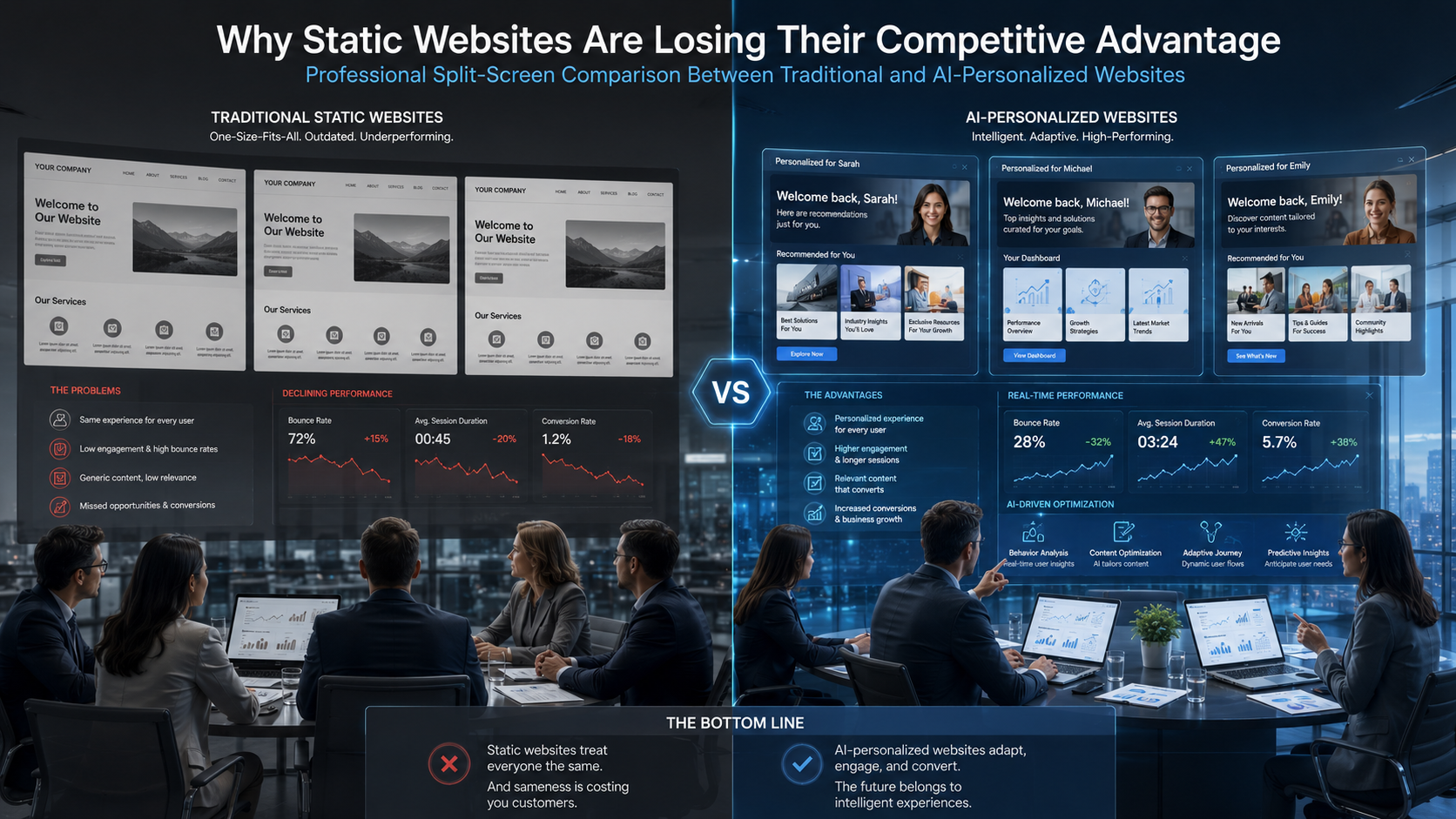
Traditional websites operate using fixed structures.
Every visitor receives:
- the same homepage
- the same messaging
- the same content hierarchy
- the same conversion paths
AI personalization changes this completely.
Modern AI website personalization services allow websites to adapt dynamically based on:
- browsing behavior
- visitor intent
- engagement history
- device usage
- interaction patterns
This means the website experience itself becomes more responsive to individual user behavior.
For example, a returning visitor exploring a specific service category may begin seeing more targeted content pathways automatically, while a first-time visitor may receive broader educational content designed to improve initial engagement.
This creates a far more intelligent and fluid user experience compared to traditional static website structures.
And this is where digital experiences are rapidly evolving.
2. AI Personalization Is Making User Experiences Feel More Relevant
One of the biggest reasons users disengage from websites is a lack of relevance.
When every visitor receives the exact same experience regardless of:
- interests
- browsing behavior
- intent
- interaction history
the digital experience begins feeling generic very quickly.
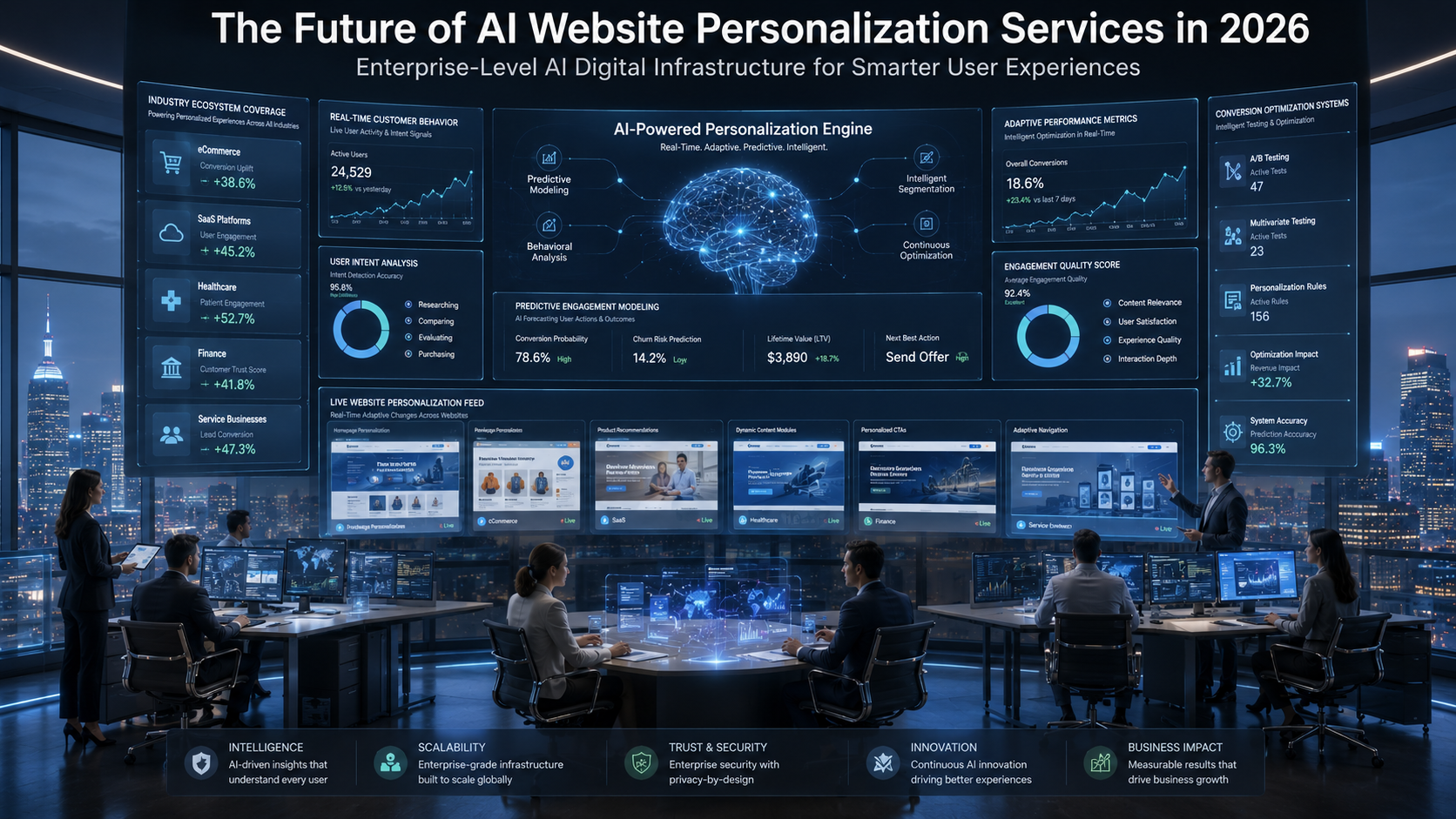
AI-powered personalization addresses this issue by helping websites respond more contextually to user behavior.
This can include:
- personalized content recommendations
- adaptive navigation paths
- dynamic interface adjustments
- intelligent engagement flows
The goal is not simply customization.
The goal is relevance.
Because relevance significantly improves how users perceive digital interactions.
When websites feel more aligned with user expectations, engagement often becomes more natural, intuitive, and conversion-friendly.
This is one of the main reasons AI-driven personalization is becoming central to modern website performance strategies.
3. Behavioral Intelligence Is Replacing Guesswork
Traditional website optimization often relies heavily on assumptions.
Businesses make decisions based on:
- limited analytics
- periodic reports
- manual testing cycles
But modern AI systems can process behavioral data continuously and identify engagement patterns far faster than traditional optimization methods.
AI website personalization services can analyze:
- user navigation behavior
- click interactions
- content engagement depth
- session flow patterns
- friction points within journeys
and use that information to improve digital experiences dynamically.
This creates a much more intelligent optimization environment where websites evolve continuously rather than waiting for occasional redesigns or quarterly updates.
And in increasingly competitive digital markets, that ability to adapt quickly is becoming extremely valuable.
4. Personalized AI Experiences Are Improving Conversion Performance
Businesses often assume conversion optimization requires:
- aggressive sales funnels
- constant redesigns
- excessive advertising
But many conversion problems actually originate from poor user alignment.
When users struggle to find relevant information or experience friction during interaction, conversions naturally decline.
AI website personalization services help reduce this friction by creating:
- smoother engagement journeys
- more relevant content experiences
- intelligent user pathways
- adaptive interaction structures
This improves conversion potential more naturally because users experience less confusion and greater contextual relevance throughout the journey.
And as digital competition continues to increase, businesses are beginning to realize that personalized experiences often outperform purely design-focused optimization strategies.
5. AI Is Pushing Websites Toward Predictive Digital Experiences
Perhaps the most important transformation happening right now is the movement toward predictive digital systems.
Traditional websites react after users take action.
AI-driven personalization systems are increasingly designed to anticipate user intent before users explicitly express it.
This includes:
- predictive content delivery
- intelligent recommendation systems
- adaptive engagement pathways
- real-time experience optimization
Over time, websites are expected to become increasingly self-optimizing, meaning digital experiences will continuously evolve based on behavioral intelligence and live interaction signals.
This is where the future of AI-powered website personalization is heading.
And businesses adopting these systems early are likely to gain major advantages in:
- engagement
- retention
- customer experience
- digital scalability
over competitors still relying on traditional website structures.
Why Businesses Still Struggle With Website Personalization
Even though personalization technology is advancing rapidly, many businesses still approach it incorrectly.
One major mistake is focusing only on visual customization.
Changing banners or adding product recommendations alone does not create intelligent personalization.
True AI-driven personalization requires:
- behavioral understanding
- adaptive UX strategy
- engagement optimization
- contextual relevance
Another common mistake is overpersonalization.
When websites become excessively intrusive or overly aggressive with personalization tactics, user trust can decrease rather than improve.
The goal should never be to overwhelm users with personalization.
The goal is to create experiences that feel naturally intuitive and friction-free.
Businesses that understand this balance often create much stronger long-term digital engagement systems.
How ZTS Infotech Pvt Ltd Supports AI-Driven Digital Experiences
ZTS Infotech Pvt Ltd focuses on building AI-powered website systems designed around adaptive user engagement, intelligent personalization, and scalable digital performance.
Rather than treating websites as static online assets, the approach emphasizes:
- AI-driven website engineering
- adaptive digital experiences
- personalization-focused UX
- scalable architecture
- conversion-focused optimization
This includes:
- website personalization solutions
- WordPress development
- eCommerce development
- Shopify development
- full-stack web development
The objective is to help businesses create digital systems capable of evolving alongside changing user expectations and market behavior.
Frequently Asked Questions
What are AI website personalization services?
They use AI systems to create adaptive digital experiences based on user behavior and engagement patterns.
How does AI personalization improve websites?
It helps websites deliver more relevant content, smoother navigation, and better user engagement.
Can AI website personalization improve conversions?
Yes. Personalized experiences often reduce friction and improve conversion performance naturally.
Are AI-personalized websites suitable for small businesses?
Yes. SMEs can use AI personalization to improve digital engagement and customer experience competitively.
What makes AI personalization different from traditional personalization?
AI personalization adapts dynamically in real time using behavioral intelligence and user interaction data.
Can AI website personalization reduce bounce rates?
Yes. More relevant and intuitive experiences often improve engagement and reduce user drop-offs.
Is AI personalization only useful for eCommerce websites?
No. Service businesses, startups, and content-driven platforms can also benefit significantly.
Are AI-personalized websites future-ready?
Yes. They are designed to evolve continuously based on user behavior and digital trends.
Final Thoughts
The digital landscape is moving rapidly toward intelligent, adaptive, and behavior-driven experiences.
Static websites that treat every visitor the same are becoming increasingly limited in a world where users expect relevance, speed, and contextual interaction.
This is why AI website personalization services are no longer just optional enhancements for modern businesses.
They are becoming foundational components of high-performing digital systems.
Because the future advantage will not belong to businesses with the most visually impressive websites alone.
It will belong to businesses operating the most intelligent digital experiences capable of learning, adapting, and optimizing continuously around user behavior.
And that transformation is already reshaping the future of web design itself.
-

Writen by Anirban Das