USA:
USA:  India: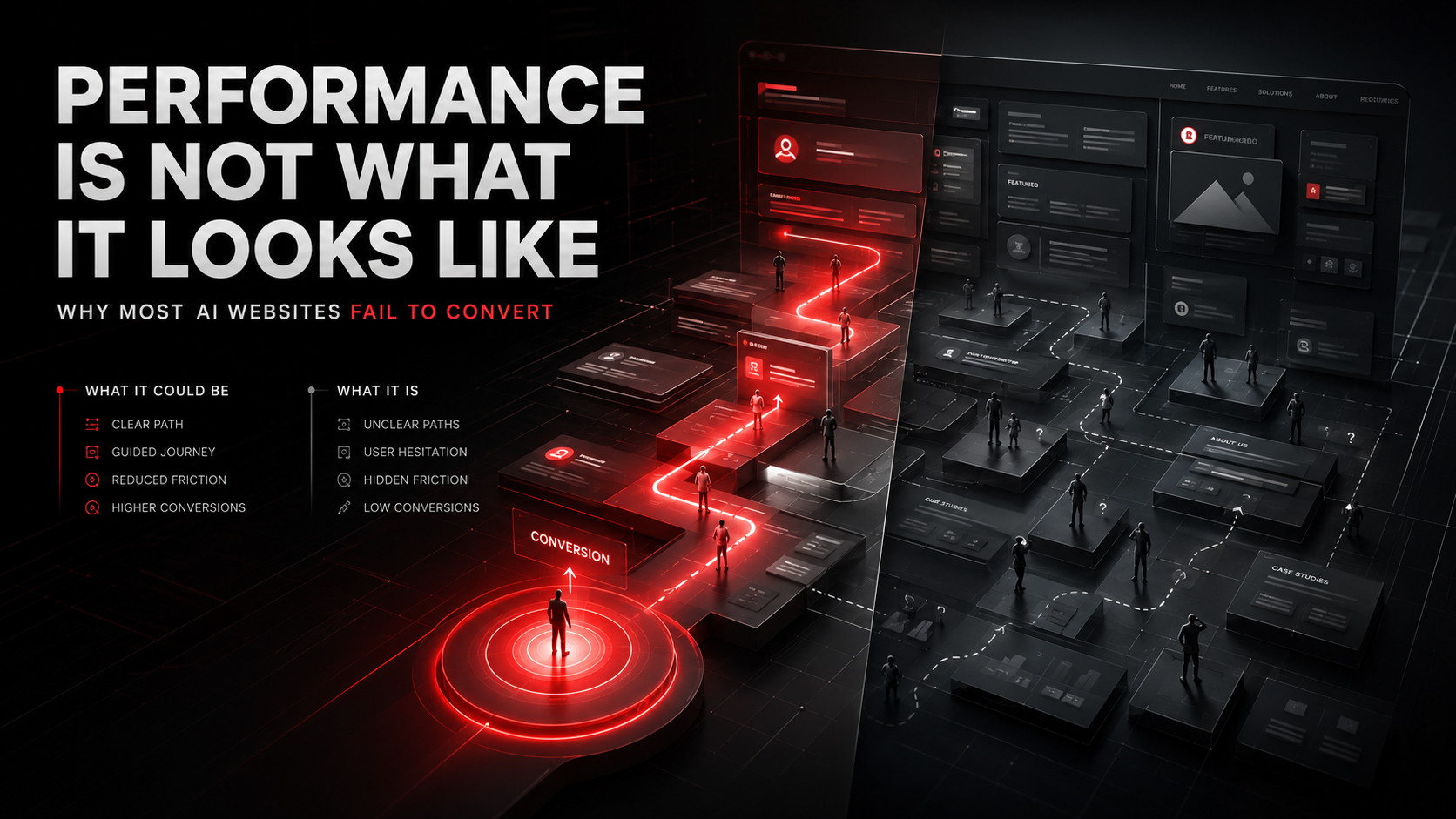
The Performance Illusion Most Businesses Don’t Notice
At first glance, many websites built using AI website design services appear highly advanced and well-structured.
They load quickly, follow modern design patterns, and often include features that suggest intelligence, such as automated interactions, dynamic layouts, or smart integrations. From a visual and technical standpoint, they seem like a clear improvement over traditional websites.
However, once real users begin interacting with these systems, a different pattern often starts to emerge.
Traffic may increase, but engagement does not improve proportionally. Visitors explore the website, but hesitate when it comes to taking action. Leads remain inconsistent, and conversions do not align with expectations.
This is where the assumption begins to break down.
Because performance is not something that automatically comes from using AI. It is something that has to be intentionally built into the system from the beginning.
A Familiar Situation Many Businesses Experience
Consider a business that recently invested in AI website design services with the expectation of improving both user experience and conversion outcomes.
The new website looks cleaner, faster, and more refined than the previous version. Early feedback is positive, and initial traffic levels appear encouraging.
But after some time, a different reality becomes visible.
Users are visiting the website, but they are not progressing through it in a meaningful way. Key actions such as enquiries, sign-ups, or purchases remain inconsistent. The business responds by making surface-level changes, adjusting content, or increasing marketing efforts.
Despite these adjustments, the results remain largely unchanged.
At this point, the issue is often assumed to be related to marketing or design.
In reality, the problem lies in how the system functions.
The website was built to present information, not to guide outcomes.
The Question That Changes How You Evaluate Everything
Most businesses evaluate websites based on what they include.
They focus on features, tools, and visual elements, assuming that these components determine effectiveness.
While these factors are important, they do not provide the full picture.
A more useful question is:
What is the website actually doing when a user interacts with it?
Is it guiding the user toward a clear next step, or simply displaying information?
Is it responding in real time, or remaining passive?
Is it reducing effort, or creating additional friction?
This shift in perspective moves the focus away from features and toward behaviour, which is where performance is truly defined.
What Performance Really Means in Practical Terms
A performance-driven website is not defined by its appearance or by the technologies it uses.
It is defined by how effectively it supports user actions and business outcomes under real conditions.
In practical terms, performance means:
- users can move through the website without confusion or hesitation
- decisions feel natural and guided rather than forced
- interactions happen quickly and without unnecessary delay
- the system removes friction instead of adding steps
- the experience improves over time based on actual user behaviour
When these elements are missing, even technically advanced websites struggle to deliver consistent results.
Where Most AI Website Design Services Fall Short
The increasing adoption of AI has made advanced tools more accessible, but it has also introduced a pattern where implementation lacks depth.
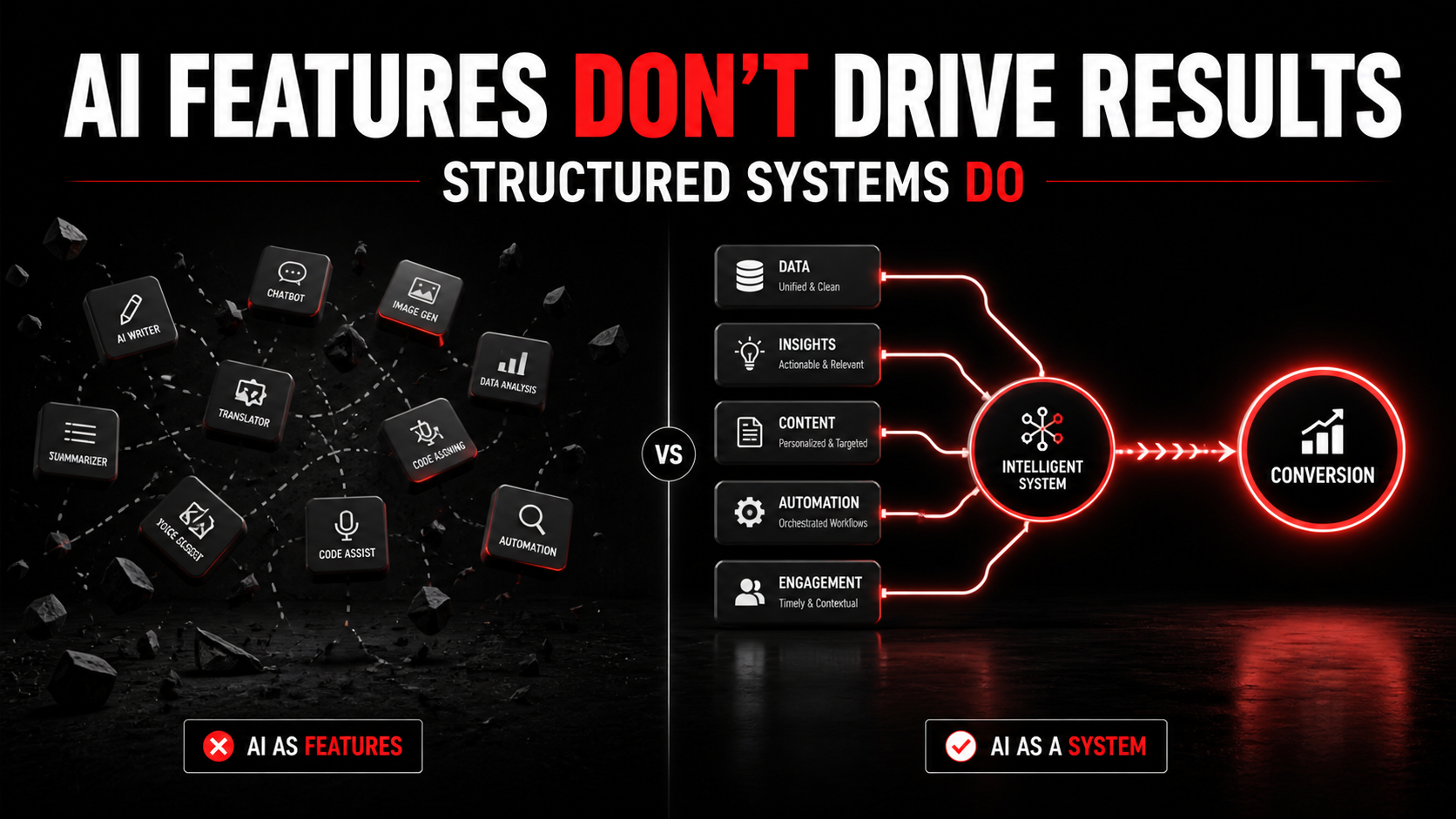
Many AI website design services focus on adding features without integrating them into a cohesive system.
This leads to common gaps:
- AI tools are treated as add-ons rather than part of the user journey
- design decisions prioritise visuals instead of behaviour
- user interaction is not analysed or refined continuously
- scalability is not considered beyond the initial build
As a result, the website may appear modern, but it does not function as a performance-driven system.
The issue is not the absence of AI.
It is the absence of structured thinking behind how that AI is applied.
What Changes When Performance is Built into the System
When a website is designed with performance as a priority, the experience begins to shift in ways that are both subtle and significant.
Users are guided through the system rather than left to interpret it on their own. The website anticipates their needs and provides direction at each step.
Interactions become more immediate, reducing delays and improving responsiveness. Instead of searching for information, users are presented with relevant options at the right time.
The overall experience feels more intuitive because unnecessary complexity has been removed.
Most importantly, the system evolves.
It adapts based on how users behave, allowing performance to improve over time without requiring continuous redesign.
This is what separates a static website from a dynamic, performance-driven system.
Looking Inside a Performance-Driven System
When you examine a high-performing AI-powered website closely, certain patterns become clear.
The user journey is intentional, with each step designed to lead naturally to the next. There is a clear flow rather than a collection of disconnected pages.
The system responds to user behaviour, adjusting content and pathways based on real interactions rather than relying on fixed structures.
Repetitive processes are automated, allowing the system to handle tasks such as lead capture, responses, and guidance without manual intervention.
Data is actively used to refine the experience, ensuring that the system continues to improve as more users interact with it.
The underlying architecture supports growth, allowing the website to scale without disruption as traffic and business needs increase.
These elements work together to create a system that performs consistently rather than relying on one-time optimisation.
A Simple Comparison That Highlights the Difference
It becomes easier to understand the difference when viewed side by side.
Traditional websites typically present information and rely on users to decide what to do next.
Performance-driven systems take a more active role.
They guide users, respond to interactions, and reduce effort at every stage.
Where a basic website waits for action, a performance-driven system encourages it.
Where isolated AI features exist independently, a structured system connects them into a unified experience.
This difference directly impacts how effectively the website supports business goals.
Why Cost Becomes a Misleading Factor
Cost is often one of the first considerations when selecting AI website design services, but it can also be one of the most misunderstood.
Lower-cost solutions tend to focus on delivering a functional website quickly, often without considering long-term performance.
Over time, this can lead to inefficiencies.
The website may require frequent updates, struggle to scale, or need significant adjustments to support new features.
A performance-driven system, on the other hand, is designed with long-term use in mind.
While the initial investment may be higher, the system operates more efficiently, adapts more easily, and reduces the need for repeated redevelopment.
This shifts the conversation from cost to value.
What Businesses are Starting to Realise
There is a noticeable shift in how businesses approach website development.
The focus is moving away from simply improving design and toward improving performance.
Instead of asking how a website can look better, businesses are asking how it can function more effectively.
This reflects a broader understanding that a website is not just a visual asset.
It is a system that influences user behaviour, supports operations, and contributes to growth.
What to Look for Without Overcomplicating the Decision
Choosing the right AI website design service does not require deep technical knowledge, but it does require clarity.
A reliable provider should be able to explain how the system works in practical terms, connecting design decisions to measurable outcomes.
They should consider scalability from the beginning, ensuring that the system can grow without requiring major changes.
They should also provide ongoing support, recognising that performance is not achieved once but maintained over time.
When these elements are present, the website is more likely to deliver consistent and meaningful results.
A More Practical Way to Evaluate Your Options
At this stage, the decision becomes less about comparing agencies and more about understanding how each one approaches problem-solving.
Instead of focusing only on portfolios or pricing, it is more useful to examine how they think about structure and performance.
Do they explain how users move through the system, or only how it looks?
Do they connect features to outcomes, or present them as isolated elements?
Do they plan for what happens after launch, or stop at delivery?
These questions provide deeper insight into how the final system will perform.
A Closing Perspective
AI continues to expand what is possible in web design, but it does not change the fundamentals of performance.
A website still needs to guide users clearly, reduce friction, and support meaningful action.
Without these elements, even advanced technology will struggle to deliver consistent outcomes.
The difference ultimately comes down to how the system is structured.
Taking a Step Back Before Moving Ahead
Before making your next decision, it is worth evaluating your current website from a performance perspective rather than a visual one.
Look at how users interact with it in real situations.
Are they moving forward with clarity, or encountering hesitation at key points?
Is the system supporting growth, or creating limitations as demands increase?
These observations provide valuable insight into what needs to change.
If you want to understand how a more structured approach to AI website design services can improve performance, you can explore this in more detail here:
https://ztsindia.com/service/ai-website-engineering-canada
The objective is not to rush into changes, but to ensure that the next step you take is aligned with long-term performance, scalability, and consistent business results.
-

Writen by Anirban Das