USA:
USA:  India:
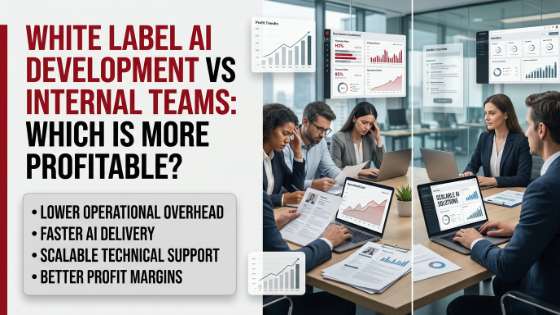
 White-label AI development is significantly more profitable than building internal AI teams for most agencies, startups, and growing businesses. Internal AI hiring typically costs $150,000 to $300,000+ per engineer annually once salary, benefits, recruitment, and infrastructure are factored in, while white label partnerships deliver the same capability at a fraction of the overhead. Companies that outsource AI functions strategically report up to 30% faster time-to-market than those building entirely in-house.
Why Are Businesses Expanding AI Operations Faster Than Ever in 2025?
The pressure to adopt AI has shifted from optional to urgent. Businesses that were cautiously experimenting with AI two years ago are now under direct competitive pressure to ship AI-powered products, automate operations, and personalise customer experiences at scale, all at the same time.
What makes this particularly challenging is the pace of the talent gap. AI specialist roles have grown by over 74% annually over the past four years, yet hiring pipelines remain severely constrained. Demand is outpacing supply by a significant margin, and that gap is not closing soon. For businesses trying to build internal AI capability, this creates a painful reality. The engineers you need are either unavailable, unaffordable, or already committed elsewhere.
Gartner projects that more than 80% of enterprises will have deployed generative AI-enabled applications by 2026, up from less than 5% in 2023. That is an extraordinary shift in an extraordinarily short window, and it is precisely why businesses are rethinking how they scale AI operations instead of simply assuming internal hiring is the answer.
What Does It Actually Cost to Build an Internal AI Team?
Most businesses dramatically underestimate this. The salary line item is just the beginning.
Senior AI and machine learning engineers command base salaries between $180,000 and $250,000 in the United States before benefits, equity, and bonuses. Add recruitment fees, which typically range between 15% and 25% of first-year salary per hire, three to six months of onboarding before anyone reaches full productivity, infrastructure costs for cloud compute and GPUs, software licensing, and the management overhead required to coordinate a technical team, and total annual investment for even a modest internal AI team can easily exceed $1 million.
None of that accounts for turnover. When a key engineer leaves, and in a field this competitive they often do, replacement costs run between 50% and 200% of annual salary. Timelines slip, projects stall, and the team has to absorb the gap. For a growing business that needs to move fast, that kind of instability is not just costly. It is strategically dangerous.
Why Is White Label AI Development a Smarter Growth Model for Agencies?
White label AI development eliminates the fixed overhead of a permanent internal department while preserving delivery speed, quality, and scalability. Instead of spending months searching for engineers, negotiating offers, and waiting out onboarding cycles, agencies can move directly into execution using a partner's existing infrastructure and team.
The appeal is both operational and financial. A 2023 Deloitte Global Outsourcing Survey found that while 70% of companies outsource for cost reduction, 40% now cite access to specialised capabilities as an equally important driver. That reflects how quickly AI expertise has become difficult to build internally.
For agencies in particular, white label partnerships unlock something that internal hiring simply cannot provide, which is the ability to take on more and more varied work without proportionally growing headcount. You can serve a client needing a recommendation engine this quarter and another client needing an AI-powered ecommerce platform next quarter without hiring a new specialist for each engagement.
How Does White Label AI Development Actually Protect Profit Margins Better Than Internal Hiring?
The core profitability advantage is structural. Internal teams create fixed costs that persist regardless of workload. You pay salaries during slow months the same as busy ones. White label partnerships convert that fixed cost into a variable one, scaling up when demand is high and drawing back when it is not.
Think about how most agencies actually operate. Client volumes fluctuate. Some quarters are packed while others are quieter. A large fixed internal AI team becomes a liability during lean periods and is barely sufficient during peak demand. A white-label partner flexes with the business. McKinsey research shows that companies implementing intelligent outsourcing strategies can improve operational efficiency by 20% to 40% compared to fully internal models, and that efficiency improvement flows directly into margin.
The profitability comparison also extends to risk. When you depend on one or two internal AI engineers, the departure of a single person can derail an entire product line. White label partnerships distribute that risk across a team, helping maintain delivery stability even when individuals change.
What Hidden Operational Costs Do Businesses Miss When Building Internal AI Teams?
The visible costs, such as salaries, recruitment, and office space, are only part of the picture. The hidden costs are often larger and almost always underestimated.
AI technology evolves rapidly. Gartner's research on technology cycles makes clear that the generative AI landscape is shifting fast enough that skills from twelve months ago may already need significant updating. That means continuous investment in training, certifications, and tooling just to stay current, not to advance, but simply to keep pace.
Beyond upskilling, there are less visible operational drains such as productivity gaps when someone leaves, workflow disruption during transitions, time spent on HR and management that grows with every hire, and infrastructure maintenance that becomes a function of its own. Many businesses discover these compounding costs only after they have already committed to internal expansion, by which point reversing the decision becomes expensive and disruptive.
White-label partnerships sidestep most of this complexity. A specialist team already maintains its own infrastructure, stays current on evolving tools, and absorbs its own management overhead. Businesses benefit from the output without carrying the operational burden internally.
Why Are Agencies and Startups Choosing AI Partnership Models Over Internal Expansion?
Speed is the most immediate reason. Recruiting, onboarding, and ramping up an internal AI engineer takes three to six months in the best-case scenario. A white-label partner can begin delivering within days or weeks. For agencies managing multiple client demands simultaneously, that time difference is not marginal. It is often the difference between winning or losing a project.
Beyond speed, there is the question of breadth. A single internal hire brings one set of skills. A white label AI team brings a range of specialisations including machine learning, natural language processing, automation architecture, and ecommerce integration that would require several internal hires to replicate. Global IT outsourcing revenue is projected to reach $587 billion by 2027, driven precisely by this recognition that external partnerships offer a depth and flexibility that internal teams rarely can.
For startups especially, the calculation is straightforward. Building an internal AI department requires capital, time, and management bandwidth that most early-stage companies simply do not have. Partnering with a white label provider allows them to move fast, stay lean, and allocate resources toward the core business rather than engineering infrastructure.
What Does the Future of AI Development Look Like: Internal Teams or Hybrid Models?
The future is not a choice between fully internal and fully outsourced. It is a blend of both. The businesses building durable AI capability right now are structuring themselves with internal strategic leadership and external scalable execution. Internal teams own the vision, product direction, and client relationships. External partners own the delivery infrastructure, specialist depth, and operational flexibility.
This hybrid model keeps businesses lean without leaving them under-resourced. PwC's AI Predictions research found that 86% of business leaders now consider AI a mainstream technology, yet fewer than 20% believe their internal teams are fully equipped to deliver it at the required pace without external support. That gap is not a failure of ambition. It is a realistic assessment of what internal teams can sustainably absorb.
The businesses that adapt to this hybrid model fastest will compound their advantage over those still trying to hire their way to AI capability. Operational adaptability, meaning the ability to access the right expertise at the right time, will matter more than headcount.
Why Should Growing Businesses Partner With a Specialised AI Web Development Company?
Building AI products requires more than engineers. It requires people who understand both the technology and the commercial realities of delivering it at scale, and that combination is genuinely rare in individual hires. The global AI market is growing at a compound annual rate of 37.3% through 2030, which means the complexity and scope of what businesses need to build is expanding faster than most internal teams can keep up with.
Specialist AI development companies bring accumulated expertise across intelligent website systems, automation workflows, scalable ecommerce platforms, and adaptive digital experiences built through repeated delivery across many clients and industries. That depth is difficult and expensive to replicate internally, and it is exactly what growing businesses need to compete credibly in an AI-first market.
How Does ZTS Infotech Pvt Ltd Support Businesses Scaling AI Operations Profitably?
ZTS Infotech Pvt Ltd approaches AI development as a long-term operational partnership rather than a series of isolated projects. The focus is on building scalable infrastructure that grows alongside the business, so that as client demand increases or technology evolves, delivery capability keeps pace without requiring the business to continuously rebuild from scratch.
Their work spans AI-powered website development, intelligent automation workflows, scalable ecommerce systems, adaptive customer experience platforms, and white-label AI development support for agencies and resellers operating in markets including New Zealand. For agencies and startups that need to expand AI capabilities quickly without accumulating internal overhead, that combination of technical depth and delivery flexibility offers a practical and commercially sound alternative to building everything in-house.
Frequently Asked Questions
Is it better to buy white-label or build a custom AI application?
It depends on your business goals, timeline, and budget. White-label AI solutions are faster and more cost-effective for quick launches, while custom AI applications offer deeper control and long-term flexibility.
What is the ROI of white-label AI solutions?
White-label AI solutions typically deliver faster ROI because they require lower upfront investment and reduce development, training, and maintenance costs.
Will an in-house team ever be cheaper than outsourcing?
For large enterprises with long-term AI infrastructure needs, internal teams may become cost-effective over several years. However, for most growing businesses, outsourcing remains more profitable in the short to medium term.
Can I customize a white-label AI app?
Yes, but customization is usually limited to branding, interface styling, and basic workflows. Deep backend modifications and custom AI architecture often require custom development.
Final Thoughts
The businesses that scale AI most effectively over the next few years will not necessarily be the ones with the largest internal engineering teams. In many cases, they will be the businesses that build the smartest partnerships, staying lean internally while scaling delivery externally through relationships that flex with demand.
AI scalability today is not just a technology problem. It is a profitability and operational design problem. Internal teams absolutely have value, particularly for businesses with long-term infrastructure needs and the resources to support them sustainably. But for most agencies, startups, and growing companies, white-label AI development offers a more pragmatic path that is faster to market, more flexible under pressure, and significantly easier to keep profitable as the market continues evolving.
Companies that partner strategically on AI rather than building everything internally report 1.4x higher revenue growth and 1.6x better profitability, and in a market moving this quickly, that kind of structural advantage tends to compound over time.
-

Writen by Anirban Das