USA:
USA:  India:
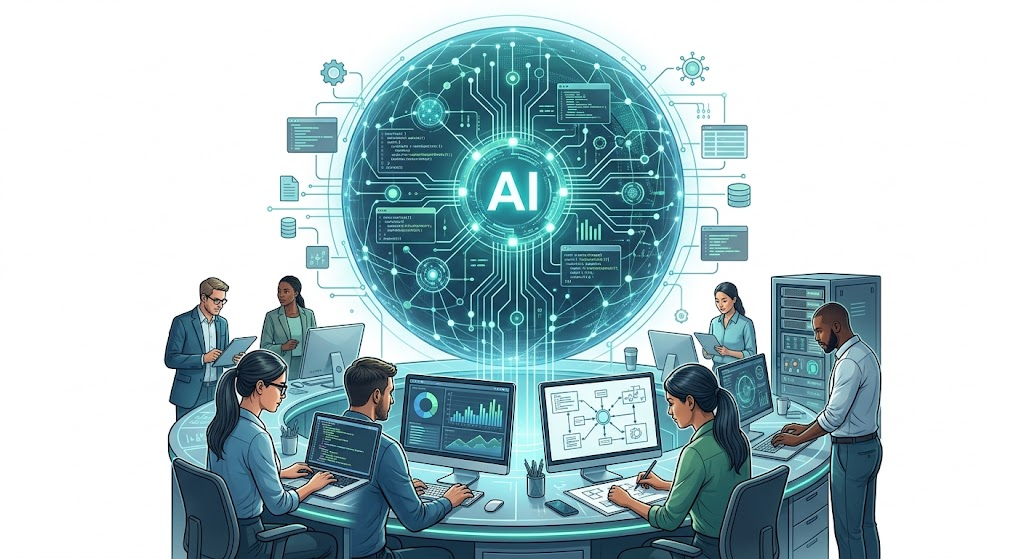
Imagine a typical AI agent demo: a slick interface, a short typed command, and then boom, reports generated, emails drafted, decisions made. The human barely moves. The message is clear: this thing runs itself.
Except it doesn't. Not even close.
Here's what nobody tells you in those polished demos behind every working agentic AI system is a carefully assembled layer of human expertise that makes the whole thing function. And companies that ignore this layer? They're the ones quietly wondering why their investment in AI-powered app development isn't delivering the ROI they were promised.
At ZTS Infotech Pvt. Ltd., we've seen this pattern play out more times than we'd like to admit, and we've learned exactly what separates agentic deployments that thrive from the ones that quietly stall six months post-launch. It almost always comes down to the humans.
The Automation Illusion and Why It Costs You
Agentic AI tools don't arrive pre-configured to your business. They arrive as raw capability. They don't know your brand voice, your compliance constraints, your customer quirks, or the five exceptions to every rule that your senior team carries in their heads. Someone has to close that gap.
The trouble is, the sales narrative around agentic AI solutions leans heavily on autonomy, the idea that the system will figure it out. And to a point, it will. But "to a point" is where most enterprise deployments quietly collapse.
Three things consistently trip up organisations:
- Demo optimism: Vendor demos feature pre-engineered prompts, clean data, and no edge cases. Real deployments are messier.
- Budget mismatch: Companies plan for the technology cost but underestimate the human calibration cost, which typically runs 30 to 40% of total project spend.
- Talent gap: The human roles agentic AI demands are new. You can't easily hire for them, and retraining takes longer than most timelines allow.
The agent is the instrument. The humans behind it are the musicians. You can own the finest instrument in the world and still produce noise.
So Who Actually Builds the Agent?
Let's get specific. These are the roles that make agentic deployments actually work, not in a whitepaper, but on a real Tuesday afternoon when the agent does something unexpected.
| THE 5 HUMANS EVERY AGENT DEPLOYMENT NEEDS |
The Prompt Architect Designs the instruction logic that the agent is told to do, in what order, and how it handles anything unexpected. |
The Domain Expert Translates deep business knowledge into structured guidance. Without them, the agent operates on assumptions that rarely match your reality. |
The AI Trainer / Feedback Curator Evaluates outputs systematically, creates quality benchmarks, and feeds improvement signals back into the system. |
The Human-in-the-Loop Reviewer Staffs the oversight touchpoints — approval gates, exception queues, spot-checks — that keep autonomous action from going off-script. |
The AI Risk & Governance Lead Defines what the agent cannot do, monitors for drift, and owns the escalation path when boundaries are breached. |
The AI + HI Advantage, Where ZTS Infotech Comes In
Here's where things get interesting. Most companies approaching agentic AI are doing so without this human infrastructure in place. And building it internally, hiring, training, and orchestrating these roles from scratch, takes 12 to 18 months that most project timelines don't have.
That's the problem ZTS Infotech was built to solve.
We are not a "deploy and disappear" vendor. Our model is fundamentally collaborative, a genuine fusion of Artificial Intelligence and Human Intelligence that we call AI + HI. When you work with us on mobile app development, website design and development, or an agentic AI project, you get the technology and the people who know how to make it behave.
In practice, that means:
- Our designers and developers work alongside AI tools, not downstream of them. The AI accelerates; the humans steer.
- We embed domain thinking from day one, translating your business logic into the structured context agents need to operate reliably.
- We build feedback loops into every deployment, so the system improves over time rather than slowly drifting off-target.
- We define governance guardrails before launch, not after the first incident.
This is why our clients see meaningful results faster. Not because the AI is doing more, but because the humans around it are doing their jobs with clarity and purpose.
A Word for Marketing Teams Specifically
Marketing is one of the functions most aggressively deploying agentic AI right now and also one of the least prepared for what maintaining it actually requires.
Think about what a marketing-focused agentic solution actually touches: brand voice, audience segmentation, lead scoring, personalization, campaign optimization, and regulatory compliance. Every single one of these areas requires human judgment to define what "right" looks like, and ongoing human oversight to catch the subtle drift that AI systems develop over time.
A content agent producing grammatically perfect but tonally off-brand copy is a trust-erosion engine. A lead-scoring agent over-optimising for short-term conversion metrics can quietly hollow out your pipeline quality over months. These aren't edge cases. They're the slow failures accumulating right now in organisations that launched their agents and walked away.
The fix is not less AI. The fix is more intentional human design around the AI.
The Bottom Line: Agents Don't Build Themselves
Every agentic AI system, however sophisticated, is downstream of human decisions. What should it do? How should it behave? What's the definition of success and who reviews whether it's hitting that mark? These are not technical questions. They're business questions that require human expertise to answer.
The organisations pulling ahead right now are not the ones who deployed fastest. They're the ones who invested in building the right human layer alongside the right technology. That combination, not the AI alone, is what's producing the results everyone is chasing.
If you're planning an agentic AI deployment, or rethinking one that's underperforming, start with the human infrastructure question. Everything else follows from there.
At ZTS Infotech, that conversation is one we genuinely enjoy having. Let's talk.
-

Writen by Anirban Das