USA:
USA:  India:
 The Era of Generic Websites Is Quietly Ending
For a long time, businesses approached websites in a relatively simple way. The goal was usually to create a clean design, present information clearly, and make the brand look professional online.
That approach worked when digital competition was lower and customer expectations were simpler.
But the environment has changed dramatically.
Today, users expect websites to understand them faster, guide them more intelligently, and reduce the effort required to make decisions. When that does not happen, they rarely complain or provide feedback. They simply leave and move to a competitor that offers a smoother experience.
This shift is one of the main reasons why Canadian businesses are increasingly investing in personalized AI website designing services in 2026.
The conversation is no longer centered around whether a website looks modern. It is centered around whether the website can adapt to how users behave in real time.
And that difference is becoming extremely important.
.png)
Why Static Website Experiences No Longer Work the Same Way
Most traditional websites still operate using fixed logic.
Every visitor sees the same structure, the same navigation pathways, and often the same messaging regardless of intent, behavior, or interest level.
The problem is that user behavior is no longer predictable enough for static experiences to perform consistently.
Some users arrive looking for immediate answers. Others need reassurance before taking action. Some are ready to convert quickly, while others require a more guided journey.
When every user receives the exact same experience, friction naturally increases.
This friction may not always be visible in obvious ways, but its effects are measurable:
- higher bounce rates
- lower engagement quality
- incomplete user journeys
- inconsistent conversion performance
This is where AI website personalization services are changing the structure of modern digital experiences.
Personalization Is No Longer a Feature. It Is Becoming Infrastructure.
One of the biggest misunderstandings around personalization is the assumption that it simply means adding recommendations, chatbots, or customized content blocks to a website.
The real shift happening in 2026 is much deeper than that.
AI-driven personalization is increasingly becoming part of the operational structure behind how websites function.
Instead of forcing users through rigid pathways, websites are beginning to adapt dynamically based on:
- interaction patterns
- browsing behavior
- engagement signals
- intent prediction
- navigation preferences
This creates an experience that feels more responsive and intuitive without requiring users to consciously think about it.
In many ways, the website begins behaving less like a static platform and more like an adaptive digital system.
That transition is reshaping how businesses approach online growth.
Why Canadian Businesses Are Investing More Aggressively in AI Website Personalization Services
Across Canada, businesses are facing growing digital pressure from multiple directions simultaneously.
Customer acquisition costs continue increasing. Competition in online spaces is becoming more saturated. Attention spans are shorter. Expectations around digital experiences are significantly higher than they were even a few years ago.
As a result, many businesses are realizing that visibility alone is no longer enough.
Traffic without engagement creates wasted marketing spend.
Clicks without meaningful interaction create weak conversion performance.
Attractive websites without adaptive functionality create digital stagnation.
This is why businesses are investing in personalized AI website designing services, not simply to modernize their websites, but to improve how digital systems perform under real user conditions.
The objective is becoming much more strategic:
- reduce friction
- improve engagement quality
- guide users more effectively
- increase conversion efficiency
- create scalable customer experiences
And personalization is increasingly at the center of that shift.
The Difference Between Traditional UX and AI-Driven Adaptive Experiences
Traditional UX design relies heavily on assumptions.
Designers predict how users might behave and create fixed journeys based on those expectations. While this approach can still be effective in some cases, it struggles to adapt when user behavior changes dynamically.
AI personalization works differently.
Instead of relying entirely on predefined assumptions, the system continuously responds to interaction data and behavioral patterns.
This creates a more flexible environment where:
- user pathways can adjust dynamically
- content relevance improves over time
- navigation becomes behavior-aware
- engagement becomes more context-sensitive
The experience feels more natural because the system adapts instead of remaining static.
This is one of the primary reasons AI website personalization services are gaining momentum in Canada. Businesses are beginning to understand that adaptability itself has become a competitive advantage.
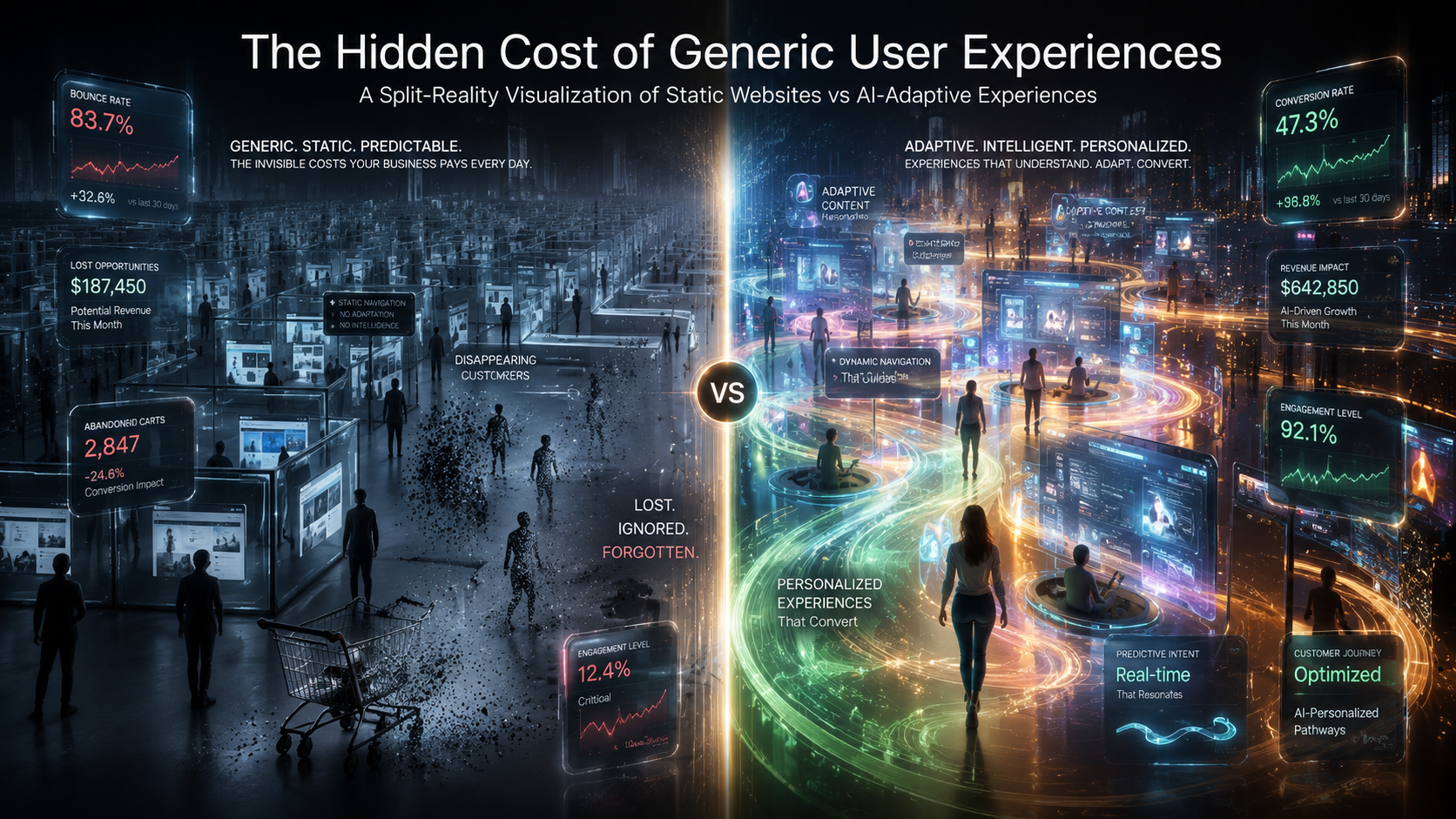
The Hidden Cost of Generic User Experiences
One of the least discussed aspects of poor personalization is the hidden business cost created by generic experiences.
When users encounter irrelevant pathways, repetitive content, or unclear navigation structures, decision fatigue increases.
That fatigue leads to hesitation.
And hesitation directly affects:
- conversions
- lead quality
- customer trust
- engagement duration
Many businesses attempt to solve these problems by increasing ad budgets or redesigning visuals, while the deeper issue remains unresolved.
The problem is often not visibility.
It is experience-relevant.
AI website personalization services address this by improving how the system responds to different user behaviors instead of treating every visitor identically.
Personalization Is Becoming More Predictive Than Reactive
One of the most important developments happening in AI-driven personalization is the shift from reactive systems to predictive experiences.
Traditional personalization reacts after users take action.
Predictive personalization attempts to anticipate user intent before friction appears.
This creates a much smoother digital experience because the system becomes proactive rather than reactive.
For example:
- Navigation pathways can be simplified automatically.
- relevant information can appear earlier in the journey.
- Content sequencing can be adjusted based on engagement signals.
- Support interactions can happen before confusion escalates.
This level of adaptive interaction is becoming increasingly important for businesses competing in crowded digital markets.
And it is one of the clearest indicators of where AI website personalization services are heading next.
Why Many Personalization Strategies Still Fail
Despite the growing popularity of personalization, many implementations still produce weak results.
The reason is not the technology itself. The issue is usually structural.
Many businesses add personalization tools without creating a connected behavioral strategy behind them.
This leads to experiences that feel fragmented or overly automated rather than intelligently adaptive.
Common problems include:
- irrelevant recommendations
- excessive popups and interruptions
- disconnected personalization layers
- lack of meaningful behavioral analysis
- automation without context
When personalization becomes intrusive instead of helpful, trust declines quickly.
This is why the strongest personalization systems focus less on adding features and more on reducing digital friction intelligently.
What Businesses Should Actually Evaluate Before Investing
Businesses often evaluate personalization services based on features alone.
But the more important questions are structural.
For example:
- Does the system adapt to different user behaviors naturally?
- Does personalization reduce confusion or create more complexity?
- Is the experience becoming more efficient over time?
- Is personalization connected to business outcomes?
These questions shift the focus away from technology hype and toward performance intelligence.
That perspective is becoming increasingly important in 2026.
How ZTS Infotech Pvt Ltd Makes a Difference
As Canadian businesses continue investing in personalized AI website designing services, the focus is gradually shifting toward providers that approach personalization as a structured performance system rather than a collection of isolated tools.
ZTS Infotech Pvt Ltd focuses on building scalable AI-driven website systems designed around usability, behavioral adaptation, and long-term digital performance.
Key Highlights:
- Over 15 years of industry experience
- 350+ global clients across multiple sectors
- ISO 9001 and ISO 27001 certified workflows
- Focus on scalable and performance-oriented AI systems
- AI integration is designed to improve engagement and usability
- Balanced approach between automation, personalization, and business efficiency
Rather than overcomplicating personalization with unnecessary features, the focus remains on creating adaptive systems that improve how users interact with digital environments over time.
The Future of Personalized AI Website Design in Canada
The future of AI website personalization services is moving toward systems that continuously evolve based on real-time behavioral intelligence.
Websites are gradually becoming:
- more adaptive
- more predictive
- more context-aware
- more responsive to user intent
This evolution is changing the role of websites entirely.
Instead of functioning only as digital presentation layers, websites are becoming intelligent interaction systems capable of improving performance dynamically over time.
That shift will likely define the next stage of digital competition in Canada.
Because eventually, businesses will not compete only through visibility or design quality.
They will compete based on how intelligently their digital systems adapt to user behavior.
Frequently Asked Questions (FAQ)
What are AI website personalization services?
They use AI to create adaptive website experiences based on user behavior and interaction patterns.
Why are Canadian businesses investing in AI website personalization services?
Businesses are using personalization to improve engagement, conversions, and overall digital performance.
How is AI personalization different from traditional website design?
Traditional websites offer fixed experiences, while AI personalization adapts content and user journeys dynamically.
Can AI website personalization improve conversions?
Yes. Personalized experiences help reduce friction and guide users more effectively toward action.
Are AI website personalization services suitable for small businesses?
Yes. Small businesses can use personalization to improve user experience and compete more effectively online.
Why do some personalization strategies fail?
They often fail because personalization tools are added without a clear behavioral or user experience strategy.
How does ZTS Infotech Pvt Ltd approach AI personalization?
ZTS Infotech focuses on scalable, performance-driven AI systems designed to improve usability, engagement, and long-term growth.
Final Perspective
The rise of AI website personalization services is not simply a technology trend.
It reflects a much larger transition happening across digital business environments.
Users no longer want generic experiences that force them through static pathways. They expect relevance, clarity, responsiveness, and efficiency throughout the interaction journey.
Businesses that continue relying on fixed website experiences may still remain visible online, but visibility alone is becoming less valuable when engagement quality remains weak.
The businesses gaining long-term advantages in 2026 are increasingly those building adaptive digital systems that learn, respond, and improve continuously.
And that is exactly why personalized AI website design is becoming a strategic investment rather than just a design enhancement.
-

Writen by Anirban Das