USA:
USA:  India:
 Remember when building a website meant you were locked into one platform's way of doing things? Those days are fading fast. The shift toward headless CMS architecture isn't just another tech trend that'll disappear in six months. It's fundamentally changing how businesses think about their digital presence.
I've watched this transformation happen over the past few years, and what strikes me most is how headless CMS solves problems that traditional systems created without us even realizing they were problems. Let me walk you through why this approach is becoming the default choice for companies that want their websites to grow with them, not against them.
What Actually Makes a CMS "Headless"?
The name sounds technical, but the concept is straightforward. Traditional content management systems bundle everything together. Your content, design templates, and front-end presentation are all interconnected. Think of it like buying a house where you can't change the kitchen without also replacing the bathroom.
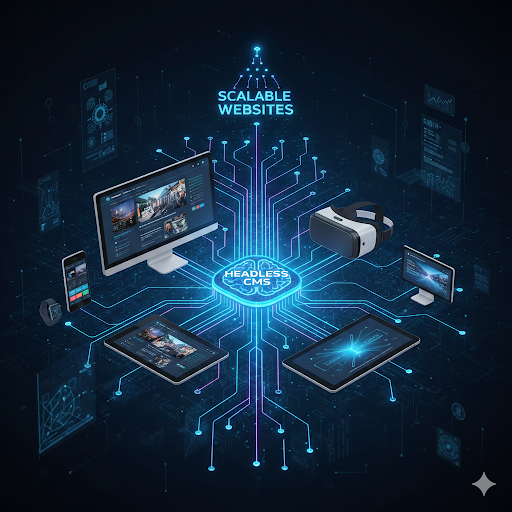
A headless CMS separates the content repository (the "body") from the presentation layer (the "head"). Your content lives in one place, accessible through APIs, while your front-end can be built with whatever technology makes sense for your project. Want to display the same content on your website, mobile app, and smart watch? You can do that without duplicating effort or creating content silos.
Key takeaway: Headless architecture gives you the freedom to build different experiences for different platforms while managing content in one central location.
The Scalability Problem Traditional CMS Platforms Can't Solve
Here's where things get interesting. Traditional CMS platforms struggle when you need to scale in unexpected directions. Maybe you started with a simple blog, but now you need a customer portal, mobile app, and integration with your IoT devices. Each addition becomes increasingly complicated because you're fighting against the system's original design.
With headless CMS, scaling becomes modular. Need to add a new customer touchpoint? Build a new front-end that pulls from your existing content API. Want to expand internationally? Create region-specific experiences without duplicating your content management infrastructure. The back-end remains stable while your front-end options multiply.
At ZTS Infotech, we've seen this play out repeatedly with our clients. One company came to us with a traditional WordPress setup that worked fine for their blog but couldn't handle their expansion into mobile commerce. Instead of building separate systems, we implemented a headless architecture that let their content team work exactly as they always had while our developers built custom experiences across five different platforms.
Key takeaway: Headless CMS lets you scale horizontally across platforms rather than vertically within a single platform's limitations.
Performance Gains That Actually Matter to Your Users
Speed isn't just about user experience anymore, though that matters plenty. Search engines factor page speed into rankings. E-commerce sites lose conversions for every second of delay. Healthcare portals need to load quickly for patients accessing critical information.
Headless CMS architectures typically deliver content through APIs to static site generators or modern JavaScript frameworks. This means faster load times because you're serving pre-rendered pages or highly optimized dynamic content rather than generating pages on the server for every request.
We recently worked with a healthcare provider whose patient portal was frustratingly slow during peak hours. Their traditional CMS was processing thousands of database queries for each page load. After migrating to a headless approach with a React front-end, their average page load time dropped from 4.2 seconds to under 800 milliseconds. Patient satisfaction scores went up, and so did their search rankings.
Key takeaway: Headless architecture improves performance by separating content delivery from presentation rendering, reducing server load and accelerating page speeds.
The Developer Experience Revolution
Let's talk about something that doesn't always make it into marketing materials but matters enormously: developer happiness. When developers can work with modern tools and frameworks they actually want to use, projects move faster and the code quality improves.
Traditional CMS platforms often lock developers into specific languages, frameworks, and patterns. Want to use the latest React features? Too bad if your CMS doesn't support them. Trying to implement a cutting-edge design pattern? You'll need to work around the CMS's assumptions about how websites should work.
Headless CMS removes these restrictions. Developers can choose the best tools for each project. Our team at ZTS Infotech combines human expertise with AI-assisted development workflows, and headless architecture makes this collaboration seamless. AI tools can help generate API integration code, optimize queries, and suggest performance improvements while our developers focus on creating exceptional user experiences.
This collaborative approach between human developers and AI accelerates projects significantly. What might have taken three months in a traditional CMS environment can often be completed in six weeks when developers aren't fighting against platform limitations.
Key takeaway: Headless CMS empowers developers to use modern tools and workflows, leading to faster development cycles and better end products.
Content Team Flexibility Without the Technical Barriers
Here's a concern I hear often: "Won't a headless CMS make things harder for my content team?" The opposite is usually true. Content editors continue using familiar, user-friendly interfaces. The difference is that their content can now appear anywhere instead of being confined to a single website template.
Think about a product description. In a traditional CMS, that description lives on a product page with a specific layout. With headless CMS, that same description can appear on your website, in your mobile app, in email campaigns, on digital signage, and anywhere else you distribute content. The content team writes it once, and it automatically populates everywhere it's needed.
We implemented this for a retail client who was manually updating product information across their website, three mobile apps, and in-store kiosks. Mistakes were common, and updates took days. After moving to a headless system, their content team updates information once, and it appears everywhere within minutes. They actually have fewer tools to learn, not more.
Key takeaway: Headless CMS simplifies content management for non-technical teams while expanding where and how content can be used.
Future-Proofing Your Digital Infrastructure
Technology changes fast. The hot framework today might be obsolete in three years. Voice interfaces, AR experiences, and platforms we haven't imagined yet will need to access your content. How do you prepare for unknown future requirements?
Headless CMS creates a stable content layer that remains constant even as your presentation technologies evolve. When the next big platform emerges, you build a new front-end for it without touching your content infrastructure. Your investment in content management remains valuable regardless of how front-end technologies change.
This matters more than most companies realize until they face a major platform migration. I've seen businesses spend hundreds of thousands of dollars migrating content from one traditional CMS to another because their needs outgrew the original platform. With headless architecture, you can switch front-end frameworks without migrating your content at all.
Key takeaway: Headless architecture protects your content investment by separating it from presentation technologies that will inevitably need updating.
The AI Integration Advantage
Here's where things get really interesting for forward-thinking companies. AI is transforming how we create, optimize, and personalize content. Headless CMS platforms integrate with AI tools far more easily than traditional systems.
Want to use AI to generate personalized content recommendations? Analyze user behavior to optimize content placement? Automatically generate meta descriptions or alt text? These capabilities plug into headless systems through APIs without requiring platform-specific integrations.
At ZTS Infotech, our combination of AI and human intelligence thrives in headless environments. AI assists our designers by analyzing user behavior patterns and suggesting content improvements. It helps our developers optimize API calls and identify performance bottlenecks. Meanwhile, human creativity and strategic thinking guide the overall experience design and ensure the technology serves genuine user needs.
This AI-augmented approach doesn't replace human expertise. It amplifies it. Designers focus on creative solutions while AI handles data analysis. Developers architect elegant systems while AI assists with code optimization. The result is better products delivered faster.
Key takeaway: Headless CMS architecture makes it easier to integrate AI capabilities that enhance both development workflows and user experiences.
Making the Transition: What Actually Happens
The migration to headless CMS sounds daunting, but it doesn't have to be an all-or-nothing proposition. Many successful implementations start small. You might begin by using a headless CMS for a new mobile app while keeping your existing website unchanged. Once you see the benefits, you can gradually migrate other touchpoints.
The typical journey involves choosing a headless CMS that fits your content model, designing APIs that serve your content effectively, and building front-end experiences that leverage this flexibility. For businesses working with experienced development partners, the transition often happens more smoothly than expected because you're not fighting against legacy assumptions built into traditional platforms.
We recently guided a financial services company through this transition. They were terrified of disrupting their existing website that served millions of users. We implemented a gradual migration where their content team started using the new headless CMS while we built a new front-end that initially replicated their existing site exactly. Once that was stable, we began enhancing it with features their old platform couldn't support. The content team noticed improvements immediately. End users experienced zero downtime.
Key takeaway: Headless CMS migration can happen gradually, reducing risk and allowing teams to adapt at a comfortable pace.
Why This Matters for Your Business Now
The websites that thrive five years from now won't be the ones using today's technology most effectively. They'll be the ones built on flexible foundations that can adapt to tomorrow's requirements. Headless CMS isn't about chasing the latest trend. It's about building digital infrastructure that grows with your business instead of constraining it.
If you're scaling across multiple platforms, if performance matters to your bottom line, if you need to move faster than your current CMS allows, or if you're simply tired of fighting against your technology instead of leveraging it, headless architecture deserves serious consideration.
At ZTS Infotech, we've built our approach around this reality. We combine human creativity and strategic thinking with AI-powered development acceleration to deliver scalable solutions that actually work for businesses, not just look good in demos. Whether you're building from scratch or migrating from a traditional CMS, the collaborative approach between our designers, developers, and intelligent tools creates better outcomes faster.
The question isn't whether headless CMS will become the standard for scalable websites. For many use cases, it already is. The question is whether your business will make the transition proactively or reactively.
Ready to explore how headless CMS could transform your digital presence? ZTS Infotech specializes in mobile app and website design and development that combines cutting-edge architecture with practical business outcomes. Our team leverages both human expertise and AI assistance to deliver projects faster without sacrificing quality. Visit us at ztsindia.com to learn how we can help you build digital experiences that scale with your ambitions.
-
Writen by Anirban Das