USA:
USA:  India:
 .png)
I Had a Call Last Month That Stuck With Me
A guy named Marcus. Runs a mid-sized HVAC company out of Charlotte. Been in business nineteen years, second generation, good reputation locally. He called because his nephew — who apparently fancies himself a web guy — had convinced him to spend $6,200 on a full website redesign eight months ago.
The site looked fine. Actually looked pretty decent. Marcus pulled it up on his phone and walked me through it while we were on the call, almost like he was hoping I'd tell him something was obviously broken and fixable. Nothing was obviously broken. The problem was subtler than that and, honestly, more expensive. Nobody had thought about why someone would land on that site and what they'd do next. No conversion logic. No local SEO structure. Contact form buried three scrolls deep on a page most visitors never reach. Analytics show an average session duration of forty-one seconds.
Eight months. Roughly four leads he could trace back to the site.
I've had some version of this conversation probably thirty or forty times in the last few years. The business owner isn't naive. The agency wasn't necessarily incompetent. But somewhere in the process, the actual goal — bring in customers — got lost underneath the goal of building something that looked like a proper modern website. Those two things are not the same goal, and the difference between them is basically the entire argument for why AI-powered website design has started to matter.
Let Me Tell You What AI Website Design Is Not
- Because I think half the confusion in this market comes from people assuming they already know.
- It's not a tool that asks you five questions and generates your homepage. Those exist. Some of them are even useful for very basic stuff — a placeholder page, a simple landing page for a one-time campaign. But that's not what any serious agency means when they talk about AI web design solutions, and it's definitely not what's actually producing better business results for companies across the US.
- Here's the version that actually changes outcomes. AI is doing real analytical work before the first wireframe gets sketched — competitive research at a depth and speed a human team simply can't match, mapping how your specific audience searches and what content they actually engage with versus what they bounce from, identifying the gap between where you sit in your market and where you could sit. Then it carries into UX — decisions about page structure and content hierarchy informed by behavioral data, not by what the lead designer thinks looks clean. Then, into development, where AI-assisted workflows genuinely compress timelines without cutting corners on the quality of the underlying code. And then after launch, there's a system monitoring real user behavior and surfacing what needs adjusting.
- That's the version worth paying for. That's also a completely different product from a template with good stock photography.
- The reason this matters for the pricing conversation is that when an AI web design agency USA is doing actual AI-integrated work versus just using the label, the costs are different and the outcomes are different. You need to know which one you're buying.
What It's Going to Cost You — Just the Numbers
- Entry-level. Five hundred to fifteen hundred dollars. Real sites, properly built, for businesses that need a professional web presence without complex functionality.
- Middle tier. Fifteen hundred to five thousand. This is where most growing US businesses belong if the website is genuinely supposed to be generating revenue.
- Enterprise. Five thousand and up. Custom platforms, deep AI functionality, serious integrations, dedicated build teams.
- I want to dwell for a second on the middle tier because it's where the most important conversations happen and also where the most money gets wasted on the wrong agencies. Fifteen hundred to five thousand dollars for affordable AI website design services USA — done by people who know what they're doing — is genuinely one of the better investments a growth-stage business can make right now. The conversion rate difference between a site properly built at this tier and a generic template job is usually somewhere between one and three percentage points. That sounds technical until you map it to your own traffic numbers and your own average deal size. For most businesses I talk to, the math on that is pretty startling.
Why Does One Quote Come Back at $1,800 and Another at $5,400 for "The Same Website"
This is the question that leads to bad decisions most often, so I want to answer it clearly even though the honest answer is a bit long.
Complexity is not always obvious from the outside. A fifteen-page website sounds like a fixed thing. But fifteen pages, where three of them have dynamic content that changes based on who's viewing it, two of them have lead forms that route to different people on your team based on what service the visitor selected, and the whole thing is connected to your CRM and your email sequences — that's not the same build as fifteen static pages. It's just not. Any AI website design company in the USA quoting both at the same price is either not thinking carefully or planning to leave things out.
How serious the AI integration actually is matters enormously. There's a version of "AI-powered" where someone used an AI writing assistant to draft copy faster. And there's a version where behavioral personalization is built into the actual UX of the live site — where a visitor who found you through a Google search for emergency plumbing sees different headline copy and a different CTA than someone who found you through a referral link. That second version costs more. It also converts better. Significantly better, in most cases.
I'll be honest about technical SEO because I feel strongly about it. An AI-powered web design company in the USA that builds sites without proper technical SEO architecture is handing you a problem that's going to cost more to fix than it would have cost to avoid. Crawl structure, internal linking logic, schema markup, Core Web Vitals performance, canonical tags — this stuff needs to be baked into the build from the start, not treated as something to worry about later when you notice you're not showing up in search. Later is always more expensive. Always.
Integrations. Each one is real engineering work. CRM connection, email platform sync, payment gateway, analytics configuration, booking tools — every integration has to be built, tested, and maintained. It's not a checkbox. It's development hours, and those hours are legitimately in the quote.
And then — I'll just say it plainly — who's doing the work is one of the biggest price drivers and one of the most underweighted factors in how businesses choose agencies. An experienced AI web design company in the USA that's been working specifically with US clients for years and can show you actual performance data from comparable projects is going to charge more than someone who took an online course last year and updated their LinkedIn. The outcome gap between those two options is almost always bigger than the price gap.
The Three Tiers, Honestly Described
Five hundred to fifteen hundred dollars gets you a real website. Not a template, not a drag-and-drop builder, not an AI-spit-out layout — a properly structured five-to-eight-page site built with mobile-first thinking, foundational SEO that gives you a genuine shot in local search, a working lead form, and a CMS you can actually manage yourself without a developer on standby every time you want to update your hours.
That's the right tier for a local business, an independent professional, a solo consultant, a contractor who just needs something credible to send people to. It is not the right tier if your website is supposed to be your primary growth engine. And it is absolutely not the $99 website builders that have been flooding the market with "AI" in the name. Those are template businesses. You get a generic layout, some AI-generated filler content, and zero strategic thinking about what your specific business needs. Some of them look okay for about six months. Then they become a liability.
Fifteen hundred to five thousand is a different conversation. This is where affordable AI website design in the USA stops being about keeping costs low and starts being about actual return. At this level, someone is thinking about strategy before touching a design tool — who your visitors are, where they're coming from, what they need to see and feel before they'll take action, and how to build the page architecture around that. UX gets mapped from behavioral data. Technical SEO goes in properly from day one. The site connects to your actual business systems. Analytics gets configured to tell you something useful rather than just collecting numbers nobody looks at.
I've seen businesses in this tier watch their lead volume double within ninety days of launch. Not because the site was prettier — because it was engineered around how their actual customers make decisions. That's what the investment buys you.
Five thousand and up is where we're not really talking about websites anymore. Custom platforms. AI doing functional work inside the live product — semantic search that learns, content that adapts to individual user signals, lead scoring that routes inquiries automatically, and enterprise integrations across multiple systems. The businesses in this tier are usually in fintech, healthcare, large eCommerce, or enterprise SaaS, and they're investing at this level because every percentage point of conversion improvement is worth a serious amount of money at their volume.
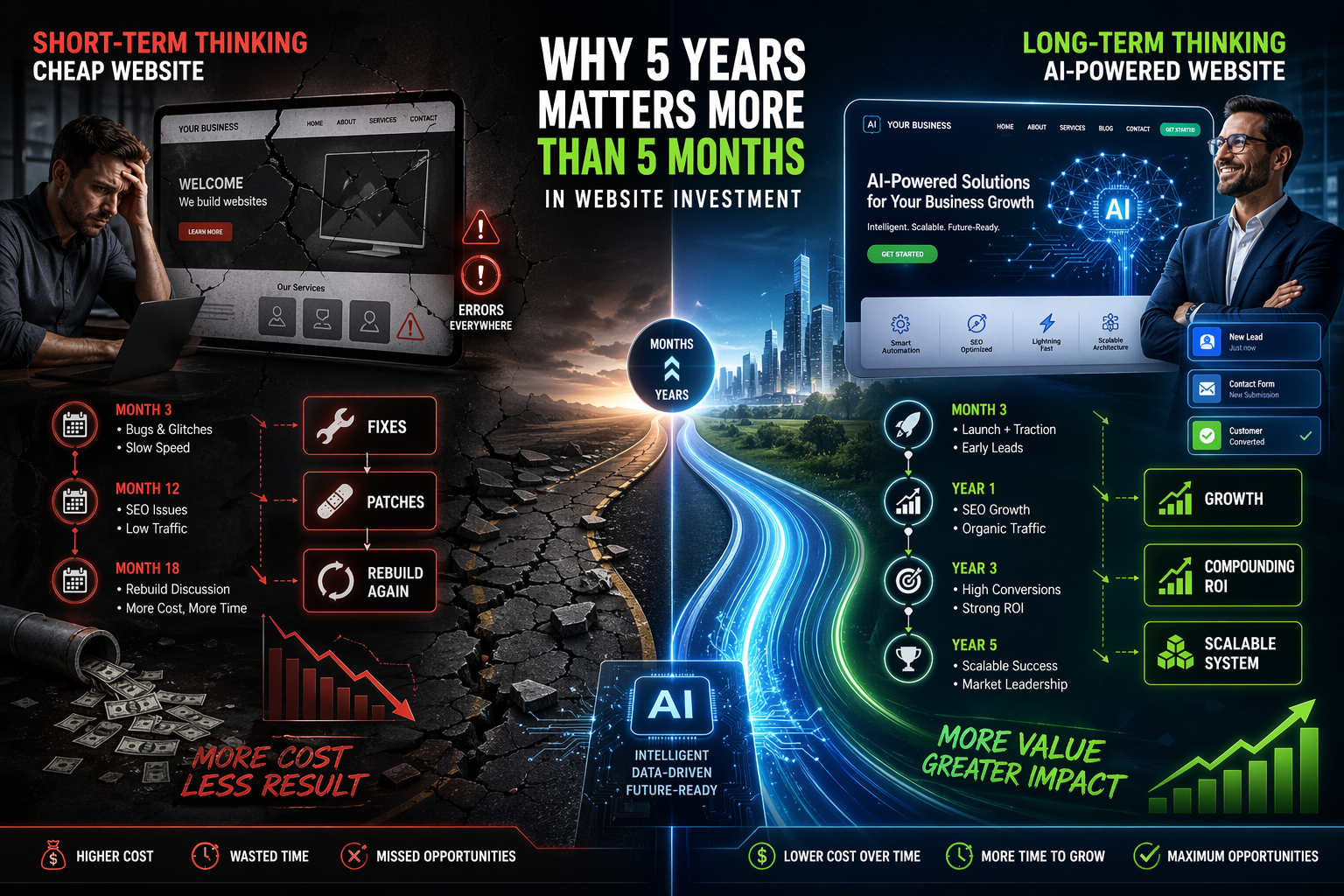
Five Years Is the Right Time Horizon, Not Five Months
Most people think about website cost as a single purchase. I'd push back on that framing pretty hard.
A website is more like renting commercial real estate than buying a piece of furniture. You're going to be living with it, maintaining it, and paying for it — one way or another — over the next four or five years. The question is whether that cost comes in the form of a smart upfront investment or a slow drain of fixes, emergency patches, retroactive SEO work, partial rebuilds, and eventually a complete do-over.
A well-built AI-powered site compounds over time in ways that a cheap site simply doesn't. The organic search visibility gets stronger every month as the SEO matures. The conversion data teaches you things you can act on. The architecture makes future updates genuinely easy rather than nightmarishly fragile. You spend less in year three than you did in year one, not more.
The cheap site usually goes the other direction. Small problems become medium problems. Retroactive optimization costs pile up. And somewhere around the eighteen-month mark, someone starts a conversation about whether it's time to just rebuild the whole thing. Which is how you end up spending twice.
The Costs That Never Show Up on the Original Quote
Post-launch surprises are remarkably consistent across projects that cut the wrong corners. I've seen enough of them that I can basically predict which ones are coming.
User flow problems are discovered after real visitors show up. The agency built what was in the scope document. Real visitors use things differently than clients imagine during design reviews, and when the gaps surface — which they do — fixing them costs anywhere from $800 to $2,500. It also happens at exactly the moment you were hoping for launch momentum, which stings twice.
SEO work that was described vaguely and delivered accordingly. "SEO optimization" in a contract means different things to different agencies. Sometimes it means someone wrote title tags and submitted a sitemap. Real technical SEO is an architectural thing — it's about how the site is structured, how pages relate to each other, how the server responds to crawlers, how page speed is engineered. If it wasn't specified in detail, it probably wasn't done. Fixing it afterward costs more than doing it right the first time. Sometimes significantly more.
Core Web Vitals. Google treats site performance as a ranking factor. A slow site doesn't just frustrate visitors — it gets penalized in search results. Retrofitting performance optimization after a site is already live costs $500 to $3,000. The best AI web design agency in the USA treats this as a baseline build requirement, not a conversation that happens six months after launch when someone notices rankings dropping.
Agencies calling themselves AI that aren't. This one is genuinely affecting businesses right now, and I want to be direct about it. The term "AI-powered" has become so commercially useful that a lot of traditional agencies have applied it without changing anything about how they actually work. If you're talking to an AI website design company in the USA, ask them specifically — which AI tools are embedded in your workflow, at which phases of the project, and what did those tools produce in terms of outcomes for clients similar to mine. Not case studies. Not testimonials. Actual before-and-after performance numbers. If they hedge on that question, you have your answer.
What to Actually Ask When You're Evaluating Agencies
Skip the question most people lead with — "Do you use AI?" — because in 2026, everyone says yes, and it tells you nothing.
Ask them to walk you through their AI workflow phase by phase. What specifically does AI do during research? During UX? During development? During post-launch optimization? A real AI web design company in the USA has specific answers to these questions because they've thought carefully about where AI actually improves outcomes versus where it's just a thing to mention in proposals.
Ask to see performance data from comparable projects. Not the nicest-looking portfolio pieces — projects similar to yours in industry, size, and goal. What were the conversion rates before and after? What happened to organic traffic in the six months post-launch? What changed in the client's lead volume? If the agency has been doing this properly, they have this data, and they're proud of it.
Ask directly how Core Web Vitals and technical SEO are handled in a standard build. The answer should be detailed and confident. If it's vague, move on.
Ask what you should realistically expect ninety days after launch, and how they'll measure whether the site is performing against those expectations. Post-launch accountability is not standard in this industry. Agencies that build it in anyway are telling you something about how they operate.
Why US Clients Work With ZTS Infotech
Over a decade of working specifically with American businesses. AI integration wasn't something we added to our pitch when it became a popular term — it's been embedded in how we build for years, and you can see it in what our clients' sites actually do after launch versus what most agency sites do, which is mostly look good in screenshots.
We're engineering-first. Every project starts with strategy — real research into your market, your audience, your competitive position — before anyone opens a design tool. Technical SEO goes in at the foundation, not as an afterthought. AI is doing real work at every phase, not decorating the proposal. And our timelines hold because AI-assisted workflows genuinely compress the parts of development that have historically eaten time without adding value.
Our team is built around what US clients actually need. People who understand American buyer psychology and competitive US markets, not generic web principles. SEO specialists who know what it actually takes to rank in saturated verticals. Engineers who know the technology deeply enough to make smart tradeoffs rather than just implement what's asked.
Pricing is straightforward. No discovery calls that turn into hour-long upsell sessions. You can see what we build and what it produces at ztsindia.com/service/ai-website-engineering-usa.
Here's the Actual Bottom Line
Affordable AI website design services in the USA — the real version, not the label — outperform traditional web design. That's not a controversial claim anymore. It's just what keeps happening in project after project, client after client.
What's still variable is whether you're working with an agency that actually delivers it and whether you're investing at a level that makes sense for what you're trying to accomplish. A $400 template won't grow a business that needs real lead generation. An expensive engagement with an agency that's just using the terminology won't either.
For most US businesses right now — SMEs, growth-stage companies, anyone serious about using their website as a revenue tool — the $1,500 to $5,000 range with a real specialist is where the smart money goes. One time. Done properly. And then the site actually does something.
Marcus from Charlotte, by the way — we rebuilt his site seven months ago. Leads from the website are up. He stopped referencing his nephew in our conversations around month three, which I took as a good sign.
When you're ready to talk about your own situation, reach out.
👉 ztsindia.com/service/ai-website-engineering-usa
Back to you within 24 hours. Real people, real conversation, no script.
FAQs
Q1. How much does an AI website design cost in the USA in 2026?
AI website design cost in the USA ranges from $500–$1,500 for basic sites, $1,500–$5,000 for revenue-focused builds, and $5,000+ for enterprise platforms with deep AI functionality and custom integrations.
Q2. What is an AI website design?
AI website design uses artificial intelligence across research, UX, development, and post-launch optimization to build sites engineered around real user behavior — not just aesthetics. It's a fundamentally different process from traditional web design.
Q3. Are affordable AI website design services in the USA worth it?
Yes — when done properly. The $1,500–$5,000 tier consistently delivers conversion rate improvements of one to three percentage points, with some US businesses doubling lead volume within 90 days of launch.
Q4. How do I spot a genuine AI web design agency in the USA?
Ask for a phase-by-phase breakdown of their AI workflow and actual before-and-after performance data from similar clients. Vague answers mean the "AI-powered" label is marketing, not methodology.
Q5. What hidden costs should I expect after launch?
UX fixes ($800–$2,500), retroactive technical SEO work, and Core Web Vitals optimization ($500–$3,000) are the most common post-launch surprises — all avoidable when the right AI web design company in the USA builds them in from the start.
Q6. Is technical SEO included in AI website design services?
It should be — but always confirm. Crawl structure, schema markup, internal linking, and Core Web Vitals must be built into the foundation. Retrofitting SEO after launch costs more and delays search visibility.
Q7. Why do AI website design quotes vary so much for the same project?
Differences in CRM integrations, dynamic content, depth of AI integration, and technical SEO scope make seemingly similar projects very different builds. Price variation reflects what's actually inside the quote.
Q8. Should I treat the cost of AI website design as a one-time expense?
No. A properly built AI-powered site compounds in value over time through stronger organic rankings and cleaner architecture. Cheap builds accumulate hidden costs in fixes and rebuilds that typically exceed a proper upfront investment.
Final Thoughts
If there's one thing worth taking away from everything above, it's this: the question isn't really how much does AI website design cost — it's how much the wrong decision is going to cost you.
Marcus from Charlotte didn't lose money because he spent $6,200. He lost money because that $6,200 bought him something that looked like a solution without functioning like one. That gap — between appearance and outcome — is exactly what separates genuine AI-integrated web design from everything else wearing the label right now.
The US market in 2026 is noisy. Every agency has updated its homepage. "AI-powered" is on a thousand proposals that were written the same way they were five years ago. That makes due diligence less optional than it's ever been.
But it also means the businesses that do this right — that invest at the right tier, with the right team, around a clear revenue goal — are pulling away from competitors who are still treating their website like a business card with a URL. The gap between a site that performs and a site that just exists is widening, and AI is the reason.
You don't need the most expensive engagement on the market. You need one that's honest about what it includes, specific about how AI actually works inside the process, and willing to be measured on what happens after launch — not just on what gets handed over at the finish line.
That's the standard. Hold every agency you talk to against it.
-

Writen by Anirban Das