USA:
USA:  India:
 Remember when a decent-looking website with a contact form was enough to bring in customers? Those days are long gone. In 2026, your website needs to work harder than ever because your potential customers have become incredibly sophisticated. They expect speed, they demand seamless experiences, and honestly, they'll abandon your site faster than you can say "loading" if things don't meet their standards.
I've spent the better part of fifteen years watching websites evolve from simple digital brochures into powerful conversion machines. The transformation has been remarkable. What separates a high-converting website from one that just takes up server space? Let me break it down for you in a way that actually makes sense for your business.
The Conversion Reality Check Nobody Talks About
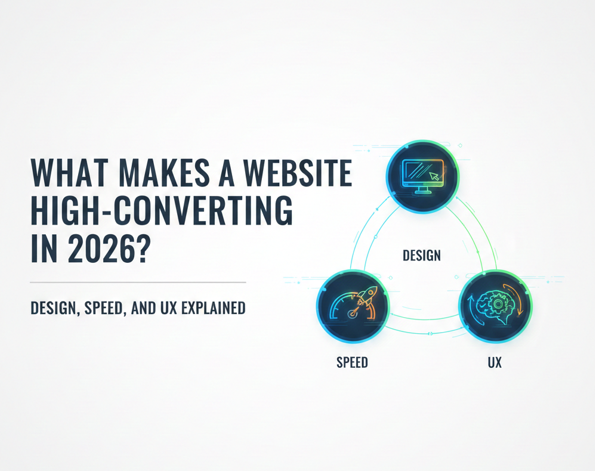
Here's something most agencies won't tell you upfront. A beautiful website means absolutely nothing if it doesn't convert visitors into customers. I've seen gorgeous sites with conversion rates below 1%, and I've seen simple, clean designs that convert at 8% or higher. The difference? Understanding that conversion is a carefully orchestrated symphony of design, performance, and user experience.
At ZTS Infotech Pvt. Ltd., we've cracked this code by combining human creativity with AI-powered insights. Our designers and developers don't work in isolation anymore. They collaborate with intelligent systems that analyze user behavior patterns, predict friction points, and suggest optimizations that a human might miss. This AI + HI (Human Intelligence) approach has transformed how we build websites that actually deliver results.
Think about it this way. Would you rather have a website that looks impressive in your portfolio or one that generates qualified leads while you sleep? I'm guessing you picked the second option.
Speed Isn't Just Important, It's Make-or-Break
Let's talk about something that keeps me up at night as a content strategist: website speed. Google's research shows that 53% of mobile users abandon sites that take longer than three seconds to load. Three seconds. That's barely enough time to take a breath.
But here's what gets really interesting. In 2026, users expect your site to load in under one second. Not three, not two, but one. Why? Because they've been conditioned by platforms like Instagram, TikTok, and modern web applications that deliver content instantaneously.
Your website speed affects everything. Search engine rankings, user satisfaction, bounce rates, and ultimately, your conversion rates. A one-second delay in page response can result in a 7% reduction in conversions. If your e-commerce site makes $100,000 per day, that one-second delay could potentially cost you $2.5 million in lost sales annually. Let that sink in.
Here's how we approach speed optimization. Our development team uses AI-assisted tools to identify performance bottlenecks before they become problems. These systems scan your codebase, analyze image compression ratios, evaluate server response times, and even predict how code changes will impact load speeds. Meanwhile, our human developers apply their expertise to implement solutions that make sense for your specific infrastructure.
The key performance metrics you need to watch are Core Web Vitals: Largest Contentful Paint (LCP), First Input Delay (FID), and Cumulative Layout Shift (CLS). If those sound technical, don't worry. The simple version is that your site needs to load fast, respond instantly to user actions, and maintain visual stability while loading.
Design That Converts Isn't About Being Pretty
I'm going to challenge a common misconception. Great design isn't about following the latest trends or creating something that wins awards. It's about guiding users toward taking the action you want them to take. Period.
Conversion-focused design in 2026 means understanding psychology, visual hierarchy, color theory, and behavioral patterns.
It means knowing that the placement of your call-to-action button matters more than its color (though color matters too). It means understanding that white space isn't wasted space but a strategic tool that directs attention.
Our design philosophy at ZTS Infotech starts with data, not aesthetics. We analyze heat maps, scroll depth, click patterns, and user session recordings. AI helps us process thousands of user interactions to identify patterns that inform design decisions. But here's the crucial part: human designers interpret this data through the lens of brand identity, market positioning, and business goals.
For example, AI might tell us that users spend more time on product pages with video content. Our human UI/UX designers then create video content strategies that align with your brand voice and product positioning. The technology provides insights, but creativity transforms those insights into compelling visual experiences.
Mobile-first design isn't optional anymore. With mobile traffic accounting for over 60% of web traffic, your site needs to deliver an exceptional experience on smaller screens. This means larger touch targets, simplified navigation, faster load times, and content that's easy to consume on the go.
User Experience: The Invisible Conversion Driver
User experience is where most websites fail spectacularly. They focus so much on looking good or loading fast that they forget to ask a fundamental question: Is this actually easy to use?
Great UX is invisible. Users shouldn't have to think about how to navigate your site, find information, or complete a purchase. Every friction point, every moment of confusion, every extra click is an opportunity for users to leave.
Consider your website's navigation. Can users find what they're looking for in three clicks or less? Is your search function actually helpful or does it return irrelevant results? Do your forms ask for only essential information or do you demand their life story before letting them proceed?
We've implemented AI-powered chatbots that don't feel robotic. They understand context, provide relevant answers, and escalate to human support when needed. This hybrid approach ensures users get help immediately while maintaining that human touch that builds trust.
Personalization has become a baseline expectation. Users want websites that remember their preferences, recommend relevant content, and adapt to their behavior. Machine learning algorithms analyze user patterns to deliver personalized experiences at scale, but human strategists ensure these personalized touches align with your brand values and marketing objectives.
Trust Signals That Actually Matter
Trust is currency in this age of data breaches and online scams. Your website needs to communicate credibility within seconds of a user landing on it. This goes beyond having an SSL certificate (though you absolutely need one).
Social proof works because humans are inherently social creatures. Testimonials, case studies, client logos, and real-time user activity create psychological safety. But they need to feel authentic.
Generic stock photos and fake reviews get spotted immediately and destroy credibility faster than having no social proof at all.
Clear privacy policies, transparent pricing, easy-to-find contact information, and professional design all contribute to perceived trustworthiness. Our team embeds these trust elements strategically throughout the user journey, not just buried in a footer somewhere.
The Technical Foundation Most People Ignore
Behind every high-converting website development is a solid technical infrastructure. Clean code, proper schema markup, optimized databases, and robust security aren't sexy topics, but they're absolutely critical.
Search engines have gotten incredibly sophisticated. They don't just look at your content anymore. They evaluate your site's technical health, mobile-friendliness, security protocols, and overall performance. A website built on shaky technical foundations will never achieve its conversion potential, no matter how beautiful it looks.
We leverage AI-assisted code review tools that catch bugs, security vulnerabilities, and performance issues before deployment. Our human developers then refine and optimize based on their experience and understanding of your specific business requirements. This collaborative process between artificial and human intelligence results in cleaner, more efficient code.
Content That Connects and Converts
Content remains king, but the kingdom has new rules. Users in 2026 skim more than they read. They watch videos, interact with infographics, and engage with dynamic content. Your written content needs to be scannable, valuable, and purposeful.
Every piece of content should serve a function. Either it educates, entertains, builds trust, or moves users closer to conversion. Fluff content that exists just to fill space actively hurts your conversion rates by diluting your message and wasting users' time.
Strategic content placement matters enormously. Your most compelling value proposition should be above the fold. Your strongest social proof should appear when users show signs of hesitation. Your call-to-action should feel like the natural next step, not a pushy sales pitch.
Why the AI + HI Approach Changes Everything
Here's what makes our approach at ZTS Infotech Pvt. Ltd. different. We don't view AI as a replacement for human creativity and expertise. We see it as an amplification tool that makes our designers and developers more effective.
AI handles the heavy lifting of data analysis, pattern recognition, and repetitive tasks. This frees our human team members to focus on strategy, creativity, and solving complex problems that require emotional intelligence and business acumen. The result? Projects that move faster, perform better, and deliver measurable ROI.
When you work with a team that understands both the art and science of conversion optimization, you get websites that don't just look professional but actually grow your business. That's not marketing speak, that's the difference between a cost center and a revenue generator.
If you're looking for a website design and development partner that combines cutting-edge AI capabilities with human creativity to build high-converting websites that actually drive business results, let's talk.
At ZTS Infotech, we don't just build websites, we engineer conversion machines that turn visitors into customers. Our collaborative approach between experienced designers, skilled developers, and intelligent systems delivers projects faster without compromising quality. Ready to transform your online presence into your best salesperson?
-

Writen by Anirban Das