USA:
USA:  India:
 .png)
Your US eCommerce Store Is Losing Sales in 2026 — and AI Is Probably Why
Okay, so I almost didn't write this.
Not for any dramatic reason. Just — I've seen too many versions of this exact article, and most of them are genuinely useless. Big stat about the e-commerce market. Three tips that could apply to literally any business in any decade. A CTA at the bottom. Everybody goes home, and nothing changes.
I don't want to do that to you.
So what I'm going to do instead is tell you what I've actually watched happen. Real stores, real problems, real results — and the specific thing that separates the ones that figured it out from the ones still scratching their heads at the same dashboard every Monday morning.
Some of it's going to be a little blunt. Fair warning.
Start here: the Colorado guy
Last October I had a phone call with someone who runs an outdoor gear store in Colorado. Nine years in business. Good products — and I mean genuinely good, not "we've spent a lot on branding so it feels premium" good. People actually love the stuff. Repeat customers, decent word of mouth, the whole thing.
He was frustrated in a way that I recognized immediately. Not panicking. Just... stuck.
Traffic was fine. His Meta numbers were holding. Email list was healthy and reasonably engaged. But his conversion rate had been sitting at 1.9% for a year and a half and he could not get it to move. He'd tried everything he knew to try — CRO consultant, two redesigns, rebuilt checkout, new product photography, homepage experiments. Nothing. Not 2.0%. Not 1.95%. Just — 1.9%, staring at him.
About forty minutes into the call I asked him one thing: what does your store show someone on their fourth visit who's never bought?
He went quiet for a second.
Then he said "...the same thing it shows everyone else, I guess."
Yeah. That's it. That's the whole problem — and I don't mean that as a knock on him specifically because this is basically every store. First-time visitor who found you through some random ad and a customer who's bought from you three times and pretty clearly has a preference — they get the same homepage. Same banner. Same products featured in the same order. The store doesn't know the difference and doesn't try to.
In a physical shop that would be absurd. Any salesperson worth anything reads those two people differently the second they walk in. Online it's just accepted as normal. And I think it's worth questioning why.
The Amazon thing nobody says out loud
Amazon spent fifteen years quietly resetting what online shopping is supposed to feel like.
When you're on Amazon the page knows you. Not in some sci-fi way — just practically. Checkout doesn't ask for your address again. Recommendations are at least in the general direction of your actual interests. Returns are painless. The whole experience has been rubbed smooth over years of obsessive optimization.
None of that feels impressive now because it's just what shopping online is. That's exactly the problem.
Because those same shoppers — all of them, every single one — carry those expectations into your store. And they won't tell you when something feels off. They won't leave a note. They'll just feel some vague friction, some sense that the page doesn't quite know why they're there, and they'll click away. Quietly. Quickly. Without a trace.
Baymard has been tracking cart abandonment for years and the number consistently sits around 70%. I've cited that stat before and it still kind of stops me every time I type it. Seven out of ten carts. Just — gone. Yes, some of that is window shopping and it always will be. But a real portion of it is fixable friction. And stores that have started catching people before they leave — using AI to read exit signals and step in with something useful right at that moment — are seeing recovery numbers move in ways that don't come from email sequences.
There's also the McKinsey research on personalization that gets passed around constantly. The short version: when personalization is done properly you can get 10 to 15 percent revenue lift from the same traffic. Not new customers. The people already showing up. On a $5 million store that's a very uncomfortable number to sit with for very long.
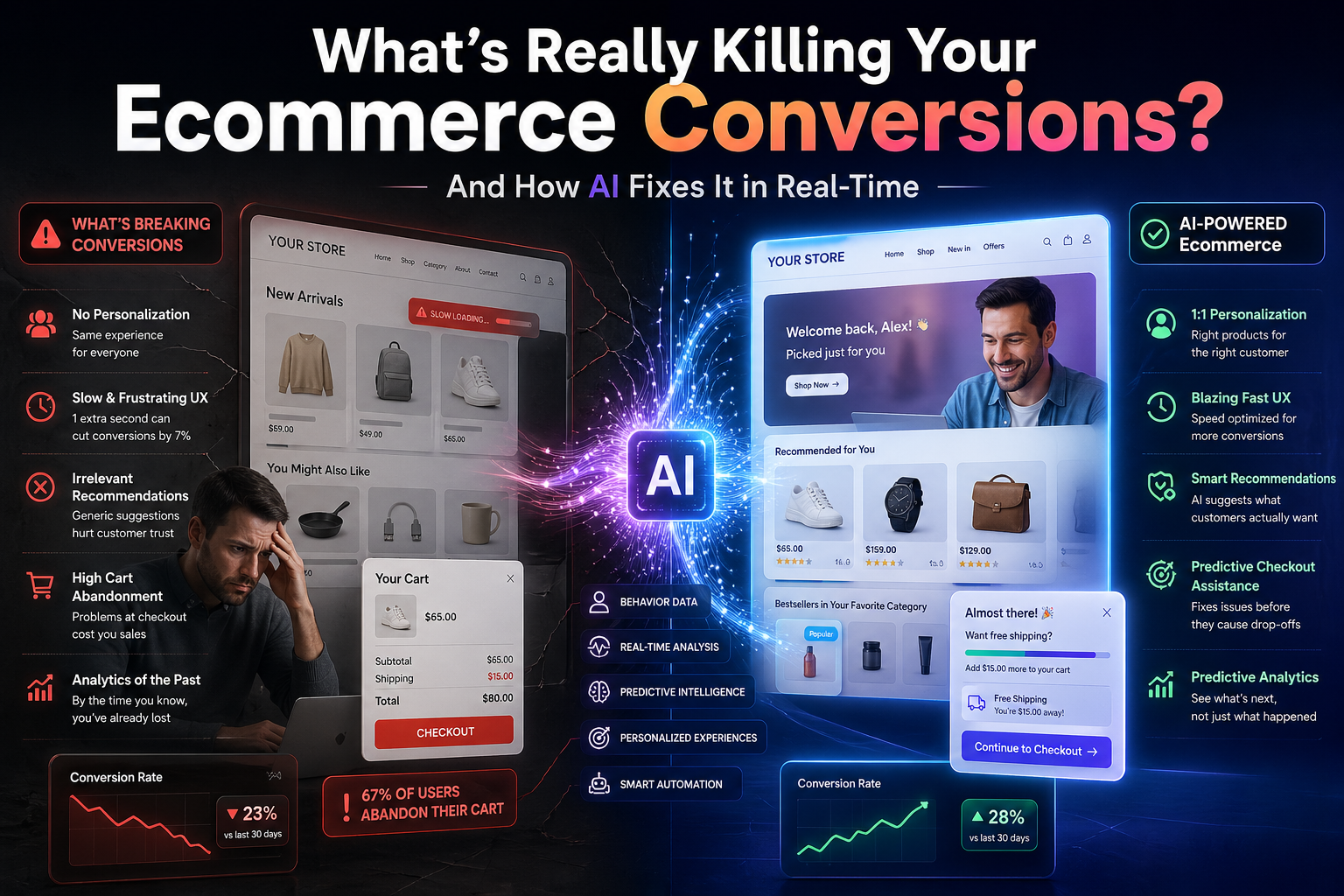
What's actually breaking conversion rates — five things
I'm just going to go through these. No fancy format.
1.The personalization gap is bigger than most stores realize
Picture this: two people hit your homepage at the exact same moment. One came from a Pinterest ad ten minutes ago and has never heard of you. The other bought from you in March, bought again in August, always gravitates to the same category, and came back today specifically because your new arrivals email landed well.
Same page for both of them.
I keep coming back to this example because there's no way to dress it up and make it not sound like a problem. A good salesperson in a physical store figures out those two people are completely different within sixty seconds of them walking in. They adjust. They point to different things. They read the room.
Online, most stores just — don't. They can't. Or haven't built the capacity. That's what AI ecommerce optimization services actually solve. Reading what someone clicked, hovered over, searched for, added and then quietly removed — and assembling something in real time that actually makes sense for who that person is. When this works properly the conversion lift doesn't feel like a small improvement. It feels like a different store.
2.UX debt is costing more than anyone's tracking
There's an Akamai figure I think about more than is probably healthy: one extra second of load time kills conversions by up to 7%. One second. Now honestly — when did your tech stack last get a real look? Not a "we updated a few things" look. A real one. Because plenty of stores are carrying infrastructure from 2020 or 2021 that's pulling three, four, five extra seconds every page load and nobody's watching it.
Load time is the simple part. The more complicated part is that browsing behavior has genuinely shifted and most stores haven't kept up. Sessions are shorter. People hop between devices mid-journey all the time — start on mobile, get retargeted two days later, finish on a laptop. The experience needs to work across all of that. For stores built a few years ago without that pattern in mind, it often just... doesn't.
AI-powered UX work handles this as an ongoing thing, not a project with a finish line. Watching real user behavior, finding where things get sticky, testing fixes, running it again. A redesign goes stale. A system that keeps learning doesn't have that problem.
3.Product recommendations — this is where I get a little exasperated
"Customers who bought this also bought" is a fifteen-year-old idea. It was smart in 2009. We are not in 2009.
And here's the thing that I don't think gets said enough: bad recommendations actively hurt you. It's not neutral. When someone sees suggestions that have no relationship to what they're actually looking at, something registers. Not consciously — they don't think "these suggestions are algorithmically poor." They just get this faint sense that the store doesn't get them. Stores that don't get their customers don't keep them.
What current AI recommendation engines are actually doing is a different category entirely. They're tracking hover behavior, what got added then removed, how long someone spent on a specific page, what they searched right before landing where they are — and they're weighing all of it against real inventory and margin priorities in real time. The effect on average order value and how often people come back isn't subtle once you see it working.
4.Cart abandonment emails are a mop, not a drain
Keep your recovery emails. They do something. But if the answer to "what's your abandonment strategy" is "we have a three-email sequence" — that's a cleanup operation, not a strategy.
The causes are almost always the same across different stores. Shipping cost that appears out of nowhere at checkout. A checkout flow with one unnecessary step too many. A payment method that's missing. Some moment of hesitation at the finish line with nothing there to address it in real time. These aren't mysteries. They're fixable. Get those fixed and your baseline abandonment rate drops before you've done anything clever.
Then you build in predictive AI that catches people before they actually leave — reading behavioral signals and doing something useful in that window. A shipping nudge. A simplified path option. The right message at exactly the right second. Stores that combine the structural fixes with that predictive layer are seeing abandonment improvements in the 15 to 28 percent range. Not because emails got better. Because the experience got smarter.
5.Analytics that describe the past are just a record
Standard dashboards are a history lesson. Traffic dipped Tuesday. Conversion was off last week. That product that crushed Q4 is losing momentum. Fine — useful to know — but by the time it's on your screen, you've already paid the cost.
Predictive analytics flips the question entirely. Not what happened but what's about to. Which customers are quietly showing early churn signals right now? Which SKU is trending toward stockout before your next reorder? Which campaign is starting to fatigue before it falls off a cliff? That's the information that changes a decision before it gets expensive. Everyone I know who's made this shift says the same thing — it's strange at first. You're trusting signals you haven't confirmed yet. But then you get used to it and going back to waiting for the rearview data starts to feel genuinely reckless.
What "AI website engineering" actually is — because the term is doing a lot of work right now
AI is stamped on everything. Every plugin, every platform, every tool update. The word is getting hollowed out.
A chatbot is not AI website engineering. Automated email sequences aren't. Even a Shopify app with some actual ML running somewhere under the hood isn't really what we're talking about here.
What we're actually talking about is how the store is built at a foundational level. How it decides what to show each specific visitor. How it surfaces and ranks products. How it reads behavioral signals and responds without a human in the loop for every decision. How it runs experiments and gets better over time. These aren't things you add to a store. They're decisions about the architecture of the whole thing.
That's why real investment in AI ecommerce website development USA isn't a feature-list decision — it's an infrastructure decision with a return that compounds. Systems get more accurate as they process more real traffic. Stores that built this eighteen months ago have been learning from real data for eighteen months. That lead doesn't close quickly. That's just how compounding works — not a threat, just a fact worth taking seriously.
Two real situations worth spelling out
A Texas-based home goods retailer. Good traffic, reasonable ad spend, solid products. Conversion stuck at 1.8% for nearly a year. They put in AI-driven personalization across category pages and added a predictive layer for sessions showing high exit intent. Three months later conversion was above 3%. Same traffic spend throughout. Revenue from existing visitors essentially doubled.
Then there's a DTC fashion brand in New York with a completely different kind of problem — returns were quietly eating the margin. Not dramatically. Just steadily, in that slow way that's easy to deprioritize until someone actually does the full math. They built AI-powered fit recommendations based on each individual customer's own purchase and return history — not a size guide, literally what that specific person had ordered and sent back over time. Returns dropped 18% in six months. Repeat purchases went up 22%.
Neither project meant starting from scratch. Neither meant dramatically increasing spend. Both meant knowing exactly where smarter systems needed to go and having people who knew how to build them correctly.
How to tell who actually builds versus who just demos beautifully
There's a lot of repackaged tooling being sold as custom AI development right now. The demos are usually pretty compelling. What you find in production six months later is often a very different story.
A real AI ecommerce development company in the USA asks you uncomfortable questions before they suggest anything. Not general ones — specific ones. What does your customer data actually look like right now? Clean? Gaps in identity resolution across sessions? What are the real constraints of your platform? Where does CCPA sit in your current data pipeline? And most importantly — what does winning actually look like in revenue terms and how will everyone agree when you've gotten there?
If those questions don't come up early, you're getting a deliverables list dressed up as a solution. The right partner measures their work the same way you measure yours. Conversion. Retention. Revenue per visitor. Not tasks completed.
On ZTS India — why they keep coming up in these conversations
ZTS India builds AI-powered eCommerce infrastructure for US brands — apparel, home goods, electronics, beauty, specialty retail, they've worked across all of it. They're not a platform reseller with a fresh coat of paint. They're an engineering team that builds around your specific stack, your actual data situation, your business model. Shopify, Magento, WooCommerce, custom builds — they've been in all of it.
Three things worth specifically flagging: they've worked through CCPA compliance for US customer data properly, they operate inside your existing tech stack rather than asking you to rebuild, and they measure what they do in revenue and retention numbers — not a feature delivery list. For brands that are seriously looking at AI ecommerce optimization services, that last part matters more in practice than it sounds on paper. If conversion doesn't move, nothing else they've shipped counts. That shapes everything about how they work.
If you're genuinely serious about AI ecommerce website development in the USA, they're worth an actual conversation, not just a demo.
How I want to end this
Stores winning right now didn't do something exotic. They moved earlier than their competitors. Their systems have been learning from real traffic for a year or two already and that advantage compounds whether or not the people behind it are paying close attention to it.
I'm not trying to manufacture urgency — I find that kind of writing annoying to read and probably annoying to write too. But I do think it's worth saying directly: AI ecommerce optimization isn't a someday category. The delay has a quiet cost and it accumulates in conversion data whether or not anyone's watching it carefully.
If it keeps getting bumped down the list — I'd genuinely ask what's actually sitting in the way.
See What AI Website Engineering Can Do for Your Store → ztsindia.com/service/ai-website-engineering-usa
FAQs
Traffic is healthy but conversion is flat. Why?
Two different problems. Flat conversion almost always means friction somewhere — pages that feel generic to everyone, surprise checkout costs, load time issues, suggestions that clearly don't know anything about the person looking at them. More traffic into that doesn't fix it. It just means more people encountering the same friction.
We already have product recommendations on the site.
What's powering them is the real question. Standard collaborative filtering is fifteen-year-old logic operating in 2026. Current AI reads hover behavior, search intent, add-remove patterns, session context — simultaneously. The order value difference is real and shows up clearly in the data.
We have abandonment recovery emails running.
Those respond to abandonment after it happens. They don't prevent it. Surprise shipping cost, extra checkout steps, last-second hesitation — those all happen before the cart is abandoned. Fix those first, then layer recovery on top.
How is this different from a better app?
Apps add a feature layer on top of a store that stays essentially static. This changes how the store is built — how it assembles pages, decides what to surface, responds to behavior in real time. One compounds over time as it learns. The other just sits there.
Does this mean a full rebuild?
No. Right implementation lives inside your existing platform. Smarter systems on top of what you already have — not instead of it.
When do results actually show up?
Meaningful conversion movement typically shows up around the three-month mark. The compounding effect builds longer than that as the systems get more accurate with more real traffic.
What should I look for in a partner?
Someone asking hard questions about your data and your platform before they say a word about their own product. If you get a feature deck before you get hard questions, that tells you what you need to know.
Final Thoughts
Amazon trained shoppers to expect a store that knows them. Most stores are still showing everyone the same static page and can't figure out why people leave.
Five areas — personalization, UX performance, recommendations, abandonment, analytics. Not future work. Present work. Every month they sit unaddressed, the stores that already addressed them get a little further ahead.
They didn't have some secret. They just decided earlier than everyone still thinking about it.
-

Writen by Anirban Das