USA:
USA:  India: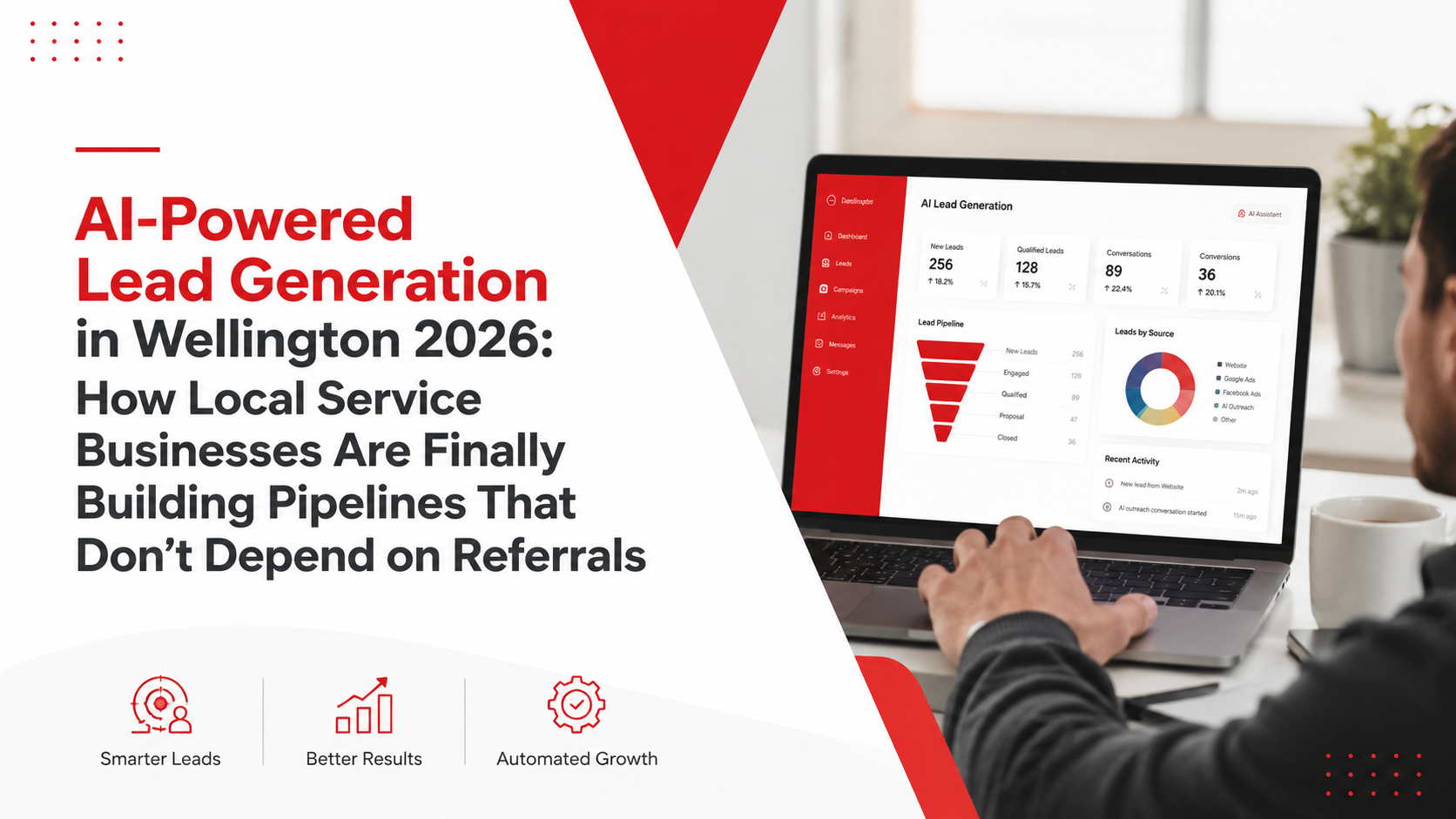
Wellington service businesses are increasingly turning to AI-powered lead generation in 2026 to move beyond the referral plateau that stalls most professional services growth. Using automated outreach, intent-based prospect identification, and machine learning-driven follow-up sequences, AI lead generation Wellington programs identify and engage in-market buyers before competitors do, at a fraction of what a traditional sales hire costs. McKinsey research found that companies applying AI to sales and marketing see revenue uplifts averaging 15–20% in year one. For a Wellington consultancy or services firm, that kind of lift changes what growth actually feels like.
What Does Wellington's Business Landscape Actually Look Like Heading Into 2026?
Bluntly, it's competitive in a way that's hard to explain to anyone who hasn't tried to sell professional services here.
Wellington isn't Auckland. The pool of decision-makers is smaller, everyone seems to know everyone, and reputation travels faster, in both directions. There's a real advantage to that if you've built strong relationships over the years. But there's also a ceiling, and most service businesses hit it somewhere between their third and fifth year. The referral tap doesn't dry up exactly, it just... plateaus. And at that point, traditional marketing advice, "just do more content," "attend more events," "get more active on LinkedIn", starts to feel pretty hollow.
The CBD itself, running from Lambton Quay up through The Terrace and into the Thorndon government precinct, is dense with procurement managers, legal decision-makers, IT leads, and consultancy heads who are, genuinely, hard to reach through conventional cold outreach. They've seen the email templates. They know the playbook. Getting cut-through there requires either a warm introduction or something a lot smarter than a mail-merged sequence.
Te Aro is a different energy, startups, creative agencies, tech companies that have grown out of the Creative HQ ecosystem, a bunch of mid-stage SaaS businesses doing interesting things. This part of Wellington has been running AI outreach tools for two or three years already, partly because founders running lean teams don't have the luxury of a dedicated BDM. They figured out early that AI systems can do the top-of-funnel work for a fraction of a human hire. That normalised the approach here faster than it might have in other markets.
Then you've got the wider region. Lower Hutt has a genuinely underappreciated B2B services market, manufacturing suppliers, engineering firms, and IT managed service providers, that doesn't often come up in Wellington marketing conversations but absolutely should. Porirua, Upper Hutt, the Kapiti Coast: these aren't secondary markets in the sense of being less valuable; they're just less obviously served by Wellington-focused agencies who tend to think no further north than Newtown.
Gartner's most recent B2B buyer research found that three-quarters of buyers now prefer to go through most of the research process before they ever speak to a sales rep. That's not a Wellington-specific stat, but it lands harder here because the decision-maker universe is smaller. If buyers are doing their own research first, you need to be findable and credible before the conversation starts, which is exactly what a well-run AI lead generation program helps you achieve.
Why Does AI Lead Generation Work Particularly Well for Wellington Professional Services?
It comes down to a fairly simple tension: Wellington's B2B market is built on relationships, but relationships don't scale.
A good referral network will carry a service business to a certain size. Beyond that, whether that threshold is $500K revenue, $1M, or $3M depends on the sector, and the people you know start running out. You've been introduced to most of the obvious prospects. The warm leads are getting thinner. You either build a system for generating new relationships at volume, or you accept that growth will be slow and lumpy.
What AI outreach does, specifically, is manufacture the top of that funnel. Not in a spammy way, the horror stories people tell about getting 40 irrelevant LinkedIn messages a week are almost always about poorly configured, low-craft implementations of these tools. Done properly, AI-driven outreach uses intent data (signals like companies hiring for roles that suggest buying intent, or businesses visiting competitor websites) to identify who's actually in-market, and then sends personalised, relevant, well-written outreach that doesn't feel like a blast.
HubSpot's 2025 State of Marketing data put some numbers around this: businesses using AI-assisted lead nurturing generated 50% more sales-qualified leads at a 33% lower cost than those running manual outreach. For a Wellington firm where the principal is still heavily involved in business development, that cost differential is the difference between prospecting eating your week or not.
There's also a precision argument that's particular to smaller markets. When your total addressable universe is, say, 1,500 relevant businesses across the Greater Wellington Region rather than 15,000, you can't afford untargeted outreach. Every irrelevant email or tone-deaf LinkedIn message burns a bit of reputation in a market where people talk. AI targeting systems, layered with good data sources, properly configured, are actually better suited to smaller, well-defined markets than large ones, because the targeting logic can be tighter.
How Does AI Outreach Actually Work And What Does It Look Like Day to Day?
Most people picture bulk email when they hear "AI lead generation." That's not what good AI-powered lead generation New Zealand programs look like, and the distinction matters.
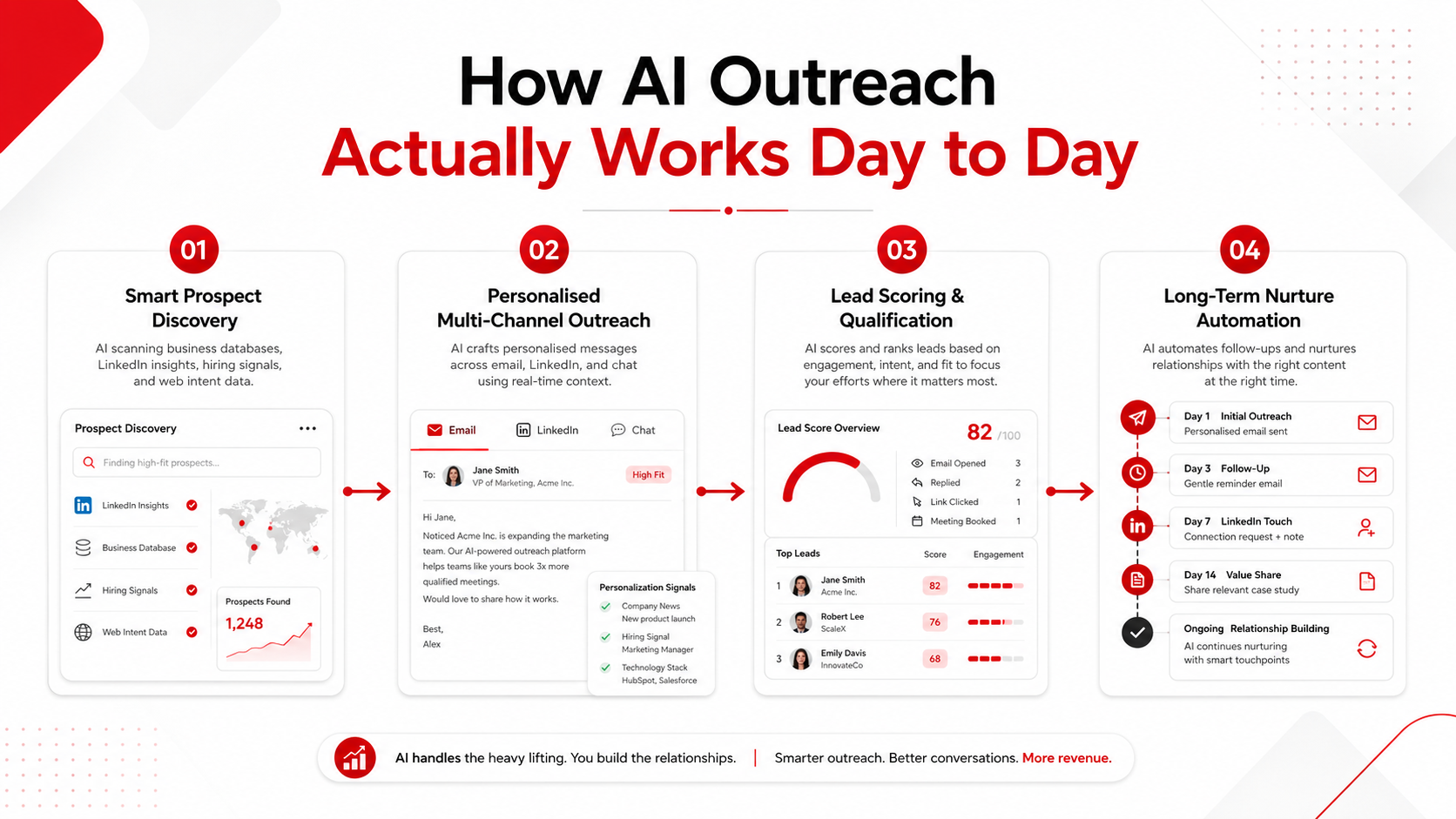
Here's roughly how it actually works, in plain terms.
Step one is finding the right people
AI tools pull from data sources, company databases, LinkedIn, web intent platforms, and job listing feeds to identify businesses and contacts that fit your ideal client profile. Not just industry and company size, but signals of active need. A Wellington law firm looking to attract corporate clients might target businesses that have recently hired a general counsel for the first time, or companies in a sector with recent regulatory changes. Those are people thinking about legal support right now, not just theoretically at some point.
Step two is personalised outreach across multiple channels
The outreach isn't generic. A well-configured system pulls in actual details about each prospect, recent news about their company, relevant industry shifts, specific context about their role, and uses that to write messages that feel like they came from a person who did their homework. The difference in response rate between that and a templated email is enormous.
Step three is scoring and handing off
As prospects engage, opening emails, clicking links, replying, and visiting your website, the system updates their priority score automatically. Your team doesn't need to guess who's worth calling; the system flags it. You spend time talking to people who've already shown interest rather than cold-calling from a spreadsheet.
Step four is the long game
Not every prospect is ready to buy in week one. Good AI lead generation services include nurture sequences that keep you visible to prospects over months, adjusting timing and content based on their behaviour, so that when they do enter a buying phase, you're already on their radar.
What this means practically for a Wellington business owner: you set it up, you review the qualified leads that come through, and you take the calls. The system handles the work in between.
What Does It Actually Cost, and Is It Worth It for a Wellington Business?
Let's be honest: pricing in this space is all over the place, and a fair chunk of what's being sold as "AI lead generation" is just bulk email with a fancier dashboard.
The DIY route, building your own stack using something like Apollo or Clay for prospect data, a dedicated email sending platform, and a LinkedIn outreach tool, will run you roughly NZD $500 to $1,200 a month just in software. Sounds manageable. The problem most Wellington business owners run into is that the configuration isn't simple. Deliverability alone — making sure your emails actually land in inboxes rather than spam folders — is a genuine technical discipline that takes months to learn properly. You also need to stay within LinkedIn's usage limits, which shift constantly. So yes, it's cheaper on paper. But the time cost is real, and if it's the owner doing it, that's time not spent on client work.
Going managed, handing the whole thing to a specialist team who handles strategy, data sourcing, copy, technical infrastructure, and ongoing tuning typically costs NZD $2,000 to $6,000 a month in this market. Compared to what a proper BDM costs (salary, KiwiSaver, annual leave, the inevitable sick days, the months it takes them to ramp up), that's often not the more expensive option. And Statista's 2025 marketing technology report noted that outsourced AI lead generation programs reached pipeline activity 30% faster than equivalent in-house setups, largely because the specialist teams weren't spending weeks debugging deliverability from scratch.
One thing people often miss when they're weighing this up: search engine marketing services and organic social media marketing aren't competitors to AI outbound, they're running a completely different race on a different timeline. Outbound generates conversations now, this month, next month. SEO and content generate conversations in a year and a half, but they compound in ways that outbound doesn't. The Wellington firms doing this well aren't choosing between them. They're funding the long-term with the short-term results.
Simple maths worth doing before you decide anything: if your average client engagement is worth NZD $15,000 to $40,000 annually, which is fairly conservative for most Wellington professional services firms, landing two or three additional clients a quarter through AI outreach makes the program cost look pretty different.
How Do You Pick an Agency That Actually Knows What They're Doing?
This is where things get murky, because "AI lead generation agency" is now a label anyone can put on their website.
A few things are worth actually testing before you commit to anyone. Ask them to walk you through exactly how they'd build a target list for your specific business, not in concept, in practice. What data sources? How do they layer in intent signals? What does the raw prospect list look like before outreach starts? If the answer is vague or pivots quickly to talking about their process deck, that's useful information.
Wellington references matter more than you'd think. Results from a Brisbane SaaS company or a London fintech don't tell you much about how an agency will perform in a market where your prospect opened the same morning newspaper as your competition, and probably knows your competitors socially. Ask specifically whether they've run programs for New Zealand professional services firms. Ask what's different about the local market and see what they say. Someone who's actually worked here will have a real answer.
CRM handoff is another thing that's worth getting specific about before you sign anything. A pipeline of interested prospects that lives entirely inside the outreach platform and doesn't flow cleanly into how your team actually works is a problem waiting to happen. Ask how the handoff works, concretely, and who's responsible for it when something breaks.
The bigger question is whether the agency is thinking about your acquisition ecosystem as a whole or just pitching outbound in isolation. Global AI digital marketing solutions need to be adapted to the local context, not just repackaged and relabelled. Your positioning, your existing content, what you're already ranking for, what your competitors are doing in Wellington, all of that should factor into how the outreach strategy is built.
Zebra Techies Solution builds outreach programs for Wellington and wider New Zealand service businesses from the ground up. Not a global template with the city name changed. If you want to understand specifically what that looks like for your sector and situation, the conversation is worth having.
Before You Decide - One Honest Take
Most service businesses that run primarily on referrals are in that position because they're good at what they do. Clients refer because they trust you. That's real, and it's nothing.
But referral pipelines have a fundamental structural problem: you're not in control of when they deliver. A great quarter of referrals might follow a slow patch that had nothing to do with your performance; it was just timing, who happened to be talking to whom, which client had a relevant conversation at the right moment. That unpredictability is manageable when you're small. It becomes genuinely stressful when you're trying to plan hiring, investment, or capacity.
AI outbound doesn't fix your referral problem. It runs alongside it, filling in the gaps, reaching prospects that your network wouldn't reach on its own, and doing it on a schedule you set, not one that depends on whether your best client happened to mention you last week.
First proper conversations from a well-run Wellington outbound program usually start appearing around weeks five or six. By the end of the first full quarter, most firms are looking at something that feels, sometimes for the first time, like a pipeline they can actually forecast from.
Book a Wellington Strategy Session →
Bring your current pipeline numbers, a rough sense of your target client profile, and any outreach you've already tried. We'll work through what a realistic program looks like for your business, specifically, not a pitch, but a working session.
Frequently Asked Questions
Is AI lead generation just automated email blasting with a nicer name?
The bad implementations, honestly? Sometimes yes. The good ones look completely different, tight prospect targeting using intent signals, outreach messages that reference actual context about the recipient's business, multi-channel sequences that adapt based on how the prospect behaves. Whether you get the former or the latter is mostly a function of who's doing it and how much craft they're applying to the copy and targeting logic.
What's a realistic monthly budget for a Wellington business?
Anywhere from NZD $500 to $1,200 if you're building and running a DIY tool stack, and that's before accounting for the time it takes to manage it. Managed agency programs run NZD $2,000 to $6,000, depending on scope. For a services firm where clients are worth NZD $10,000-plus, the maths on managed services tends to work once you're generating a few additional engagements a quarter.
How quickly should we expect to see leads?
First meaningful activity, replies, meeting requests, and target accounts poking around your website usually show up within four to six weeks. A genuinely consistent pipeline takes closer to a full quarter to develop, partly because the early weeks involve calibrating the targeting and refining the copy based on what's resonating. Don't walk away at week three.
We get most of our work through referrals. Is this even relevant for us?
Probably yes, depending on whether you're happy with the growth rate. Referrals don't scale predictably; they tend to deliver in waves, and the waves aren't always timed to when you need the work. AI outbound runs in the background, steadily, reaching people your referral network doesn't cover. Most firms treat it as insurance against the slow quarters.
Can you get specific with targeting, like Lower Hutt engineering firms, or Kapiti-based accountants?
Very specific, yes. You can filter by location down to the suburb level, by industry, company size, seniority, and increasingly by live intent signals, companies hiring for relevant roles, businesses that have recently visited competitor sites, and sectors experiencing regulatory change. In a small market like Wellington's, that precision is worth a lot.
Why not just hire a business development manager instead?
A BDM is genuinely valuable once you have qualified conversations to manage. The problem is that most of their time gets consumed by prospecting, finding who to call, doing the initial outreach, and following up. That's exactly what AI outreach handles. So the smarter framing is usually: AI handles top-of-funnel volume, your BDM (or you) handles the actual relationships. The two work much better together than either does alone.
Outreach in a small market like Wellington makes me nervous about brand reputation. Should it?
That's a fair concern. The reputation risk in mass outreach is real; everyone does know everyone here, and a badly calibrated campaign that's blasting irrelevant messages at the wrong people will get noticed. The answer is conservative volume, tight targeting, and genuinely well-written messages that feel relevant. Any agency worth talking to should be able to explain specifically how they manage that risk rather than dismissing it.
Does any of this apply to businesses that sell into Wellington's government sector?
It applies differently. Government procurement typically runs on longer cycles with panel agreements, so the aim of outreach isn't to book a meeting tomorrow; it's to become visible and credible with the right contacts well ahead of when a contract or panel opens. Intent signals for this context include budget cycle timing, personnel changes in relevant roles, and contract renewal patterns on public tender databases. It's slower, but the deal sizes usually justify the patience.
Sources: McKinsey & Company — AI in Sales and Marketing (2024); Gartner B2B Buyer Survey (2025); HubSpot State of Marketing Report (2025); Statista Global Marketing Technology Report (2025).
-

Writen by Anirban Das