USA:
USA:  India:
 Look at how a typical local agency operates versus a scaled offshore team. A local Dubai firm carries immense structural baggage. They have to cover massive monthly overheads, which means their entry-level retainers are incredibly high. The result? A huge chunk of your budget goes toward funding their lifestyle costs rather than actual engineering hours on your project.
Indian agencies live in an entirely different operational world. In India's tech hubs, scaling a development team from three engineers to twenty doesn’t take a quarter—it takes a couple of weeks. There is a reason why global enterprise firms rely on these specific tech corridors. The volume of specialized talent is staggering.
With a local team, you usually get one or two generalist full-stack developers trying to build your UI, configure your databases, and manage your security. It’s simply too much heavy lifting for a tiny team. An offshore partner, though, can assign a niche specialist to every single layer of your platform. It’s not a question of who is more capable anymore; it’s about how much of your capital is actually hitting the screen as working software.
Why Are Business Bay’s Tamani Arts Tower Businesses Choosing Offshore Web Design?
If you walk through Tamani Arts Tower or Park Place today, you’ll hear the same frustration repeated across real estate firms, legal consultancies, healthcare startups, and fintech operators: local web development pricing has drifted far beyond what most scaling businesses can justify.
And the timing could not be worse.
Dubai’s commercial market is moving faster than most agency structures can realistically support. According to the Dubai Chamber of Digital Economy, the UAE added more than 20,000 new digital-first businesses and startups over the past few years as the government accelerated its digital economy strategy. That created enormous pressure on local agencies, especially in Business Bay and DIFC, where demand for AI-enabled development exploded almost overnight.
The result? Longer project queues, higher retainers, and increasingly rigid contracts.
Most founders don’t realize how expensive that becomes until they are already trapped inside a project cycle. A local agency retainer can quietly consume the same budget that should have funded launch campaigns, paid acquisition, SEO infrastructure, or AI automation.
I recently spoke with a consultancy owner inside Tamani Arts Tower who received a proposal for a fairly standard corporate platform with API integrations and multilingual functionality. The quote alone nearly matched their quarterly operational runway.
That’s where many Dubai businesses changed direction.
Instead of treating offshore development as “cheap outsourcing,” they started treating it as operational leverage. By partnering with a structured offshore engineering team, the company didn’t just reduce costs. They deployed faster, received live sprint updates, and gained direct access to dedicated developers instead of filtered account managers.
McKinsey’s latest GCC AI analysis found that 84% of organizations across the Gulf are already using AI in at least one business function, while UAE companies remain among the region’s fastest adopters of AI-enabled customer experiences and digital workflows. BCG also reported that the GCC now ranks second globally for workplace AI adoption, reflecting how aggressively businesses across Dubai, DIFC, JLT, and Business Bay are pushing toward automation-led growth. The pressure to launch faster is no longer just operational. It is directly tied to competitiveness, investor expectations, and customer retention.
And honestly, local agency timelines often can’t keep pace with that pressure anymore.
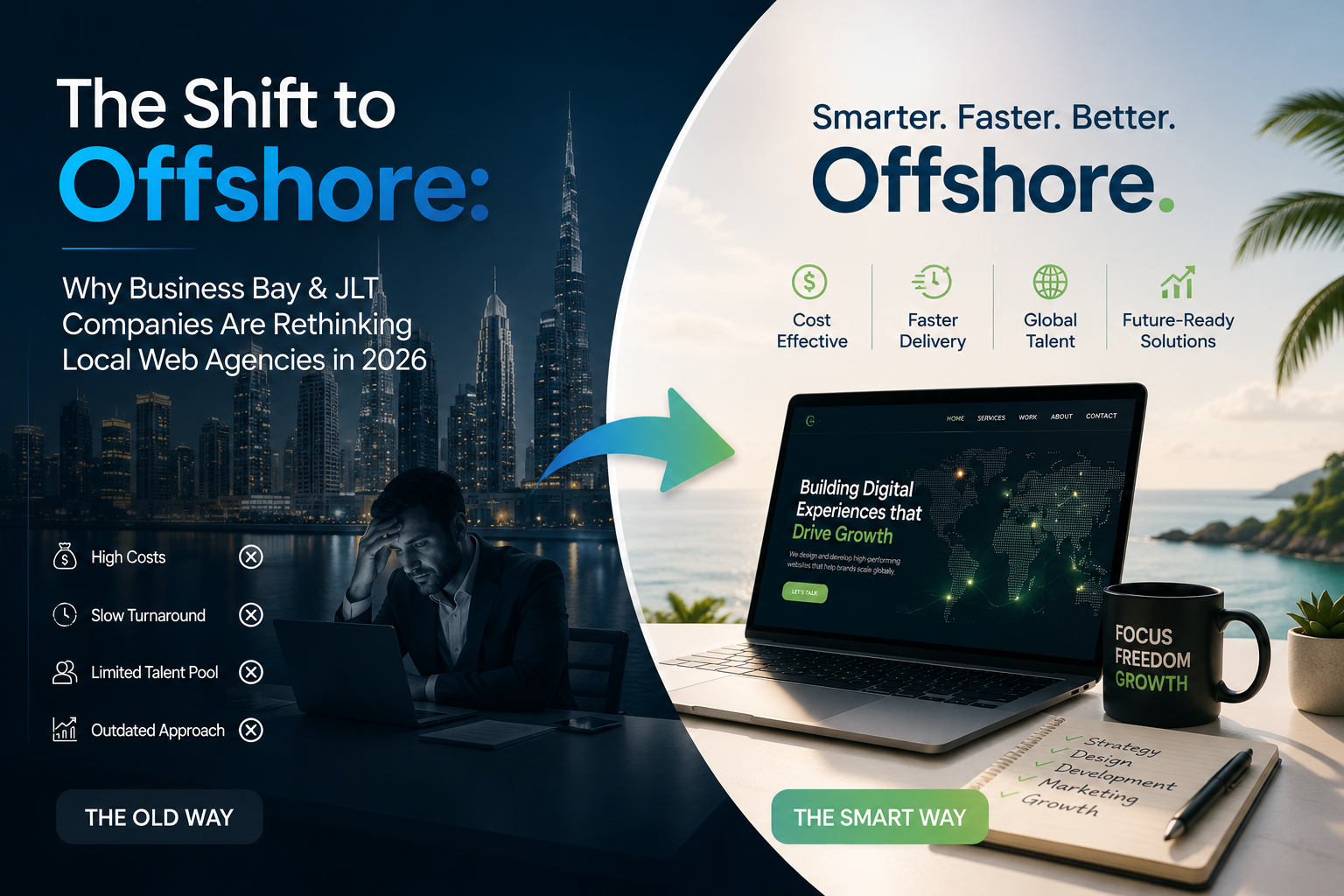
JLT’s XL Tower & Mazaya Centre: When Local Agencies Can’t Match Offshore Value
For ecommerce brands operating from JLT’s XL Tower or Mazaya Centre, margins are tighter than most people outside the startup ecosystem realize.
You are paying premium Dubai rents.
Premium customer acquisition costs.
Premium staffing costs.
At the same time, customers expect flawless mobile UX, fast checkouts, Arabic support, AI-powered personalization, and same-day service experiences.
Your website is no longer a static brand asset. It’s an operational growth engine.
According to Statista, UAE ecommerce revenue is projected to surpass USD 9 billion in the coming years, with mobile commerce driving a major share of consumer activity. That growth pressure is forcing startups to iterate constantly instead of relying on one-time website launches.
And that changes how development partnerships are evaluated.
| The Local Retainer Model | The Offshore Partner Model |
| High fixed monthly retainers regardless of delivery | Agile sprint-based scaling |
| Smaller generalized teams | Access to specialized engineering talent |
| Slow onboarding when scaling projects | Rapid deployment of additional developers |
| Significant cost tied to office overhead | Budget focused directly on technical execution |
| Monthly update cycles | Continuous deployment and weekly iteration |
The reality is simple.
Most JLT businesses no longer care whether developers sit in Dubai, Bengaluru, or Hyderabad. They care about responsiveness, technical depth, AI capability, and execution speed.
Especially in e-commerce website development and UAE startup projects, where delays directly affect revenue.
Gartner recently reported that IT spending across the MENA region is projected to surpass $230 billion in 2025, with software spending alone growing nearly 14% as businesses accelerate investment in generative AI, automation, and AI-enabled customer experiences. Gartner also noted that AI-related infrastructure demand in the Middle East is rising so aggressively that data-center system investments are expected to grow by more than 37% across the region. That surge is creating a major capability gap. Smaller Dubai agencies often struggle to maintain specialized AI engineers, cloud architects, and machine-learning talent internally without dramatically increasing retainers or slowing delivery timelines.
That’s why offshore engineering partnerships started becoming commercially attractive rather than purely cost-driven.
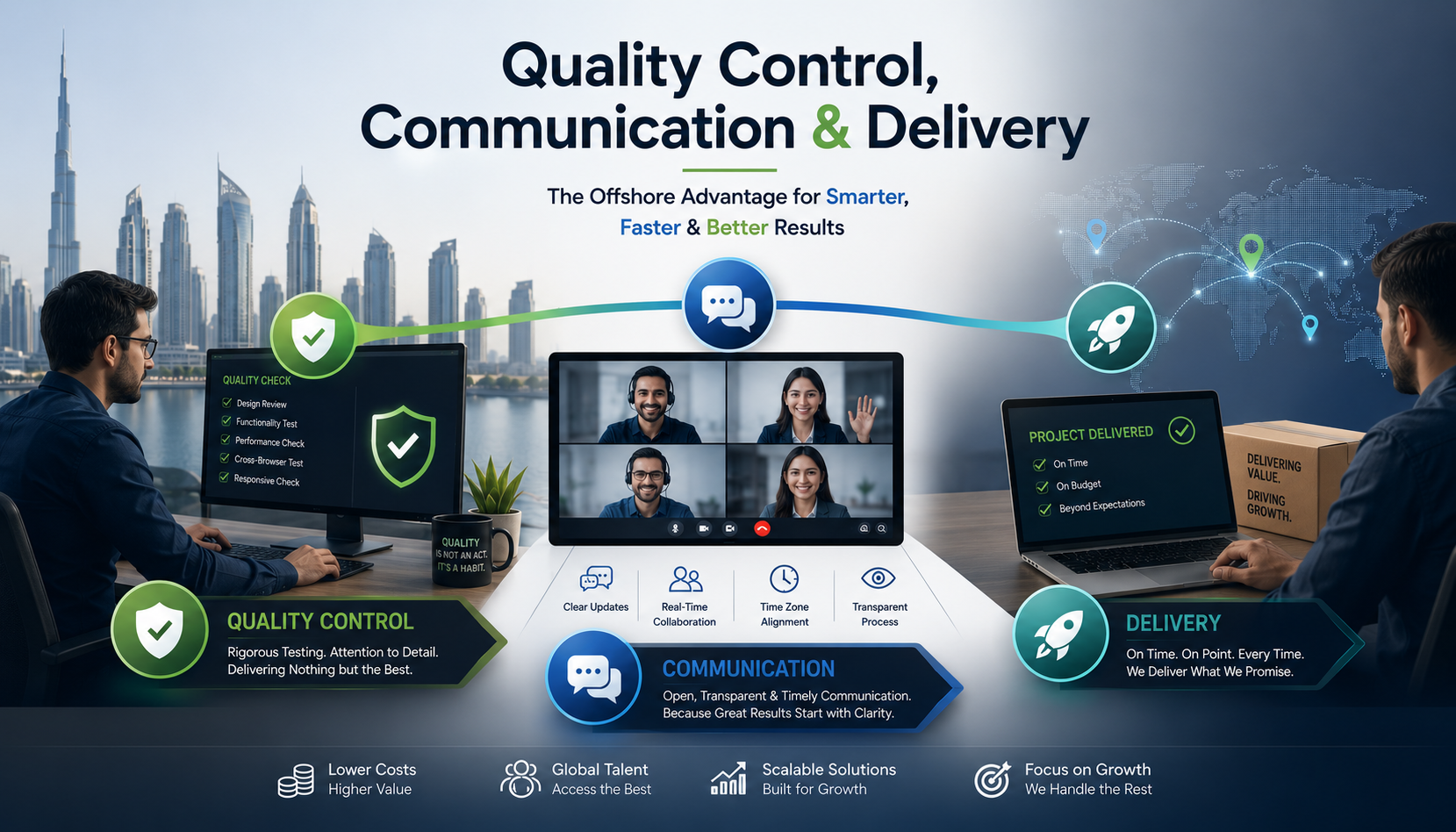
Quality Control, Communication & Delivery: Myths vs Reality
There’s still an outdated perception in parts of Dubai’s business community that offshore development automatically means communication issues, missed deadlines, or poor-quality code.
In 2026, that assumption feels increasingly disconnected from reality.
Modern development infrastructure has changed the equation completely. Git-based version control, automated QA testing, sprint dashboards, real-time collaboration tools, and cloud deployment pipelines make development visibility far more transparent than it was even five years ago.
The real risk was never geography.
It was poor process management.
A structured offshore engineering company now operates with clearer workflows than many overloaded local agencies juggling dozens of Business Bay and Downtown Dubai accounts simultaneously.
And most founders eventually notice the difference.
McKinsey’s latest GCC AI analysis found that 84% of organizations across the Gulf are already using AI in at least one business function, while UAE companies remain among the region’s fastest adopters of AI-enabled customer experiences and digital workflows. BCG also reported that the GCC now ranks second globally for workplace AI adoption, reflecting how aggressively businesses across Dubai, DIFC, JLT, and Business Bay are pushing toward automation-led growth. The pressure to launch faster is no longer just operational. It is directly tied to competitiveness, investor expectations, and customer retention.
A premium offshore team aligns directly with Dubai working hours, maintains dedicated communication channels, and often provides faster implementation turnaround than agencies burdened by internal bureaucracy.
If projects fail today, it is usually because:
- Scope definitions were unclear
- Internal stakeholders kept shifting priorities
- Technical leadership was weak
- Delivery management broke down
Not because the engineering team happened to be outside Dubai Silicon Oasis.
Once systems, communication protocols, and sprint structures are set up properly, the physical distance becomes almost irrelevant.
Why Is AI Website Engineering for Dubai Businesses No Longer Limited to Local Teams?
The biggest misconception in Dubai’s digital market is that advanced AI capability still depends on local hiring.
It doesn’t.
The AI website engineering Dubai companies now require involves data pipelines, predictive workflows, AI search functionality, intelligent automation systems, recommendation engines, and multilingual machine-learning-supported customer experiences.
That level of engineering requires scale.
According to the UAE National Artificial Intelligence Strategy 2031, the country aims to position itself among the world’s leading AI economies, with billions being invested into digital infrastructure and AI ecosystem development. The demand for AI-enabled web systems is growing much faster than the local technical hiring market can realistically supply.
That’s especially visible across:
- DIFC fintech startups
- JAFZA logistics firms
- Real estate portals
- Healthcare appointment systems
- Ecommerce brands scaling regionally
A generic WordPress build simply cannot support the type of intelligent customer journeys many UAE businesses now need.
And honestly, most founders realize this after their second rebuild.
This is why offshore AI web development UAE partnerships have become increasingly normalized. Businesses are looking for scalable engineering ecosystems capable of supporting continuous innovation instead of isolated design projects.
That naturally led many companies toward firms like ZTS Infotech.
Not because offshore is “cheaper.”
Because scalable engineering capacity matters more than geography now.
What Do Dubai Businesses Actually Get When They Switch to ZTS Infotech?
Businesses moving toward ZTS Infotech Pvt Ltd are usually looking for scalability, continuity, and technical execution speed rather than flashy agency branding.
The offshore conversation matured significantly in the UAE over the last few years.
Companies are no longer impressed by expensive office spaces in Downtown Dubai or oversized account-management teams. They want engineering output, AI readiness, continuous deployment capability, and long-term scalability.
That’s where firms like ZTS Infotech started gaining traction.
Instead of operating like a traditional design agency, the model focuses on dedicated engineering structures built around ongoing delivery. Businesses gain direct access to developers, UI/UX specialists, AI integration support, QA systems, and sprint-based workflows without carrying the financial burden of premium Dubai retainers.
For UAE businesses, another major advantage is regional familiarity.
Teams handling Middle Eastern projects now routinely work with:
- Arabic right-to-left UX systems
- Checkout.com integrations
- UAE payment gateways
- Multilingual SEO architecture
- Regional compliance requirements
- AI chatbot implementation
- Ecommerce automation workflows
That operational familiarity removes one of the biggest concerns Dubai businesses used to have about offshore partnerships.
The relationship starts feeling less like outsourcing and more like extending your internal technical department.
How to Transition From a Local Dubai Agency to an India-Based Team
Moving away from a local Dubai agency sounds complicated on paper, but most successful transitions happen quietly and systematically.
The companies that handle it best avoid emotional vendor disputes and focus entirely on operational continuity.
Start by securing complete ownership access first:
- Hosting accounts
- Source-code repositories
- Domain registrars
- Analytics platforms
- CRM systems
- API credentials
- Cloud infrastructure
Many businesses discover surprisingly late that their agency still controls critical infrastructure access.
After that, the smartest approach is usually a short transition overlap period.
A two-week shadow phase works particularly well for Dubai businesses. The offshore engineering team audits the current system, documents vulnerabilities, reviews architecture, and builds a staging environment while the old contract phases out naturally.
Then comes the important shift.
Move away from vague monthly “support retainers” and transition toward milestone-based sprint delivery. Businesses gain much better visibility into engineering output that way.
And honestly, it creates healthier accountability on both sides.
Finally, establish fixed communication structures immediately:
- Dedicated Slack or Teams channels
- Scheduled Dubai-hour check-ins
- Defined escalation processes
- Weekly sprint reporting
- Shared QA visibility
Once those systems are in place, the operational distance between Dubai and offshore teams becomes surprisingly small.
Frequently Asked Questions
Are Indian web design agencies good for Business Bay businesses?
Absolutely. For Business Bay companies that need to launch fast and scale their digital platforms without burning capital, Indian agencies provide a level of technical depth and speed that local firms can't match at the same price point. The minimal time difference makes real-time collaboration seamless.
How do I switch from a UAE agency to an Indian web design agency?
It’s all about asset control. Secure your source code repositories and hosting passwords first. Then, have the new Indian agency perform a comprehensive technical audit of your platform before you officially terminate your local contract.
What do JLT businesses get from outsourcing web design to India?
They get a massive competitive advantage. Instead of overpaying for local overhead, JLT e-commerce and retail startups can divert their capital into marketing while leveraging specialized AI and database engineers offshore.
Is ZTS Infotech reliable for Dubai businesses?
Yes. ZTS Infotech bridges the gap by offering the cost efficiencies of offshore development combined with strict project governance and a deep understanding of the UAE market requirements.
Want to fix your digital development strategy? Talk to a development strategist at ZTS Infotech PVT Ltd and get a realistic roadmap for your next project.
-

Writen by Anirban Das