USA:
USA:  India: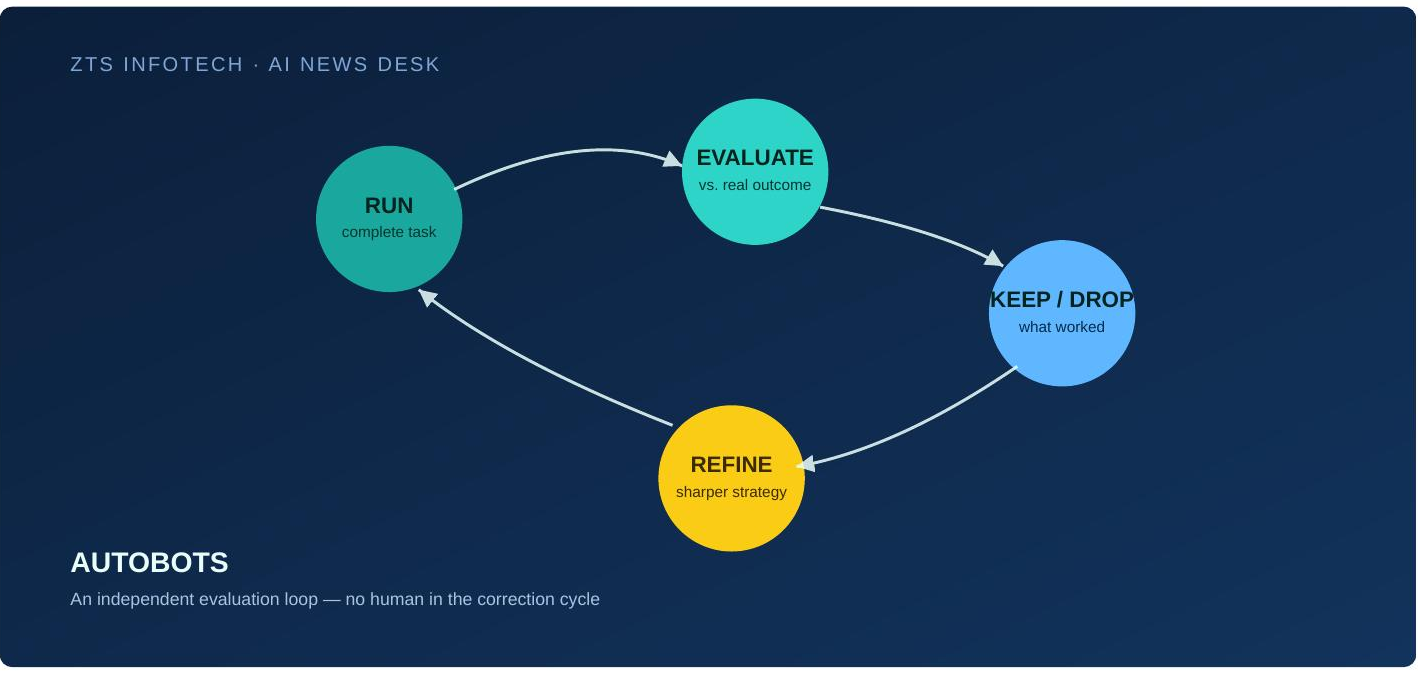
Autobots run on an independent evaluation loop that measures outcomes and refines strategy without human correction. (Illustration: ZTS Infotech)
Ask most AI tools the same question two days in a row and something strange happens: nothing. No memory of yesterday’s mistake, no adjustment, no improvement. The tool performs on day 100 exactly as it did on day one, because whatever it learned during the last session evaporated the moment that session closed.
Abacus AI is betting that flaw has an expiration date. The company has released Autobots, a class of AI agents built around what it calls an independent evaluation loop, a mechanism that lets an agent measure its own output against real-world outcomes, keep what worked, and discard what did not. Run after run, without a human sitting there correcting it, the strategy sharpens itself.
ZTS Infotech, the digital marketing and technology firm behind the AI News Update series presented by Anirban Das, says it is now testing that pattern for client-facing internal tools. For business leaders evaluating where to place their next AI investment, the distinction Autobots is built around, a tool that merely completes tasks versus one that gets measurably better at completing them, is worth understanding before the next vendor pitch lands on the desk.
The Flaw Baked Into Most AI Tools
Static performance is the default state of most AI deployments today, not a limitation anyone chose deliberately. A model answers a prompt, the session ends, and whatever context existed disappears with it. The next interaction starts from the same baseline as the first. That is fine for one-off tasks. It is a real liability for anything an organization expects to run repeatedly, where the same blind spots resurface indefinitely because nothing in the system is built to notice them.
What Makes an Autobot Different
According to Das, the difference is not the underlying model, it is the loop wrapped around it. An Autobot does not stop at task completion. It evaluates its own performance against real outcomes, retains the approach that produced a good result, and drops the one that did not. That evaluation cycle runs independently, without a person reviewing each output and manually feeding back corrections. The agent’s strategy is, in Abacus AI’s framing, self-refining by design.
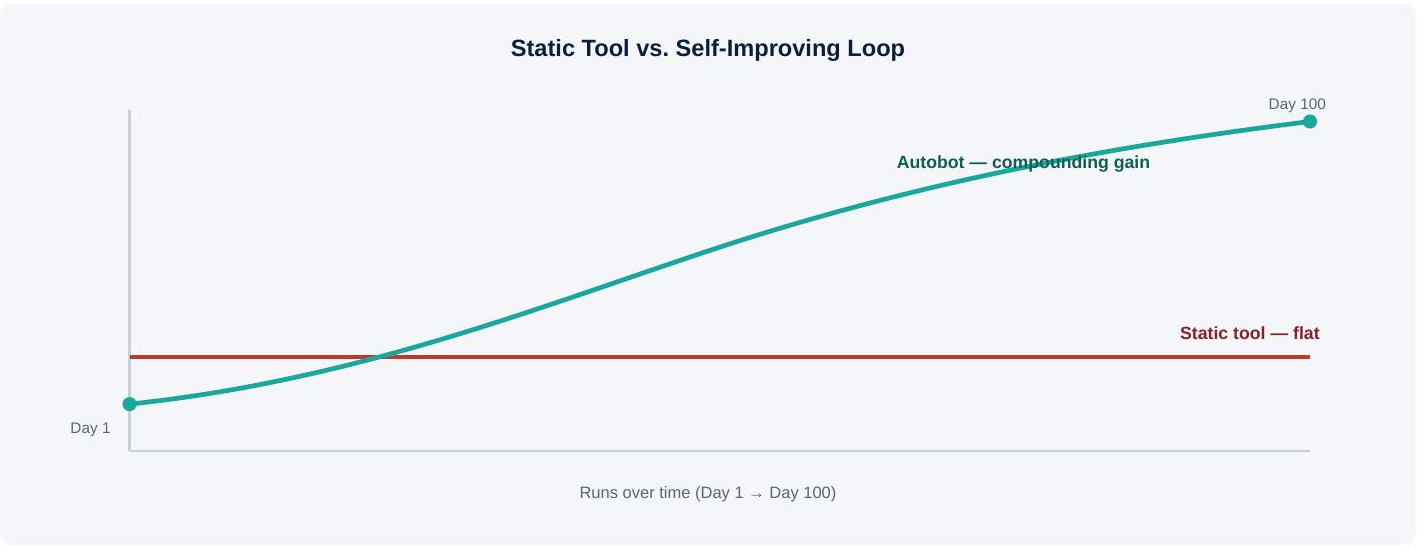
A static tool’s output stays flat over time. An Autobot’s evaluation loop compounds gains run over run.
Three Autobots, Three Real Jobs
Das grounded the concept in three specific deployments rather than leaving it abstract.
The Bug-Fixing Agent
A bug-fixing Autobot gets better at spotting bugs the more it runs, building on which fixes actually resolved an issue and which did not. Instead of applying the same fixed logic to every ticket, its detection strategy shifts based on what has proven correct in practice.
The Sales Lead-Scoring Agent
A sales-focused Autobot builds what Das called a persistent playbook, refined against real closed deals rather than a static scoring rubric set once and left untouched. As more deals close or fall through, the scoring model adjusts to reflect what actually predicted a win.
The YouTube Growth Agent
A third Autobot applies the same loop to content strategy, adjusting thumbnail choices based on actual watch-time data rather than best-practice assumptions. The feedback signal is real audience behavior, not a rule of thumb from a marketing playbook.
A static model performs the same on day 100 as day one. A self-improving loop is measurably sharper — the whole time.
— Anirban Das, ZTS Infotech AI News Desk
Why the Gap Compounds
The comparison Das draws is a simple one, and it is the part business leaders should sit with the longest. A static model performs the same on day 100 as it did on day one. A self-improving loop does not, because it is learning from its own failures continuously, without anyone managing the process. Over a long enough timeline, that gap between the two is not a marginal difference in output quality. It compounds.
Expert Perspective: Why This Matters Beyond One Product
Autonomous evaluation loops are not a brand-new concept in AI research, but packaging one into a deployable agent product, rather than a research paper, changes who can access it. Most organizations do not have a team dedicated to continuously auditing an AI tool’s output and feeding corrections back into it. An agent that performs that audit on itself removes the single biggest reason self-improvement has stayed theoretical for most businesses: nobody had the headcount to manage it.
The caveat worth naming is that self-improvement is only as good as the outcome signal it is measured against. A lead-scoring loop is only as reliable as the deal data feeding it, and a thumbnail-testing loop is only as reliable as the watch-time metric it optimizes for. Leaders adopting agents like this should ask what the evaluation loop is actually being scored on before trusting the trend line, not just whether a self-improvement loop exists.
ZTS Infotech’s decision to pilot the pattern internally before extending it to client tools is a sensible sequencing. A loop that quietly reinforces the wrong signal is a slower, harder problem to catch than a static tool that simply underperforms, and testing it on internal workflows first is the more cautious path.
Key Takeaways
- Abacus AI has released Autobots, AI agents built around an independent evaluation loop that measures their own performance against real outcomes.
- Unlike static AI tools, Autobots retain strategies that work and discard ones that do not, without human correction between runs.
- A bug-fixing Autobot improves its detection strategy with each run based on which fixes actually resolved issues.
- A sales lead-scoring Autobot builds a persistent playbook from real closed-deal outcomes rather than a fixed rubric.
- A YouTube growth Autobot adjusts thumbnail strategy using real watch-time data instead of general best practices.
- The performance gap between static and self-improving AI tools compounds over time rather than staying constant.
- ZTS Infotech is currently testing this self-improvement loop pattern for client-facing internal tools.
What Comes Next
ZTS Infotech has not announced a timeline for rolling the Autobot pattern into client deliverables, framing the current work as an internal pilot rather than a released product. For business leaders, the more immediate signal is directional: self-improving agents are moving from research concept to deployable product, and the organizations that get comfortable evaluating what an agent’s feedback loop is actually optimizing for will be better positioned to use them well when they arrive.
-

Writen by Anirban Das