USA:
USA:  India: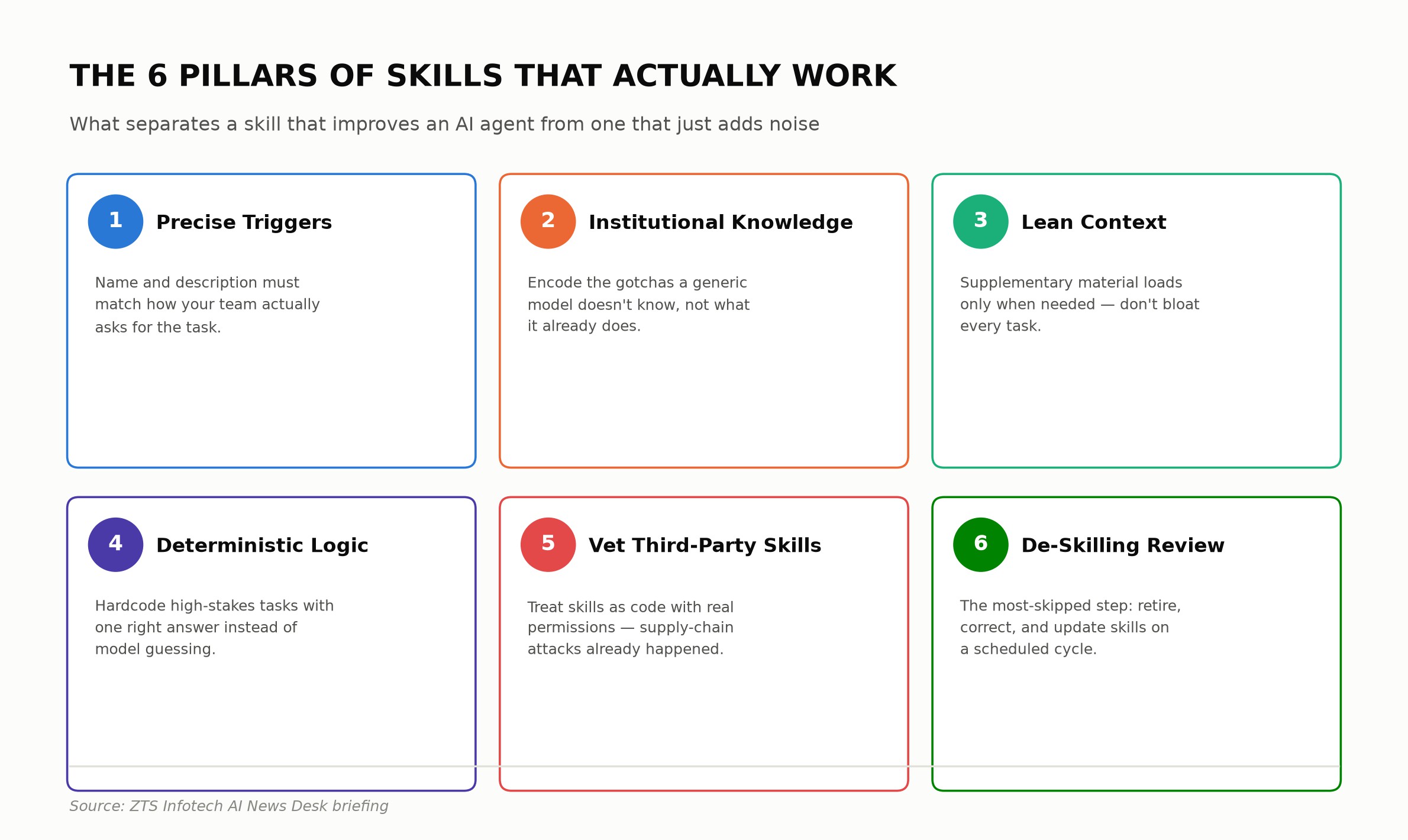
Installing a skill for an AI agent feels like progress. It rarely is. Most teams that add skills to their agents' libraries end up with something noisier, not more capable — instructions that fire at the wrong moment, reference material that bloats every task, or logic left untouched long after the process it describes has changed.
That's the assessment behind a new breakdown from ZTS Infotech's AI News Desk, which lays out six engineering pillars separating skills that genuinely improve agent performance from ones that quietly degrade it. Every pillar, the briefing notes, came from lessons learned the hard way on client work — and the sixth is the one most teams skip entirely.
Pillar 1: The Trigger Is Everything
A skill activates based on its name and description, not the quality of its instructions. That distinction matters more than most teams realise: a vague description causes an agent to either miss the skill when it's actually needed, or fire it constantly when it shouldn't. The fix is writing the description like a real search query, using the exact phrase a team already uses for that task, rather than a generic label that sounds correct but doesn't match how anyone actually asks.
Pillar 2: Ground It in Institutional Knowledge, Not Generic Output
A skill that simply repeats what any general-purpose model already knows adds no real value. The skills that move the needle encode specific, hard-won knowledge a team has already learned — that a particular API silently fails on a given day of the week, that a specific client always expects dates in one exact format. That kind of institutional detail is exactly what a generic prompt cannot replicate.
Pillar 3: Keep the Context Window Lean
Dumping every reference document into a skill's main instructions is a common mistake. Supplementary material belongs in subfolders that load only when a task actually needs them. A bloated skill doesn't just slow down the edge cases that require the extra detail — it slows down every single task the skill touches, including the simple ones that never needed that reference material in the first place.
Pillar 4: Replace Guessing With Deterministic Logic for High-Stakes Tasks
For anything with real consequences, the guidance is to stop asking the model to reason its way to an answer each time. If a task has exactly one correct answer — verifying a webhook signature, calculating a specific tax figure — that logic should be hardcoded rather than left to probabilistic reasoning. A model can reason through the same calculation correctly ninety-nine times and still get it wrong on the hundredth; a deterministic script doesn't have that failure mode.
Pillar 5: Vet Every Third-Party Skill Before Installing It
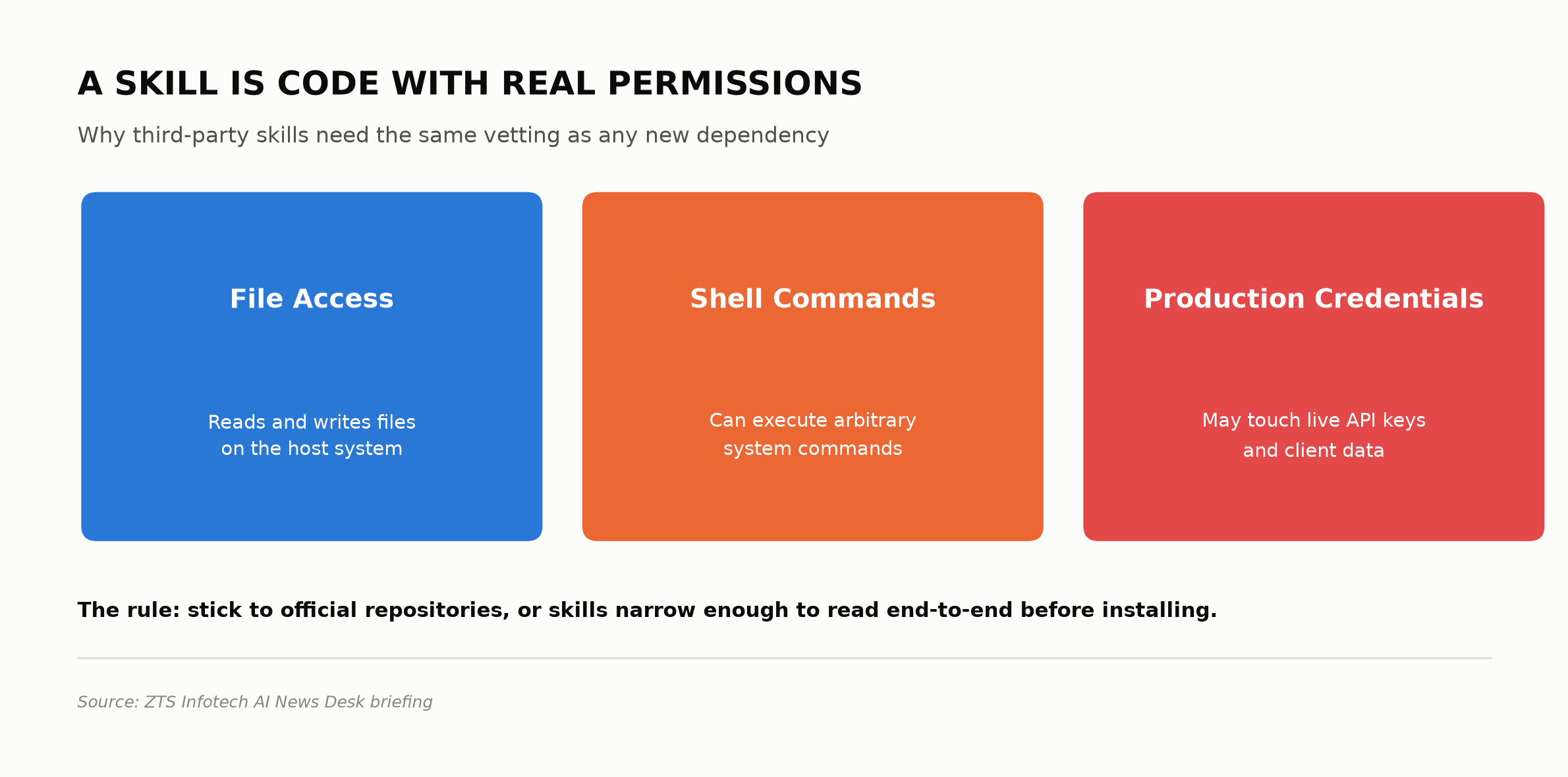
This one isn't optional. A skill is code an agent runs with real permissions attached — file access, shell commands, and in some cases production credentials. Supply-chain attacks distributed through malicious skills have already happened in the wild. The guidance is to stick to official repositories, or to narrowly scoped skills a team can genuinely read end-to-end before installing — the same discipline any engineering team applies to a new dependency, rarely extended to AI tooling.
Pillar 6: De-Skilling — the Review Cycle Almost Everyone Skips
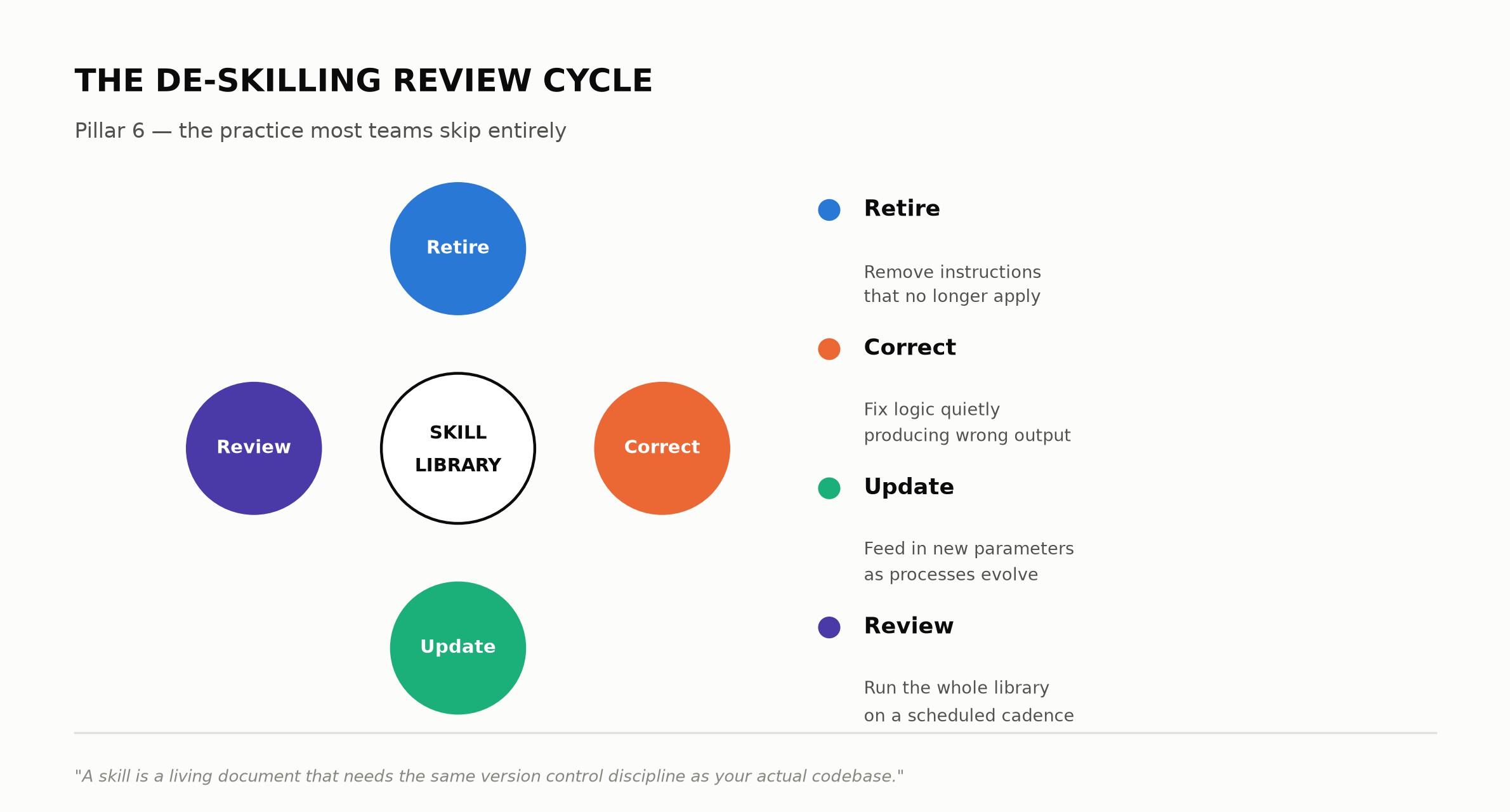
The sixth pillar is the one the briefing flags as most commonly ignored. A skill written once and never revisited is a liability, not a durable asset. Businesses change, client requirements change, and the APIs a skill depends on change. The recommendation is a scheduled review cycle across an entire skill library: retiring instructions that no longer apply, correcting ones quietly producing wrong output, and feeding in new parameters as real-world processes evolve. A skill, in this framing, is a living document needing the same version-control discipline as an actual codebase — not a one-time build left to drift.
Expert Perspective
What's notable about this framework isn't any single pillar — most experienced engineering teams would recognise pieces of it. It's that the failure modes span the entire lifecycle of a skill, from the moment it's named to years after it ships, and most organisations only ever address one end of that lifecycle. Teams that write careful, well-scoped skills at the outset frequently have no process for revisiting them once in production, which is precisely how pillar six becomes the one everyone skips.
The security pillar deserves particular attention as agent tooling scales inside organisations. A skill is functionally equivalent to installing a new dependency with elevated permissions, yet many teams apply far less scrutiny to a downloaded skill than they would to a new npm package or vendor integration. As more of these tools carry file access, shell execution, or credential handling, that gap between how skills are treated and how they actually behave becomes a real exposure, not a theoretical one.
The broader signal for business leaders is that AI agent tooling is maturing into something that needs the same engineering discipline as any other production system — versioning, review cycles, security vetting
— rather than one-off prompts assembled once and left alone. Organisations building out agent capabilities at scale should staff for that ongoing maintenance, not just the initial build.
Key Takeaways
- A skill activates based on its name and description, not its instructions — vague descriptions cause agents to miss or over-trigger skills.
- The most valuable skills encode specific institutional knowledge and known gotchas, not information a generic model already knows.
- Bloated context windows slow every task a skill touches; supplementary material should load only when actually needed.
- High-stakes tasks with one correct answer should use deterministic, hardcoded logic rather than the model's probabilistic reasoning.
- Third-party skills carry real permissions — file access, shell commands, sometimes production credentials — and must be vetted like any dependency; supply-chain attacks via malicious skills have already occurred.
- The most skipped practice is de-skilling: a scheduled review cycle that retires, corrects, and updates skills as business processes and APIs change.
- ZTS Infotech runs every client-facing skill through all six checks, including a standing review cycle, before it touches production.
Conclusion
The gap between a skill that improves an agent and one that quietly degrades it isn't really about clever prompting — it's about applying the same engineering rigor to AI tooling that already governs production software: precise triggers, real institutional knowledge, lean context, deterministic logic where it counts, security vetting, and ongoing maintenance. Teams that treat skills as a one-time build are the ones most likely to end up with noise instead of capability. As agent adoption scales through 2026, the organisations that build review discipline in from the start will be the ones whose skill libraries keep working, rather than quietly working against them.
Related Reading on Our Sites
- AI Agent Engineering Advisory Services
- Securing AI Tooling: A Supply-Chain Checklist
- What the ChatGPT Ecosystem Means for Enterprise AI
- AI Governance Consulting for Enterprises
- ZTS Infotech AI News Desk — Archive
External References
- Anthropic — Agent Skills documentation
- OWASP — guidance on software supply-chain risk
-

Writen by Anirban Das