USA:
USA:  India: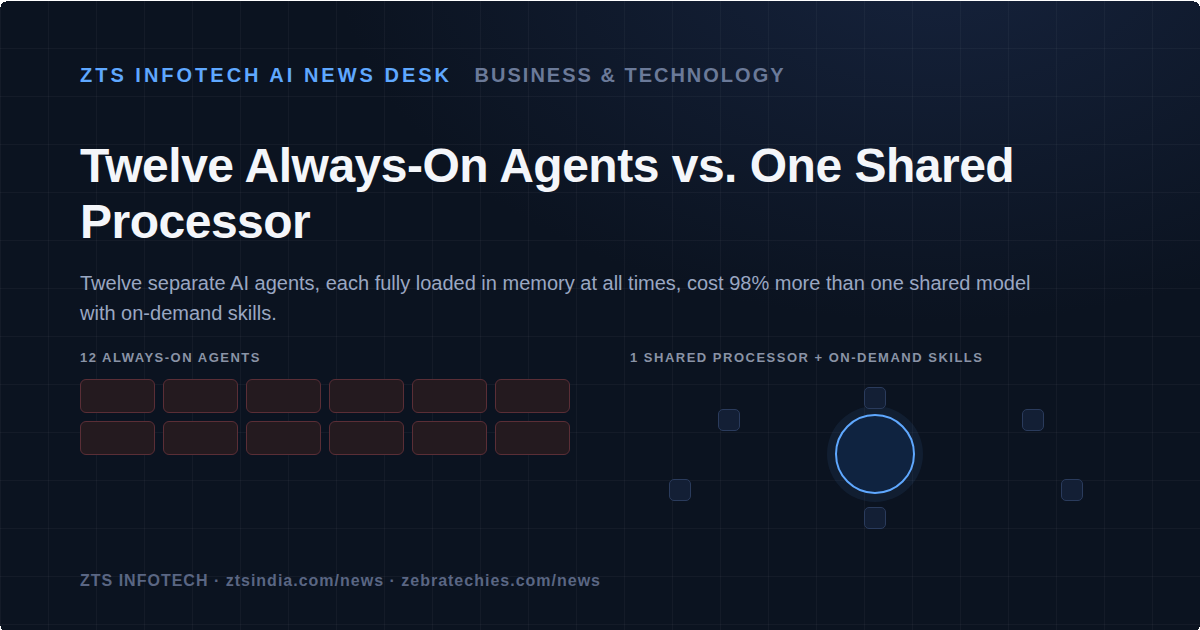
The Efficient-Looking Habit That Was Quietly Expensive
It feels productive: a new problem shows up, so a team spins up a new AI agent to handle it. One for customer support, one for reports, one for onboarding. Over six months, a development team known to ZTS Infotech's AI news desk built twelve of them this way. Each agent carried its own complete set of instructions, loaded into memory at all times, whether it was actively working or sitting untouched. The approach looked like specialization. The token bill said otherwise.
The Number That Exposes the Real Cost
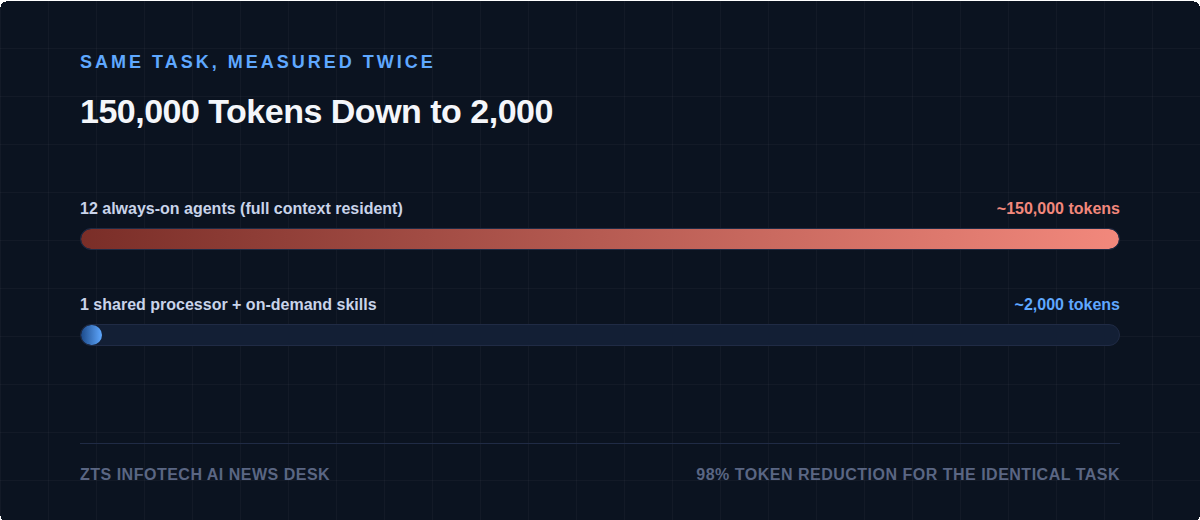
Running the same workload through the old twelve-agent setup versus the corrected shared architecture produced a 98 percent reduction in token usage for an identical task, a drop from roughly 150,000 tokens down to about 2,000. That is not a rounding-error optimization. It is the difference between a system that scales sustainably and one that quietly multiplies its own operating cost every time a team adds a new capability.
The reason is straightforward once named. Each of the twelve agents kept its full instruction set resident in memory continuously, regardless of whether it was doing anything at that moment. Twelve agents meant paying, constantly, for twelve complete sets of context, even on the nine or ten idle at any given time. The inefficiency was not a bug in any single agent. It was a property of the architecture itself.
The Fix Works Like a Phone, Not Twelve Computers
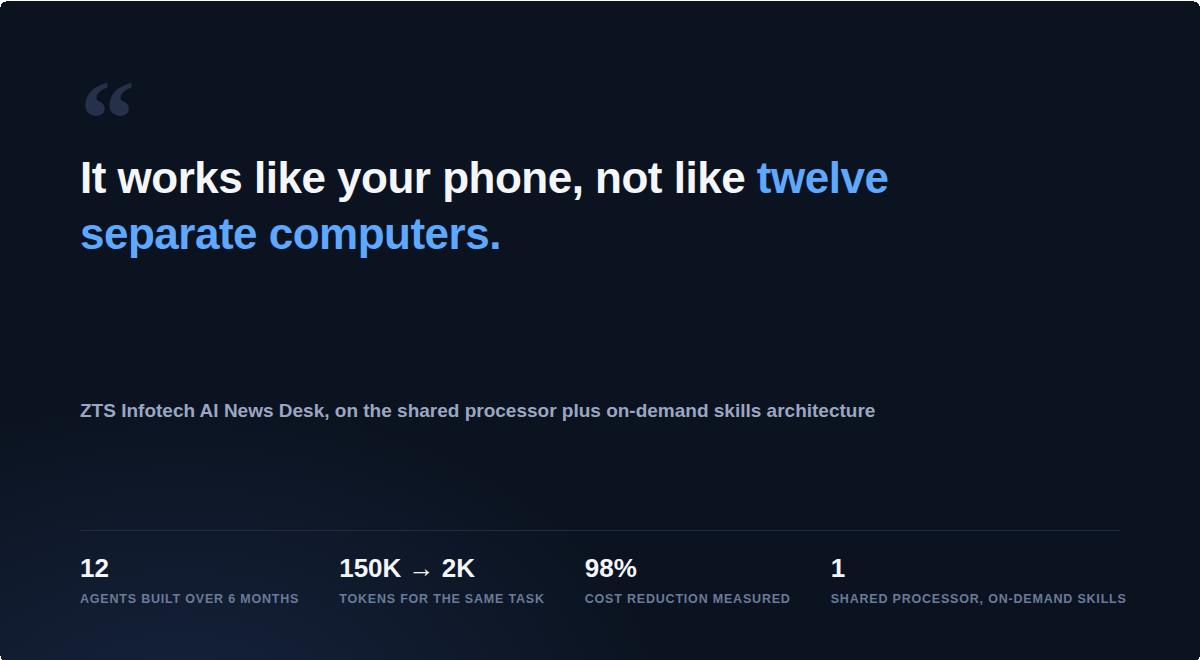
The corrected approach follows a pattern most people already carry in their pocket. A phone runs on a single processor. It does not keep every installed app loaded into active memory simultaneously; it loads the specific app a person taps, exactly when it is needed, and lets everything else sit dormant. Applied to AI systems, the same logic holds: one model acts as the shared processor, and individual capabilities, referred to as skills, function like apps. A skill loads only when a task actually matches it, and it costs nothing while dormant. This single architectural change is what produces the token reduction. Instead of twelve agents each paying a constant memory tax, one model pulls in only the relevant skill for the task in front of it, then releases it. The system's total footprint scales with what it is actually doing, not with how many capabilities it happens to have accumulated over time.
The Same Fix Also Stops Behavioral Drift
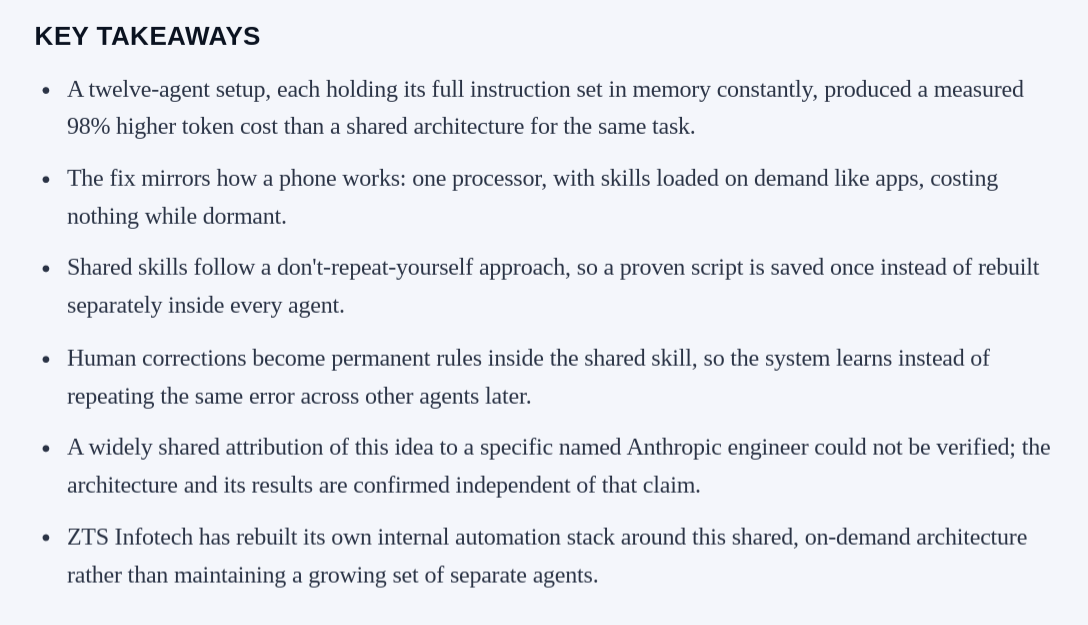
A second, less obvious benefit shows up over time. The twelve original agents were built and modified across six months, and each one likely drifted slightly from the others as separate fixes accumulated in isolation. A shared-skills architecture follows a don't-repeat-yourself philosophy instead: a proven script or procedure is saved once and reused everywhere it applies, rather than being reimplemented, and re-drifted, inside every separate agent. When a human corrects a mistake, that correction becomes a permanent rule inside the shared skill, so the system learns from it instead of repeating the same expensive error the following month in some other agent that never received the fix.
Expert Perspective
The business lesson here is less about tokens and more about what token waste signals. Twelve separately maintained agents is not just a cost problem; it is an early warning sign of the same sprawl that has always afflicted software built without a shared foundation: duplicated logic, inconsistent behavior, and a maintenance burden nobody budgeted for. The fix, one processor, on-demand skills, and centralized corrections, is a governance pattern as much as a technical one. It gives a team exactly one place to fix a mistake instead of twelve.
For leaders evaluating their own AI initiatives, the practical question is not whether an agent works today. It is whether the architecture underneath it still makes sense after the fifth, tenth, or twentieth capability gets bolted on. Systems built agent-by-agent tend to look fine in a demo and grow expensive, inconsistent, and hard to audit exactly as they scale. A shared architecture with on-demand skills is built to survive that growth rather than multiply its cost alongside it.
Looking Ahead
As more teams move past their first one-off AI agent and start accumulating a second, fifth, or twelfth, the architecture underneath will matter more than any individual agent's performance. The pattern emerging here, one shared processor with on-demand, reusable skills, is likely to become the default for any organization that has already felt the cost of the alternative. ZTS Infotech's AI news desk will keep tracking how this shift plays out as agent sprawl becomes a more common, and more expensive, problem across the industry.
-

Writen by Anirban