USA:
USA:  India: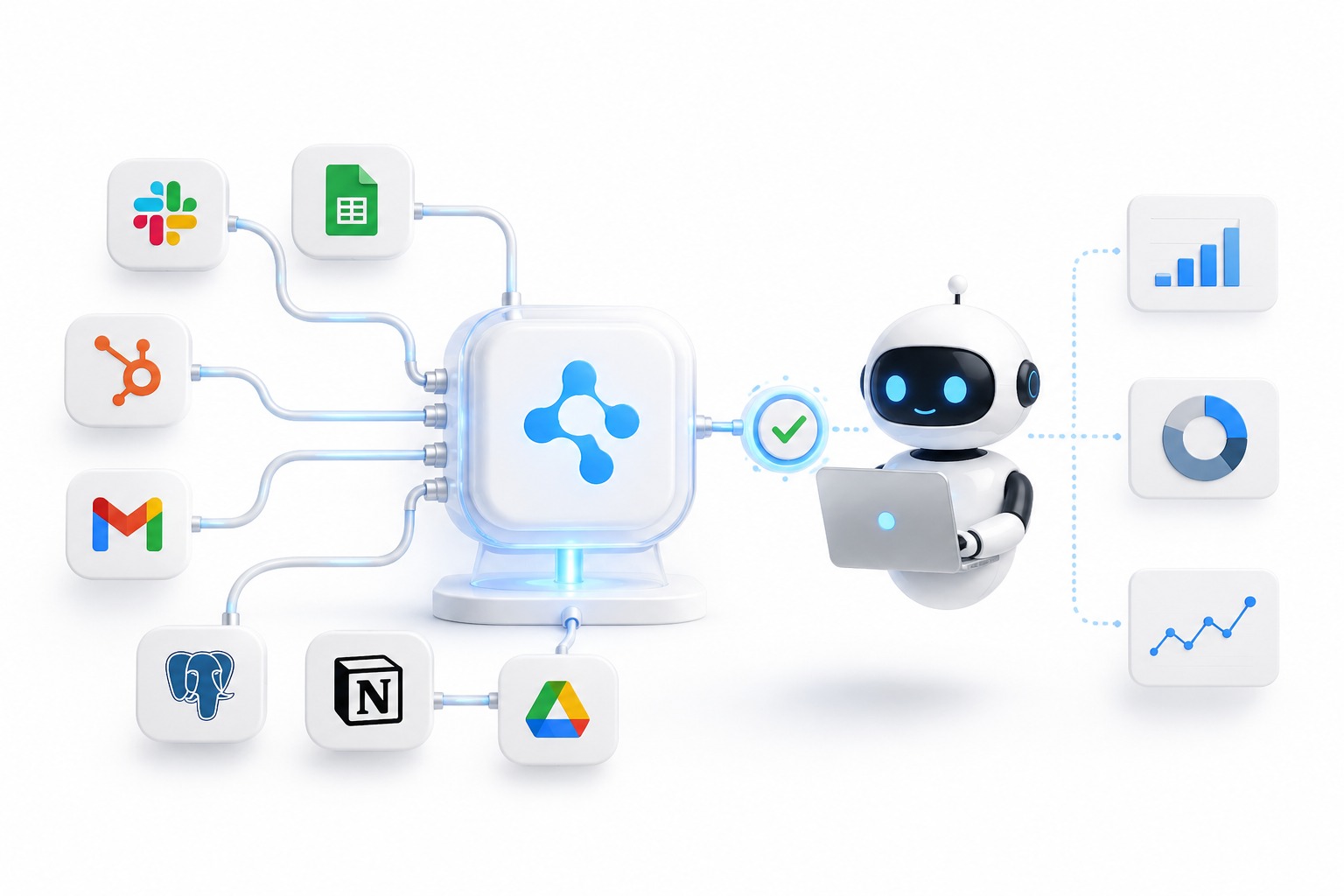
If you have already tried automation and it stopped working efficiently somewhere around month three, you are not alone. Most businesses do not fail at automation because the idea was wrong. They fail because the bot they built could only handle the tidy 60 percent of a process and quietly dumped the rest back on someone's desk.
That gap is exactly where AI automation services are supposed to step in, and it is also where MCP (Model Context Protocol) is quietly changing how AI agents actually get work done. Let's walk you through what any of this means for a business owner who just wants fewer hours lost to repetitive work.
Why traditional automation keeps hitting a wall
Rule-based bots and classic RPA (Robotic Process Automation) tools are great at one thing: doing the exact same task the exact same way, every time. The moment a scanned invoice shows up in a new layout, or a customer email phrases a request slightly differently, the bot stops and hands it to a human. Over time, that exception queue grows until it costs more to manage than the manual process ever did.
AI automation is different because it can read unstructured input, and cope with variations, while still routing the genuinely tricky cases to a person. That is the whole point of pairing automation with real AI reasoning instead of rigid rules.
Where MCP integrations fit into the picture
Here is the part that trips people up. API and MCP are often talked about as if they compete with each other, but they really do not.
An API (Application Programming Interface) is a contract. Your software already knows exactly which endpoint to call, sends the request, and gets a response back. The developer decided on that path in advance.
MCP (Model Context Protocol) works differently, and it sits closer to how an AI agent actually thinks. Instead of your system knowing every step ahead of time, an AI agent connects to an MCP server, reads what tools are available to it, chooses the right one for the task, and then sends the request. The agent is not hardwired to one action. It can figure out which tool it needs, whether that is your CRM, a document store, or an internal database.
Behind that MCP server, APIs are usually still doing the actual work. MCP does not replace your APIs, it sits on top of them as a translation layer so an AI agent can discover and use several tools without a custom integration being built for every single one. That is why MCP integrations matter so much for businesses trying to connect agents to HubSpot, Salesforce, an ERP, a helpdesk, and a shared Google drive all at once, instead of building five separate one off connections.
A quick way to think about it
- API: "I already know exactly what to call."
- MCP: “Show me what tools exist, and I will pick the right one for this task.”
For a business running an AI agent that has to check inventory in one system, pull a customer record from another, and log the outcome in a third, that difference is the reason the agent can actually finish the job instead of getting stuck waiting for a developer to wire up one more connector.
What this looks like in practice
Businesses that combine proper AI automation with this kind of integration approach tend to see a few consistent patterns:
- Documents that used to get rejected by template based OCR, like scanned invoices or purchase orders in a new format, get read and processed with confidence scoring, and only the genuinely low confidence ones go to a human for review.
- Exceptions such as shipment delays or customs holds get triaged or checked automatically, with the policy behind the decision pulled from the right document and cited, rather than guessed at.
- A single process that used to touch four or five separate systems runs end to end through one combined layer, instead of someone copying data between screens.
- The first automation gets built as a reusable foundation, so the second, third, and tenth process plug into existing connectors instead of starting to retrieve from zero.
None of this is theoretical anymore. Analyst research backs up how quickly this shift is happening. Gartner projects that forty percent of enterprise applications will be integrated with task-specific AI agents by the end of 2026, up from less than five percent today.
On the other hand, McKinsey's State of AI survey found that sixty-two percent of survey respondents say their organizations are at least experimenting with AI agents. The interest is real, and it is moving fast, which means the businesses that get the integration layer right early are the ones who will actually see the return, not just the pilot.
A simple way to start, without overhauling everything
You do not need to replace your existing systems or your current RPA (Robotic Process Automation) tools to get started. The more realistic path is to map the one process that eats the most hours each week, figure out honestly whether it is worth automating or simply needs fixing first, and then add an AI layer that handles the documents and decisions your current bots already reject. Most engagements begin with a short process assessment, followed by a targeted pilot-run in shadow mode alongside your team before it is trusted to act on its own. That shadow period matters more than people expect. It is the difference between automation that earns trust gradually and automation that breaks something on day one and gets shut off for good.
If you are earlier in the process and just trying to figure out which use cases are worth pursuing at all, that is really a job for AI automation consulting services rather than jumping straight to build, since the honest answer for some processes is that they need to be redesigned or removed before any automation touches them.
The Final Say
AI automation and MCP integrations are not separate trends. One is the reasoning layer that decides what needs to happen, and the other is the connective tissue that lets an AI agent actually reach the tools it needs to make that happen across your CRM, ERP, and everything in between. Get both right, and automation stops being a pilot that stalled and starts being a process that quietly runs itself, with a human stepping in only where it genuinely matters.
Frequently Asked Questions
What is the difference between AI automation and regular RPA?
RPA follows fixed rules on clean, structured data, and it is fast until something varies. AI automation can read messy input like scanned documents or free text emails, handle variations it has not seen before, and decide within limits you set, so it picks up the exceptions RPA usually hands back to a person.
Is MCP just another name for an API?
Not really. An API is a fixed contract your software already knows how to call. MCP lets an AI agent discover which tools are available and choose the right one on its own, and it usually works on top of your existing APIs rather than replacing them.
Do I have to get rid of my current automation tools to add AI on top?
No, and in most cases you shouldn't. Existing RPA tools (UiPath, Automation Anywhere, Microsoft Power Automate, etc.) are often still good at the structured work they were built for. The more common approach is adding an AI layer that catches what those tools currently reject, rather than ripping everything out.
How long does it actually take to get an AI automation project live?
A single, well understood process typically goes live in six to ten weeks, including a shadow mode period where it runs alongside your team before it acts alone. Document heavy or multi system processes usually take longer.
Will this replace people on my team?
It mostly replaces repetitive tasks rather than entire roles. In practice, most teams stay in place and help grow volume that would otherwise have meant hiring, while spending their time on the decision-makings that still need a human.
How do I know which process to automate first?
Look for something with high volume, high manual effort, and a process you already understand well. A short process assessment usually makes this obvious within a couple of weeks rather than months.
-

Writen by Anirban Das