USA:
USA:  India:
 A new framework from ZTS Infotech reframes how businesses should structure what their AI assistants remember — and why treating memory as one bucket quietly wrecks output quality.
By ZTS Infotech News Desk • August 2026 • Source video: youtube.com/watch?v=r7tdJMLShVs
.jpg)
Introduction
Ask ten business owners how they use AI chatbots day to day and most will describe the same two frustrations. Either they dump every detail of their business into the prompt window and get answers so generic they could apply to any company, or they say nothing and end up re-explaining their team, tone, and goals in every new conversation. Anirban Das, presenting on ZTS Infotech's AI News Desk, argues both habits stem from the same root cause: businesses treat AI memory as one undifferentiated bucket instead of a structured system. In a recent video breakdown, Das laid out a five-part framework
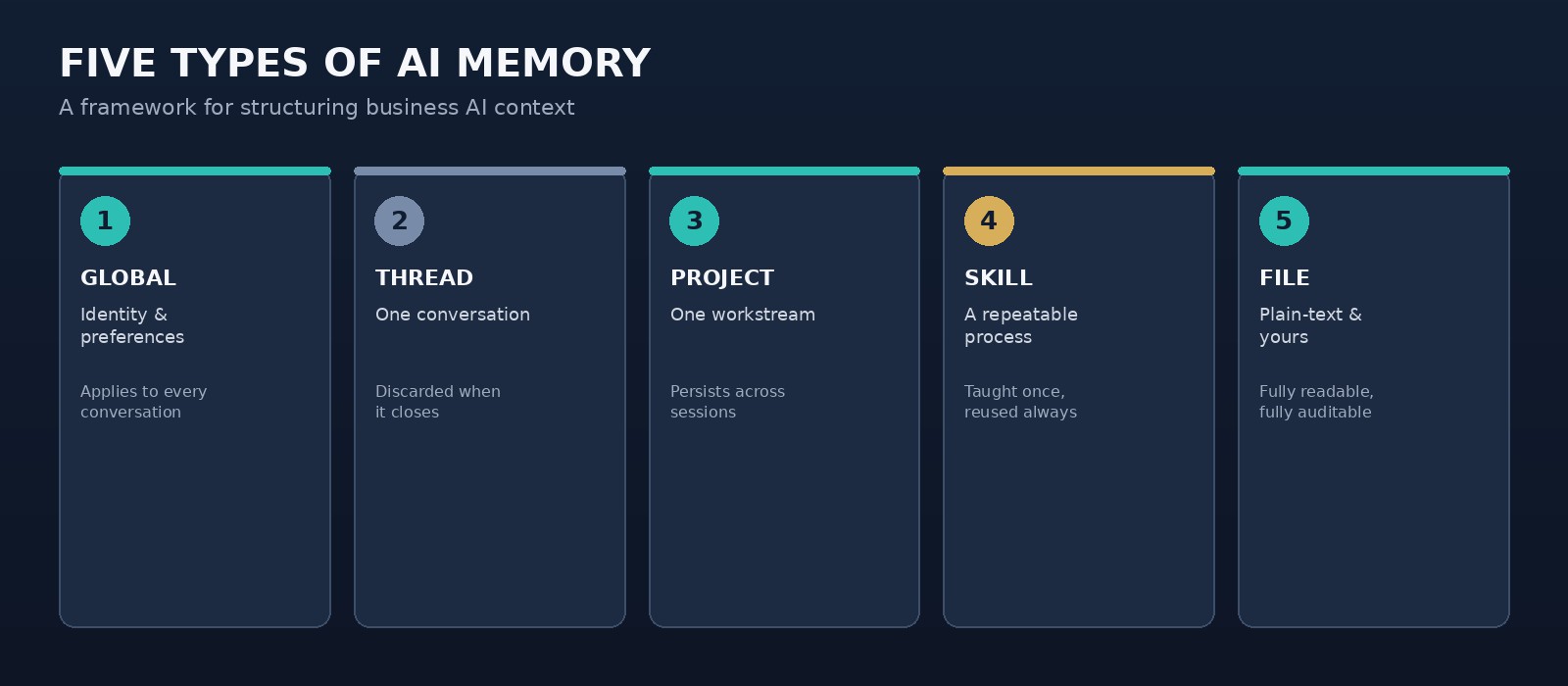
— five “memory drawers” — that reframes how companies should feed context to tools like Claude. For executives weighing how deeply to integrate AI, the distinction is not a technical footnote; it determines whether an AI deployment saves real time or adds another chore.
Why “One Big Memory” Fails Businesses
Handing an AI assistant everything at once feels efficient, but it produces the opposite result. A single, undifferentiated memory pool mixes a client's onboarding history with a one-off debugging session and a company style guide, and the model has no way to know which details matter for which conversation. Output drifts toward a generic middle ground that satisfies no particular need. Das's framework instead separates memory by function — “who you are,” “what we're working on right now,” and “how we always do this task” are different categories of information that deserve different lifespans and scopes.
The Five Drawers, Explained
Drawer One: Global Memory
Identity-level context — role, communication preferences, standing expectations — set once and applied automatically to every future conversation. A business owner who states they run an agency and prefer concise answers should never need to repeat that instruction again.
Drawer Two: Thread Memory
Scoped to a single conversation and discarded when it ends. A 50-message debugging session stays fully coherent within itself, but nothing leaks into unrelated chats later, preventing irrelevant details from quietly accumulating.
Drawer Three: Project Memory
Persistent across many conversations but scoped to one ongoing body of work — a client account, a launch, a long-running initiative. Decisions made in week one of an onboarding remain available in week twelve, without bleeding into unrelated projects.
Drawer Four: Skill Memory
The most underused category. Not facts about the business, but a repeatable process taught once — a weekly reporting format, a QA checklist, an outreach sequence. Once captured, the AI executes it the same way every time, instead of improvising a new version each session.
Drawer Five: File Memory
Plain-text files stored in a folder the business fully controls. Nothing here is opaque or algorithmically curated — the company can open the file and read exactly what the AI has stored. Das describes this as treating the AI “like a librarian, not a black box.”
Industry Implications
Structured memory is becoming a genuine differentiator in enterprise AI deployments, not a minor configuration detail. Vendors including Anthropic have built out persistent, project-scoped memory and custom “skills” features for this reason — generic chat history isn't sufficient for serious business use (see Anthropic's documentation on Projects and Claude's memory capabilities at anthropic.com).
Companies that configure these layers deliberately get assistants that behave consistently across teams; others get a tool that impresses in a demo and disappoints daily.
Practical Business Takeaways
- Audit before you deploy. Map which information belongs in which drawer rather than dumping everything into one prompt.
- Separate the permanent from the disposable. Identity belongs in global memory; one-off troubleshooting doesn't need to persist at all.
- Document processes once. Any task your team repeats weekly is a candidate for skill memory
— the payoff compounds with reuse.
- Keep an auditable layer. File-based memory gives leadership visibility into what an AI system actually “knows.”
Challenges and Opportunities
The obvious challenge is discipline. Structuring memory takes upfront setup and a team willing to maintain it — a harder sell than simply typing into a chat window. The opportunity is proportional: businesses that get this right report assistants that feel personalized, useful on ongoing work, fast on repeat tasks, and trustworthy enough for sensitive workflows — a combination hard to achieve with default, unstructured memory.
Expert Perspective
The broader significance here is strategic rather than technical. As AI assistants move from novelty to infrastructure, the businesses that pull ahead won't necessarily be the ones with the most powerful model — they'll be the ones that did the unglamorous work of organizing what that model is allowed to remember. Das's framework is applied information architecture, borrowed from enterprise knowledge management and repointed at conversational AI. Expect this to become standard practice for companies running AI at scale over the next 12 to 18 months, much as structured CRM data became non-negotiable a decade ago. Firms offering AI implementation services, including ZTS Infotech, are positioning structured memory setup as core to enterprise deployment rather than an optional extra.
Key Takeaways
- Undifferentiated AI memory produces generic outputs — organization matters more than volume of context.
- Global memory holds identity and standing preferences, set once and applied everywhere.
- Thread memory is intentionally temporary and should stay that way.
- Project memory persists across sessions but stays scoped to one initiative or client.
- Skill memory captures repeatable processes, not just facts, and pays off with every reuse.
- File-based memory gives businesses an auditable, human-readable record of what the AI knows.
- Enterprise AI vendors are increasingly building these memory tiers directly into their platforms.
Conclusion
The companies getting the most out of AI assistants right now are rarely the ones with the fanciest prompts. They're the ones treating memory as infrastructure worth designing deliberately, not an afterthought handled by trial and error. As memory-aware AI tools mature, expect the gap between organized and unorganized deployments to widen. Business leaders evaluating their AI strategy would
do well to ask not “how much can we tell the AI,” but “which drawer does this belong in.”
-

Writen by Anirban Das