USA:
USA:  India:
 An AI-powered website UK brands deploy today represents a fundamental shift from static digital storefronts to dynamic commercial environments. According to Gartner, data-driven personalization and automated system architectures now influence over 80% of digital consumer interaction choices. This enables companies to achieve a 10% to 20% better sales return on investment by executing highly tailored user experiences in real time.
Why Are Northern Quarter Businesses Adopting AI-Powered Websites in 2026?
Let’s be honest about the Manchester business scene right now. Most independent brands in the Northern Quarter don't actually have a traffic problem. They have a conversion problem. You can get people onto your site, but if it treats a first-time browser clicking through from a cafe on Thomas Street the same way it treats a massive wholesale client, you're throwing money away.
One major trend we're seeing across Manchester businesses is that the old, static digital brochure just doesn't move the needle anymore. Local retail shops, design agencies, and food brands are realizing that their websites need to feel just as fast and curated as a physical shop layout on Oldham Street.
A common misconception is that this means adding flashy tech tricks or weird animations to your homepage. The reality is a bit different. It’s simply about context. By putting quiet machine learning layers right into your web setup through dedicated AI website engineering UK strategies, you can stop losing revenue to massive multinational platforms.
What Makes an AI-Powered Website Different from a Traditional Website?
Traditional web design relies entirely on fixed setups. A web developer builds a template, someone uploads text and images into a database, and every single person who visits sees the exact same layout.
A smart site completely flips that model. It doesn't treat your online presence like a billboard. It treats it like a real-time conversation that shifts based on exactly what a customer is doing at that moment.
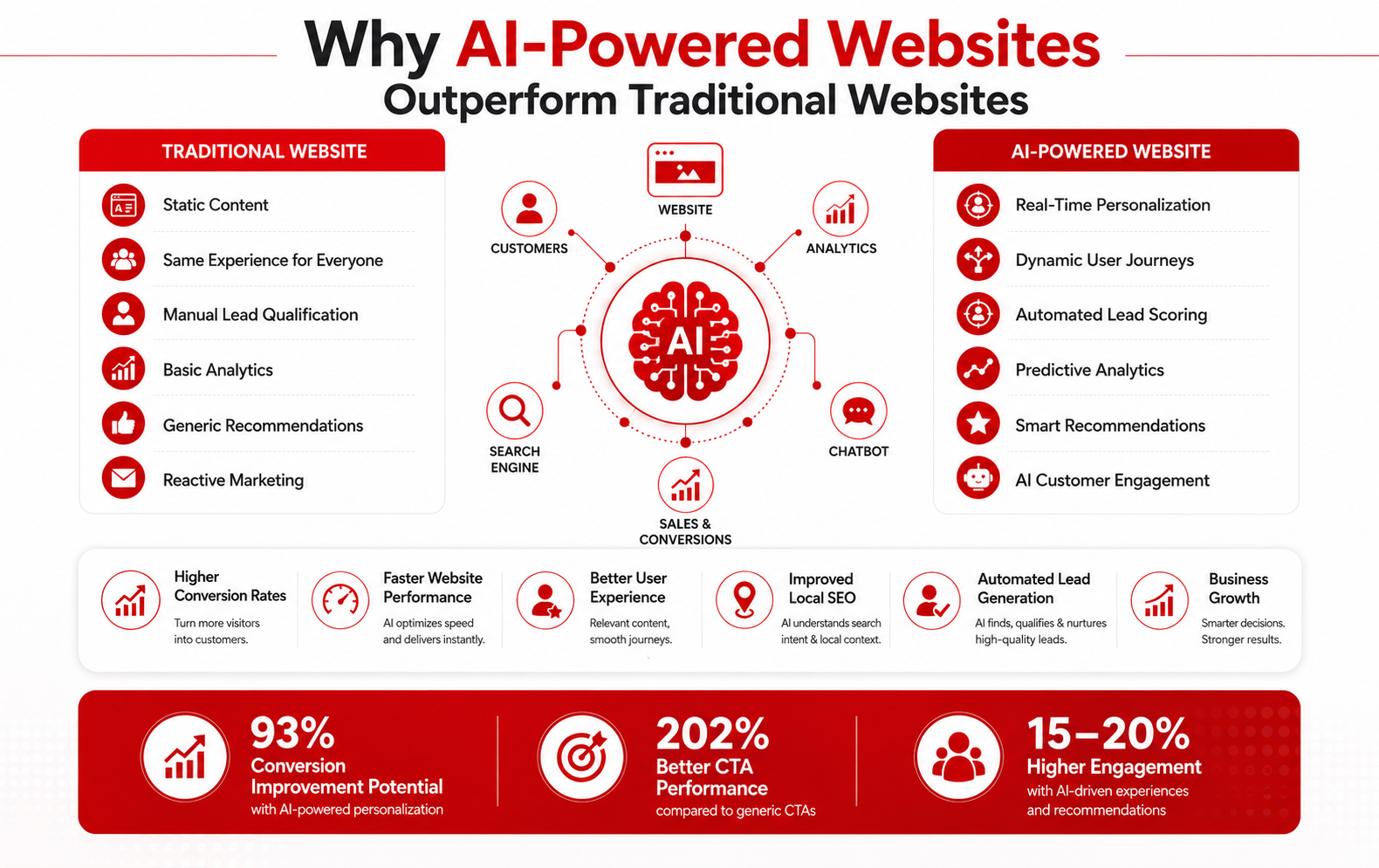
Traditional web design operates on a rigid structural model where a static template serves uniform content along a fixed conversion path, delivering the exact same user experience to every visitor and requiring slow, manual updates to change layout elements. In sharp contrast, an AI-powered website completely flips this blueprint into an active conversation by continuously pulling in unique user context to run real-time dynamic processing, instantly generating a highly personalized interface that automatically adapts its layout, product recommendations, and navigation paths on the fly.
According to a global study by Econsultancy, 93% of companies experience a significant uplift in conversion rates after implementing real-time website personalization and dynamic content strategies. Additionally, research from HubSpot indicates that call-to-actions targeted to specific user contexts convert 202% better than generic, static alternatives.
Businesses working with ZTS Infotech leverage AI-powered development frameworks that enable real-time personalization, intelligent content delivery, and adaptive user experiences designed to improve engagement and conversion performance.
By combining modern web architecture with machine learning capabilities, ZTS Infotech Pvt. Ltd. helps brands transform traditional websites into dynamic digital platforms that continuously optimize for user intent and business outcomes.
How Does Real-Time Personalization Improve User Experience?
The second someone lands on a page, the platform looks at simple clues: where they came from, their location, their device, and how they scroll. Instead of serving up a slow, generic page, the site changes what the user sees on the fly.
For an ecommerce brand based in Greater Manchester, prioritizing responsive website development UK frameworks means your homepage can automatically highlight raincoats for a local visitor clicking through on a wet afternoon, while showing summer gear to someone browsing from abroad. You don't need to build fifty different landing pages anymore; the site just does the work for you.
How Does AI-Powered Customer Engagement Increase Conversions?
Many companies initially assume that engagement means using loud pop-ups or chat boxes that jump out at you. It doesn't. That usually just annoys people.
True engagement is about helping people find what they want without making them dig through massive drop-down menus. Smart platforms remove that friction by putting context-aware tools right into the user journey to answer specific customer questions.
What Can Predictive User Behaviour Analysis Tell Businesses?
Most marketing agencies focus heavily on looking backward. They look at analytics sheets at the end of the month to tell you where people left your checkout.
Predictive tools work the other way around. By tracking live movements across thousands of sessions, the system spots the patterns that happen right before someone walks away from a shopping cart. If a user hesitates on a price screen, the layout can adjust or offer a quick detail before that customer gives up and leaves.
What Are the Key Benefits of AI Website Design for Manchester Businesses?
Upgrading your web setup brings direct financial returns to your brand positioning, daily workflow, and local sales. For any business looking into a comprehensive website redesign UK project, these automated features fundamentally change what it costs to win a new customer.
- Higher Conversion Rates: Data from McKinsey highlights that businesses using digital personalization see a revenue lift of 3% to 15% from tailored user journeys. When your site matches its text to what a visitor is actively trying to find, they don't have to think as hard.
- Speed and Performance: Fast sites happen because of smart data choices. Instead of loading heavy, identical code scripts for every single visitor, an intelligent AI website design UK setup predicts what asset a user will click next based on past trends, loading it quietly in the background.
- Better User Experiences: A massive headache during website redesign projects is trying to build a single page layout that satisfies everyone. Smart web engineering solves this because the platform stays flexible, adjusting typography, menus, and buttons to match what works best for specific users.
- Local Search Visibility: In packed commercial areas like Ancoats or Spinningfields, showing up first in local searches dictates your foot traffic. Modern search tools rely on deep semantic context. A smart platform organizes its own data schemas to stay ready for voice or conversational queries.
How Does AI Website Engineering Support Business Growth?
To scale a business across Greater Manchester, you need an online presence that acts less like an administrative bill and more like a top-performing sales rep. This comes down to the code choices running behind the scenes.
| Capability | Traditional Impact | AI Engineering Impact | Business Outcome |
| Lead Handling | Static form fields, generic auto-responders | Real-time intent analysis, instant routing | Faster sales pipelines, higher lead value |
| Content Delivery | Fixed blog feeds, manual tagging | Dynamic contextual recommendations | Deepened user session depth, lower bounce rates |
| Data Analytics | Historical dashboards, manual review | Real-time anomaly detection, predictive trends | Proactive operational adjustments |
What Is Automated Lead Qualification?
If you run a professional services firm in Spinningfields, sorting through endless spam or bad lead forms eats up hours of billable time. Modern platforms handle this screening inside your contact forms. As a prospect types, the backend evaluates their company details, scope, and project size. It scores the lead, updates your CRM, and shoots over relevant pricing guides or booking links before anyone on your team even has to open the email notification.
How Do Smart Content Recommendations Increase Engagement?
Complex resource sections and big online shops often struggle to get their content discovered. Instead of relying on manual "related posts" tags that get old fast, smart systems scan the actual text across your library. The engine understands how different topics connect, serving up the exact articles or products that match the problem your visitor is dealing with right then.
According to data from McKinsey & Company, deploying algorithmic recommendation engines can increase digital customer engagement and click-through rates by up to 15% to 20% while driving a significant lift in overall net conversion values. Furthermore, Salesforce research indicates that personalized product and content recommendations influence up to 26% of total digital revenue by guiding users toward relevant items they otherwise would not have discovered.
How Does AI-Driven Analytics Improve Decision-Making?
When your web infrastructure links directly with predictive tools, you don't have to guess why a certain service or product isn't selling. The system isolates the variables for you. It tells you if a drop in sales is down to a pricing issue, a bad mobile layout on specific phones, or a drop in your ad traffic quality. This gives your team actual, live data to shift budgets instead of relying on guesswork.
AI-Powered Websites vs Traditional Business Websites: Which Performs Better?
When you're trying to figure out if it's worth making the switch, it helps to look at performance head-to-head. Old static layouts struggle to keep pace as modern search tools shift toward direct, answer-based results.
A traditional corporate web stack operates on a rigid, retrofitted infrastructure consisting of static HTML, CSS, and JavaScript caches that pull from a single database query path, resulting in standardized analytics tracking that relies entirely on reactive data gathering after a user has already left a page. Conversely, an AI-powered corporate web stack utilizes edge computing alongside predictive asset loading to serve pages instantly, combining a dynamic data injection layer that executes real-time schema changes with an integrated large language model and semantic core to drive proactive personalization and instant intent tracking.
Older sites require constant manual work to run basic split tests, fix meta descriptions, and build separate pages for every single ad campaign. It creates a major internal bottleneck and slows down your speed-to-market.
A smart platform handles that optimization on its own. Because it can test minor tweaks to text, images, and buttons across live traffic simultaneously, it locks in the versions that convert best. You get an asset that actually gets better at winning clients the longer it runs.
What Features Should Every AI-Powered Website Include in 2026?
If you're upgrading your setup or partnering with an established agency for custom AI web development UK services, focus on a few practical features that deliver real business value:
- AI Chat Assistants: Today's tools understand full business context. They check your live inventory, explain service options, fix support issues, and book meetings directly inside the chat window while sounding completely natural.
- Personalized User Journeys: The visual path on your site changes based on why a visitor clicked your link. High-end prospects jump straight to case studies, while casual browsers see entry-level options.
- Smart Search Functionality: Standard search bars break on typos. Semantic search looks at the actual meaning behind the words. If someone searches "what to wear to a wet summer event in Manchester," a clothing site will show the right options from completely different categories.
- Predictive Recommendations: Instead of basic "you might also like" carousels, smart setups track complex actions like reading times and scroll speeds to pitch items with a higher chance of lifting your average order value.
Redesign or Rebuild: What’s the Right Choice for Local Brands?
If your platform uses slow plugins or carries heavy legacy code, launching a full website redesign UK project is the right move. Trying to force machine learning onto old code means dealing with complex, unpredictable user journeys.
But if you already use a modern headless setup built within the last couple of years, you can keep your content hub. Your tech team can build smart middleware and connect custom APIs to upgrade how the page acts without changing your actual database.
Technology partners such as ZTS Infotech Pvt. Ltd. help businesses evaluate whether a complete rebuild or a phased modernization strategy offers the best long-term return on investment. Through technical audits, performance assessments, and AI readiness evaluations, organizations can identify the most efficient path toward intelligent digital transformation.
But if you already use a modern headless setup built within the last couple of years, you can keep your content hub. Your tech team can build smart middleware and connect custom APIs to upgrade how the page acts without changing your actual database.
For businesses with modern infrastructure, ZTS Infotech supports the integration of AI-powered personalization, semantic search capabilities, automation workflows, and advanced analytics layers without requiring a complete platform replacement, helping brands accelerate innovation while protecting existing technology investments.
How Much Does an AI-Powered Website Cost in the UK in 2026?
The total investment for an AI-powered website UK project comes down to your operational size, your external software connections, and how custom the user experience needs to be.
The total investment for deploying AI-driven web infrastructure is categorized into three clear tiers based on engineering complexity. Entry-level intelligent sites range from £5,000 to £12,000, combining professional content management setups with template customization and foundational integrations like basic machine learning algorithms or semantic assistive chatbots. Mid-market commercial platforms scale to between £12,000 and £35,000, covering advanced UI/UX design, custom API bridges, intent-based dynamic layouts, and Retrieval-Augmented Generation (RAG) conversational features. At the enterprise tier, bespoke web platforms start from £35,000 and can significantly exceed £100,000, supporting advanced requirements such as deep learning solutions, autonomous multi-agent systems, multi-region content delivery, and dedicated predictive analytics models built to process heavy corporate data sets in real time.
When you look at these prices, don't just think about the initial build cost. Look at the long-term running expenses. A standard site might look cheaper on paper, but it takes endless hours of manual content updates, constant optimization bills, and manual landing page production. For those seeking high-quality web design Manchester affordable paths, a smart setup turns those tasks into automated processes, saving you heavy operational expenses down the line.
How Do You Choose the Right AI Web Development Partner?
Building these platforms requires a blend of solid software engineering and modern data science skills. A basic web shop that just resells generic design themes won't have the technical expertise to set up live personalization data streams.
When you're vetting potential tech teams, find a partner who understands how to wire up a great front-end look with a solid database setup. Ask them how they manage data privacy, where the actual data processing happens to keep speeds fast, and how they build out custom user flows.
According to a comprehensive vendor evaluation report by Forrester Research, over 74% of enterprise technology buyers state that a development partner's data engineering and architectural capabilities are the primary factors that dictate whether an advanced software deployment succeeds or fails. Additionally, data from an internal agency analysis by DesignRush indicates that businesses partnering with engineering-led firms experience an average 45% reduction in post-launch technical debt and operational troubleshooting costs compared to those using standard design agencies.
As a scalable development team and strategic website engineering partner, ZTS Infotech Pvt Ltd focuses completely on building clean, high-performance web applications that turn everyday traffic into reliable business revenue. Choosing a partner with a clear, engineering-led approach means you won't get stuck paying for flashy tech projects that don't bring in real cash flow.
What Future Trends Will Shape AI Website Development Across the UK?
The web is moving fast toward highly individualized experiences. Over the next couple of years, we’re going to see a big shift toward agentic web systems. Instead of websites just waiting for a person to click an option, platforms will be built to talk directly with a customer's personal software agent.
Multi-modal setups are also becoming standard. This means users can fluidly switch between voice inputs, image uploads, and text in a single visit, and the site will change its look instantly to support how they want to browse. Businesses that build a flexible data foundation now will step into this shift easily, while old static sites will face a massive uphill climb to stay relevant.
Building a Competitive Advantage with AI-Powered Websites
Investing in an AI-powered website UK businesses can count on for long-term growth isn't about jumping on a trend. It's about securing your market position. Whether you run a growing retail brand in Ancoats or a professional consulting firm in Spinningfields, your digital setup dictates your growth.
By qualifying leads automatically, cutting out user friction, and serving a custom space to every visitor, you build an online asset that adds real value to your business around the clock. The future of digital commerce belongs to the companies that turn their sites from static online brochures into active, intelligent engines for customer acquisition.
Frequently Asked Questions
What is an AI-powered website?
An AI-powered website is a live, adaptive platform that integrates machine learning into its code. Instead of a static site that looks identical to everyone, an intelligent site watches browsing behaviors and context in real time to automatically change its text, layouts, and product options for individual users.
How much does an AI-powered website cost in the UK?
A custom local business site with standard personalization and a smart chat tool typically runs between £5,000 and £12,000. Mid-market platforms with custom API connections fall between £12,000 and £35,000, while deep enterprise ecosystems start from £35,000.
Are AI-powered websites suitable for small businesses?
Yes, because they automate tasks that usually require extra staff. A smart site handles customer service questions, qualifies sales leads, and optimizes checkout steps automatically, letting lean local teams compete with massive national brands.
How does AI improve website conversions?
It removes friction from the user journey. By showing personalized text right away, answering specific questions instantly via an advanced assistant, and offering accurate product suggestions, the platform makes taking action incredibly simple for your visitors.
Can AI websites help with local SEO?
Yes. Sites designed with smart data layers keep their schema markup updated naturally, align content with conversational local search terms, and maintain top mobile page speeds, which gives them a massive advantage in local search rankings across Greater Manchester.
Next Steps for Your Business Growth
Ready to turn your digital presence into a self-optimizing commercial asset? Let's talk about how an intelligent digital framework can scale your operations and lower your acquisition costs.
- Talk to the ZTS Infotech team about your website strategy
- Request a custom AI website development proposal
- Discuss an AI-powered website redesign project
-

Writen by Anirban Das