USA:
 India:
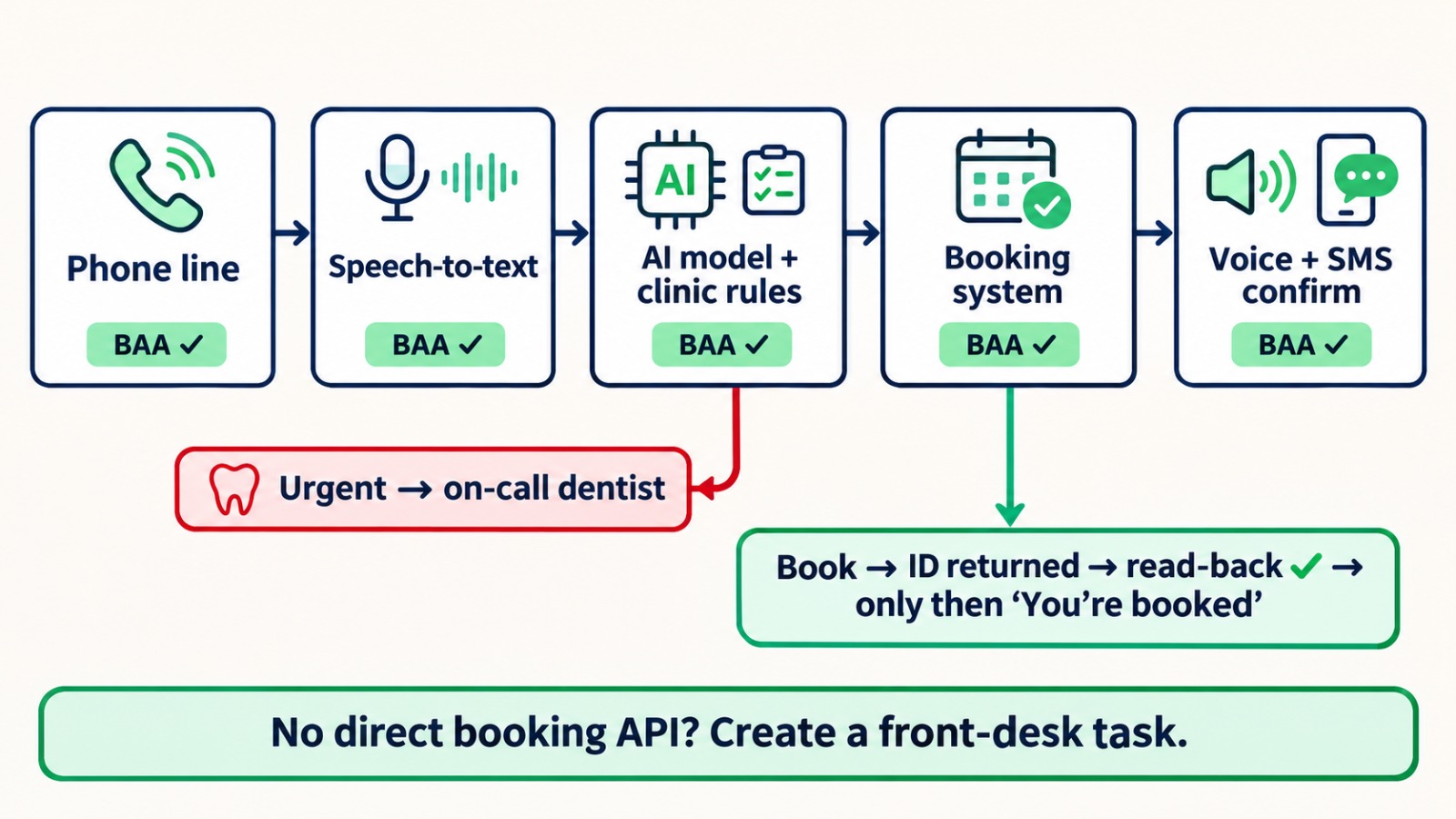
An AI receptionist for a dental clinic connects a phone line, speech recognition, an AI model and the clinic’s booking system. It can book directly with systems such as Open Dental, Dentrix Ascend, Denticon and CareStack. It should confirm a booking only after the system accepts it, send urgent cases to a human, and, in the US, use only vendors that sign a HIPAA business associate agreement.
Key takeaways
Check the clinic’s practice software first, because not every system allows direct booking
Confirm each appointment with the booking system before telling the patient they’re booked
Route urgent symptoms to a human; the agent gives no medical advice
In the US, every vendor that touches patient data needs a signed BAA
Follow one call
At 8:47 PM, a patient calls a small dental clinic in New York after the front desk has closed. An AI receptionist passes that call along like a relay baton. The phone line receives it, and speech-to-text turns the voice into words. The AI model understands the request and checks the clinic’s rules. The booking system records the appointment, and a voice reply and text message confirm it.
Step 1: Check the practice software
Some systems allow direct booking through an API. Open Dental can read open slots and create appointments, though writing needs its paid tier (about $30 per location), and the free tier is too slow for live calls. Dentrix Ascend, Denticon and CareStack also publish booking APIs. Dentrix desktop, Eaglesoft and Curve don’t publish direct booking writes, so for those clinics the agent should capture the request and create a task for the front desk.
Step 2: Write the clinic’s rules
List the appointment types and how long each takes, how new patients are handled, which dentists see which cases, and the opening hours. Open Dental’s API doesn’t check for overlapping appointments, so the agent must do that check itself.
Step 3: Confirm before you promise
The agent should say “you’re booked” only after the booking system accepts the appointment, returns an ID, and a read-back confirms it. If anything fails, it takes the details and alerts the front desk. This is the step that prevents double bookings.
Step 4: Hand urgent cases to a human
Severe pain, swelling or a dental injury should go straight to a person or the on-call dentist. The agent books appointments and answers practical questions. It doesn’t give medical advice.
Step 5: Close the compliance chain
In the US, HIPAA requires a business associate agreement with every vendor that handles patient data: the phone carrier, speech-to-text, the AI model, text-to-speech, the voice platform and any storage.
Twilio signs a BAA on request.
Anthropic’s Claude API and OpenAI’s API offer BAAs under specific settings.
ElevenLabs offers BAAs on Enterprise only.
Voice platforms vary, from self-serve BAAs to paid HIPAA add-ons.
Consumer AI chat apps can’t be used for patient data. In the UK and EU, GDPR sets the rules. Check every vendor’s current terms before you sign.
Frequently asked questions
Trending question: Can AI book dental appointments automatically?
Yes, if the clinic’s practice software allows booking through an API, as Open Dental, Dentrix Ascend, Denticon and CareStack do. Otherwise the AI can take the request and pass it to staff.
Trending question: Is an AI receptionist HIPAA compliant?
It can be, but only if every vendor that handles patient data signs a BAA and is configured correctly. No platform is compliant on its own.
How does an AI receptionist avoid double bookings?
It checks availability, books, and confirms only after the system returns the appointment and a read-back matches.
Will the AI give patients medical advice?
It shouldn’t. A well-built agent books appointments and answers practical questions, and sends anything clinical or urgent to a human.
-

Writen by Anirban Das