USA:
USA:  India: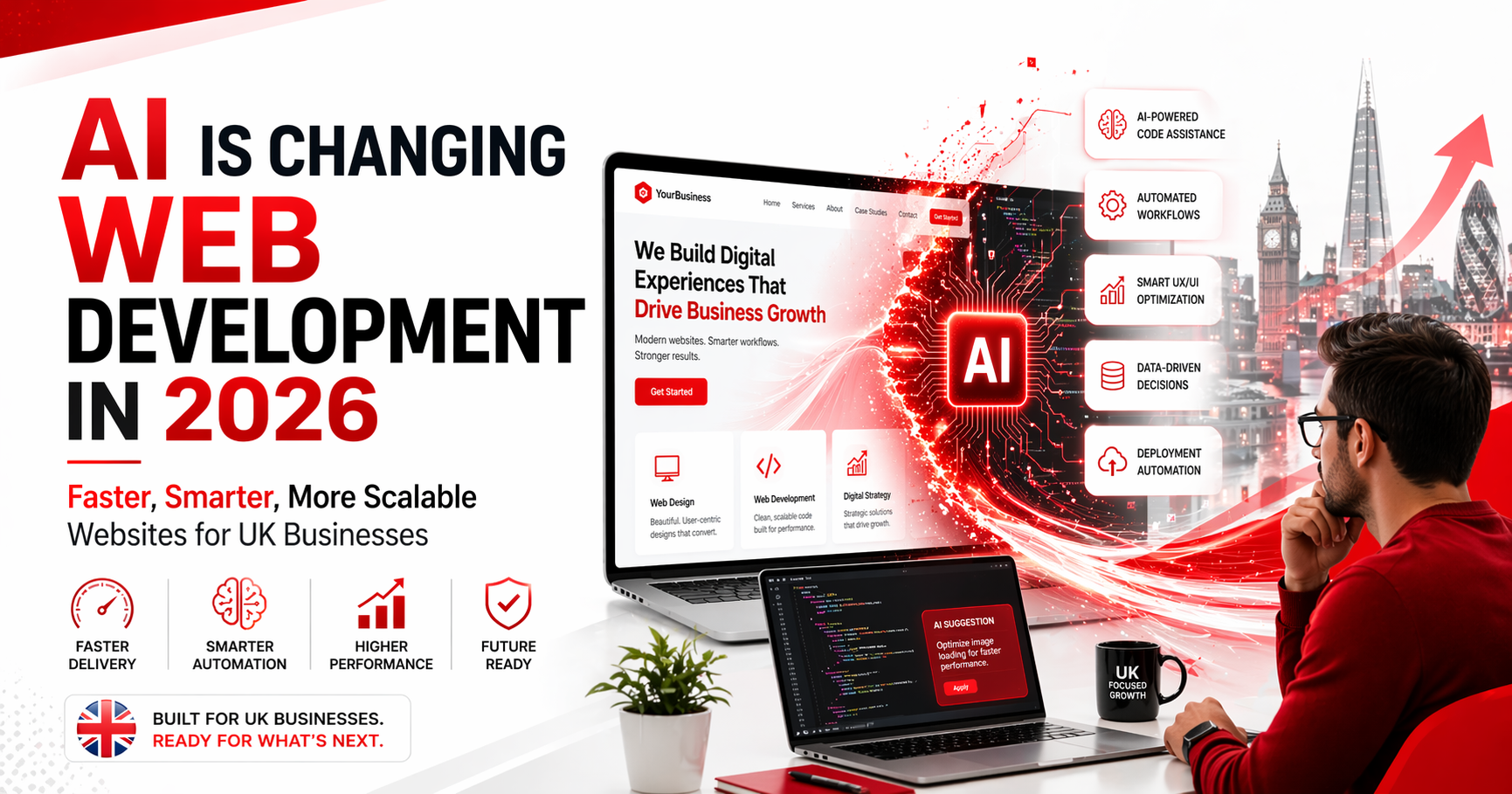
Something Has Changed. Most People Just Haven't Clocked It Yet.
Here's a question worth sitting with for a moment.
When did you last look at your website and think — genuinely think — that it was working as hard as it could be for your business?
For a lot of UK business owners, the honest answer is uncomfortable. The site looks fine. It's technically functional. But it was built two, maybe three years ago, cost more than expected, took longer than promised, and hasn't really been touched since. Sound familiar?
What's interesting isn't that this happens. It's why it keeps happening. Traditional web development services have always been expensive, slow, and heavily dependent on the availability of skilled people who are increasingly hard to find and harder to afford. Those are structural problems — and structural problems tend to persist until something comes along and changes the underlying conditions.
That something, in this case, is AI. And it's further along than most people realise.
Let's Be Honest About What "AI Web Development" Actually Means
Because the phrase has been thrown around so loosely that it's starting to lose meaning.
It doesn't mean you describe your ideal website to a chatbot and collect a finished product twenty minutes later. Anyone selling that story is either confused or not being straight with you. What it actually means — in the hands of a competent agency AI web development agency — is that experienced developers and designers now work alongside AI tools that handle the heavy lifting: writing and checking code, drafting layout options, running performance tests, building in SEO from the ground up rather than patching it on afterwards.
The human expertise is still there. It's just being pointed at the right problems instead of being swallowed up by repetitive tasks that a machine can handle faster and more accurately anyway.
Think about how a good structural engineer works with modern modelling software. The software doesn't know what the building is for. It doesn't understand the client's vision, or the planning constraints, or what the neighbourhood looks like. The engineer brings all of that. The software just removes hours of manual calculation. The output is better than either could produce alone — and that's the whole point.
Why This Is Happening Now, Specifically
Timing isn't accidental. A few things have collided to make 2026 the year this genuinely goes mainstream for any serious web development company in the UK worth paying attention to.
The cost of traditional development has become harder and harder to defend. A bespoke website from a decent UK agency — not a boutique Shoreditch studio, just a solid mid-market shop — typically runs anywhere from £10,000 to £50,000. Timeline? Three to six months, if you're lucky. For a funded startup or a growing enterprise, that's painful but manageable. For most SMEs? It's simply not an option. That's exactly why demand for affordable AI web development services in the UK has grown so sharply in such a short space of time.
Meanwhile, UK consumers have quietly become much less tolerant. Over half of mobile users will leave a site that takes more than three seconds to load. Three seconds. That's not a lot of grace. And beyond speed, people now expect websites to feel relevant to them — the right products, the right offers, content that doesn't feel like it was written for someone else entirely. Delivering that with older development approaches is genuinely difficult.
There's also the developer shortage, which isn't going away. The UK tech sector has been wrestling with a talent gap for years. Rates have gone up. Availability has gone down. AI-powered website development services help smaller, leaner teams produce more — which matters enormously for businesses that can't afford to keep a large technical team on retainer.
And then there's the post-COVID backlog. A huge number of UK businesses intended to sort out their digital presence "when things settled down." Things settled down. The website is still the same as it was in 2021.
What You Actually Get Out of It
Speed that's actually meaningful. Not in a "we shaved two weeks off" kind of way. We're talking about going from a three-month build to two to four weeks. For a business launching a new service, entering a new market, or rebranding before a busy season, that's a genuinely different situation to be in.
Lower cost without lower quality. This is the one people tend to be sceptical about, understandably. But the savings from working with an affordable AI web development company come from cutting inefficiency — not from cutting expertise. You're paying less for code that a machine can write accurately in minutes. The strategic thinking, the design judgement, the understanding of your customers — that's still provided by people. You're just not paying developer day rates for the parts that don't require it.
Personalisation that used to be out of reach. Showing different content to different visitors based on where they are, what device they're on, what they've looked at before — that was previously the preserve of large eCommerce businesses with dedicated engineering teams. AI web development services in the UK have made it accessible to companies of almost any size. For UK retailers especially, that capability tends to show up directly in conversion rates.
Less ongoing maintenance anxiety. Automated performance monitoring, AI-assisted testing, content updates that don't require a support ticket and a two-week wait — a well-built AI-assisted website keeps working without needing constant human intervention. That matters a lot for businesses that want a website that performs consistently, not just on launch day.
A structure that scales. Traffic spike from a piece of press coverage? New product lines being added? A sudden shift in how the business operates? The best work coming out of any AI-powered web development company is built to handle that kind of growth without needing to be ripped out and rebuilt every eighteen months.
A Few Real Examples Worth Looking At
A fashion retailer in the Midlands worked with an AI web development company in the UK to add AI-powered product recommendations and dynamic pricing to their website. Within six months, their average order value had risen by around a third and their bounce rate had dropped considerably. Not because the products changed — because the website got better at showing the right things to the right people.
A Birmingham accountancy firm needed a professional, GDPR-compliant website without the kind of budget a traditional agency would have required. AI website development services UK got them live in under three weeks, at roughly 40% of what they'd been quoted elsewhere. Within 90 days, they were on page one of Google for their primary search terms.
A London fintech startup had investor demos booked and needed something polished to show. Eighteen days later, they had a high-performance, analytics-integrated marketing site ready to go. That would have been unthinkable with a traditional development process — and it's exactly the kind of result that's made people start paying proper attention to what the best AI web development company in the UK can actually deliver.
Where AI Makes the Biggest Difference Inside the Build
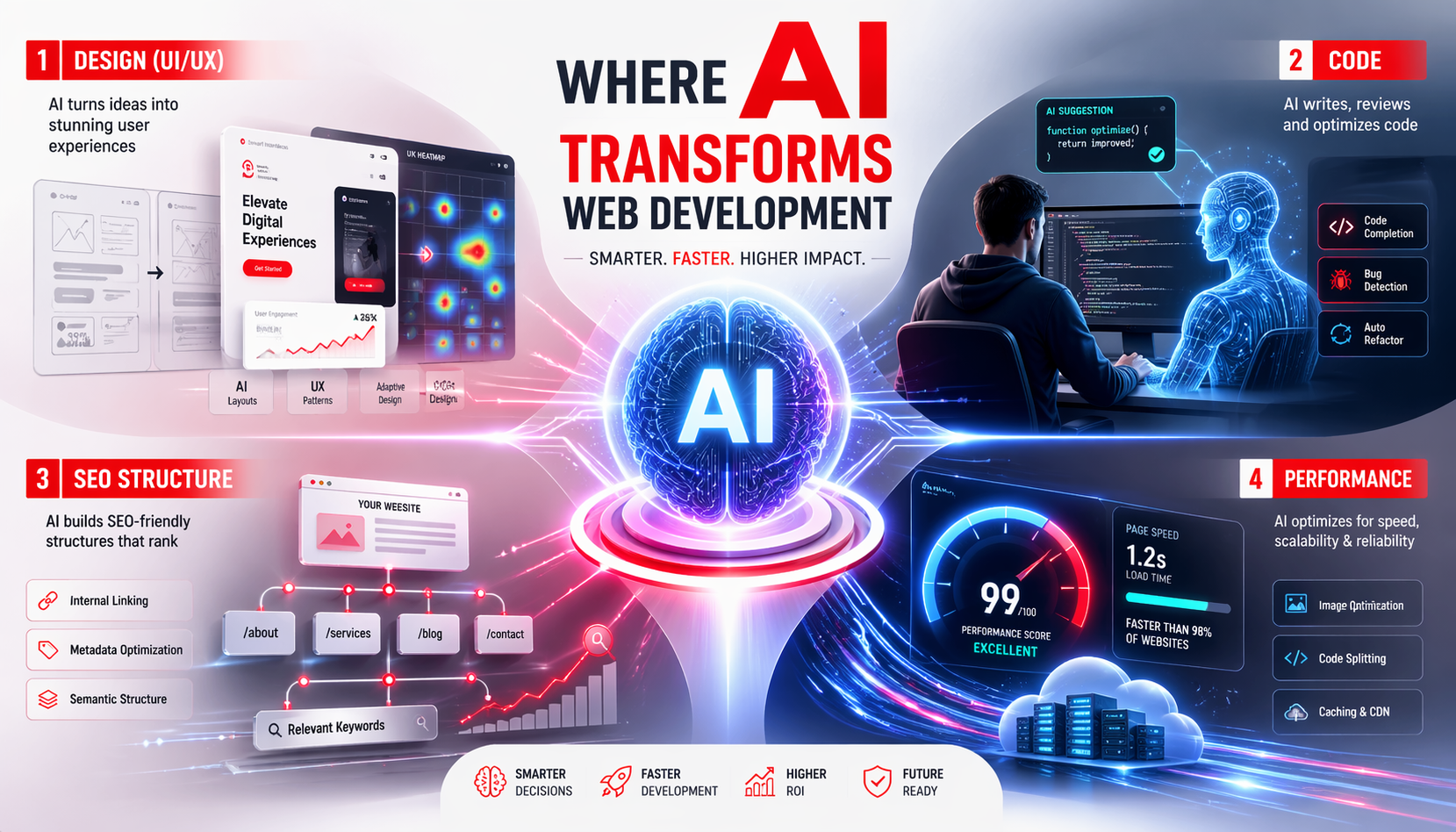
In design. Good AI design tools don't just guess at what looks nice. They analyse what has actually worked — across thousands of comparable websites, in your sector, for your type of audience — and apply those patterns to your layouts. Call-to-action placement, information architecture, colour, and typography choices — all grounded in data rather than aesthetic preference. The results tend to look human and feel considered, because the underlying logic is sound.
In code. AI coding tools write, review, and refactor across multiple languages and frameworks. They catch bugs before they cause problems in production. They maintain consistency across large projects. And they dramatically reduce the kind of technical debt that builds up quietly and then creates expensive headaches a year down the line.
In SEO. When SEO is treated as a structural consideration from day one — semantic HTML, proper metadata, internal linking logic, Core Web Vitals — the results are meaningfully better than when it's added as an afterthought by someone running a plugin after the fact. A proper AI web development agency in the UK bakes this in from the start. For businesses targeting competitive search terms, that's a real and measurable advantage.
In performance. Page speed affects both user experience and Google rankings simultaneously. AI systems monitor loading times, image compression, server response, and caching continuously, adjusting automatically rather than waiting for someone to notice the numbers have slipped.
The Limitations — And You Deserve a Straight Answer on These
AI tools are only as useful as the people directing them. Without genuine strategic input, it's entirely possible to produce a website that is technically polished but strategically incoherent — one that doesn't reflect what the business actually does, who it's trying to reach, or what it needs people to do when they arrive. That's not an AI problem. It's a process problem. But it happens, and it's worth knowing it can.
Complex platforms — multi-sided marketplaces, applications in regulated sectors like finance or healthcare, anything with genuinely unusual technical requirements — still need substantial human engineering involvement. Working with the right web development company means they'll be upfront about this rather than overpromising. AI makes that work faster. It doesn't replace the specialist knowledge required to do it properly.
AI personalisation also needs good data to work from. A relatively new website without much traffic yet won't see the full benefit of AI-driven features until the data foundation is stronger. That's not a reason to avoid it — it's just a realistic expectation to set.
And any AI-generated design still needs to be checked against WCAG accessibility standards and UK regulatory requirements, GDPR included. That's not something you can fully automate, and any agency that implies otherwise should be pressed on it.
Where Things Are Heading Over the Next Few Years
The trajectory is fairly clear, even if the exact shape is hard to predict.
By 2027, websites that actively optimise themselves — adjusting copy, restructuring layouts, refining targeting based on live performance data — will be standard practice rather than a novelty. By 2028, the distinction between a "website" and an "intelligent application" will have largely dissolved for most businesses. By the end of the decade, conversational interfaces, voice-first design, and genuine predictive personalisation will be baseline expectations.
Businesses that get serious about AI-assisted development in 2025 and 2026 will be a meaningful step ahead. Those who wait will spend years trying to close a gap that keeps moving.
Choosing an Agency — What Actually Matters
"AI-powered" has become a badge that a lot of agencies are sticking on their websites without much to back it up. Here's what to actually dig into when you're evaluating any AI-powered web development company you're considering working with.
Do they have a track record with UK businesses? Not just international work — UK-specific experience, which means understanding GDPR compliance, UK hosting preferences, and how local search actually works here.
Can they talk fluently about the human expertise behind their AI use? An agency that can't articulate what its team brings to the table beyond the tools is a concern.
Do they handle the full lifecycle? Strategy, design, development, SEO, post-launch optimisation — or are significant pieces being outsourced to parties you'll never meet?
Is the pricing actually reflecting the genuine efficiencies AI delivers? Or have they just repackaged old agency pricing with new language? The best AI web development company in the UK won't need to inflate margins to make their model work — the efficiency gains are real enough.
ZTS Infotech — For UK Businesses That Want It Done Properly
ZTS Infotech Pvt Ltd has built a genuine track record as a trusted AI web development company in the UK for businesses across the United Kingdom, the US, the UAE, Europe, and Australia. Their work combines real AI capability with the kind of strategic and creative thinking that makes the difference between a technically impressive website and one that actually grows a business.
For UK clients specifically, they deliver AI website development services in the UK that cover the full picture: AI-assisted UX and UI design, rapid development workflows, SEO engineered into the build from day one, Core Web Vitals and accessibility work, and ongoing optimisation that continues well after launch.
Whether you're a startup building a serious digital presence for the first time, an SME whose current site is genuinely underperforming, or a larger organisation trying to integrate AI capabilities into something more complex, they have the experience and the tools to help.
Worth Starting a Conversation
The difference between businesses embracing AI web development now and those that haven't is already visible — in search rankings, in page speed, in how their websites handle traffic and convert visitors. That gap will keep growing.
If you want to understand what's actually possible for your business — properly, without jargon — ZTS Infotech offers a free, no-obligation consultation with their UK-focused team.
Visit their AI Website Engineering UK page, or reach out directly. Worth an hour of your time.
FAQs
Q1. What is an AI web development agency?
An AI web development agency uses artificial intelligence tools alongside real developers and designers to build websites faster, cheaper, and smarter than traditional methods — without removing the human expertise behind the decisions.
Q2. Are AI web development services in the UK suitable for small businesses?
Absolutely. AI web development services in the UK were practically made for smaller businesses — bringing professional-grade websites within reach of budgets that traditional development would have made impossible.
Q3. How affordable is an AI web development company compared to traditional agencies?
Working with an affordable AI web development company typically costs 30–50% less than a conventional agency. The savings come from cutting inefficiency, not quality.
Q4. How fast can an AI web development company in the UK deliver a website?
Most projects handled by an AI web development company in the UK are delivered in two to four weeks, compared to the three to six months a traditional agency typically takes.
Q5. What do AI-powered website development services include?
AI-powered website development services cover design, coding, SEO, performance optimisation, accessibility compliance, and ongoing post-launch improvements — all under one roof.
Final Thoughts: The Clock Is Already Ticking
Here's the uncomfortable truth no one wants to say out loud — your competitors are not waiting for you.
While you're still deciding whether AI web development is "right for your business," someone in your sector is already ranking above you on Google, loading faster on mobile, and converting visitors you never even got a chance to speak to. Not because they're smarter. Because they moved sooner.
The businesses that thrived after the internet went mainstream weren't the ones who understood it best — they were the ones who stopped overthinking and started building. What's happening with AI in 2026 is no different.
You don't need a perfect plan. You need a better website — one that works while you sleep, adapts while you're busy, and grows while you're focused on everything else running your business demands.
The technology is ready. The agencies that know how to wield it properly exist. The only variable left is whether you're the business that acts now, or the one that spends 2027 playing catch-up.
That choice is entirely yours. But it won't be available indefinitely.
-

Writen by Anirban Das