USA:
USA:  India:
 .png)
There's a kind of business loss that never shows up on a report.
It doesn't get flagged in your quarterly review. Your accountant won't find it. But it's happening — every single day — on your website.
A potential customer lands on your page. Maybe they found you through a Google search, or someone referred them, or they saw your ad. They spend four seconds looking around. Then they leave. They don't fill out the form. They don't call. They don't buy. They just... go somewhere else. And you never know it happened.
That's the quiet loss. And for most US businesses in 2026, it's bigger than they think.
Here's the uncomfortable truth: the web has moved fast, and most business websites haven't kept up. What felt like a solid digital presence in 2021 or 2022 is, in many cases, quietly underperforming today — not because the business got worse, but because the expectations of users, and the standards of search engines, have raised the bar significantly.
AI-powered web development is what's raising that bar. And understanding it — really understanding it, not just the buzzword version — is one of the more important things a US business owner can do right now.
If you've been searching for a reliable web development company in the USA or trying to figure out whether AI web development services in the USA are actually worth the investment, this is the piece that answers both of those questions honestly.
So let's get into it. No jargon. No filler. Just what's actually changing and why it matters.
What AI Web Development Actually Is — Because Most Explanations Miss the Point
Every agency website right now has some version of "we use AI to build better websites." It's become nearly meaningless.
So let's strip it down.
Traditional web development is skilled manual labour. A designer makes decisions based on their experience and aesthetic instincts. A developer writes code line by line. An SEO consultant reviews the site after it's built and makes a list of fixes. A project manager keeps everyone coordinated. It works — but it's slow, it's labour-intensive, and once the site goes live, it more or less stays exactly as it is until someone budgets for another round of work.
AI-powered development doesn't replace those people. What it changes is what those people spend their time doing.
The predictable, repetitive work — scaffolding components, writing responsive code for twelve screen sizes, running performance tests, monitoring for security issues — gets handled by intelligent tooling at a fraction of the time. That frees skilled humans to focus on the decisions that actually require judgment: strategy, user psychology, brand differentiation, and content architecture.
The result, for a business owner, is pretty simple. A better website. Built faster. One that doesn't just sit there after launch but keeps being refined. And one that costs less to maintain over the long run because problems get caught before they become expensive.
That's AI web development. Not magic. Not hype. Just a smarter way to build — and exactly what separates a genuine AI web development company in the USA from one that's just borrowed the language.
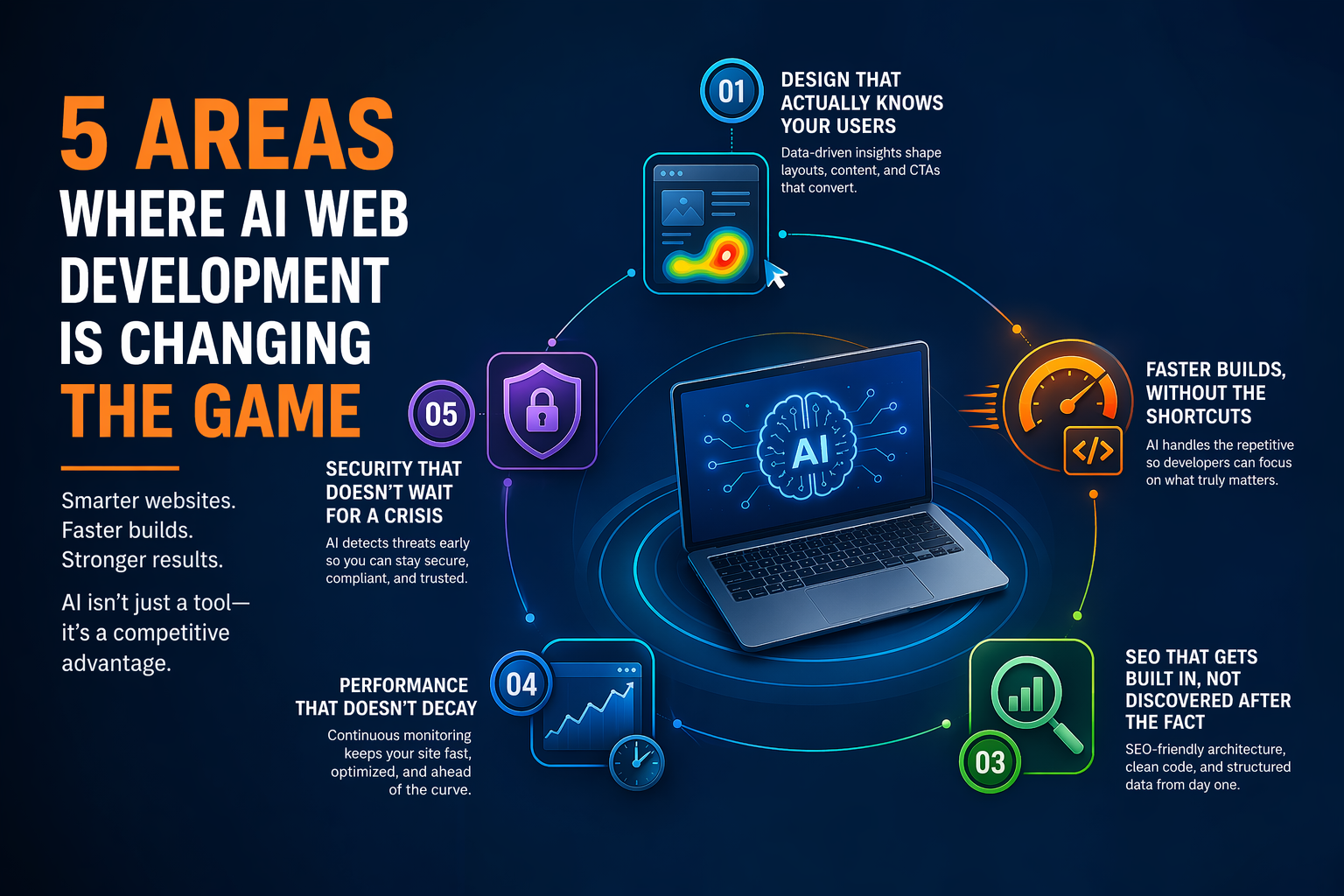
The Five Areas Where This Is Changing the Game
1. Design That Actually Knows Your Users
Here's something most people don't realize about traditional web design: a significant amount of it is guesswork.
Good guesswork, made by experienced designers who've studied user behaviour and built hundreds of sites. But it was nonetheless.
AI-informed design changes that. Instead of imagining how users will interact with a page, the design process gets fed real data — heatmaps, scroll depth, session recordings, click patterns, exit triggers. That data shapes decisions about where the headline goes, what the call to action says, how long a page should be, and which images actually build trust versus which users skip right past.
For a business owner, this matters because design quality isn't really about aesthetics — it's about whether visitors take the action you want them to take. A beautiful site that doesn't convert is just expensive decoration.
2. Faster Builds, Without the Shortcuts
Nobody likes hearing that quality takes time. It's true, but it's frustrating.
AI-assisted development is one of the first genuine solutions to that tension. The reason development projects take so long isn't that developers are slow — it's that a huge portion of development work is boilerplate. Repeatable. Predictable. The kind of code that has to be written carefully, but doesn't require creative thinking.
When intelligent tools handle that layer, skilled developers get to spend their hours on the custom logic that actually differentiates a product. Projects that used to run four to six months are now being delivered in eight to ten weeks — not because corners are being cut, but because the time spent on non-creative work has been dramatically compressed.
For startups with a burning runway, that timeline difference is enormous. For established businesses that have been pushing a redesign to next quarter for the past two years, it removes the excuse.
3. SEO That Gets Built In, Not Discovered After the Fact
Let's talk about one of the most expensive mistakes in web development.
A company spends $40,000 on a new website. It looks great. The team is thrilled. They launch it, and six weeks later, they get a report from their SEO agency listing a hundred and twelve technical issues that are preventing the site from ranking properly.
That's not a hypothetical. It happens constantly. And it happens because most development teams treat SEO as someone else's problem — something that gets addressed after the build, not during it.
An experienced AI web development agency understands that technical SEO is a structural discipline — and any AI website development services in the USA worth their price will prove it by showing you how SEO is addressed during the build, not after. The site's URL architecture, internal linking logic, page speed decisions, semantic markup, and schema implementation — all of this gets designed in from week one. Not bolted on afterwards.
For US businesses trying to build organic search traffic that doesn't vanish when an ad campaign pauses, the difference between a site built with SEO foundations and one without them compounds dramatically over time. Months two, six, and eighteen look very different depending on which kind of site you launched.
4. Performance That Doesn't Decay
Websites slow down. It's a boring fact that most business owners don't find out until it's already a problem.
More content gets added. More integrations get layered in. A plugin gets updated and conflicts with another. The homepage that loaded in 1.8 seconds at launch is now taking 4.2 seconds eighteen months later — and nobody noticed because it happened gradually.
AI-driven performance monitoring works against this. Load times, Core Web Vitals scores, image optimization, script execution, server response — these get tracked continuously and flagged when they start drifting in the wrong direction. Not after a user complains. Not after Google drops your rankings. Before.
For any business where the website is a revenue channel — which, in 2026, is most businesses — this sustained performance has real financial value attached to it.
5. Security That Doesn't Wait for a Crisis
Most small and mid-sized US businesses operate with reactive security. Something breaks or gets compromised, and then they act.
AI-powered monitoring flips that posture. Unusual traffic spikes, unauthorized access attempts, vulnerability exposures in third-party code — these get surfaced and addressed before they escalate. For businesses handling customer data, processing payments, or operating under any form of compliance obligation, this shift from reactive to proactive isn't a luxury. It's due diligence.
Why This Is Happening Now in the US Market — Not Three Years From Now
A few things have converged to make 2026 a particularly important moment for US businesses, specifically.
The cost of doing nothing has gotten real. Two or three years ago, a mediocre website was a drag on performance but not necessarily a crisis. Today, in most US verticals, the gap between businesses with strong digital infrastructure and businesses without it is wide enough to affect outcomes meaningfully. Customers notice. Search engines notice. The gap compounds.
Domestic development talent is expensive and hard to find. Senior web developers in US cities command salaries that put quality development out of reach for many businesses. AI-assisted development changes the productivity equation for skilled teams — which means businesses can access genuinely high-quality work at price points that weren't available before.
The timeline barrier is gone. One of the most common reasons US businesses delay a website overhaul is the timeline. Six months feels like a long time to be in the middle of a major project. When the realistic timeline compresses to eight or ten weeks, the decision to move forward gets much easier to make. This is especially true for founders — a good AI web development agency for startups in the USA can get a high-quality, performance-ready site to market before a slower traditional agency has even finished scoping.
Competitors are already moving. This one is harder to quantify but worth naming. The businesses in your market that started investing in AI-powered web infrastructure in 2024 and 2025 have had a year or two of compounding advantage. Every month that passes without a deliberate response to that is a month of further gap.
What the Business Outcomes Actually Look Like
Here's where it's worth getting concrete, because "better website" is too vague to act on.
Businesses that make this shift typically see measurably higher conversion rates — not because the new site looks nicer, but because it's been built around how real users actually behave. They see stronger organic search performance because the technical foundation supports ranking rather than creating friction against it.
They spend less on emergency fixes. They have fewer "the site is down" moments. They stop having the conversation about "we need to rebuild this again" every eighteen months because the architecture was built to scale, not just to handle today's traffic.
And perhaps most importantly: the site keeps improving. Rather than a static product that ages from launch day forward, an AI-powered web infrastructure is one that gets refined based on real performance data over time. The site you have at month twelve is meaningfully better than the one you launched.
What to Look For When You're Evaluating Companies
The market is legitimately full of agencies that have added "AI-powered" to their positioning without changing much about how they actually work. Here's how to tell the difference.
Ask for specifics, not language. "We use AI throughout our process" is meaningless. Ask which tools, at which stages, for which specific problems. A team that actually does this work will be able to explain it concretely. A team that doesn't will pivot to portfolio images.
Test their SEO thinking. Ask them to walk you through how technical SEO decisions are made during a build — not as an add-on service, but as part of the architecture. If they treat SEO as something the client handles separately, that's a structural problem with how they build.
Find out what happens after launch. Most agencies are structured around project completion. Once the site ships, the relationship ends. Ask explicitly what ongoing support, monitoring, and optimization looks like. The answer tells you a lot about how they think about their work.
Don't over-optimize on price — but do look for value. The cheapest option in this space is rarely cheap once you factor in what gets missed, what breaks, and what has to be redone. That said, finding affordable AI web development services in the USA is genuinely possible — you don't have to choose between quality and a budget that makes sense for your business. The best AI web development company in the USA for your situation isn't necessarily the most expensive one. It's the one that's transparent about what their pricing includes, honest about the trade-offs, and able to show you outcomes — not just deliverables. Find companies that are upfront about what they charge and why. An affordable AI web development company in the US market absolutely exists. But "affordable" and "cheap" are not the same thing.
About ZTS Infotech — Worth a Genuine Look
ZTS Infotech Pvt Ltd has built a focused practice around exactly this kind of work — AI-powered website development services in the USA for businesses that want performance, strategic thinking, and long-term value without the overhead of a large domestic agency.
If you've been trying to identify the best AI web development company in the USA for your specific situation — one that actually delivers on the promise rather than just the pitch — ZTS Infotech is a name worth putting on that list. They're not the loudest voice in the market. But they're one of the more consistent ones.
They work specifically with US clients: founders, marketing leaders, and enterprise teams who need a development partner with real fluency in the US market — not just technically, but strategically. What US users trust. What US search engines reward. What a US business actually needs to see from its website before the investment makes sense.
For startups that need to move fast without burning through budget on a six-month build cycle, and for established businesses that need to upgrade infrastructure without the disruption of a massive project, their AI web development services in the USA offer a delivery model worth understanding.
Their AI website engineering services for US clients: https://www.ztsinfotech.com/service/ai-website-engineering-usa
One Last Thing — And It's the Most Important Part
If you've read this far, you probably already know that your website needs attention. Most business owners do. The question is never really "should we do something about this?" It's "when, and with whom, and how do we make sure it actually moves the needle?"
Here's the honest answer to the timing question: the businesses that will look back on 2026 as the year they made a smart infrastructure decision are the ones making that decision now. Not because there's a deadline. But because every month of compounding advantage that a well-built AI-powered website creates is a month that a competitor who moved earlier keeps adding to their lead.
You can close that gap. It's still closeable. But it closes a little more with every quarter that passes.
The good news is that doing something real about it — something that actually changes outcomes rather than just replacing one mediocre website with another — is more accessible than ever.
Ready to have an honest conversation about what your website should actually be doing for your business?
ZTS Infotech Pvt Ltd works with US businesses that are serious about building digital infrastructure that performs — not just looks good. If that's what you're after, reach out.
Start the Conversation — ZTS Infotech AI Web Development Services USA
FAQs
Q1. What is an AI web development company in the USA?
An AI web development company in the USA uses artificial intelligence tools to design, build, and optimize websites faster and more accurately than traditional methods. Instead of manual, one-time builds, AI handles repetitive tasks — freeing developers to focus on strategy, custom logic, and performance. The result is a smarter website that improves over time, not just at launch.
Q2. Are AI web development services in the USA worth it for small businesses?
Yes. AI web development services in the USA reduce build time, lower long-term maintenance costs, and produce stronger SEO foundations — all of which matter more when budgets are tight. Small businesses get enterprise-level website quality at a price point that previously wasn't accessible to them.
Q3. How do I find the best AI web development company in the USA?
The best AI web development company in the USA will explain specifically how AI is used in their process — not just claim it. Ask about SEO architecture during the build, post-launch monitoring, and what happens six months after your site goes live. If their answers are vague, keep looking.
Q4. What makes AI-powered website development services different from traditional web development?
Traditional web development is largely manual and static — built once, updated occasionally. AI-powered website development services continuously optimize design, performance, SEO, and security based on real user data. The site gets better over time rather than slowly going stale.
Q5. Is there truly affordable AI web development in the USA without compromising quality?
Yes, but affordable and cheap are not the same thing. Affordable AI web development services in the USA exist because AI tooling reduces the hours needed for repetitive work, passing those savings to the client. Always ask what's included in the price and what trade-offs are being made to hit a lower number.
Final Thoughts: Your Website Is Either Working For You — Or Against You
Your website isn't just a digital address anymore — it's either closing deals or costing you them.
In 2026, the gap between businesses with smart, AI-powered web infrastructure and those without it isn't closing — it's widening. Every day without a high-performing website is a day your competitors are quietly pulling ahead.
The good news? Catching up has never been more accessible. The only real question is: how much longer can you afford to wait?
-

Writen by Anirban Das