USA:
USA:  India:
 The problem on a Montreal managing partner's desk
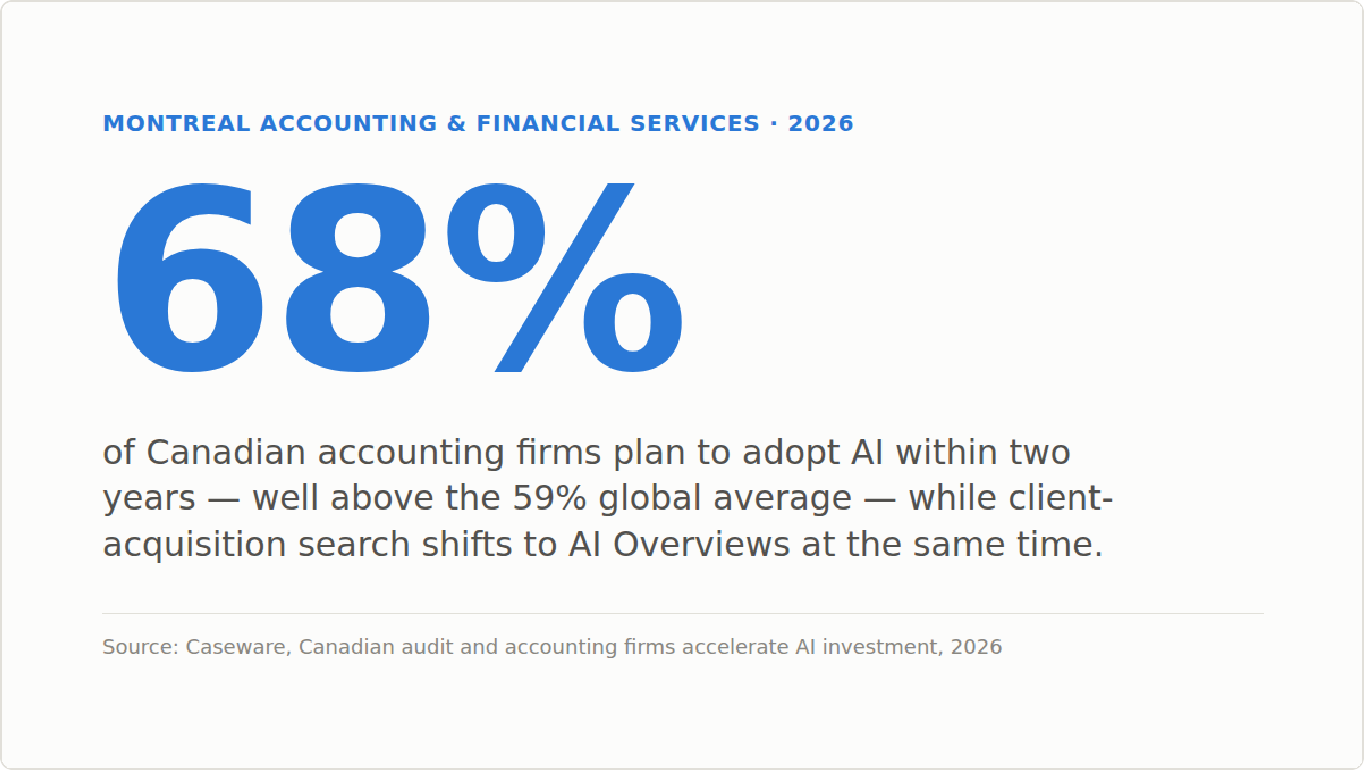
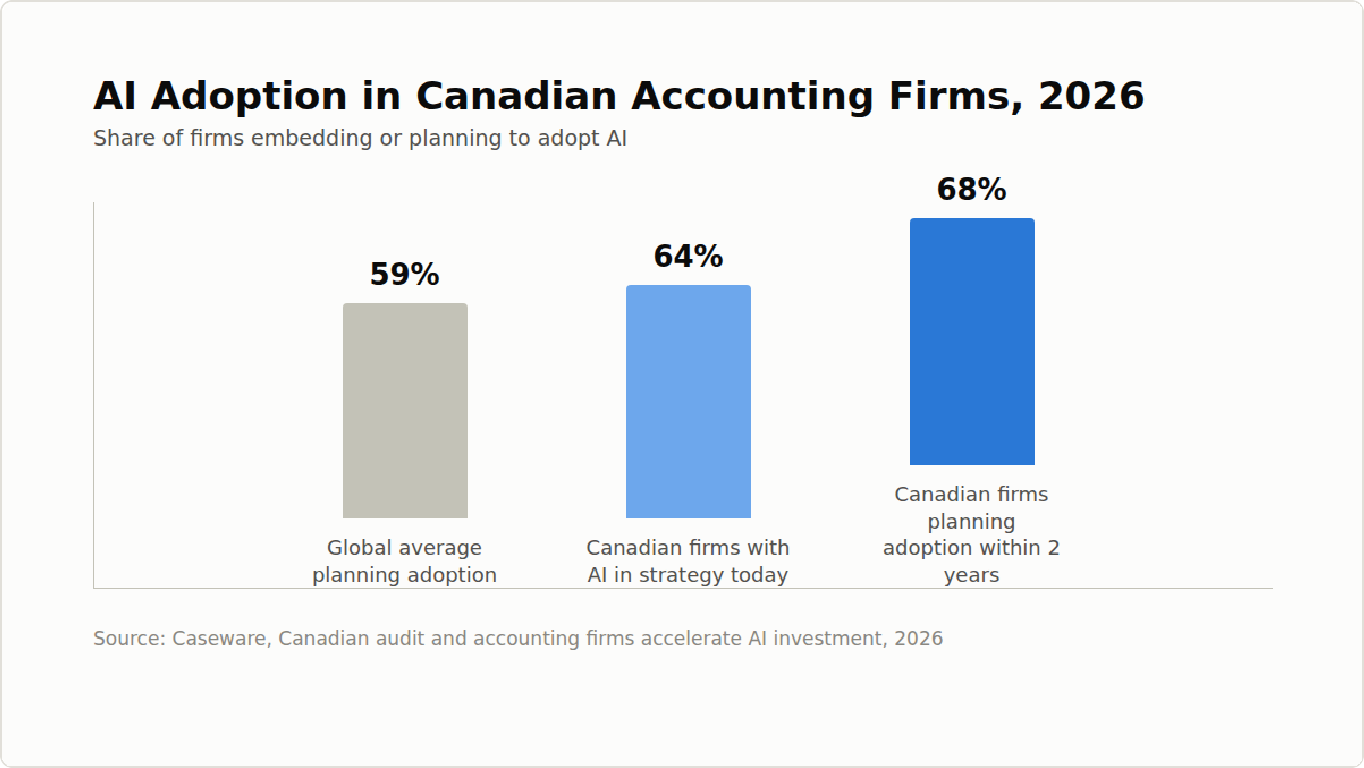
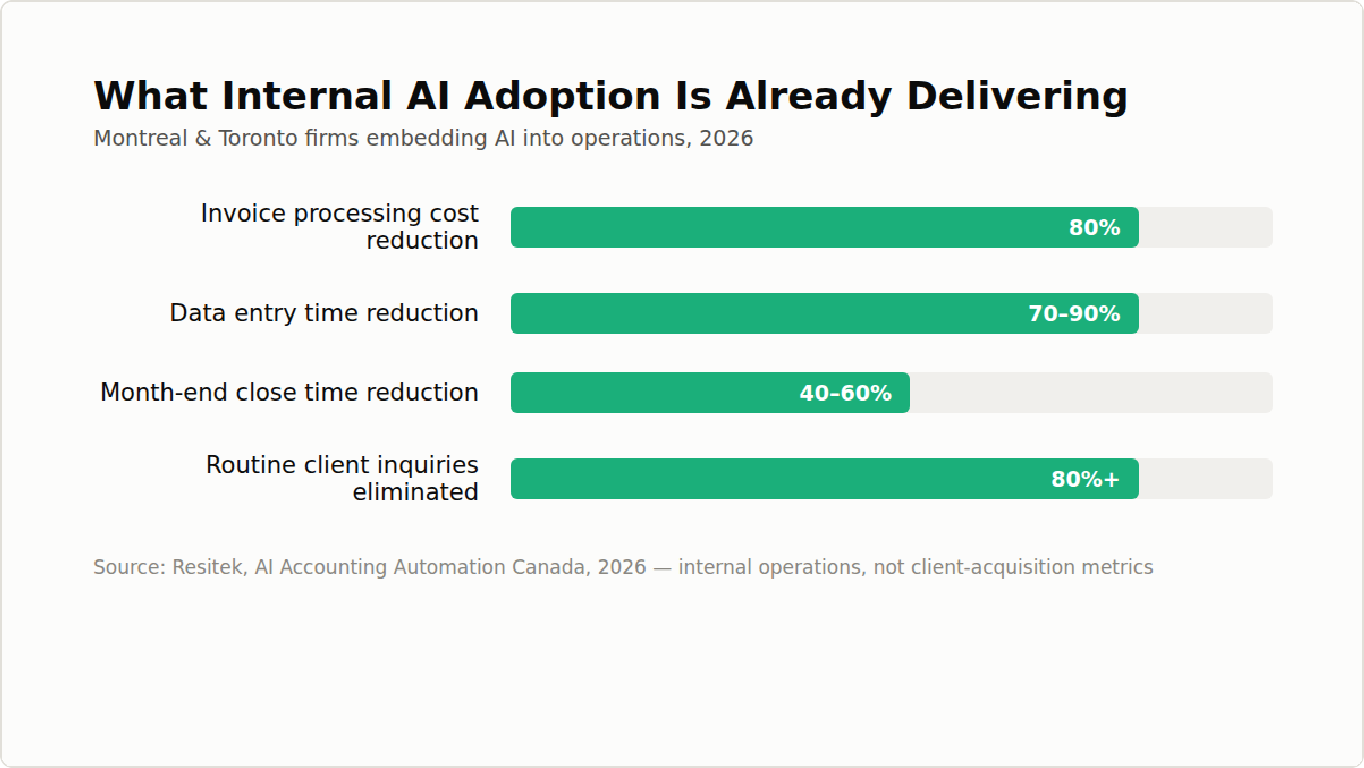
Quebec's accounting sector is in the middle of two shifts at once. Internally, firms are automating: Montreal and Toronto practices embedding AI into their workflows are now reporting 80% cost reductions on invoice processing, a 40–60% drop in month-end close time, and 10–20 hours per week per accountant freed up for advisory work rather than data entry. Nationally, 64% of Canadian firms have already embedded AI into firm strategy or have pilot
projects underway, and 68% plan to adopt AI within two years — well above the global average of 59%.
Internal automation is the story most firms are focused on. But there's a second shift happening at the same time, on the client-acquisition side, that gets far less attention from managing partners — and it's arguably more urgent,
because it determines whether a prospective client ever discovers the firm in the first place.
What changed in 2026
Search behavior has moved decisively toward zero-click results. In early 2026, roughly 64–68% of Google searches resolve without a click at all, and when Google's AI Overview appears — which now happens on more than 20% of queries — the zero-click rate climbs to around 83%. Queries like "best accounting firm for a small business in
Montreal," "how to choose an accountant for a startup," or "CPA vs. accountant Quebec" are exactly the informational, comparison-style queries AI Overviews are built to answer directly on the results page.
For a Montreal accounting firm, that means the traditional top of the client-acquisition funnel — a prospective client researching options before ever contacting a firm — increasingly resolves inside Google's AI layer or a conversational assistant, with no click, no site visit, and no trace in the firm's analytics.
The executive problem this creates
For a managing partner or director of business development, this changes the client-acquisition equation in three ways:
- Discoverability now depends on being cited, not just ranked. A firm that ranks well in traditional search but isn't structured clearly enough to be summarized and cited by an AI Overview or assistant becomes effectively invisible for exactly the research-stage queries that used to build the top of the pipeline.
- The visitors who do click convert better. AI-assisted research shows that clicks surviving an AI Overview convert roughly 23% higher, because the prospect has already been pre-educated and is seeking something specific — a consultation, a fee structure, a service comparison — rather than general information.
- Trust signals matter more, not less. Choosing an accounting firm is a high-trust decision involving data security and regulatory competence. AI systems tend to favor sources with clear, well-structured credentials, service descriptions, and client-relevant content — meaning firms with thin or generic websites lose visibility even if their actual expertise is strong.
How AI is changing how businesses choose a firm
- Conversational, comparison-driven research. A business owner evaluating firms increasingly starts with a conversational query — "which Montreal accounting firms handle e-commerce clients" — rather than a firm-name search. Firms only appear in that answer if their site content directly and clearly addresses the specific client type, service, or industry being asked about.
- Generative Engine Optimization (GEO) becomes a client-acquisition discipline. Traditional SEO still matters, but it's no longer sufficient on its own. Firms need service pages, FAQs, and credential content structured so AI
- systems can extract and cite them accurately — clear statements of specialty, service area, and client fit, not broad generic marketing copy.
- Website experience becomes the trust layer. Because fewer, higher-intent prospects are reaching the site directly, the site itself has to do more work per visit: fast load times, clear service structure, and content engineered for both human readers and AI systems. A firm's website is now simultaneously its storefront and its AI-visibility
infrastructure — a materially different engineering problem than a traditional marketing site.
The executive questions this raises
- For the managing partner: How does this affect client acquisition and revenue? Firms that only optimize internal workflows with AI while leaving their client-acquisition presence built for 2023-era search are automating their delivery while losing visibility on the intake side — a mismatch that shows up as flat or declining new-client
pipeline even as service delivery gets more efficient.
For the director of business development: What should we measure now? AI citation share for comparison and specialty queries relevant to the firm's target client (e.g., "accountant for a Quebec startup," "CPA for e-commerce business Montreal") is becoming as important a metric as organic ranking position.
- Note on scope: this shift is about how firms are discovered and evaluated — it is not financial or tax advice, and firms should continue to rely on qualified professional judgment for client-specific guidance. The trend described here is about marketing, technology, and client behaviour, not
- accounting practice itself.
Where the opportunity sits
- Montreal firms that pair their internal AI adoption with an AI-visible, well-engineered website stand to capture a
- disproportionate share of the smaller, higher-intent pool of prospects still clicking through. That requires rebuilding service pages and site architecture around AI-era discovery — structured, specific, citable content — rather than defending traditional keyword-ranking tactics alone. This is the specific gap AI-focused website engineering closes for Montreal accounting and financial services firms: building a site that functions as both a client-facing storefront and a structured, AI-legible source of firm credibility. Firms evaluating this can review how an AI-engineered
website approach applies to their own client-acquisition funnel at ztsindia.com/service/ai-website-engineering-montreal.
hat to watch over the next 12–24 months
- Expect zero-click rates on comparison and "how to choose" queries to keep climbing, expect AI assistants to take a larger role in shortlisting firms before any direct contact happens, and expect the Montreal firms that gain client
- share to be the ones whose websites are engineered to be read by AI systems as clearly as they are read by
- prospective clients.
-

Writen by Anirban Das