USA:
USA:  India:
 Google's AI Overviews now sit on top of shopping searches, ChatGPT and Perplexity are sending qualified buyers straight into product pages without a click on Google, and AI shopping agents are starting to compare and even purchase on a customer's behalf. For Montreal ecommerce and retail leaders, this is no longer a marketing footnote — it is a shift in how product data, site architecture and checkout systems need to be engineered to stay
revenue-relevant.
What Changed in 2026
For most of the last two decades, the ecommerce customer journey followed a predictable arc: a shopper typed a query into Google, scanned ten blue links, clicked through to a handful of retailer sites, and compared products across open tabs. That arc is breaking apart.
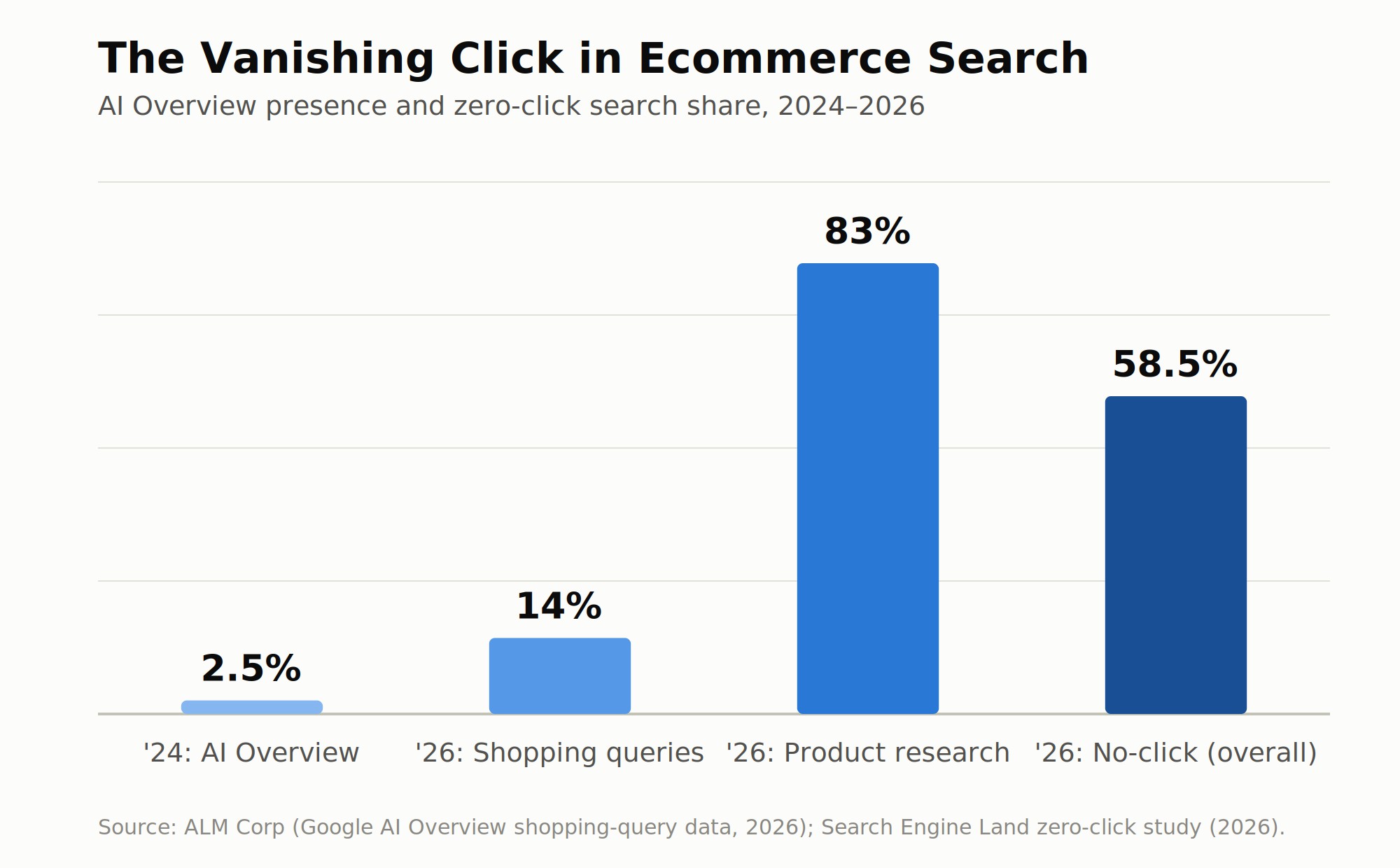
By early 2026, AI Overviews were appearing on roughly 14% of shopping-related Google queries — a 5.6x increase from November 2024 — and on as much as 83% of informational product-research queries such as "best running shoes for flat feet" (ALM Corp). Across all Google searches, 58.5% now end with no click at all, rising to roughly 75% on mobile, and Google's experimental AI Mode produces a zero-click rate of 93%, with three-quarters of those sessions never leaving Google's own interface (Search Engine Land; Pasquale Pillitteri). Pew Research found that when an AI summary appears, users click through to a traditional result only 8% of the time, versus 15% when no summary is shown.
Layered on top of this is agentic commerce: AI agents that research, compare and, increasingly, transact on a shopper's behalf. The agentic AI market is estimated to have grown from roughly $5–7 billion in 2025 to over $15 billion in 2026, with Morgan Stanley projecting that nearly half of online shoppers will use an AI shopping agent by 2030, representing about a quarter of their spending (commercetools; nshift). OpenAI's own attempt is instructive of how unsettled this still is: ChatGPT Instant Checkout launched in September 2025 with Etsy and over a million Shopify merchants via the Agentic Commerce Protocol built with Stripe, but by February 2026 only about 30 Shopify merchants were actually transacting through it, partly because OpenAI had not solved state sales-tax remittance. In March 2026, OpenAI pivoted toward in-ChatGPT retailer apps that hand the customer back to the retailer's own checkout rather than completing the purchase inside the chat window (CNBC; Retail Dive).
The takeaway for executives: AI-mediated discovery is real and growing fast, but AI-mediated checkout is still immature. The two need different responses.
Why This Matters Specifically for Montreal Ecommerce Businesses
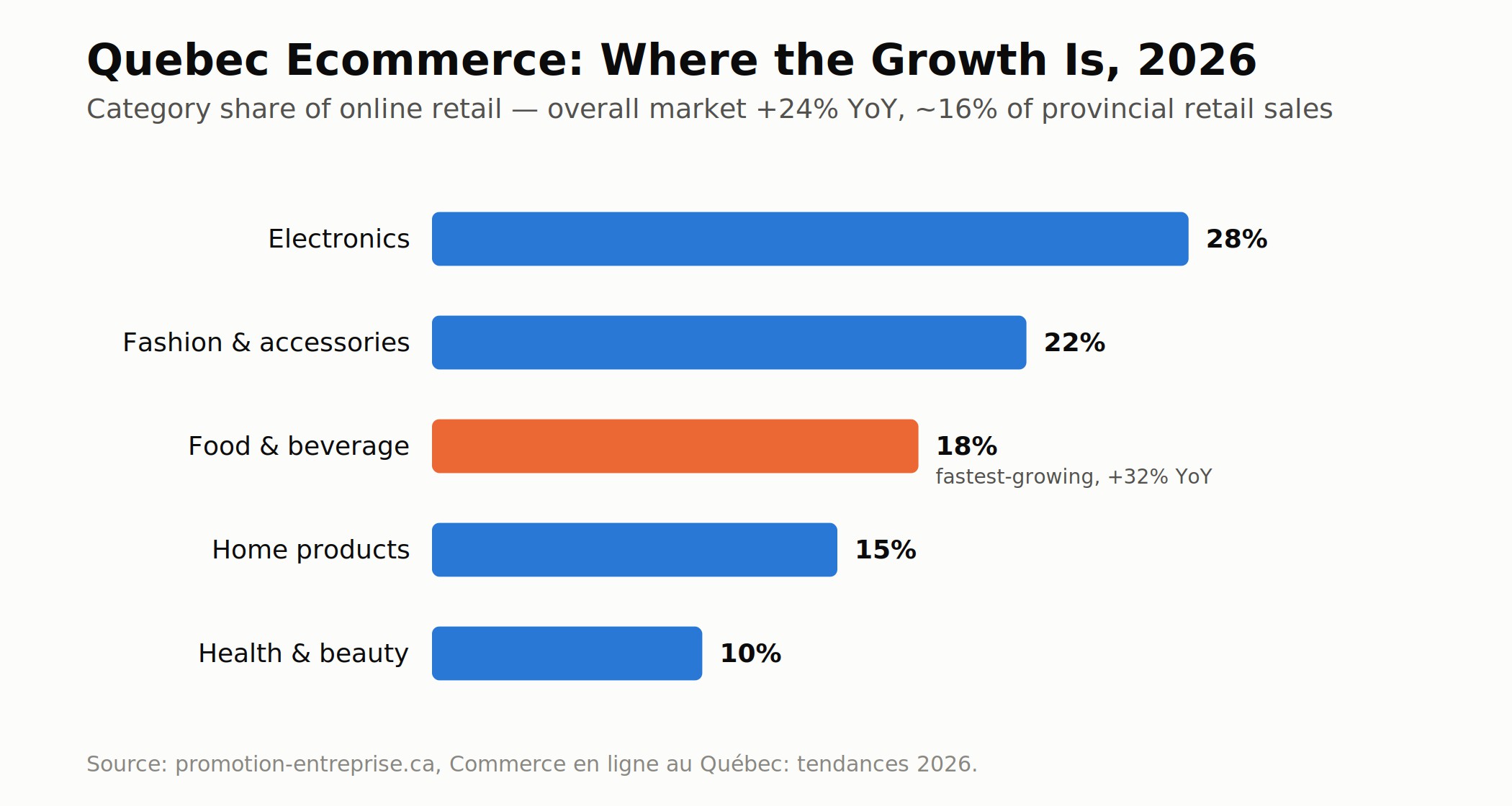
Quebec's online retail market crossed roughly $18 billion in 2026, now representing about 16% of all provincial retail sales and up 24% from 2024 — a growth rate well ahead of the national average (promotion-entreprise.ca). Electronics (28%), fashion and accessories (22%), and food and beverage (18%, growing fastest at +32%) dominate the category mix, and local, Made-in-Canada purchasing intent has climbed to 38%, up six points — a sentiment Montreal brands are well positioned to capture if their sites can actually be found and understood by AI systems.
Two Montreal-specific complications sit on top of the general AI-discovery shift. First, Bill 96 requires French-language parity across digital commerce touchpoints for an estimated 250,000 Quebec businesses. That obligation now extends beyond the visible storefront: product titles, descriptions, FAQ content and structured data feeds must exist in properly localized French, because AI Overviews, Gemini and Perplexity increasingly synthesize answers directly from underlying product data rather than from a rendered page a human proofread. Feeds with thin or machine-translated French are a real citation and conversion risk, not just a compliance checkbox — and there is early evidence that proper AI-assisted translation, done well, can lift conversion among francophone shoppers by as much as 35% (promotion-entreprise.ca). Second, Montreal's ecommerce base skews toward independent retailers and regional chains competing against national platforms (Amazon.ca, Walmart, Costco) that AI agents integrate with first. A Montreal retailer invisible to AI shopping agents isn't losing a ranking position — it's being skipped from the shortlist entirely.
The Shopper Behavior Shift
The customer journey used to have a visible top of funnel: impressions, clicks, site sessions, all measurable in Google Analytics. In 2026, a growing share of product research happens entirely inside an AI interface — a shopper asks Gemini or ChatGPT to compare three espresso machines, gets a synthesized answer with a recommendation, and may never visit any of the three retailer websites during the research phase. The retailer only reappears in the journey, if at all, at the point of purchase intent.
This compresses the discovery-to-consideration funnel and shifts where influence is actually exerted. Product feed data, structured reviews, and third-party mentions now persuade where a well-designed category page and remarketing sequence used to. Encouragingly, early data suggests that traffic which does arrive via AI referral converts well — one analysis found AI-referred visitors converting 22% higher than traditional organic visitors (Demand Local) — meaning the shoppers AI systems do send through tend to be further along and better qualified. The strategic problem isn't that AI-sent traffic converts poorly; it's that a shrinking share of total research volume produces any traffic at all.
The Technical and Website-Engineering Implication
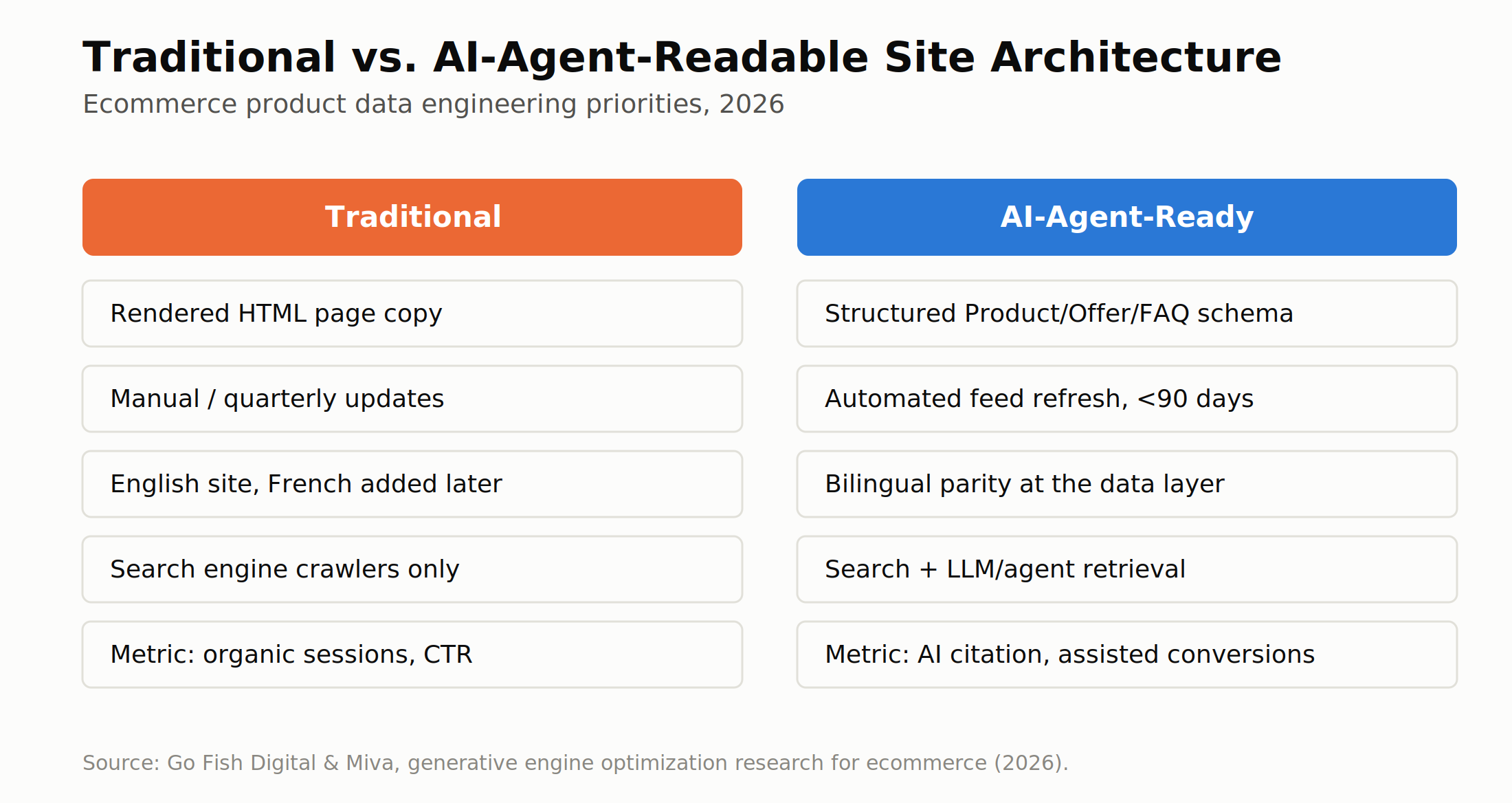
This is where the shift stops being a marketing conversation and becomes a website engineering one. AI systems don't read a page the way a human does — they parse structured data, crawl product feeds, and increasingly consult machine-readable summaries of a site's content. Three engineering priorities follow directly:
- Structured data as the primary product record. Product, Offer, FAQPage and Organization schema are now the four most load-bearing markup types for ecommerce, because AI systems pull price, availability, specifications and policy answers directly from them rather than from body copy. Schema markup alone has been shown to improve LLM discoverability by roughly 67% (Go Fish Digital; Miva). Sites where schema, product feeds and the rendered page drift out of sync — a common state in bolted-on ecommerce builds — are effectively invisible to this layer, regardless of how the page looks to a human.
- Feed freshness and Merchant Center integrity as an ongoing engineering discipline, not a launch task. Google's Shopping Graph is queried continuously by conversational systems through retrieval loops, and content that hasn't been refreshed or reverified within roughly 90 days is losing citation eligibility on several platforms. A product feed pipeline that updates weekly or on a manual schedule is no longer adequate infrastructure for a site that wants to be recommended by an AI assistant.
- Agent-readable site architecture, cautiously. Formats like llms.txt — a machine-readable summary of a site's key content — have been adopted by over 844,000 domains, but a
300,000-domain analysis found no measurable citation benefit from the file's presence alone, and adoption still sits near 10% even among sophisticated publishers (Gracker.ai). The lesson for Montreal ecommerce leaders is not to chase every emerging AI-SEO artifact, but to build the underlying architecture — clean structured data, fast and stable rendering, bilingual content parity, consistent product identifiers across channels — that any current or future AI crawler can actually parse. The wrapper format matters far less than the substance underneath it.
None of this is a plugin. It requires a technical audit of how product data, page rendering, feed pipelines and localization work together — and in most Montreal ecommerce stacks built incrementally over several years, that audit tends to surface real gaps.
The Executive Risk and Opportunity
Frame this in numbers a board will recognize. Ecommerce customer acquisition cost is already up roughly 40% since 2023, with average cost-per-acquisition on ecommerce search ads sitting near
$45 at a 4.4% conversion benchmark (Ringly). If a growing share of top-of-funnel research now resolves inside an AI interface before a paid or organic click ever occurs, the effective CAC on the traffic that does arrive keeps climbing — you are paying the same or more to reach a shrinking pool of clickable demand. That is the risk side of the ledger.
The opportunity side is that AI-referred shoppers appear to arrive with higher intent and convert at a premium, and Quebec's overall online retail growth (+24% year over year) means the category is expanding even as the mechanics of discovery change. The businesses likely to capture that growth are the ones whose product data is structurally legible to AI systems in both English and French — not necessarily the ones with the biggest ad budgets. In an AI-mediated market, technical discoverability is starting to function like a distribution channel in its own right, and it is one incumbent players have not yet fully occupied.
What Business Leaders Should Do Next
For the next 12–24 months, three moves matter more than any single tactic:
- Audit AI visibility, not just SEO rankings. Ask directly: does Gemini, ChatGPT or Perplexity correctly describe our products, pricing and availability today? Where the answer is wrong, thin, or missing entirely, that is now a revenue gap, not a content nice-to-have.
- Treat the product feed and structured data layer as core infrastructure, with an owner and a refresh cadence, not a one-time Merchant Center setup. This includes bilingual parity in both the visible French storefront and the underlying feed data, given Bill 96's reach and Quebec's francophone conversion advantage.
Rebuild the analytics view of the funnel to account for AI-influenced, zero-click research, so that a shrinking click volume with strong conversion isn't misread internally as declining demand when it may actually be a channel-attribution blind spot.
This is fundamentally a website engineering problem before it is a marketing one, which is the gap ZTS India's AI Website Engineering service for Montreal is built to close — restructuring product data, feeds and site architecture so Montreal ecommerce businesses stay legible and competitive as AI systems take over more of the shopping journey.
-

Writen by Anirban Das