USA:
USA:  India:
 Google's AI Mode, Merchant Center's new conversational commerce fields, and the shift to "discover in AI, buy on your own site" mean a Montreal retailer's website now has to be engineered for machines before it can convert a human. Here's what that changes for the P&L.
The 2026 question every Montreal ecommerce leader should be asking
For a decade, the ecommerce growth playbook was fairly stable: rank on Google, run paid search and social, convert on-site, retarget, repeat. In 2026, the first step in that chain has quietly broken. A growing share of product research — comparing running shoes, sourcing a Quebec-made gift box, checking whether a Montreal boutique has a dress in stock — now
happens inside an AI interface before a shopper ever types a retailer's name into a browser.
The business question for a Director or Founder running a Montreal ecommerce operation is no longer “is our SEO good enough?” It is: can AI systems even see, parse, and trust our
product data well enough to recommend us at all? That is a different problem, and it lives largely in how a website is engineered, not in how it is marketed.
What actually changed in 2026 — and what's still forecast
It's worth separating what is confirmed from what is still directional, because the two get conflated constantly in trend content.
Confirmed 2026 developments
- Google's AI Mode — a conversational, Gemini-powered search experience that replaces the traditional ten blue links — became available to all US users in March 2026, following its earlier limited rollout, and industry analysts tracking search behavior report zero-click rates approaching the high 80s to low 90s (percent) within AI Mode sessions specifically, since
users research and compare entirely inside the AI interface (reported by Go Fish Digital, 2026 benchmarks).
- Google and Shopify introduced the Universal Commerce Protocol (UCP) at the National Retail Federation's January 2026 event, alongside new Merchant Center “conversational
commerce attributes” — structured fields such as product Q&A, compatible accessories, and substitute products designed specifically for AI-native product discovery.
- OpenAI retired ChatGPT's in-chat Instant Checkout in March 2026, roughly six months after launch, after adoption stayed thin and Walmart reportedly measured in-chat checkout converting at a fraction of a normal click-through to its own site (as reported by Digital
Commerce 360, March 2026). The practical effect: the industry consensus that emerged in 2026 is “discover in AI, buy on your own site” — AI agents surface and compare products, but the transaction still closes on the retailer's own domain.
- Semrush's tracking, cited across multiple 2026 retail-SEO analyses, found retail keywords triggering Google AI Overviews grew sharply through early 2025 into 2026, even as Google reportedly narrowed which shopping queries get an AI Overview after finding many didn't convert into sales.
What's still a forecast, not a settled fact: exactly how large a share of Montreal shoppers' research happens inside AI tools today, and how fast agentic checkout standards will consolidate around one protocol (UCP vs. ACP vs. others). Treat any specific adoption percentage for a single city as an informed estimate, not a measured statistic.
Why this is fundamentally a website-engineering problem, not a copywriting problem
Here is the part executives most often miss: AI shopping agents and AI Overviews do not read a product page the way a human does. They do not respond to persuasive copy, lifestyle photography, or brand voice. They parse structured data — Schema.org / JSON-LD markup that explicitly labels price, availability (in stock / out of stock), GTIN or SKU, shipping terms, reviews, and now the newer conversational-commerce attributes Google introduced in Merchant Center.
If a Montreal retailer's product pages don't expose that data cleanly — or if the site is slow,
blocks crawlers, buries products behind JavaScript rendering an AI agent can't execute, or has an inconsistent product feed — the agent has nothing reliable to cite. Industry guidance on this point is blunt: a product page without proper schema markup is effectively invisible to most AI shopping agents, regardless of how good the marketing copy is
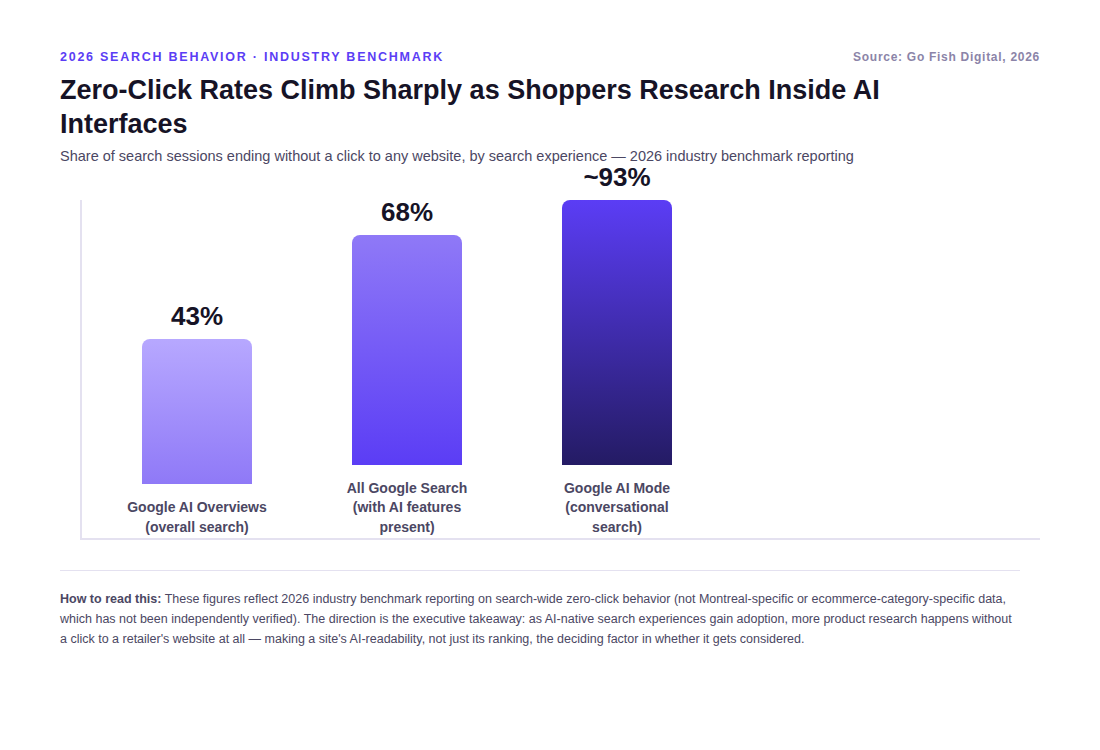
Zero-click behavior is markedly higher inside AI-native search experiences than in traditional search, based on 2026 industry benchmark reporting (Go Fish Digital). City- and sector-specific figures should be treated as directional estimates.
That reframes the priority list for 2026:
- Structured data coverage — Product, Offer, AggregateRating, and now conversational-commerce schema fields, implemented consistently across the full catalog, not just hero products.
- Crawlable, fast architecture — pages that render cleanly for both human visitors and
AI/LLM crawlers, with server-rendered or pre-rendered product content rather than client-side-only JavaScript.
- Accurate, machine-readable product feeds — inventory, pricing, and shipping data that stays synchronized in near-real time, since agents penalize stale or contradictory information.
- Site performance — Core Web Vitals and load speed still matter, both for conversion once a human agent-referred visitor lands, and because slow sites are harder for automated
systems to fully crawl and re-crawl.
This is squarely a technical engineering scope — information architecture, backend/CMS configuration, structured data implementation, feed management — sitting closer to a development team's desk than a content or ads team's.
The Montreal and Quebec context
Two local factors sharpen the stakes for Montreal specifically. First, Canada's ecommerce market has been growing well ahead of brick-and-mortar retail, with online sales continuing to take share nationally through 2026 — meaning digital customer acquisition is not optional
infrastructure for Montreal retailers, it is the growth channel. Second, Quebec's Bill 96 requires French-language parity across digital touchpoints, which directly affects how product data, structured markup, and page content need to be built and maintained — a compliance layer that most AI-readiness guidance written for the US market simply doesn't address. A Montreal retailer optimizing for AI shopping agents has to get bilingual structured data right, not just
English-language schema, or risk being unreadable — or non-compliant — in one of its two required languages.
Layer on Quebec's ecommerce base being dominated by small and mid-sized retailers with lean internal teams, and the practical reality is clear: most Montreal ecommerce businesses do not currently have anyone whose job is specifically “make our site AI-agent-readable.” That gap is itself a competitive opening for whoever closes it first.
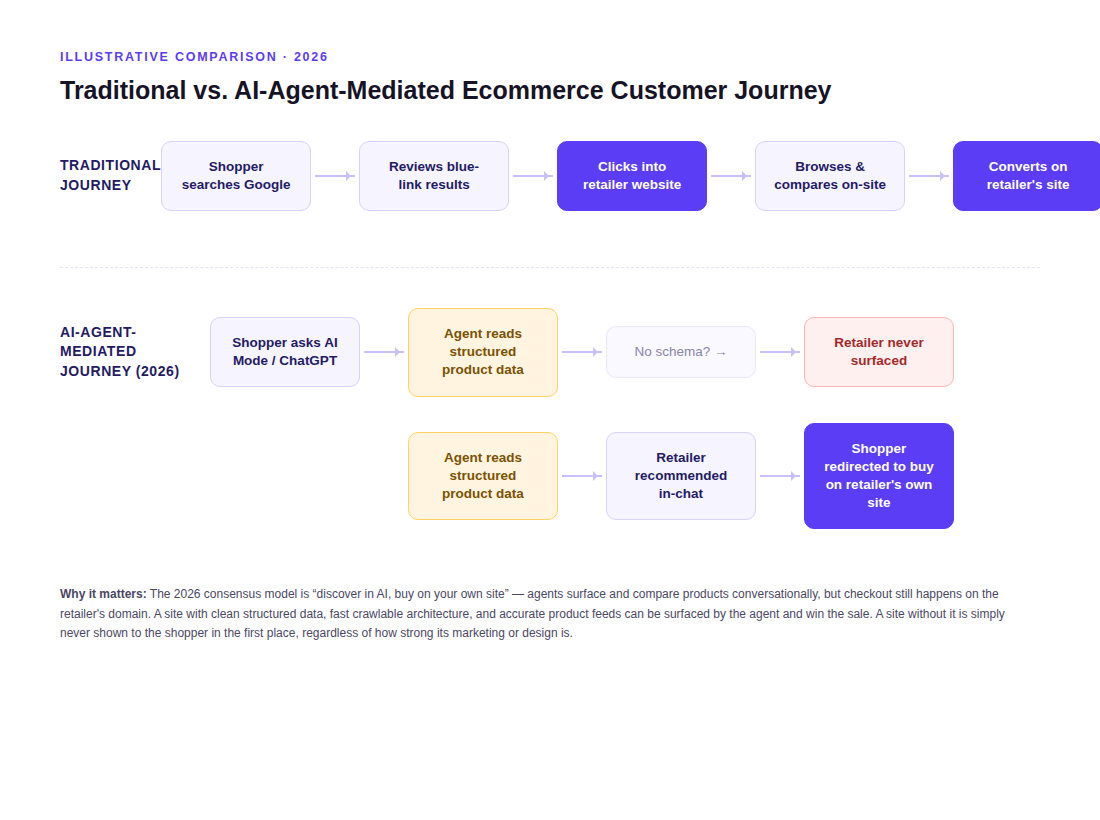
The traditional funnel routes a shopper through search results to a retailer's site at the research stage. The AI-agent-mediated journey inserts an AI assistant that must read structured data before a retailer is even surfaced.
What should business leaders do next
For a CEO, Director, Founder, or Marketing Head running a Montreal ecommerce business, four steps are worth prioritizing before year-end:
- Audit AI visibility, not just search rankings. Ask AI Mode, ChatGPT, and Perplexity direct product-comparison questions in your category and see whether your brand appears, with correct pricing and availability.
- Get structured data onto every product page, not a sample set — Product, Offer, Review, and the newer conversational-commerce attributes Google is rolling into Merchant Center.
- Treat site speed and crawlability as a revenue issue, not a developer nice-to-have — both AI agents and the humans they refer to your site abandon slow, unstable pages.
- Budget this as engineering work. Fixing AI-agent readability is closer in scope and cost to a website re-platforming project than a marketing campaign, and should be planned and resourced that way.
Businesses evaluating what a technical audit and rebuild for AI-agent readiness looks like in
practice can review ZTS India's AI website engineering services for Montreal businesses, which covers structured data implementation, crawlable architecture, and AI-agent-ready product
feeds specifically for this shift.
The retailers who treat 2026 as the year they engineered their site for AI agents — not just for Google's old algorithm — are the ones most likely to still be discoverable when the majority of product research has moved off the search results page entirely.
-

Writen by Anirban Das