USA:
USA:  India: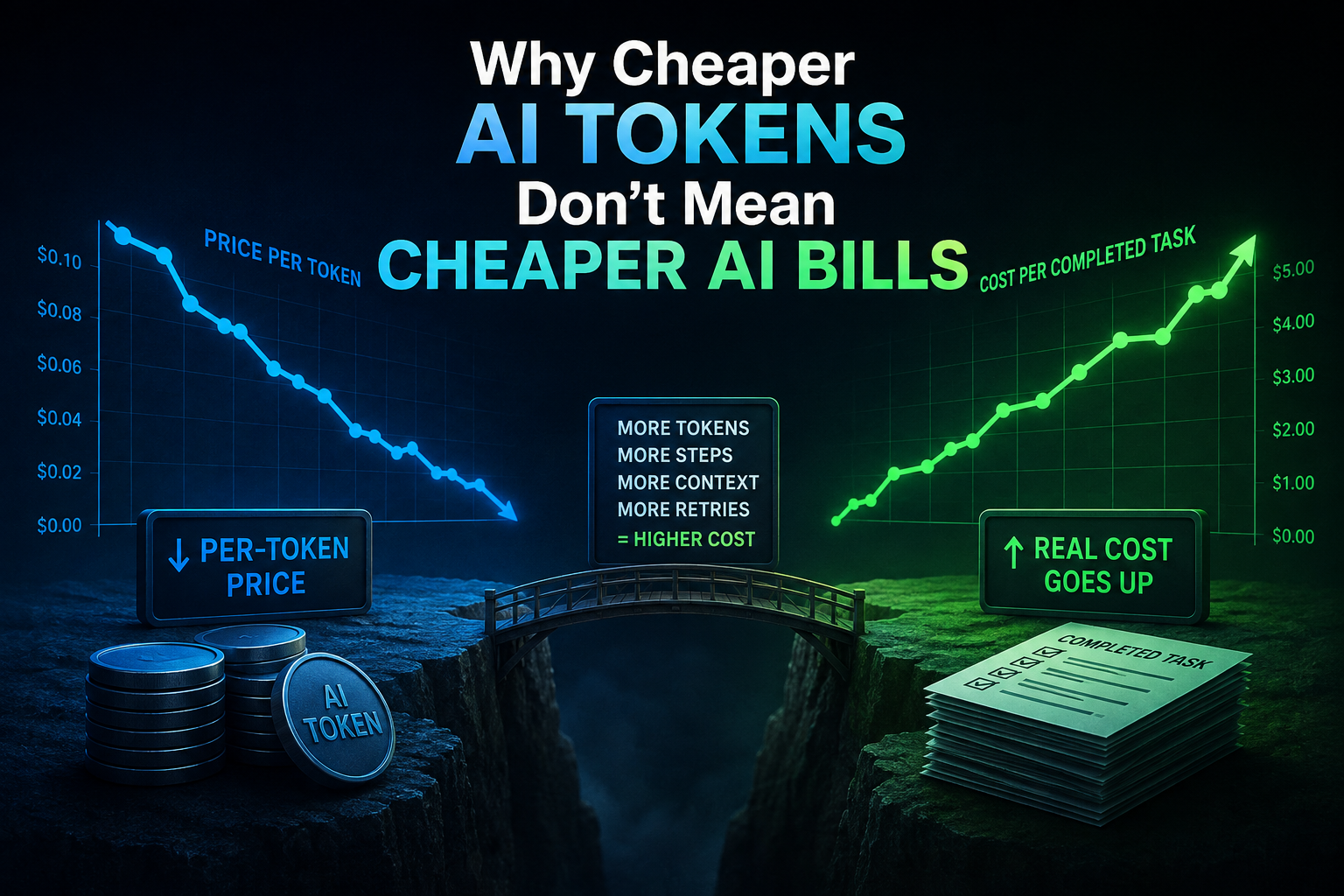
Most companies budgeting for AI make the same comparison: which model charges less per million tokens. According to a new report from ZTS Infotech's AI News Desk, that comparison is quietly costing businesses money. A cheaper model that needs twice as many tokens to solve the same problem is not cheaper at all — it is the same bill with extra steps. The report introduces a sharper way to measure AI cost, and a three-model workflow its own team now uses on client projects that reportedly cut costs by 60% without changing the output.
For any leader signing off on an AI budget, that distinction is the difference between a real savings line and a false one. Token price is what a vendor charges; cost per completed task is what a business actually pays. Confusing the two is an easy mistake to make and, per this report, an expensive one to repeat across every project a team ships.
The Pricing Mistake Most Businesses Are Making
The trap, as the report frames it, is straightforward: a lower-cost model priced at roughly half the rate of a premium frontier model looks like an obvious switch. But if that cheaper model needs twice as many tokens to reach the same result, the total bill lands in the same place. Cheaper per token does not mean cheaper per job done.
ZTS Infotech calls the missing metric “intelligence density” — how much actual work a model completes per token, rather than what it charges for each one. It is a small reframing with a large consequence: it shifts AI vendor selection from a price-list comparison to a per-outcome comparison, which is the number that actually shows up on an invoice.
The Three-Stage Strategy Cutting Costs by 60%
Rather than routing an entire task through one model, the report describes splitting complex jobs across three stages, matching each to the model best suited for it.
Stage One — The Planner
A frontier-grade model analyses the problem and produces a detailed plan. This stage consumes mostly input tokens, which are priced cheaply, and produces almost no output — so using a premium model here costs little despite its higher rate.
Stage Two — The Executor
A faster, cheaper model does the actual writing or coding, following the plan already produced in stage one. Because the thinking is done, this high-output stage does not require an expensive model — it requires a fast one.
Stage Three — The Reviewer
A second frontier model checks the execution against the original brief and catches errors. Like stage one, this is mostly input-token work, so it stays cheap even using a premium model for the review.
The Real Numbers
On the same complex task, the report puts a single-model approach at $81. The three-model pipeline reached the same result for $25.55 — a roughly 60% reduction with no drop in output quality, because the expensive model is only ever paying for its cheapest kind of work: reading and reasoning, not bulk generation.
Why This Matters Beyond the Line Item
The report ties this to a larger shift already underway. As open-source models push raw token prices toward zero, the competitive advantage moves away from whoever sells the cheapest tokens and toward whoever builds the best application on top of them. Model access is becoming commodity infrastructure; the orchestration layer — deciding which model handles which step, and why — is where the value is concentrating instead.
Opportunities and Challenges
The opportunity is straightforward for any team running AI at meaningful volume: the same 60% cost reduction compounds across every complex task processed this way, without asking staff to accept worse output. The challenge is equally real — a three-model pipeline requires engineering work a single-model prompt does not: routing logic, quality checks between stages, and ongoing tuning as model prices and capabilities keep shifting. It is a build-once, save-repeatedly trade-off, not a free lunch.
Expert Perspective
The interesting part of this report is not the specific dollar figure — it is the budgeting logic underneath it. Marketing teams stopped judging channels by cost-per-click alone once cost-per-acquisition made the real number visible; AI spending is at the same inflection point. Cost per token is a vanity metric if it is not paired with tokens required per outcome. As open-source competition keeps pushing token prices down, the businesses that win will not be the ones chasing the cheapest sticker price on any given month — they will be the ones with workflows engineered to route the right work to the right model, which is a durable advantage rather than a pricing coincidence.
Key Takeaways
● Comparing AI models by price-per-token alone is misleading; a cheaper model needing more tokens per task can cost the same or more.
● “Intelligence density” — work completed per token — is the metric that actually determines cost.
● A three-stage workflow (frontier planner, cheap-and-fast executor, frontier reviewer) reportedly cut a task's cost from $81 to $25.55, roughly 60% less, with no quality loss.
● Savings work because input tokens are cheap and output tokens are expensive; premium models are reserved for input-heavy planning and review.
● Open-source models are pushing raw token prices toward zero, commoditising model access.
● As tokens commoditise, value is shifting toward the orchestration layer built on top of models, not the models themselves.
● The approach requires upfront engineering investment in routing and quality checks between stages.
Conclusion
As more open-source entrants compete on raw token price, comparing AI vendors by sticker rate alone will keep getting less useful, not more. The businesses managing AI costs well in 2026 will be the ones measuring output per dollar, not price per token, and engineering their workflows accordingly. ZTS Infotech's AI News Desk says it is already building for that world, and leaders reviewing their own AI spend have a clear next step: audit which of today's tasks are paying frontier prices for work a cheaper model could finish just as well.
-

Writen by Anirban Das