USA:
USA:  India:
 .png)
AI Website Design vs Traditional Web Design: A Straight-Talking Guide for UK Businesses
Right, let's not dance around it.
Most UK business websites are not working. And before anyone gets defensive, this is not about blaming the designers or the developers who built them. The problem runs deeper than that. It is the entire process most businesses still use to commission, build, and maintain websites. That process was designed for a different era, and it is showing its age badly.
For years, everybody followed the same script. You brief an agency, you wait weeks for mockups, you spend three rounds of revisions arguing about things that probably do not matter, you launch, you move on. Job done. And for a while, that was fine — because your competitors were doing the same thing and customers were more forgiving of slow, clunky websites.
Neither of those things is true now.
British consumers are genuinely ruthless online. Three seconds is generous. If your site loads slowly, they are gone before they have even read your headline. If it is awkward on a phone — and let's be honest, most people are on a phone — they bounce. If your homepage looks like it could belong to literally any company in your sector, they do not bother. And here is the painful part: they do not come back and give you a second chance. They just go to whoever ranks below you and find someone who makes it easier.
So the question most businesses should be asking has shifted. It is no longer "should we redesign our website?" It is "Are we even building websites the right way anymore?"
What Is Actually Going Wrong With Traditional Web Design
To be fair, traditional web design is not the enemy here. There are talented people doing it, and for certain kinds of projects, it is still the right call. But there are some structural problems baked into the traditional approach that are genuinely hard to get around, and most agencies are not going to volunteer that information.
The core issue is this: most of the decisions in a traditional web project are based on guesswork. Educated guesswork, sure — but guesswork. A designer looks at your brief, draws on their experience, picks layouts and structures they have seen work before, and builds something that looks credible. What they cannot tell you with any real confidence is how your specific audience will respond to those choices. Because they do not have that data. They have instincts and case studies, which is a different thing entirely.
That gap between what feels right and what actually works shows up later. Sometimes much later. You launch a beautiful site and then spend the next six months wondering why the enquiries are not coming in. Then someone audits it and finds the SEO architecture is a mess. Or the page speed is terrible on mobile. Or the user journey has a drop-off point nobody noticed because nobody was looking.
Fixing all that after launch is expensive. And while you are fixing it, the site is sitting there costing you in missed opportunities every single week.
What AI Website Design Services Actually Mean in Practice
Here is where a lot of people get confused, often because the marketing around AI website services has been pretty breathless and vague.
AI-powered web development does not mean a machine designs your website while you go for lunch. What it means is that artificial intelligence, real behavioural data and smart automation are woven into the entire design and build process — not just added on at the end like a chatbot plugin.
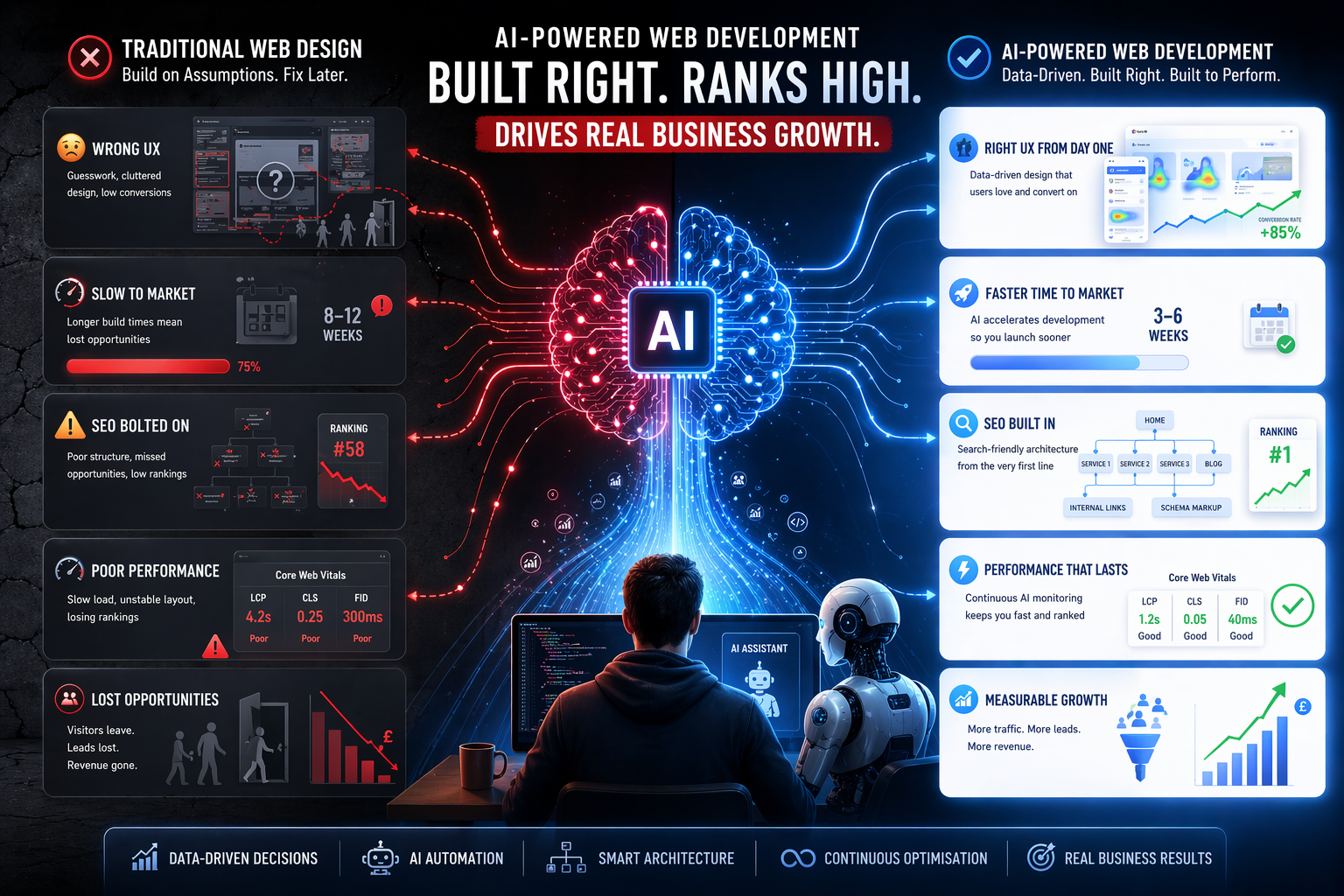
The most meaningful difference is where decisions come from. In a traditional project, the designer chooses a layout based on what they have seen work. In an AI-driven project, that layout choice is informed by data on how users actually behave on comparable sites — where they click, where they stop scrolling, where they leave, what navigation patterns drive them toward an enquiry. The design comes out of that analysis. You are not starting from aesthetic preference and hoping the data catches up later.
Then there is the build speed. A significant chunk of time on any traditional development project is eaten up by tasks that are important but not creative — configuring responsive breakpoints, compressing images for performance, checking accessibility, and setting up metadata. AI handles the bulk of that automatically. Which means developers spend their time on the things that actually need human judgment. The result is faster delivery — and not the kind of faster delivery that means corners are being cut.
The third thing — and this is the one most businesses do not fully appreciate until they have experienced it — is what happens after launch. A traditional website is essentially done on the day it goes live. It might get updated here and there, but its underlying performance gradually drifts downward. Technology moves on, Google's standards shift, but the site does not keep up. Nobody is watching it closely enough to notice until something has already gone wrong.
An AI-powered site works differently. It monitors its own performance. When page speed starts slipping, it flags it. When users are abandoning a checkout at a particular step, that gets surfaced before it becomes a serious revenue problem. The site twelve months after launch is genuinely better than the site on launch day. For anyone who has managed a traditional website, that is a pretty significant change.
And one more thing worth mentioning: personalisation. The kind of dynamic content that adapts to where a visitor came from, what device they are on, how they have behaved on the site — that used to require an enterprise budget and a dedicated team to run it. AI website design services are making that available to UK SMEs at a price point that actually makes sense.
The Specific Areas Where It Makes the Biggest Difference
Building the right UX from the start, not fixing the wrong one afterwards
The cycle most businesses end up in with traditional web design goes like this: build on assumptions, launch, discover the conversion rate is terrible, spend money trying to fix it. That cycle has been around so long that most people just accept it as normal. It really should not be.
When design decisions are driven by real data from day one, you are not guessing at what your audience needs — you are building for what they have actually shown they respond to. For UK businesses trying to generate meaningful commercial returns from their websites, that difference shows up directly in enquiry volumes.
Getting to market earlier
This one gets underestimated. Every week, a new site is not live is a week competitors are capturing the traffic you should have. That is not abstract — it is actual leads going elsewhere.
AI-accelerated development consistently cuts build timelines by somewhere between a third and a half compared to traditional methods. For a business in a competitive market, launching two months earlier can represent a material difference in revenue, particularly if you are in a seasonal industry or chasing a market window.
SEO that is built in, not bolted on
This is probably the most common and most expensive mistake in traditional web design: treating SEO as something that gets sorted after the site is built. A developer puts together the structure, a designer populates it, and then an SEO consultant reviews it and finds problems — heading hierarchies that are confusing Google, URL structures that carry no topical signal, page layouts that bury the content crawlers need to make sense of the site.
Fixing all of that post-launch is slow and costly. And while the fixes are being made, you are paying for a website that Google is only half-rewarding.
With a proper AI web development approach, the SEO architecture is decided before the design phase begins. The information hierarchy, URL structure, internal linking strategy, schema markup, technical foundations — all of it is set up to be search-engine-friendly from the very first build. You get a site that starts earning rankings from day one, rather than one that needs six months of remediation before it does.
Performance that does not quietly deteriorate
Google's Core Web Vitals are live ranking signals, not optional extras. A site that loads slowly or shows layout instability during load is being actively penalised in UK search results, regardless of how strong the content is or how much you spent building the thing.
Traditional sites get performance-optimised at launch and then left to drift. Nobody is watching closely enough to notice when a new image gets added without proper compression, or when a third-party script starts dragging down load time. By the time it shows up in analytics, the damage has already been done.
AI-powered sites are different. Continuous monitoring is part of the infrastructure, not a separate service you have to pay someone else to provide. Performance problems get flagged before they affect rankings.
When Traditional Design Is Still the Right Answer
Genuinely, there are cases where traditional web design still makes sense, and it would not be honest to pretend otherwise.
If you are building something that is explicitly unconventional — an art installation site, an immersive brand experience, a luxury product where the visual design is intentionally unusual and that unusualness is the whole point — then a skilled human designer with full creative latitude is the right choice. Data-driven optimisation is not always what the project is about.
There are also projects with complex legacy system integrations, or ones that require genuinely novel interactive engineering, where intensive manual development work is unavoidable.
But for the vast majority of UK businesses — professional services, e-commerce, SaaS, B2B technology, recruitment, healthcare, financial services, hospitality — none of those exceptions apply. If the website's job is to generate leads, drive sales and produce a measurable commercial return, the AI approach wins on almost every dimension.
Why UK Businesses Are Moving This Way Now
The shift is accelerating, and it is not hard to see why.
UK consumers are sophisticated, mobile-first, and genuinely unforgiving of poor digital experiences. Google's algorithm keeps raising the technical bar. And marketing directors and founders are being held accountable for website ROI in a way that simply was not common five years ago. Boards want to know what a website investment is returning, not just what it looks like on a desktop in a pitch presentation.
There is also just basic competitive pressure at play. AI-powered web development is not something that is coming — it is happening right now, and the businesses that have adopted it are pulling ahead. Faster builds, better rankings, stronger conversion rates. Their competitors using traditional methods are watching that gap widen, often without knowing exactly why.
Being early to this shift is still an advantage. That window will not stay open indefinitely.
What Does It Cost?
The assumption that AI website design services cost more is widespread and, in most cases, wrong — or at least wrong when you look at the full picture rather than just the upfront invoice.
Traditional web design can look cheaper at first glance. But that number does not include the extended timelines where agency fees compound over extra weeks. It does not include the post-launch SEO audit and remediation that almost always follows. It does not include the separate performance monitoring retainer, or the full rebuild that typically becomes necessary after eighteen months to two years in when the site no longer meets current standards.
The affordable AI website design services UK businesses are accessing today consolidate a lot of those costs. Automation reduces manual overhead on build time. Built-in SEO means there is no remediation retainer. Continuous performance monitoring is infrastructure, not a separate contract. And because the site is built to be modular and scalable, you are not staring down another full rebuild before you have even got a decent return on the first one.
Over two to three years, the total cost of an AI-engineered website is typically lower than the traditional alternative. The commercial return is consistently higher. That is the comparison that matters, and it is the one most people do not do when they are deciding.
How to Work Out Which Option Is Right for Your Business
A few honest questions that tend to make this fairly clear:
Is the primary goal of your website measurable commercial return — leads, sales, bookings? If the answer is yes, AI web design is the right foundation.
Do you need to get to market quickly, or is your current site actively costing you in missed traffic and poor conversions? AI-accelerated development shortens timelines in ways that have real commercial consequences.
Is organic search a meaningful part of how your customers find you? If you rely on Google, you need SEO built into the architecture from the start — retrofitting it later is both expensive and slow.
Is your business growing and do you need a website infrastructure that can grow with it? Traditional builds rarely scale without expensive rework.
Is your project genuinely an unconventional creative or artistic endeavour where the unusual design is the product itself? If that is truly the case, traditional design still has a place.
For most UK businesses, answering those questions honestly points in a pretty clear direction.
Why UK Businesses Work With ZTS Infotech on This
ZTS Infotech has been building digital products that perform commercially for businesses across the UK, USA, UAE and Europe for over a decade. Not a traditional agency that has retrofitted "AI" onto its list of services — a specialist AI web design agency built around the idea that a website is a piece of digital engineering, not a creative project.
Every decision we make — from information architecture to page structure to technical stack — is made in service of a measurable business outcome. Not in service of visual awards or looking impressive in a portfolio.
The team brings together AI-powered UX design, conversion rate optimisation, technical SEO and full-stack development under one roof. Our clients do not manage five different suppliers and hope they are talking to each other. They get one expert team accountable for results.
We have delivered websites that rank, convert and scale for startups working with tight budgets and enterprises navigating complex requirements. The common thread across every single one is the same: built to do a job, not fill a brief.
The Bottom Line
Traditional web design se3. How do I know if my site needs a full rebuild or just a refresh?
rved its purpose. In a narrow set of circumstances, it still does. But for most UK businesses competing for search rankings, customer attention and a genuine return on digital investment, the traditional model carries too many structural weaknesses to recommend without significant caveats.
AI website design services are not a future concept to evaluate at some later stage. They are delivering real, measurable results for UK businesses right now. The businesses moving in this direction are building compounding advantages — in rankings, conversion rates, and operational efficiency — that slower-moving competitors will find genuinely hard to close.
The question is not really "AI or traditional?" It is "how much longer can you afford to stay with the model that is holding you back?"
Talk to Us
If any of this has raised questions about your own website — whether it is actually performing, whether a rebuild makes sense, what an AI-powered approach could realistically deliver — we are happy to talk it through.
ZTS Infotech offers a free consultation for UK businesses. We will look at where you are, where you want to get to, and give you a straight answer on what it would take to close that gap.
Explore our AI Website Engineering Services for UK Businesses
No hard sell. No template pitch. Just a real conversation with people who have been doing this long enough to know what actually moves the needle.
FAQs
1. What are AI website design services?
Put simply, it is using artificial intelligence and real user behaviour data to make smarter design decisions, build sites faster, and keep improving performance after launch rather than relying on gut feel and manual processes. It is less about the technology itself and more about the quality of decisions that technology enables.
2. Are AI website design services only for big businesses?
No, and this is probably the most common misconception. Affordable AI website design services UK agencies offer today are built with SMEs and startups in mind. Smaller businesses often see the clearest impact — built-in SEO and performance monitoring replace the need for multiple separate retainers that would otherwise eat into a tight budget.
3. How do I know if my site needs a full rebuild or just a refresh?
Honest answer: if your site has structural SEO problems, fails Core Web Vitals, or is simply not generating leads at a reasonable rate, a rebuild is almost certainly the right call. Surface-level refreshes rarely fix deep technical issues — they just put a coat of paint on problems that are still running underneath. A proper audit from a specialist AI web design agency UK team will give you a clear answer rather than a vague recommendation.
4. Is AI web design actually more expensive?
Upfront, costs are broadly similar to quality traditional web design. Over two to three years, AI-built sites consistently cost less because they eliminate the expenses that quietly pile up with traditional sites — post-launch SEO fixes, performance retainers, and the full rebuild that tends to follow when a traditional site ages out of current standards.
5. What should I budget for AI website design services in the UK?
Pricing varies by project scope, but it sits in a similar range to quality traditional web design. The difference is not really in the number on the invoice — it is in what you get for it. Faster delivery, fewer revision rounds, and a site that keeps performing without constant paid maintenance.
6. Can startups realistically get ROI from this?
Yes, and honestly, this is where the value tends to be most visible. A conversion-focused, technically sound site delivered in two to four weeks rather than three to four months gives a startup a genuine head start on rankings, traffic, and leads. In a competitive market, that time advantage compounds.
7. Does AI web design genuinely improve SEO?
Yes — because SEO architecture is built into the site from the start, not retrofitted after launch. URL structures, schema markup, heading hierarchy, load speed — all configured before design even begins. That gives the site a real structural advantage in UK search results rather than a theoretical one that needs months of remediation before it materialises.
8. What are Core Web Vitals, and do they really matter?
They are Google's performance benchmarks — measuring load speed, interactivity and visual stability. They are direct ranking factors, not suggestions. AI-powered sites are continuously monitored against these benchmarks so performance does not quietly slide between reviews. Traditional sites get performance-optimised at launch and then largely left to decline.
9. Why choose ZTS Infotech?
Over a decade of building high-performance websites for businesses across the UK, USA, UAE and Europe. We are a specialist AI web design agency UK businesses come to when they need results, not just a good-looking site. Every project includes built-in SEO architecture, data-driven UX design and ongoing performance monitoring — not as add-ons, but as part of how we build.
Free consultation → www.ztsindia.com/service/ai-website-engineering-uk
Final Thoughts: The Clock Is Already Ticking
The gap between businesses using AI-powered web design and those still doing it the old way is not standing still — it is widening every month.
Your website is not a brochure. It is your hardest-working salesperson, and if it is built on guesswork rather than data, it is quietly costing you leads, rankings, and revenue.
The shift is already happening. The only real question is whether you are ahead of it or catching up to it.
If your website is not actively working for your business, it is working against it. That is worth fixing — and sooner is always better than later.
-
Writen by Anirban Das