USA:
USA:  India:
 The physical landscape around Old Street Roundabout has always evolved quickly, but the digital shift happening inside its glass towers this year is unprecedented. In 2026, the traditional creative agency model that dominated the Shoreditch startup ecosystem for over a decade is facing an existential shift. Founders, product teams, and venture capital (VC)-backed startups across Tech City London are moving away from manual development. In their place, AI website engineering UK services have taken over, fundamentally changing how digital platforms are built, scaled, and maintained.
What Is AI Website Engineering and How Is It Changing Web Development?
AI website engineering is the shift from manual coding and pixel-pushing to automated website development governed by Large Language Models (LLMs) and specialized AI agents. It goes far beyond the basic AI template generators of the early 2020s. Today, it represents a unified framework where frontend development automation, generative website creation, and LLM-powered development workflows construct complex, production-ready web platforms directly from product specifications.
AI website engineering is the shift from manual coding and pixel-pushing to automated website development governed by Large Language Models (LLMs) and specialized AI agents. It goes far beyond the basic AI template generators of the early 2020s. Today, it represents a unified framework where frontend development automation, generative website creation, and LLM-powered development workflows construct complex, production-ready web platforms directly from product specifications.
The scale of this shift is backed by definitive industry data in 2026:
- Massive Workflow Adoption: According to the DevOps Research and Assessment (DORA) report, 90% of software development professionals have now actively adopted AI tools into their daily workflows.
- Collapsing Timelines: Controlled, empirical testing by GitHub and Accenture revealed that developer workflows using advanced AI orchestration complete core coding tasks 55% faster than traditional manual methods, leading to a 50% increase in how quickly pull requests (code updates) are merged into production.
How Does Modern AI Architecture Collapse Traditional Development Silos?
The traditional website development process involves disjointed handoffs between separate design, engineering, and project management teams. In contrast, modern AI website engineering collapses these silos into a fluid, automated framework.
The process begins directly with raw user prompts and structured product requirements. These inputs feed into an autonomous AI engineering layer, which instantly generates functional UX/UI prototypes while simultaneously compiling production-ready code. Instead of manually building out individual pages, the AI systematically provisions a modern architecture—such as a decoupled Next.js frontend integrated with a headless CMS and pre-wired APIs. This shifts the human role from writing boilerplate code to overseeing system design and strategy, reducing delivery times from months to days.
For tech-forward companies, this process bridges the gap between raw concept and enterprise-grade deployment. Instead of manually writing boilerplate code, configuring databases, and wiring up APIs over several weeks, engineering teams utilize autonomous AI systems to generate functional, hyper-optimized codebases in minutes. The focus shifts entirely from writing code to engineering the system architecture and refining user experience (UX).
According to global data from McKinsey & Company, generative AI development workflows compress the time required to build and deploy web products by 35% to 45%. Heavily flattening the multi-week timelines traditionally required for baseline code generation and API wiring into minutes. Instead of manually writing boilerplate code, configuring databases, and wiring up APIs over several weeks, engineering teams utilize autonomous AI systems to generate functional, hyper-optimized codebases in minutes. Research from Microsoft demonstrates that developers utilizing these automated systems complete multi-layered tasks 55% faster than those using manual coding methods. Gartner shows leads to an overall 50% increase in immediate software delivery velocity. The focus shifts entirely from writing code to engineering the system architecture and refining user experience (UX).
Why Is Speed to Market the Ultimate Metric for London Startups?
For London fintech startups and London SaaS businesses based around Hoxton, Clerkenwell, and the Liverpool Street technology corridor, speed to market defines survival. Waiting three to six months for a traditional agency to deliver a marketing site or web application is no longer a viable strategy.
- Rapid Prototyping: Startups can deploy fully interactive, content-mapped landing pages and custom web applications in hours, allowing them to validate product-market fit or iterate before a pitch at a nearby accelerator.
- Modern Tech Stacks by Default: These systems generate clean, modular code utilizing the modern startup technology stack—typically leveraging React, Next.js, and a headless CMS (where the backend content repository is decoupled from the frontend presentation layer).
- Instant Data Integration: AI engines automatically wire up CRM tools, analytics software, and subscription billing engines without requiring weeks of custom middleware development.
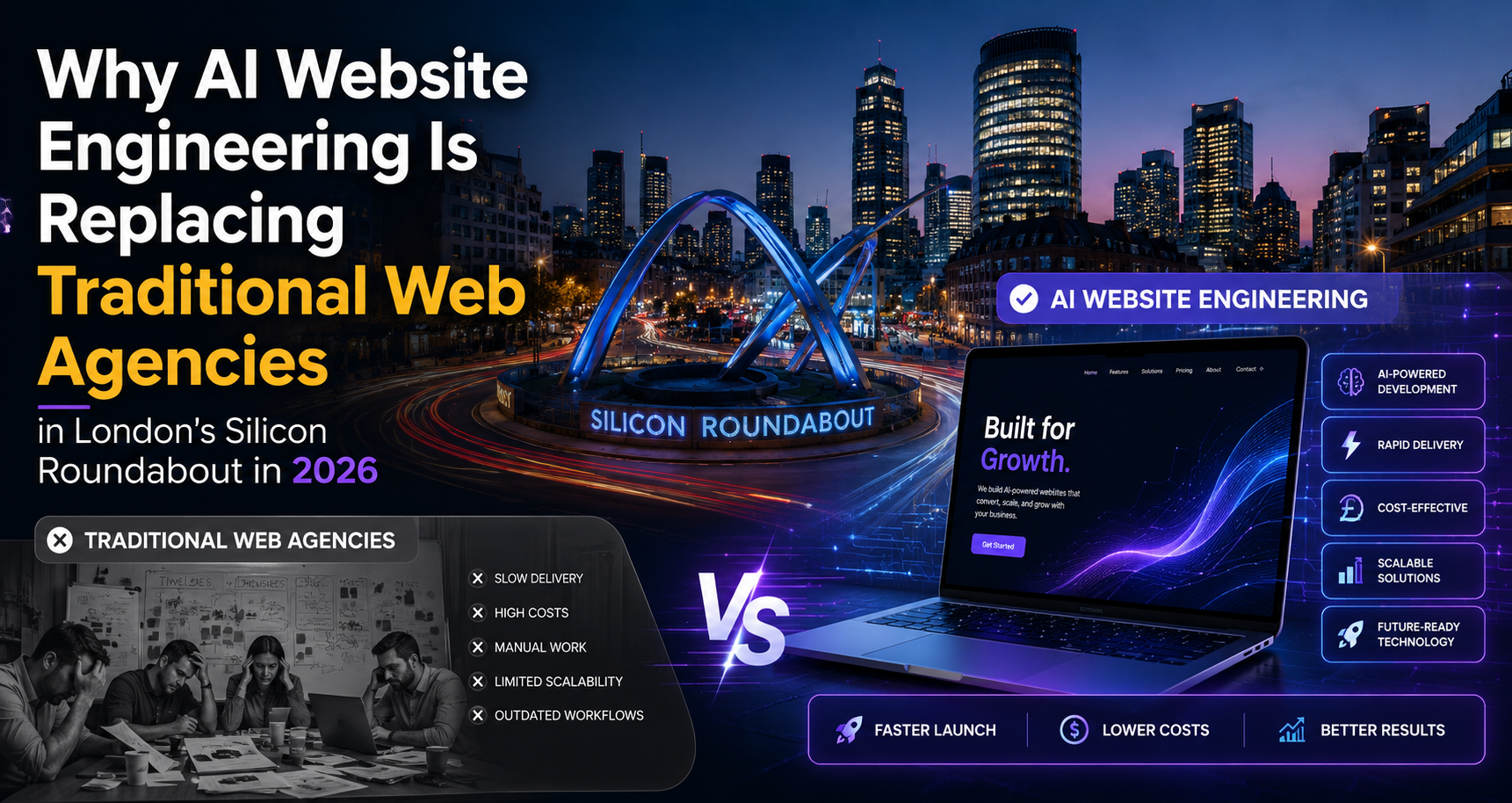
AI Website Engineering vs Traditional Web Agencies: What's Changed in 2026?
The contrast between legacy digital agencies and modern AI-driven models highlights why many traditional shops in East London are re-engineering their entire businesses.
| Attribute | Traditional Web Design Agency | AI Website Engineering Services |
| Average Delivery Timeline | 6 to 12 Weeks | 48 to 72 Hours |
| Workflow Efficiency | Manual handoffs between UI designers and frontend developers | Unified agentic workflows generating design and code simultaneously |
| Optimization Timing | Post-launch tracking and periodic manual reviews | Continuous, automated UX optimisation and performance auditing |
| Scalability & Upgrades | High friction; requires retainer fees or new development sprints | Modular architecture easily updated via structural prompts |
Traditional agencies rely on fragmented, multi-tiered teams where miscommunications during the design-to-development handoff frequently cause delays. AI-driven website development bypasses this friction entirely, ensuring that visual design intents are instantly compiled into structured, accessible, and performant code.
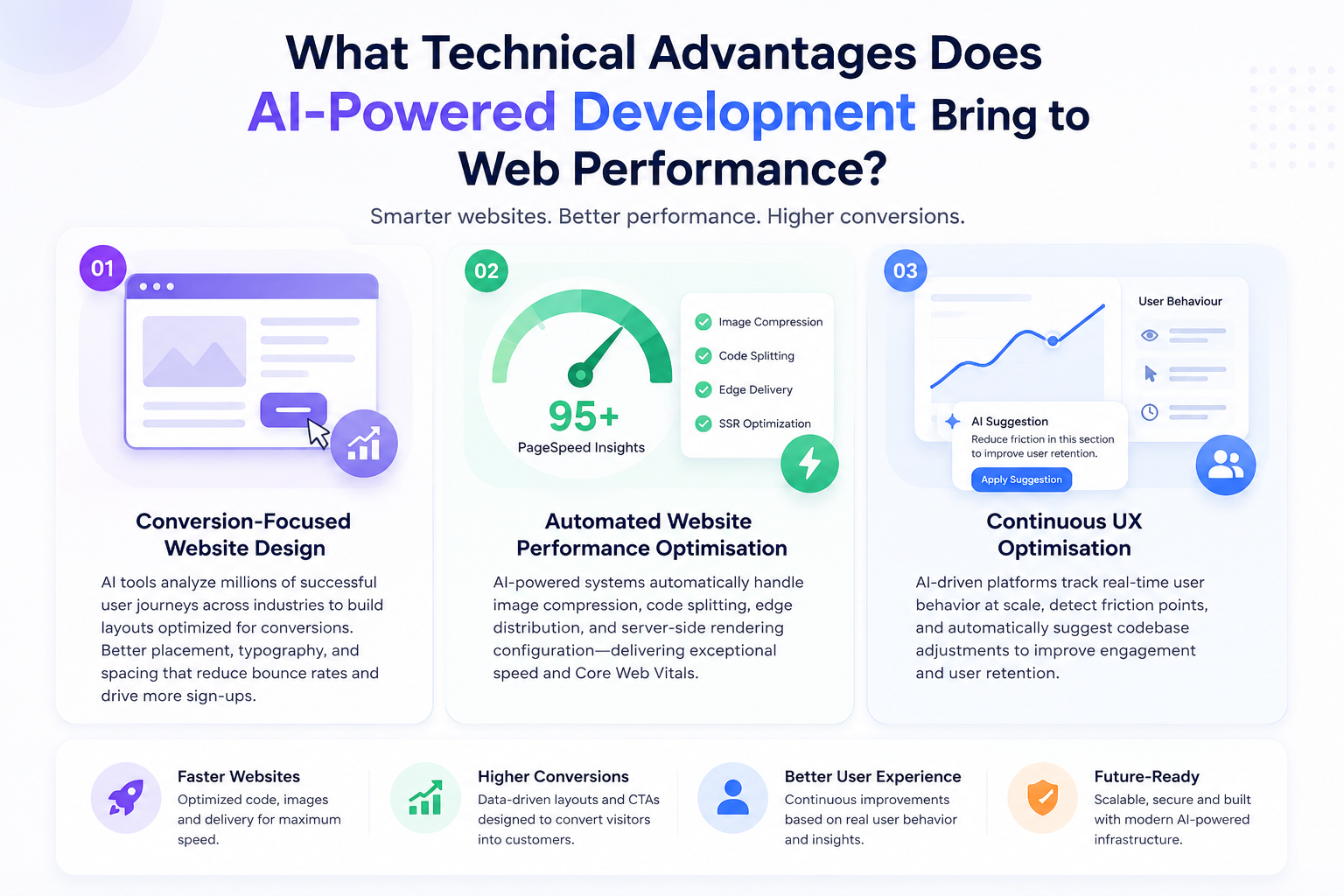
What Technical Advantages Does AI-Powered Development Bring to Web Performance?
Beyond deployment speed, choosing an AI-powered website UK solution introduces severe technical advantages to growing companies:
Conversion-Focused Website Design: AI tools evaluate millions of successful user journeys across specific industries to build layouts optimized for conversions. Elements like button placement, typography weight, and content spacing are programmatically chosen to reduce bounce rates and maximize user sign-ups.
Automated Website Performance Optimisation: Websites engineered via modern AI infrastructure achieve exceptional PageSpeed Insights scores right out of the box. The engines manage automated image compression, code splitting, edge network distribution, and server-side rendering configuration without needing human intervention.
Continuous UX Optimisation: Instead of a website remaining static after launch, AI-driven platforms track real-time user behavior anonymized at scale. They can flag layout friction points and suggest codebase adjustments automatically to improve user retention.
How Are AI-Native Pipelines Optimizing Capital Efficiency for VC-Backed Teams?
In the current funding climate, capital efficiency is a primary metric for VC-backed teams. Traditional web design agency for UK startups models require heavy upfront investments, often driven by massive billable hours rather than direct output.
| Allocation Model | Strategic Architecture & UX Oversight | Development & Execution | Project Management / Compute Operations |
| Traditional Agency Budget | 35% (Design Sprints) | 40% (Manual Coding & QA) | 25% (Project Management Overhead) |
| AI Engineering Budget | 85% (High-Level Strategy & Review) | 0% (Automated Generation) | 15% (AI Compute & Infrastructure Ops) |
By leveraging frontend development automation, the cost-per-project plummets. Startups don't need to outsource to disjointed offshore development teams or hire a massive squad of dedicated developers just to launch an initial web product. Instead, a lean internal product team working alongside an AI development partner can execute enterprise-scale projects. This dramatically lowers the startup web development cost, shifting capital away from maintenance overhead and directly into core product engineering and customer acquisition.
What Are the Core AI Tools Dominating the UK Technology Ecosystem?
The UK technology market relies on a mix of specialized ecosystem tools and enterprise frameworks to drive automated development:
- Vercel v0: A leading tool for rapid layout creation, turning text or image prompts into clean, accessible React components styled with Tailwind CSS.
- Cursor & GitHub Copilot Workspace: Advanced integrated development environments (IDEs) providing AI-assisted coding frameworks that let engineers build complete web features across full codebases using natural language.
- Bolt.new & Lovable.dev: Full-stack development sandboxes that provision servers, deploy databases, and write both frontend and backend architectures simultaneously within a browser window.
- Framer AI: Ideal for highly visual marketing platforms, bridging high-end AI website design in the UK with direct web deployments.
Is AI Website Engineering the New Operating Standard for UK Software Brands?
The expectation around digital product creation has changed across London. From the King's Cross innovation hub down to the heart of Shoreditch, the concept of a static, hard-coded website that takes months to deliver is outdated. Modern platforms must operate as living pieces of software—constantly adapting, perfectly optimized, and tightly integrated into a company’s operational stack. For businesses looking to capture market share, migrating to modern development methods is no longer optional. It is the core framework powering the fastest-growing digital brands in the UK.
FAQ
What is AI website engineering?
It is the practice of designing, coding, and deploying highly optimized websites and web applications using autonomous AI engines, LLM workflows, and automation code-generation frameworks rather than manual hand-coding.
How is AI website engineering different from traditional web development agencies?
Traditional agencies rely heavily on manual labor, human handoffs, and prolonged project timelines. AI website engineering uses agentic systems to generate enterprise-grade code in hours, drastically reducing costs while ensuring high performance.
Can AI tools help build complex e-commerce websites?
Yes. Modern AI web frameworks easily generate scalable AI-driven e-commerce website development solutions, integrating headless transaction systems, dynamic inventory filters, and automated payment gateways smoothly.
Is AI website engineering replacing web designers and developers?
No—it shifts their responsibilities. Instead of spending hours writing boilerplate components or chasing layout bugs, human professionals act as systems architects, focusing on high-level UX strategy, strict branding compliance, and precise product positioning.
The teams scaling quickly across the Shoreditch startup ecosystem are building with speed and agility. If your current platform feels slow, outdated, or expensive to maintain, it is time to upgrade your development strategy.
- Talk to an AI website engineering expert to audit your current technology infrastructure.
- Get a custom website development quote for your next project built on a modern headless architecture.
- Book a strategy consultation to discuss how to integrate automated development tools into your product roadmap.
-

Writen by Anirban Das