USA:
USA:  India: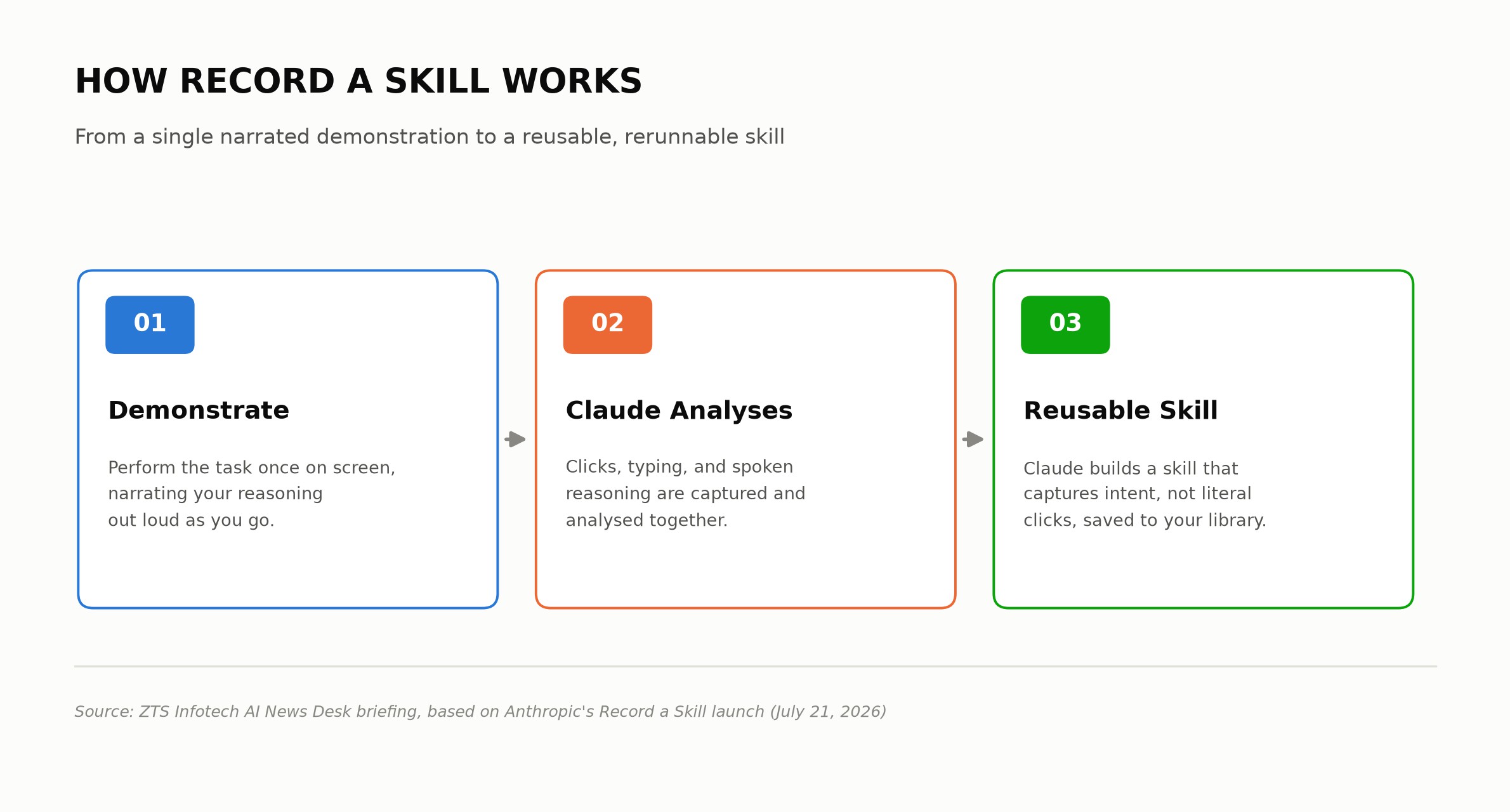
Anthropic has shipped a feature inside Claude Cowork that changes the mechanics of how repeatable business workflows get automated. Called Record a Skill, it was launched on July 21, 2026, and its premise is disarmingly simple: perform a task once on your own screen while narrating your reasoning out loud, and Claude turns that single demonstration into a reusable, rerunnable skill.
For any business that has ever tried to standardise a manual process — reconciling a report, exporting a summary, cross-checking two spreadsheets — the pitch is that the barrier to automating it just dropped from writing a specification document to simply doing the job once on camera.
How It Actually Works
The mechanics are straightforward. Inside Claude Cowork, a user clicks the plus button, selects Record a Skill, and then performs the task normally on their actual screen, narrating what they're doing and why as they go. Claude captures three things simultaneously: the clicks, the typing, and the spoken reasoning behind each decision.
Once the recording ends, Claude analyses the entire sequence and generates a reusable skill that can run the same task again — added directly to a skill library, ready to be triggered whenever the workflow needs to repeat.
Why This Isn't Just Another Macro Recorder
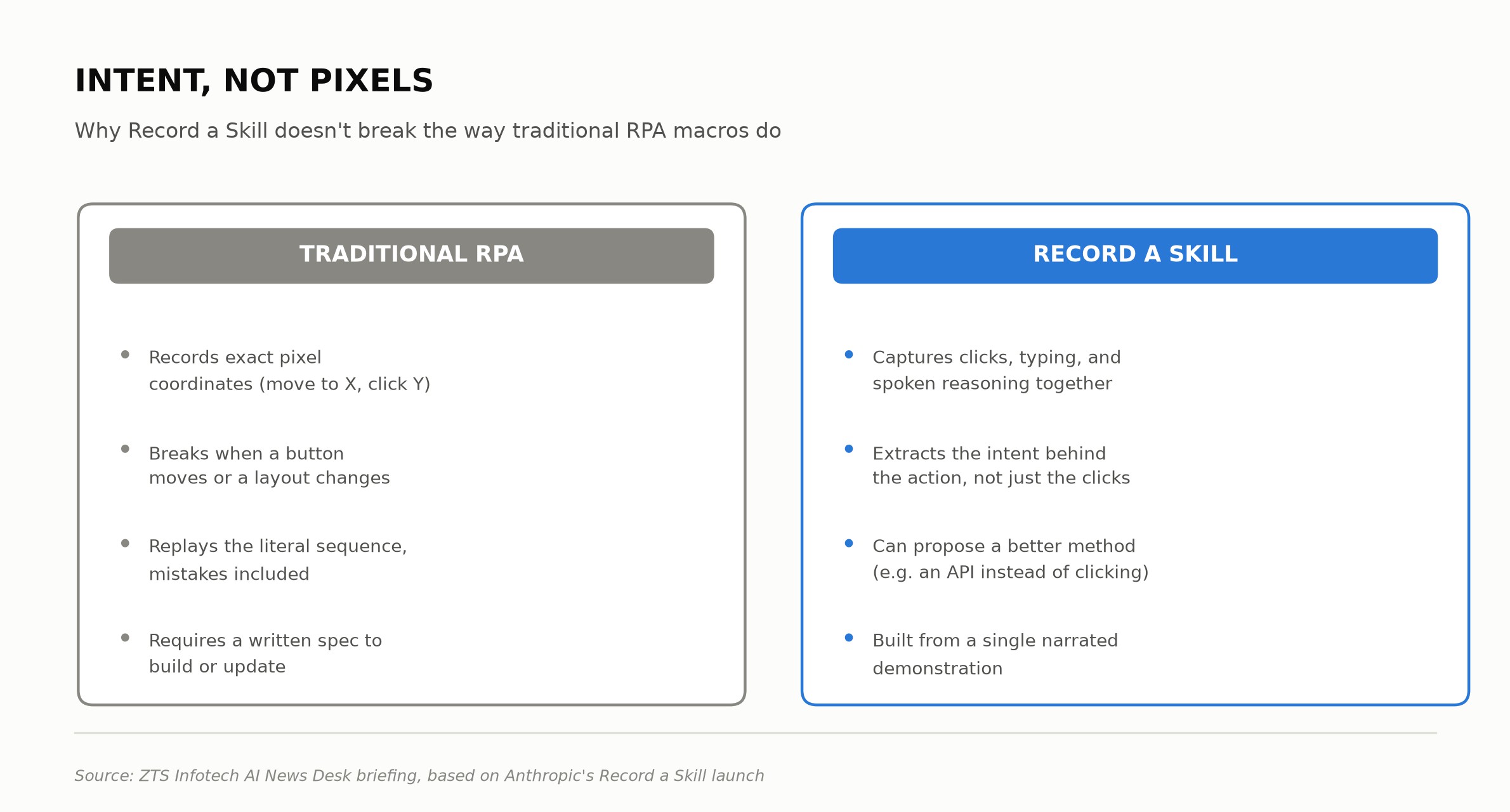
The detail that separates this from two decades of robotic process automation tools is what gets captured. Traditional RPA software recorded literal pixel coordinates — move the mouse to X, click Y — and broke the moment a button shifted position or a page layout changed. Record a Skill instead extracts the intent behind what a user did, not just the literal sequence of clicks.
That distinction showed up clearly in one documented test case: a user recorded a manual YouTube upload process, navigating through Finder and Safari. Rather than simply memorising and replaying those exact clicks, Claude recognised that a more reliable method already existed — the YouTube Data API — and proposed using it instead. That's a materially different category of automation than one that fails the instant an interface is redesigned.
A Practical Example for Any Operations Team
Consider a common scenario: a developer manually reconciles a weekly report every Friday, opening three tabs, cross-checking two spreadsheets, and exporting a summary. Under the old model, automating that task meant writing a specification thorough enough for an engineer — or another automation tool — to replicate it exactly.
Under Record a Skill, the same employee records the process once, narrating each decision out loud as they go: why they check a particular column, what they do when two numbers don't match. Claude turns that single walkthrough into a skill sitting in the skill library, ready to run again the following Friday without anyone having to re-explain the steps in writing.
The Honest Limits
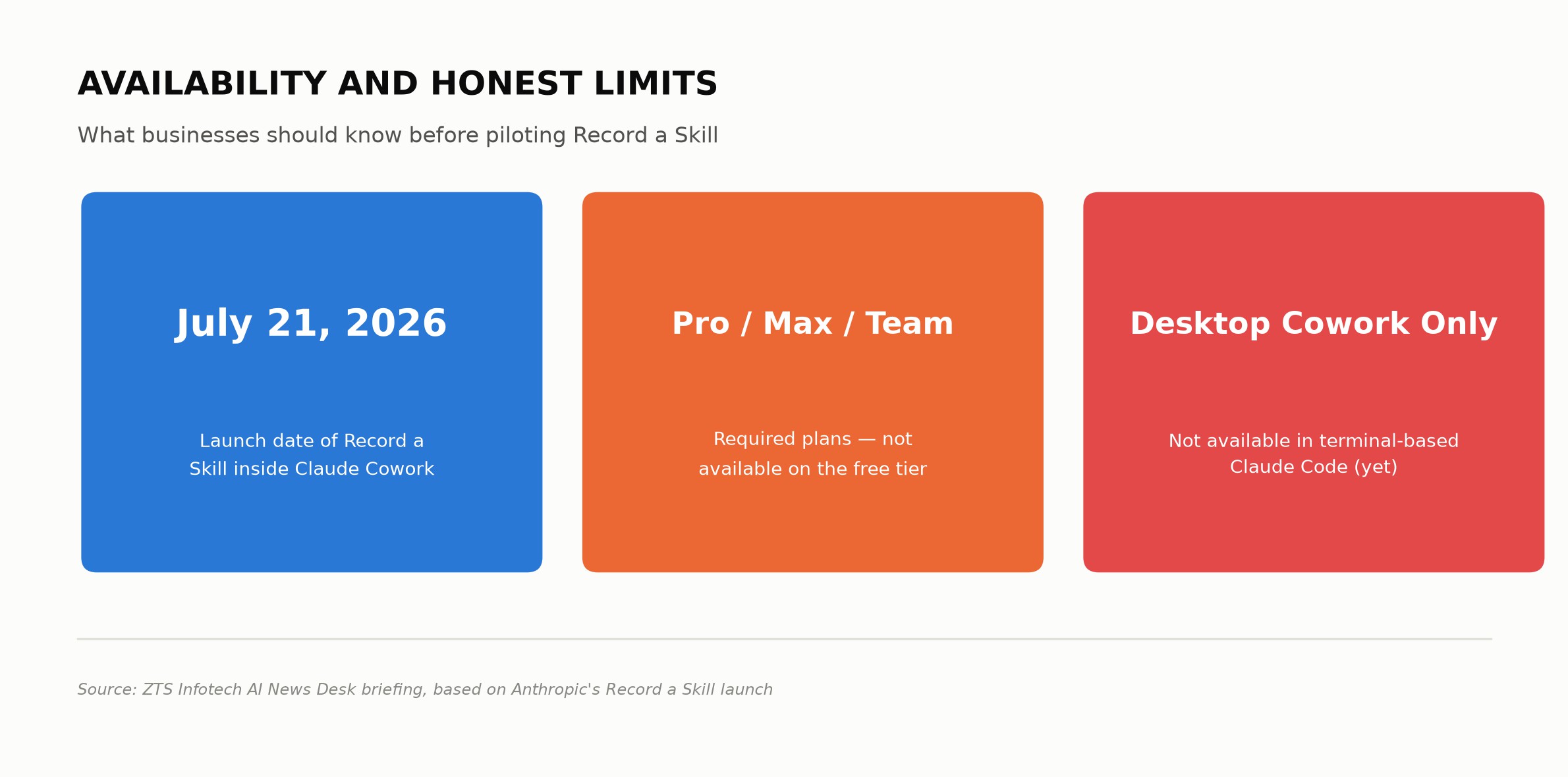
The feature isn't universally available yet. It currently requires a Pro, Max, or Team plan — it isn't offered on the free tier. It also lives specifically inside Claude Cowork on desktop, not inside the terminal-based Claude Code environment that many developers use for day-to-day coding work, which means teams already standardised on that workflow won't encounter Record a Skill in their usual tool.
Expert Perspective
The significant shift here isn't the recording mechanic itself — screen recording as an automation input has existed in various forms for years. It's that Claude is reasoning about intent rather than replaying literal input, which is precisely the failure mode that made most RPA deployments brittle and expensive to maintain. Any interface change, any moved button, any redesigned page has historically meant re-recording the macro from scratch. A system that instead asks "what was this person trying to accomplish" is a fundamentally more durable basis for automation.
The YouTube API substitution is the detail worth paying attention to, because it demonstrates something beyond fault tolerance: the system evaluating whether the demonstrated method was even the best available approach, and proposing a better one. That's a different category of tool than one that faithfully reproduces whatever a human happened to do, mistakes and inefficiencies included.
The plan restriction and desktop-only availability are real constraints businesses should factor into rollout planning, not caveats to gloss over. Teams standardised on Claude Code's terminal workflow, or on the free tier, won't have access yet, and organisations should treat this as an early-stage capability to pilot on contained, well-understood workflows — internal reporting, QA checks, routine reconciliation — rather than something to hand mission-critical processes to on day one. That is exactly the posture ZTS Infotech is taking, testing the feature this week against internal QA and reporting workflows before drawing conclusions about broader use.
Key Takeaways
- Anthropic launched Record a Skill inside Claude Cowork on July 21, 2026 — perform a task once on screen while narrating your reasoning, and Claude generates a reusable skill.
- Claude captures clicks, typing, and spoken reasoning together, then analyses the full recording to build the skill.
- Unlike traditional RPA tools that replay literal pixel coordinates and break when interfaces change, Record a Skill extracts the intent behind actions.
- In one documented test, Claude proposed the YouTube Data API instead of replaying a manually recorded browser upload — recognising a better method than the one demonstrated.
- A practical use case: recording a weekly report reconciliation once turns it into a rerunnable skill, without a written specification.
- The feature requires a Pro, Max, or Team plan and is not available on the free tier.
- It currently lives inside Claude Cowork on desktop, not the terminal-based Claude Code environment most developers use daily.
Conclusion
Record a Skill reframes automation as something closer to teaching by demonstration than programming by specification, and the intent-extraction behind it addresses the exact fragility that has limited RPA adoption for years. It remains an early-stage feature — gated to paid plans, confined to one interface, and still being tested internally by early adopters like ZTS Infotech on contained workflows. For operations and engineering leaders evaluating where to invest automation effort next, the practical move now is a small, well-scoped pilot rather than a wholesale rollout, watching closely for how reliably the intent-extraction generalises beyond simple, well-defined tasks.
Related Reading on Our Sites
- AI Workflow Automation Advisory Services
- Piloting AI Tools Safely Inside Operations Teams
- What the ChatGPT Ecosystem Means for Enterprise AI
- AI Governance Consulting for Enterprises
- ZTS Infotech AI News Desk — Archive
External References
- Anthropic — official product announcements
- Claude Cowork — product documentation
-

Writen by Anirban Das