USA:
USA:  India:
Most agencies build a single SEO report template and run it more often or less often, depending on the client. According to Zebra Techies Solution (ZTS), that is the mistake. In a recent AI news video, the company argued that a weekly check and a monthly report are not the same job at different speeds. They answer different questions, and building them as one agent instead of two is why reporting still consumes hours that nobody has.
For agency owners and marketing heads, the argument is practical rather than theoretical. ZTS says it split the work into two automated agents using Claude, and that the arrangement replaced hours of manual reporting every month for every client it manages. That outcome is the company's own claim, but the design logic behind it is worth examining.
The Core Idea: Two Questions, Two Jobs
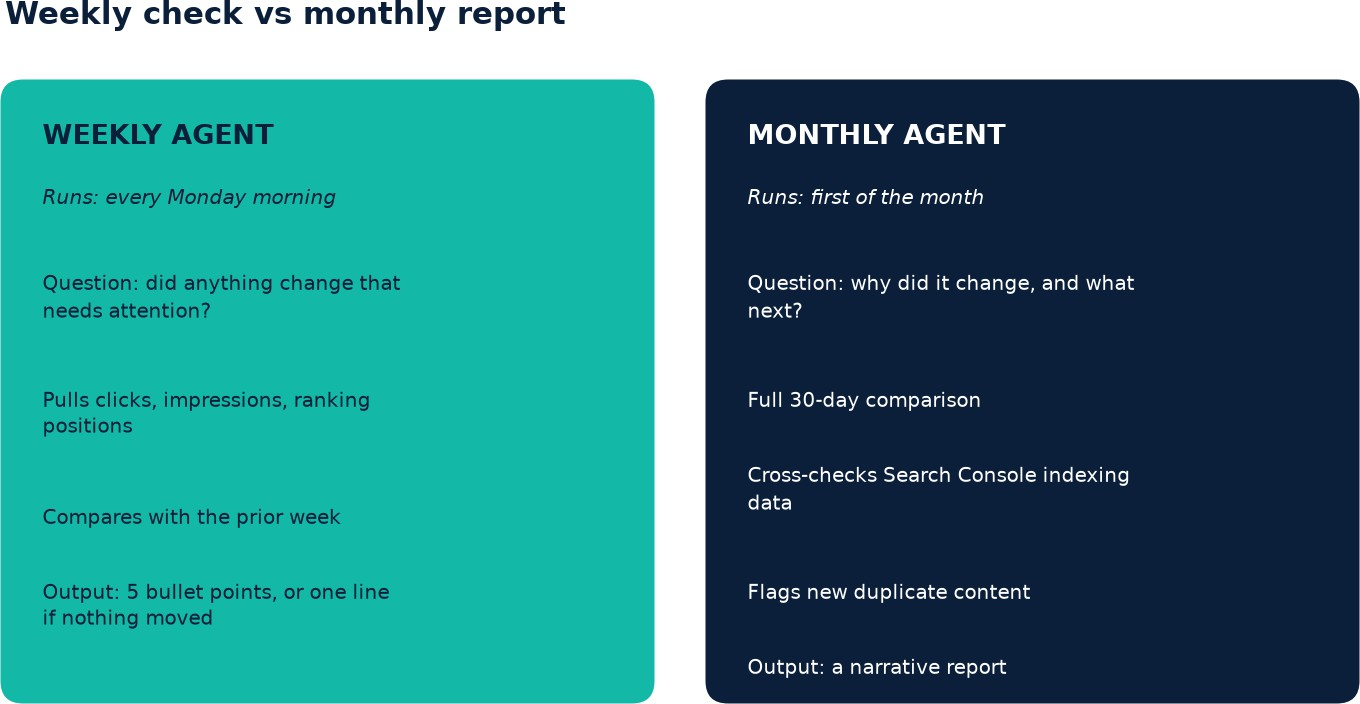
The distinction is simple to state. The weekly job asks whether anything changed that needs attention before the Monday client call. The monthly job asks why things changed and what should happen next. One is a watch; the other is an analysis.
The Weekly Agent: Flag What Moved
ZTS says its weekly agent connects to Google Search Console and Google Analytics through free, open-source MCP connectors. The setup uses a one-time OAuth authorisation, and the company says there is no ongoing cost for the connection.
What it does each week
- Pulls clicks, impressions and ranking positions.
- Compares them against the prior week.
- Flags only what moved meaningfully.
The output is deliberately short: five bullet points, not five pages. If nothing moved, the report says exactly that in a single line. For busy account managers, a report that can honestly say "no change" is arguably more useful than one that always finds something to say.
The Monthly Agent: Explain Why and What Next
The monthly agent works at a different depth. Per ZTS, it pulls a full 30-day comparison and cross-references it against Search Console's indexing data. It also checks for new duplicate content.
The result is a narrative, the kind of document a client reads in a meeting rather than glances at. That is the point of separating the jobs. A short alert list cannot do the explaining, and a long narrative is wasted on a weekly check where nothing happened.
Automation Through Scheduled Tasks
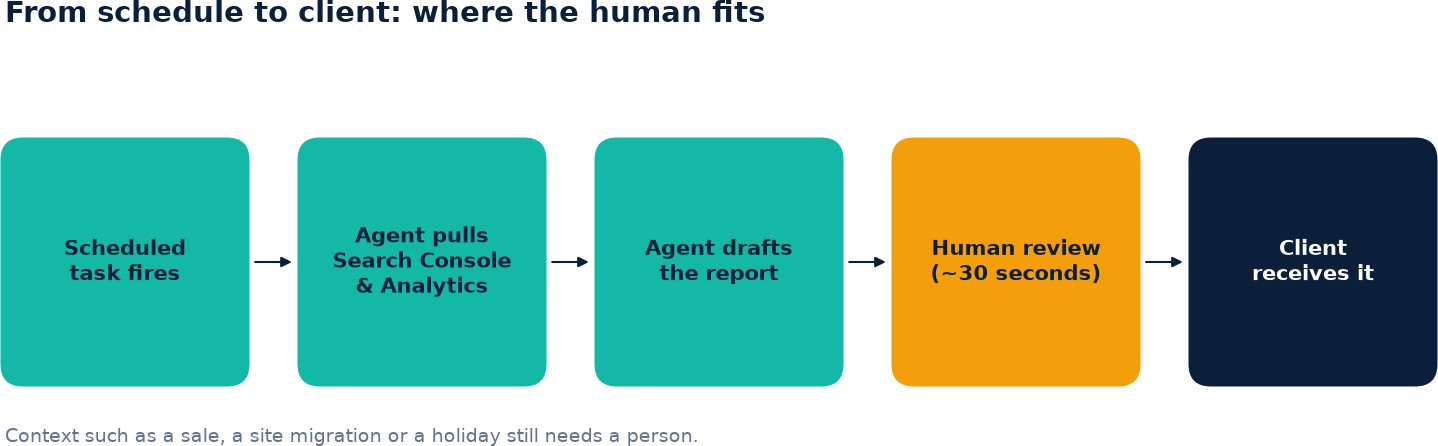
ZTS says both agents are set up once inside Claude using its Scheduled Tasks feature. The weekly agent fires every Monday morning, before the team is at their desks. The monthly agent fires on the first of the month. Neither relies on someone remembering to run it.
The Honest Catch: Context Still Belongs to a Human
ZTS is clear about the limit. A scheduled agent drafts a report. It does not know whether last week was unusual for a genuine reason, such as a sale, a site migration or a holiday. That context belongs to a person, and ZTS says it allows about 30 seconds of human review before anything goes to a client.
Editorial view: this is the right place to draw the line. Data pulls and week-on-week comparisons are repeatable work. Judgement about why a number moved depends on knowledge the agent does not have, and a client will hold the agency, not the software, responsible for the explanation.
Practical Takeaways for Agency Leaders
- Separate the "what changed" check from the "why and what next" analysis, and give each its own format.
- Keep weekly reports short enough to read in a minute, and let them say "no change" when that is true.
- Reserve the narrative effort for the monthly report, where clients expect interpretation.
- Schedule both so that reporting does not depend on anyone's memory.
Build in a brief human check for context before delivery.
Challenges and Opportunities
The opportunity is time. Reporting is repetitive, and a design that automates the repetitive parts frees staff for client conversations. The challenges are equally real. Connector setup requires an initial authorisation step, the drafts need human context, and the time savings quoted here come from ZTS's own experience rather than an independent study. Agencies should test the approach on a few accounts and measure their own results before rolling it out.
Key Takeaways
- ZTS argues weekly checks and monthly reports need two separate agents, not one template run at different speeds.
- The weekly agent asks what changed, using Search Console and Analytics data, and reports in five bullets or one line.
- The monthly agent asks why and what next, adding a 30-day comparison, indexing data and duplicate-content checks.
- Both run automatically through Claude's Scheduled Tasks: Mondays for weekly, the first of the month for monthly.
- A human still needs about 30 seconds to add context such as sales, migrations or holidays.
- The time-saving result is ZTS's own claim and has not been independently verified.
What to Watch Next
Scheduled, connector-driven agents are becoming a practical option for routine marketing operations. The agencies that benefit most will likely be those that match each automated report to a clear question and keep a person in the loop. Follow this news desk for further updates on AI tools and digital marketing.
-

Writen by Anirban