USA:
USA:  India:
 .jpg)
Quick answer: On July 7, 2026, Reuters reported that Chinese officials — led by the Ministry of Commerce — met with Alibaba, ByteDance, and Z.ai over the previous month to discuss restricting foreign access to China's most advanced AI models, including some not yet released. Nothing has been finalized. The talks reportedly include a possible three-tier control system similar to how the US now treats frontier AI. No company or government body has confirmed the details on record.
What Reuters Actually Reported
The story, filed from Singapore, cited three people described as familiar with the discussions who were not authorized to speak publicly. According to those sources, China's Ministry of Commerce ran a series of meetings over roughly a month, and representatives from Alibaba, ByteDance, and the AI startup Z.ai attended. The National Development and Reform Commission — China's central planning body — reportedly sat in as well.
The subject on the table: whether Beijing should start limiting who outside China can access the country's strongest AI systems, including models that haven't shipped yet. That's notable because it would apply not just to closed, proprietary systems but potentially to open-weight models too — the freely downloadable kind that companies like Alibaba (Qwen), ByteDance (Doubao), and Z.ai (GLM-5.2) have used to build global user bases over the past two years.
It's worth being precise about what this is and isn't. It is a set of internal policy conversations reported by a credible wire service using anonymous sourcing. It is not a signed regulation, an announced ban, or an official position from any Chinese ministry. When Reuters approached the Ministry of Commerce, the NDRC, Alibaba, ByteDance, and Z.ai for comment, none responded. That silence doesn't confirm or deny the story — it just means there's no on-record government statement yet.
Where the Three-Tier Idea Comes From
The framework getting the most attention online traces back to a May 2026 roundtable of Chinese legal scholars, the conclusions of which were published in an official Supreme People's Court journal. That roundtable proposed sorting AI systems by sensitivity:
- Tier 1 — Basic open-source tools: Would only need a simple filing requirement, similar to registering software rather than seeking approval for it.
- Tier 2 — Advanced models: Would require a formal security review before wider release.
- Tier 3 — Frontier-capability models: Would either be barred from public release entirely or restricted to domestic use only.
Reuters says this framework offers the best available hint at what any future rule might look like, though it stops short of saying this is the plan Beijing will adopt. Other ideas reportedly raised in the same meetings include classifying theft or unauthorized disclosure of proprietary Chinese AI as a national security offense, and restricting which investors are allowed to fund homegrown AI startups.
Why Now: The US-China AI Tit-for-Tat
This story doesn't exist in isolation. It's the latest move in an escalating back-and-forth between Washington and Beijing over frontier AI that's played out over the past several weeks.
In June 2026, the US restricted overseas access to some of Anthropic's most capable models under export control rules, citing national security concerns tied to cyber capability. Those restrictions were paired with broader scrutiny of AI systems considered strong enough to identify software vulnerabilities at scale — a capability regulators on both sides now treat less like a consumer feature and more like a controlled technology. Access to Anthropic's consumer-facing model was later restored after additional safeguards were introduced, while tighter controls have stayed in place for its more security-sensitive counterpart.
Then, in early July, a developer discovered that Anthropic's coding tool, Claude Code, contained code attempting to detect whether a user was located in China or connected to a Chinese AI lab. An Anthropic engineer addressed it publicly, saying the code had actually been added back in March as a defense against "distillation" — a technique where one company trains a cheaper model by learning from a stronger rival's outputs — and that it would be removed. Anthropic has separately accused Chinese labs, including Alibaba, of attempting exactly this kind of distillation against Claude, and published findings earlier this year alleging a pattern of fraudulent accounts used to extract data from its models at scale.
Alibaba's response was swift. According to reporting from the Information, the company banned Claude Code internally, classified it as high-risk software, and instructed employees to uninstall it and switch to Alibaba's own coding assistant, Qoder, with a deadline reportedly landing around July 10.
Seen against that backdrop, Beijing's talks with Alibaba, ByteDance, and Z.ai look less like an isolated regulatory idea and more like the natural next step in a pattern: both governments are moving to treat their most capable AI systems the way they'd treat sensitive hardware, not consumer software.
Timeline at a Glance
- June 2026 — US restricts access to Anthropic's most advanced AI systems over national security concerns; the consumer-facing model is later reopened with added safeguards, while the security-focused model remains restricted.
- Early July 2026 — A developer flags detection code inside Claude Code aimed at identifying users connected to China or Chinese AI labs; Anthropic says it dates to March and will be removed.
- July 10, 2026 — Alibaba reportedly bans internal use of Claude Code, telling staff to uninstall it and adopt Qoder instead.
- July 7, 2026 — Reuters reports Beijing has spent the past month in talks with Alibaba, ByteDance, and Z.ai about restricting foreign access to top Chinese AI models, potentially through a tiered filing-and-review system.
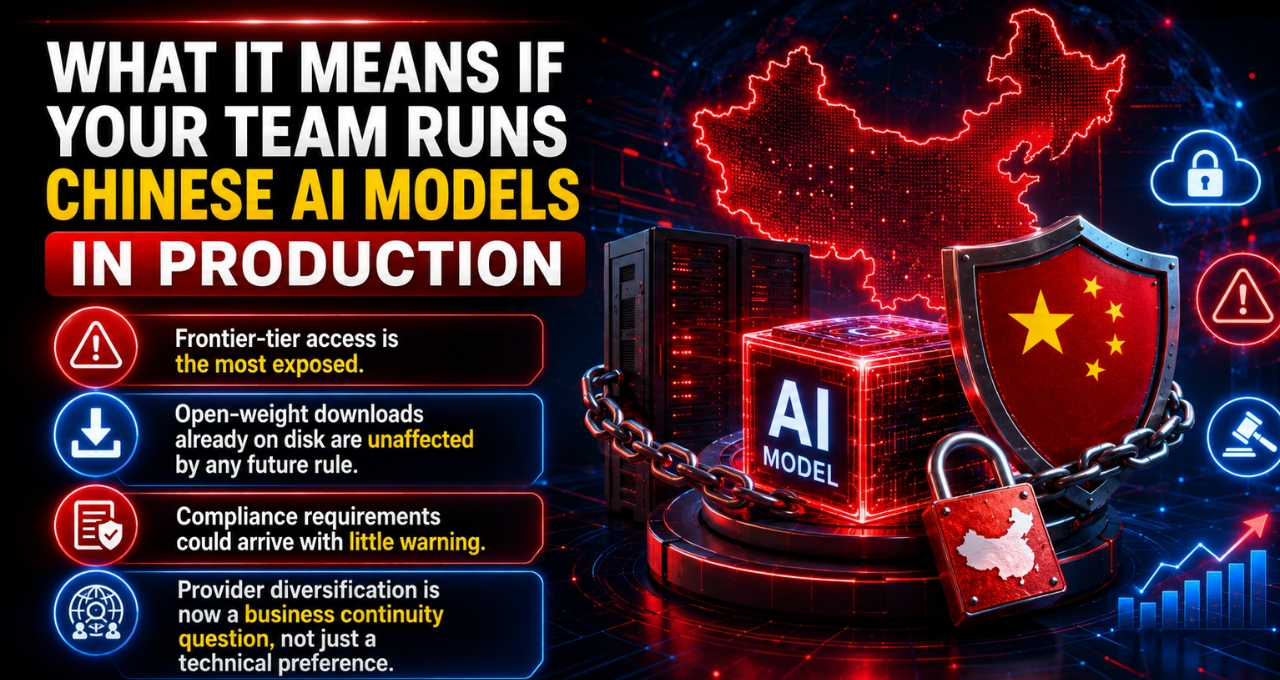
What It Means If Your Team Runs Chinese AI Models in Production
Nothing has changed for existing deployments yet — no restriction has actually taken effect. But the direction of travel matters more than the exact wording of any future rule, and a few practical implications stand out for teams currently relying on models like Qwen, Doubao, or GLM-5.2 in live systems:
Frontier-tier access is the most exposed. If the eventual policy resembles the tiered structure being discussed, it's the newest, most capable models — not the widely deployed current versions — that face the tightest restrictions. Teams building around the next generation of these models should treat continued open-weight access as uncertain rather than guaranteed.
Open-weight downloads already on disk are unaffected by any future rule. A restriction on future releases can't retroactively pull back model weights already published. What it can change is whether tomorrow's version — the successor model — ships with the same open access.
Compliance requirements could arrive with little warning. Given how the equivalent US rules rolled out — announced, applied, partially reversed, and reapplied within weeks — any Chinese framework could move just as fast once it's finalized, leaving limited runway to adjust vendor dependencies.
Provider diversification is now a business continuity question, not just a technical preference. Relying on a single foreign AI provider — American or Chinese — carries policy risk that didn't exist eighteen months ago. Multi-vendor architecture has quietly gone from "best practice" to "risk mitigation."
How ZTS Infotech Pvt Ltd. Tracks What's Actually Reliable
Headlines move fast in this space; production systems can't afford to move on headlines alone. At ZTS Infotech, we track which AI tools our clients can actually rely on for real production work — not based on benchmark leaderboards or press releases, but on actual regulatory exposure, uptime under policy pressure, data handling practices, and how a given provider has behaved the last time restrictions actually hit. That's the difference between a model that looks strong in a demo and one that's still dependable six months into a client's roadmap.
ZTS Infotech Pvt Ltd's CEO, Mr. Anirban Das, has been especially focused on one thing throughout this period: continuity risk hiding inside AI vendor choices. His view is that the technical capability of a model matters less to a business than whether that capability will still be accessible, compliant, and stable a year from now — and that too many teams are only asking that question after a restriction has already hit their stack.
That's the lens ZTS applies before recommending any AI tool for production use: not just what a model can do today, but what happens to a client's roadmap if access changes overnight.
FAQs
1. Is China banning foreign access to its AI models right now?
No. As of now, no ban or official restriction has been announced. Reuters reported that Chinese officials have been discussing possible controls with major AI companies, but no final policy has been confirmed or implemented.
2. Which Chinese AI models could be affected if new rules are introduced?
The discussions reportedly focus on China's most advanced AI models, including future frontier models from companies such as Alibaba (Qwen), ByteDance (Doubao), and Z.ai (GLM series). Existing publicly available models remain accessible unless new regulations are officially introduced.
3. How could these proposed restrictions impact businesses using Chinese AI models?
If China adopts a tiered access system, businesses may face limited access to future high-capability models, additional compliance requirements, or delays in obtaining new model releases. Organizations relying on these models should consider multi-vendor AI strategies to reduce operational risk.
4. How can businesses prepare for changing AI regulations?
The best approach is to monitor verified regulatory updates, diversify AI providers, evaluate compliance requirements regularly, and build flexible AI infrastructure that can adapt if access to a specific model changes. This helps minimize disruption while maintaining long-term business continuity
-

Writen by Anirban Das