USA:
USA:  India:
Not every tactic that works belongs on every account. That’s the uncomfortable but honest starting point for a link-building method now in use at Zebra Techies Solution — one built entirely around Claude in Chrome, Anthropic’s browser-automation extension, and explicitly reserved for a specific type of client.
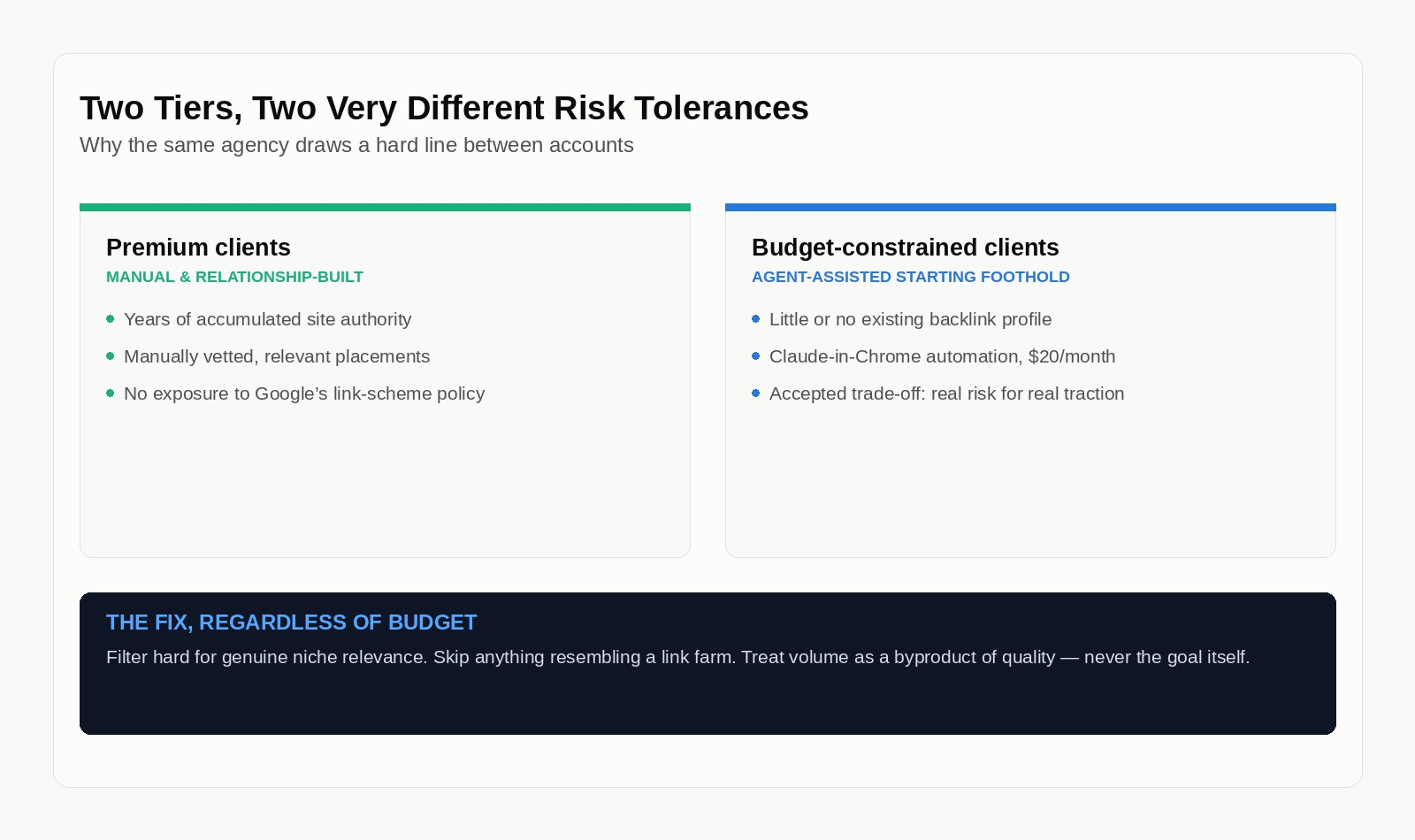
It’s worth being upfront about who this is for before describing what it does. Clients on the agency’s full-service plan don’t get this. They receive manually vetted, relationship-based link placements, because that’s what the budget buys and what the quality bar demands on an established site. This method exists for a different situation entirely: businesses that genuinely can’t yet afford that level of service but still need a real starting point rather than no backlink profile at all.
The Setup: Six Steps, One Browser Extension
The entire method runs on a single tool — Claude in Chrome — and requires nothing beyond a paid Claude plan starting at $20 a month. No additional software, no separate scraping infrastructure.
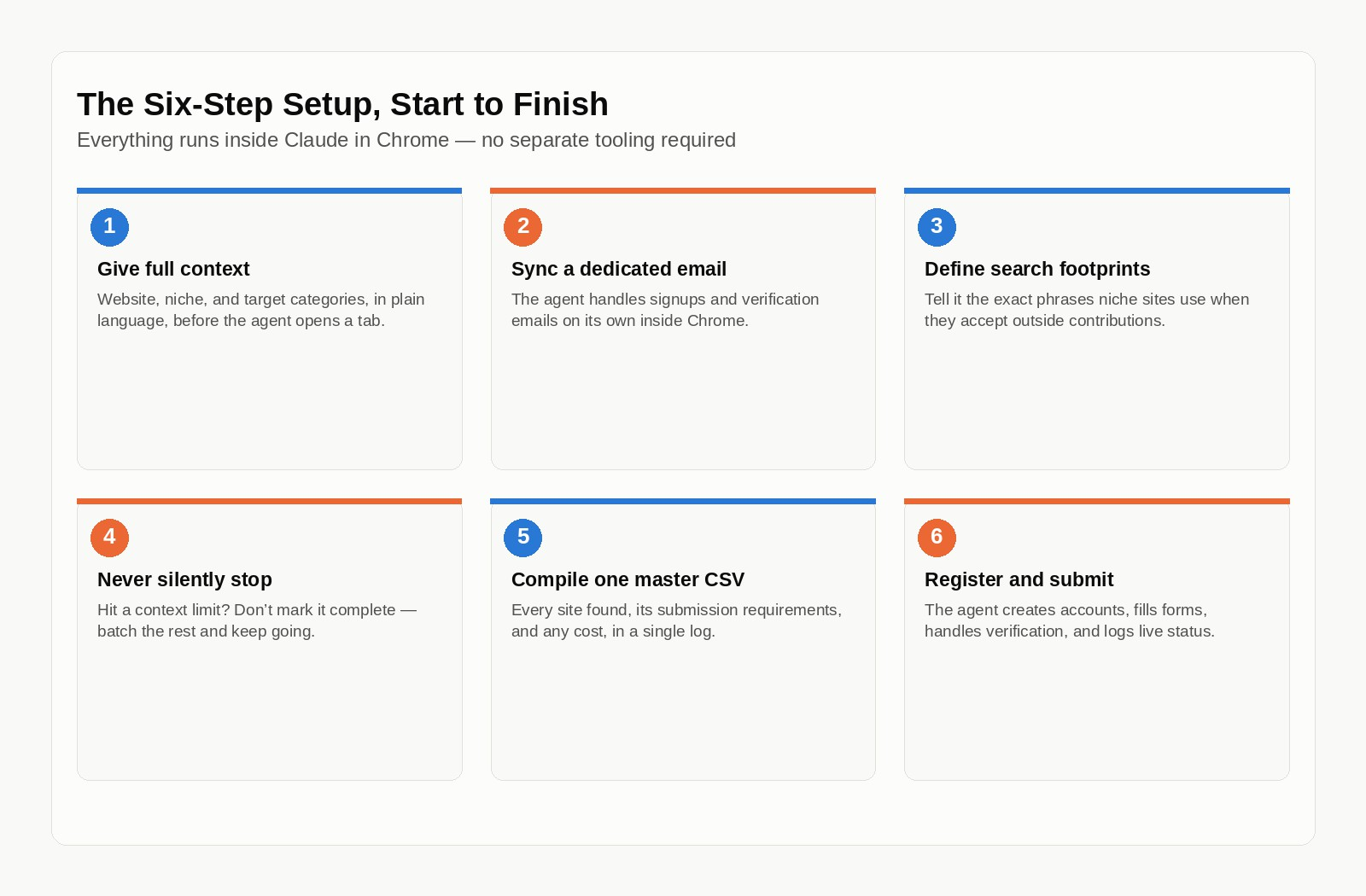
End to end, it’s a fully agent-run pipeline — from discovery through account creation to submission tracking — running on consumer-grade tooling rather than custom-built infrastructure. The step that matters most operationally is the fourth one: agents left to run long tasks will often quietly wrap up early once they hit a context limit, marking a job “complete” when it has really just stopped. Explicitly instructing the agent to batch and continue instead is what keeps the output honest.
The Part That Doesn’t Get Left Out
Here’s the reason this method is walled off from premium accounts, stated plainly rather than buried in fine print: Google’s own guidelines treat indiscriminate, footprint-based mass link building as a link scheme. That’s a real penalty risk, not a hypothetical one — Google has spam policies specifically written to catch exactly this pattern of behavior, and enforcement against it is a known, documented outcome, not a theoretical edge case.
For a budget-constrained business with little or no existing backlink profile, that trade-off can be defensible: a real starting foothold now, accepting some risk, versus no visibility at all while saving up for a fully manual campaign. For a client whose site carries years of accumulated authority, the calculation flips entirely. The downside of a penalty scales with what there is to lose, and an established site has far more to lose than a new one does. That asymmetry is the entire reason the agency draws a hard line between the two service tiers rather than applying one method universally.
The Fix That Applies Regardless of Budget
None of this is presented as a reason to run the method carelessly. The mitigation that matters, regardless of which tier a client sits in, is relevance discipline: filter hard for genuine niche fit, skip anything that resembles a link farm, and treat volume as a byproduct of quality rather than the goal itself. A method that produces fifty genuinely relevant placements is doing something different — and something defensible — from one that produces five hundred placements on sites that exist purely to host outbound links. The automation accelerates discovery and submission; it doesn’t replace the judgment call about which sites are actually worth submitting to in the first place.
Expert Perspective: Automation Doesn’t Change What Google Penalizes
The more useful way to read this isn’t as a story about a clever new automation trick — link-building automation itself isn’t new. It’s a story about a business being explicit, in public, about where it draws a risk line and why. That’s rarer than it should be in SEO content, where “here’s how to automate backlinks” pieces routinely skip the part where the tactic sits close to what search engines explicitly penalize.
The underlying lesson generalizes well beyond this one tool: AI agents make it dramatically easier to execute a tactic at scale, but they don’t change whether that tactic is safe to run at scale. Google’s spam policies were written around patterns of behavior — indiscriminate submission, low relevance, volume as the goal — not around which tool produced them. An agent that submits to five hundred marginally relevant sites in an afternoon is exposed to exactly the same policy risk as a human doing the same thing manually over months; the agent just gets there faster. Any business evaluating AI-driven marketing automation should apply that same test before adopting a new agent workflow: does this tactic hold up under the platform’s actual guidelines, independent of how efficiently AI lets you execute it?
Looking Ahead
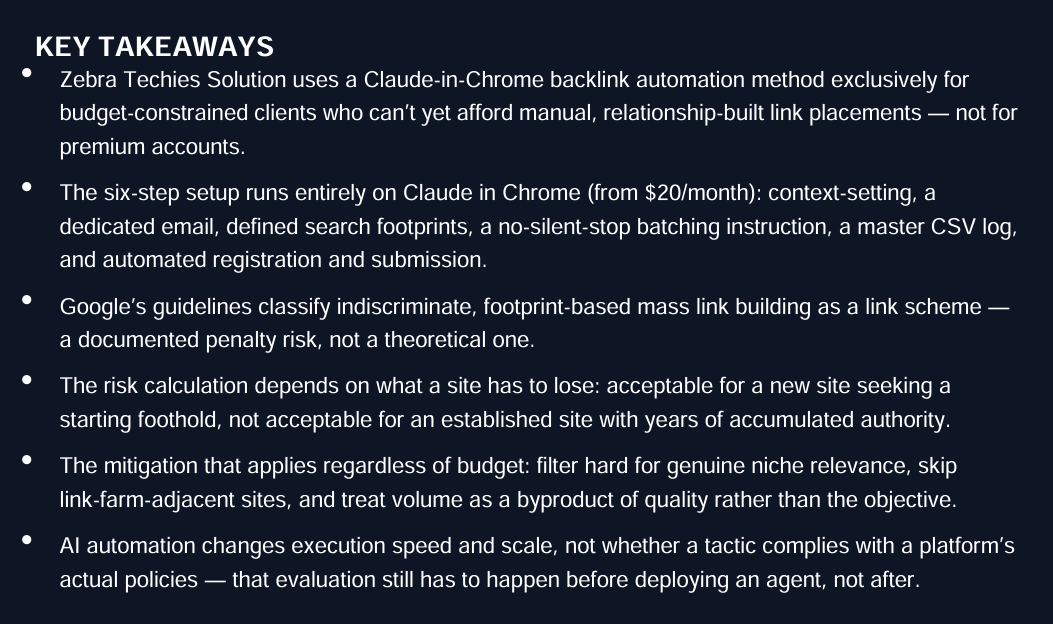
As AI agents make it easier to execute marketing tactics at scale, the businesses that hold up best will be the ones applying old-fashioned judgment to new-speed execution — asking whether a tactic is defensible before asking whether it’s automatable. Expect more agencies to start publishing exactly this kind of tiered, risk-explicit approach as AI-driven marketing tools become standard rather than novel, if only because the alternative — treating every client’s risk tolerance identically — is the harder position to defend when a penalty actually lands.
-

Writen by Anirban