USA:
USA:  India:
 By ZTS Infotech News Desk
A technique spreading through the Claude Code community consolidates a day's conversations into long-term memory while you sleep. It traces back to Andrej Karpathy and Anthropic's own internal tooling — and it comes with two failure modes most coverage skips.
Every AI assistant has the same blind spot: it forgets. Close the chat window, and everything discussed disappears with it. A technique spreading through the Claude Code community this month proposes a fix — and it has picked up a name that sounds more like science fiction than software engineering: dreaming.
The idea, reported by ZTS Infotech’s AI News Desk, traces back to a pattern Andrej Karpathy open-sourced earlier this year and has since been formalized by Anthropic as an internal mechanism referred to as “Auto Dream,” built directly into Claude Code. For any business now running AI assistants against real, ongoing work rather than one-off queries, this is worth understanding before it shows up in a vendor’s feature list.
What "Dreaming" Actually Means
Strip away the branding and the mechanism is straightforward. Every conversation with Claude during the day generates a transcript. Under normal circumstances, most of that context is lost the moment the session ends — the model has no persistent memory of what it discussed yesterday unless a human manually re supplies it. Dreaming changes that by adding a scheduled overnight process that reviews the day’s transcripts, looks for patterns across separate sessions, strips out duplicate or outdated information, and consolidates what’s left into a refined long term memory file. The result: the next morning, Claude already has context on what happened the day before, without a person having to reconstruct it.
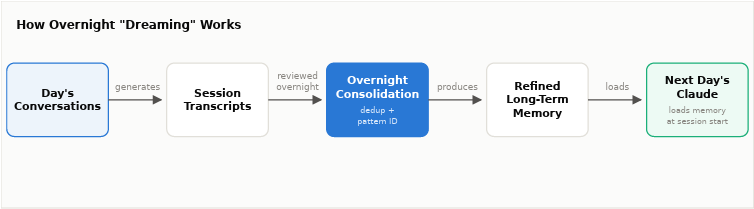
Figure 1. The overnight consolidation cycle: transcripts are reviewed, deduplicated, and merged into a refined memory file that loads automatically at the next session. Source: ZTS Infotech AI News Desk.
Where the Idea Comes From
This isn’t a single company’s invention so much as a pattern that spread. Karpathy’s original open-sourced version planted the idea; Anthropic built its own internal implementation into Claude Code under the “Auto Dream” name; and the wider developer community has since built independent tools — including claude second-brain — that apply the same logic on top. That lineage matters for buyers: it signals a pattern multiple serious engineering teams have independently converged on, which tends to happen when the underlying problem is real and costly enough to solve repeatedly.

Figure 2. The pattern's lineage, from Karpathy's original open-source release through Anthropic's internal implementation to community-built tools. Source: ZTS Infotech AI News Desk.
The Two Real Risks Most Coverage Skips
Here is where the story gets more interesting than the “AI gets smarter while you sleep” framing suggests. Automated memory consolidation is not risk-free, and the failure modes are specific enough to name.
Overdreaming. If the consolidation process runs too aggressively, it doesn’t just remove genuine duplicates — it starts compressing away nuance. Specific details that mattered in context get flattened into generic summaries, and the resulting memory becomes less useful precisely because it tried to be efficient. A system optimized purely for compactness will, sooner or later, throw away the exception that made a piece of information worth keeping.
Bad dreams. This is the sharper risk. If a day’s transcripts contain an error — a wrong assumption, a hallucinated fact, a misread instruction — the dreaming process has no way to know that. It consolidates the mistake into long-term memory with the same confidence it applies to everything else, and from that point forward the system treats the error as established fact. Every future conversation inherits it. One bad night of consolidation can quietly corrupt weeks of accumulated context, and because the process runs unattended, nobody necessarily notices until the bad assumption surfaces in a decision that depended on it.
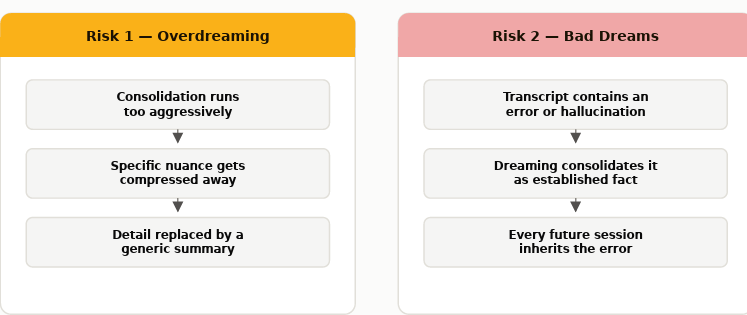
Figure 3. The two failure modes: overdreaming compresses away nuance through over-aggressive consolidation, while bad dreams let an unreviewed transcript error become permanent, inherited "fact." Source: ZTS Infotech AI News Desk.
Bottom line for buyers: Automated memory consolidation solves a real, expensive problem — re-explaining context every session — but it hands an unattended process the authority to decide what counts as fact. That authority needs a review step, not just a feature flag.
What This Means for Businesses Building AI Knowledge Systems
For any organization experimenting with persistent AI memory — internal documentation, support history, long-running project context — the appeal is obvious: less manual re-briefing, more continuity, an assistant that behaves like it remembers working with your team. But the same properties that make it useful make errors dangerous. Manual mistakes are usually visible and correctable in the moment. A system that silently consolidates a wrong fact into settled knowledge is harder to catch, precisely because it now carries the system’s own authority behind it.
Expert Perspective
The pattern here is a familiar one in AI tooling: automation that looks purely beneficial on the surface almost always trades away a safeguard somewhere less visible. Dreaming solves a genuine, expensive problem — re-explaining context every session — but it does so by giving an unattended process the authority to decide what’s worth remembering and what counts as fact. That’s a meaningful shift in trust, and it should come with a review step, not just a feature flag. Teams piloting memory consolidation should treat the overnight output the way an editor treats a junior reporter’s draft: useful, often accurate, but not something that goes to print unread. Expect the next wave of tooling here to focus less on making consolidation smarter and more on making it auditable — diffs of what changed overnight, confidence flags on consolidated claims, and an easy rollback before a bad night compounds.
Key Takeaways
- “Dreaming” is an overnight process that consolidates a day’s Claude Code conversations into long-term memory.
- It traces back to a pattern Andrej Karpathy open-sourced, formalized internally by Anthropic as “Auto Dream.”
- The open-source community has built on the pattern, including a project called claude-second-brain.
- Overdreaming can compress away important nuance if consolidation runs too aggressively.
- Bad dreams are the sharper risk: an unreviewed transcript error gets consolidated as permanent fact.
- One flawed consolidation run can corrupt weeks of accumulated AI memory.
- The core lesson: autonomous self-improvement systems still need periodic human review.
Conclusion
Persistent AI memory is clearly where the tooling is heading, and the appeal for any business tired of re-explaining context every session is real. But “dreaming” is a useful reminder that autonomy and reliability aren’t the same thing — a system that consolidates its own memory unsupervised will eventually consolidate a mistake with just as much confidence as a fact. ZTS Infotech’s team is testing memory consolidation patterns for internal knowledge systems now, with human review built in as a deliberate checkpoint rather than an afterthought. Any organization evaluating similar tools should ask the same question before rolling one out: not just how well it remembers, but how easily a wrong memory gets caught.
-

Writen by Anirban Das