USA:
USA:  India: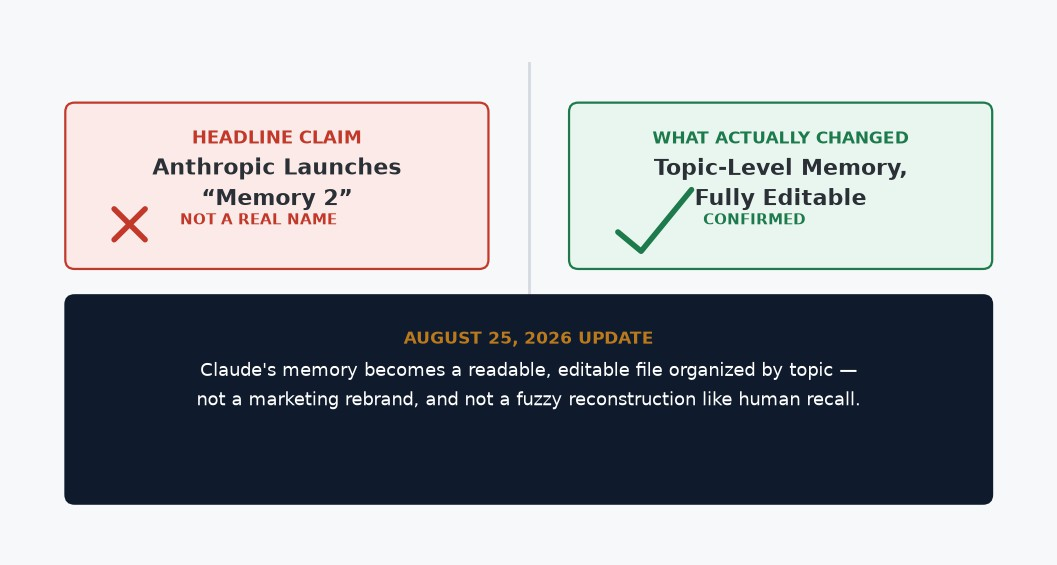
A product update from Anthropic landed this week wrapped in a name that doesn't officially exist. Coverage circulating online has been calling it "Memory 2" — a tidy label, and an inaccurate one. Anthropic has not branded this release that way, and leading with a made-up version number obscures what actually shipped.
On August 25, Anthropic updated how Claude's memory works, and the real changes are specific enough to matter for anyone using the assistant for ongoing work rather than one-off questions. Users can now see everything Claude remembers about them, organized topic by topic, and edit or delete any single piece of it directly. Just as significant for teams already running Claude day to day: memory now carries across both regular chat and Cowork. Before this update, it did not.
What Changed, Specifically
Two changes matter here, and they are worth separating from each other because they solve different problems.
The first is visibility and control. Claude's remembered information about a user is now presented as an organized, topic-by-topic file rather than an opaque running context. Anyone can open it, review what has been retained, and remove or correct individual entries without wiping everything else. The second is continuity. Memory now persists across both standard chat conversations and Cowork sessions, where previously the two existed as separate, disconnected stores. A detail established in one no longer has to be re-explained in the other.
The Human Memory Problem This Is Built To Avoid
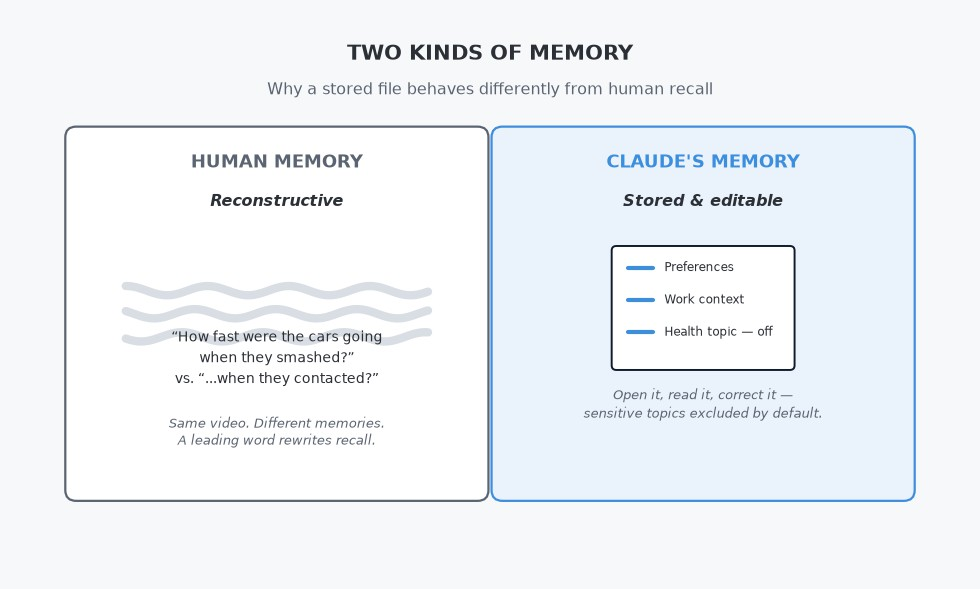
The more interesting part of this story is not the feature list — it's the reason the design choice matters, and that reason has been documented in psychology for decades. Human memory is not a recording. It reconstructs events each time they are recalled, and that reconstruction is measurably swayed by how a question is framed.
The classic demonstration of this involves showing people the same video of a car collision and asking how fast the vehicles were going — with one group asked how fast the cars were going when they "smashed" into each other, and another asked the identical question with "contacted" substituted for "smashed." The wording alone shifts the speed estimates people report. In follow-up recall a week later, some participants confidently describe broken glass at the scene — glass that was never in the video at all. A single leading word does not just color how someone describes a memory; it can quietly rewrite what they believe they saw.
That is the backdrop against which a stored, topic-organized, user-editable memory file looks different from how most people intuitively think about "memory" in an AI product. It is not attempting to simulate human recall. It behaves like a record you can audit, which is a meaningfully different design goal than a system trying to sound more human.
Why This Matters for Day-to-Day Business Use
Consider a practical scenario: someone mentions a health concern or another personal detail in passing during an otherwise work-focused conversation. By default, Claude does not store sensitive topics like that at all — that category of information stays out of memory unless a user deliberately opts in and turns retention on for it.
That default is a useful point of comparison against how information moves through a human team. A colleague who happens to overhear a personal detail might misremember it, repeat it in the wrong context, or simply retain something that was never meant to be permanent. A stored, reviewable memory file with sensitive-topic exclusions built in as the default behavior removes that particular failure mode — not because the underlying model is infallible, but because the record itself is inspectable rather than reconstructed after the fact.
EXPERT PERSPECTIVE
The naming noise around this release is a distraction from the part that deserves attention: Anthropic shipped a memory system explicitly designed around auditability rather than human-like recall, and did so at the same moment it unified memory across two previously separate product surfaces. Those two decisions reinforce each other. A memory store that spans chat and Cowork is only trustworthy for business use if it is also easy to inspect and correct — otherwise a small early error in one context would silently propagate into every future session, in both.
For teams already treating Claude as a working tool rather than a novelty, this update changes the calculus around what information is safe to establish once and rely on going forward. The practical guidance is the same one any organization applies to a stored business record: check it periodically, correct it when it drifts, and don't assume permanence without verification. That standard is arguably a higher bar than most people apply to their own memory of a conversation from a few months back — and, per the underlying research on reconstructive recall, a justified one. Expect memory transparency and edit controls to keep becoming a differentiator among AI assistants used for sustained business work, rather than a one-time feature announcement.
KEY TAKEAWAYS
- Anthropic updated Claude's memory system on August 25, 2026; "Memory 2" is not an official name for the release.
- Users can now view everything Claude remembers, organized by topic, and edit or delete any individual item directly.
- Memory now carries across both regular chat and Cowork sessions — previously these were separate and disconnected.
- Claude's memory is a stored, reviewable file rather than a reconstruction, unlike human memory, which research shows is reshaped by how questions are worded.
- The classic Loftus-style car-collision study found that a single word change ("smashed" vs. "contacted") altered speed estimates and produced false memories of details, like broken glass, that were never present.
- Sensitive topics mentioned in passing, such as health details, are not stored by default unless a user deliberately opts in.
For business use, treat AI-stored memory the way you'd treat any stored record: periodically check it, correct it, and don't assume permanence without review.
CONCLUSION
The headline chasing a rebrand that doesn't exist will fade quickly. What's left after the correction is a more modest but more useful story: Claude's memory is now something a user can actually see, edit, and trust across every surface where they use it, built on a design philosophy that deliberately avoids the distortions known to affect human recall. As more teams lean on AI assistants for continuity across weeks and projects rather than single sessions, memory that behaves like an auditable record — not a fuzzy impression — is likely to become table stakes rather than a differentiator. Organizations building workflows around Claude should treat this update as a prompt to review what they've allowed it to retain, and to build a habit of checking that record the same way they would any other piece of business documentation.
-

Writen by Anirban Das