USA:
USA:  India:
 Most teams dump every task into one Claude Project and wonder why the output sounds generic. Here's the structural fix one agency uses on live client work instead.
By the Zebra Techies Solution AI News Desk | August 26, 2026
.jpg)
The Real Reason Most AI Projects Sound Generic
Ask any team that has tried to fold generative AI into daily work, and a familiar complaint surfaces quickly: the output is competent, but it never quite sounds like them. It reads like it was written for any company in any industry, because in practice, that is exactly what happened. One workspace was asked to write emails, weigh strategic decisions, and run recurring reports — all at once, with no memory of what makes the business distinct.
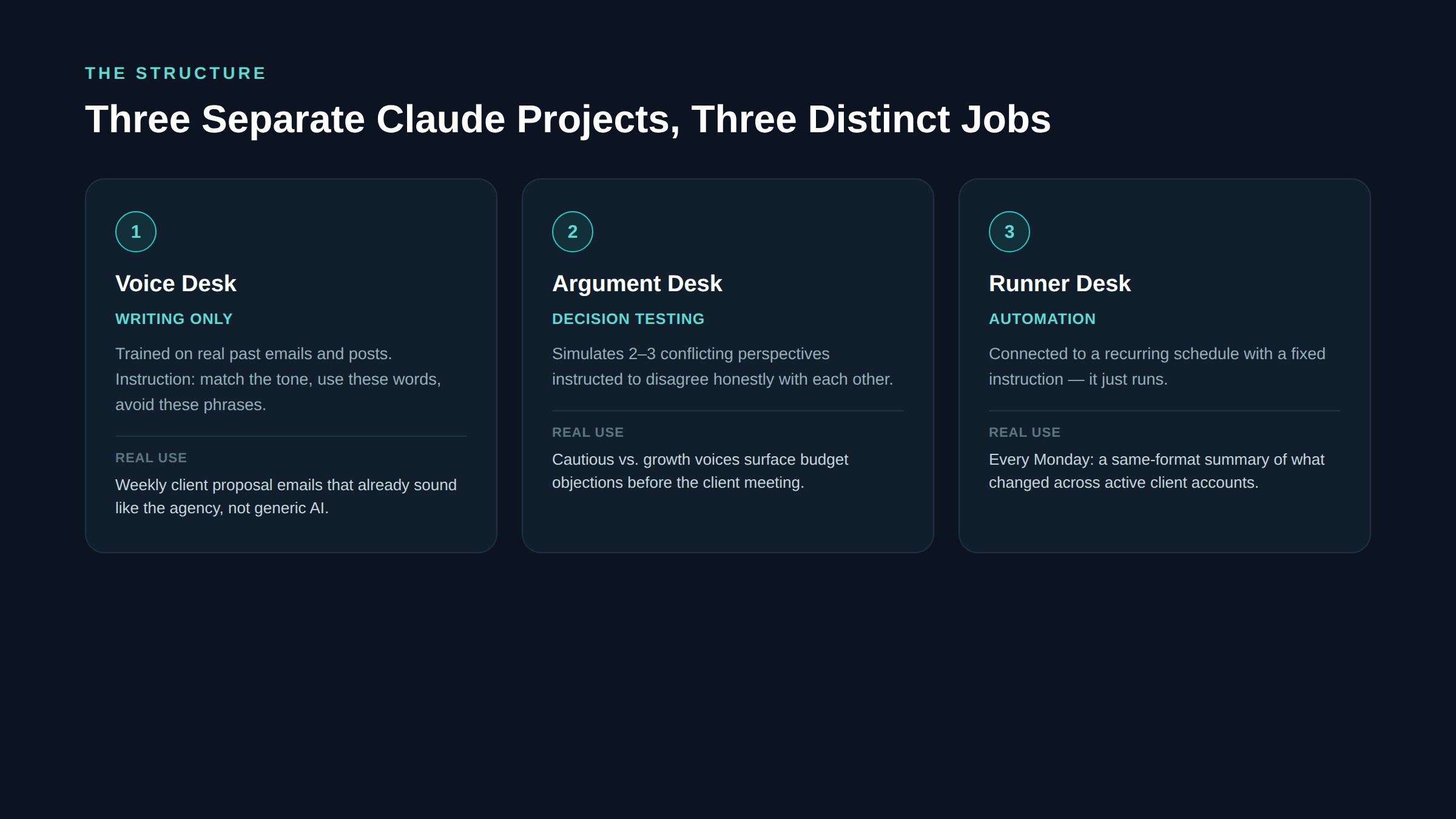
That diagnosis, more than any prompting trick, is the argument behind a structural approach now circulating among marketing and operations teams: instead of one catch-all Claude Project, run three separate ones, each with a single, narrow job. Zebra Techies Solution, which has been testing the model on live client work, frames it simply — three desks, not one messy desk trying to do everything.
The framework is notable less for being technically clever and more for being organizationally obvious once stated. It borrows a principle familiar from any well-run office: specialists outperform generalists on repeated, high-stakes tasks, and that holds just as true when the “employee” is an AI workspace.
Desk One: The Voice Desk
The first project has exactly one job — writing in the company’s actual voice. Rather than starting from a blank page, the team uploads a library of real past writing: previous emails, published posts, anything already written and approved. The instruction set stays deliberately narrow: match this tone, use these words, avoid these phrases we never use.
At Zebra Techies Solution, the clearest use case is client proposal emails, a task the team handles weekly. Because the Voice Desk already has a working memory of how the agency phrases things, a first draft comes back sounding recognizably like the company rather than like generic AI copy — the
difference between a draft that needs a light edit and one that needs a rewrite.
Desk Two: The Argument Desk
The second project is not a writing tool at all. It is built for stress-testing a decision before the team commits to it, by simulating a debate among distinct, conflicting perspectives — a cautious finance voice, an aggressive growth voice, a skeptical customer — instructed to argue honestly and disagree with one another.
The practical payoff shows up before client-facing conversations. When Zebra Techies Solution is preparing to pitch a campaign budget, the idea goes through the Argument Desk first: the cautious voice pokes holes in the cost assumptions, the growth voice pushes for a bigger spend, and the resulting friction surfaces objections the team would otherwise hear for the first time in the client meeting — a costlier and less controlled moment to discover them.
Desk Three: The Runner Desk
The third project handles the recurring, low-glamour work that tends to slip through the cracks precisely because it depends on someone remembering to do it. Connected to a scheduled task with a clear, standing instruction, it simply runs on its own cadence.
The team’s example is a weekly account summary: every Monday, the Runner Desk checks the same folder of active client accounts and returns the same structured summary of what changed — without anyone re-explaining the task or reformatting the request from scratch.
The One Rule That Determines Whether Any of This Works
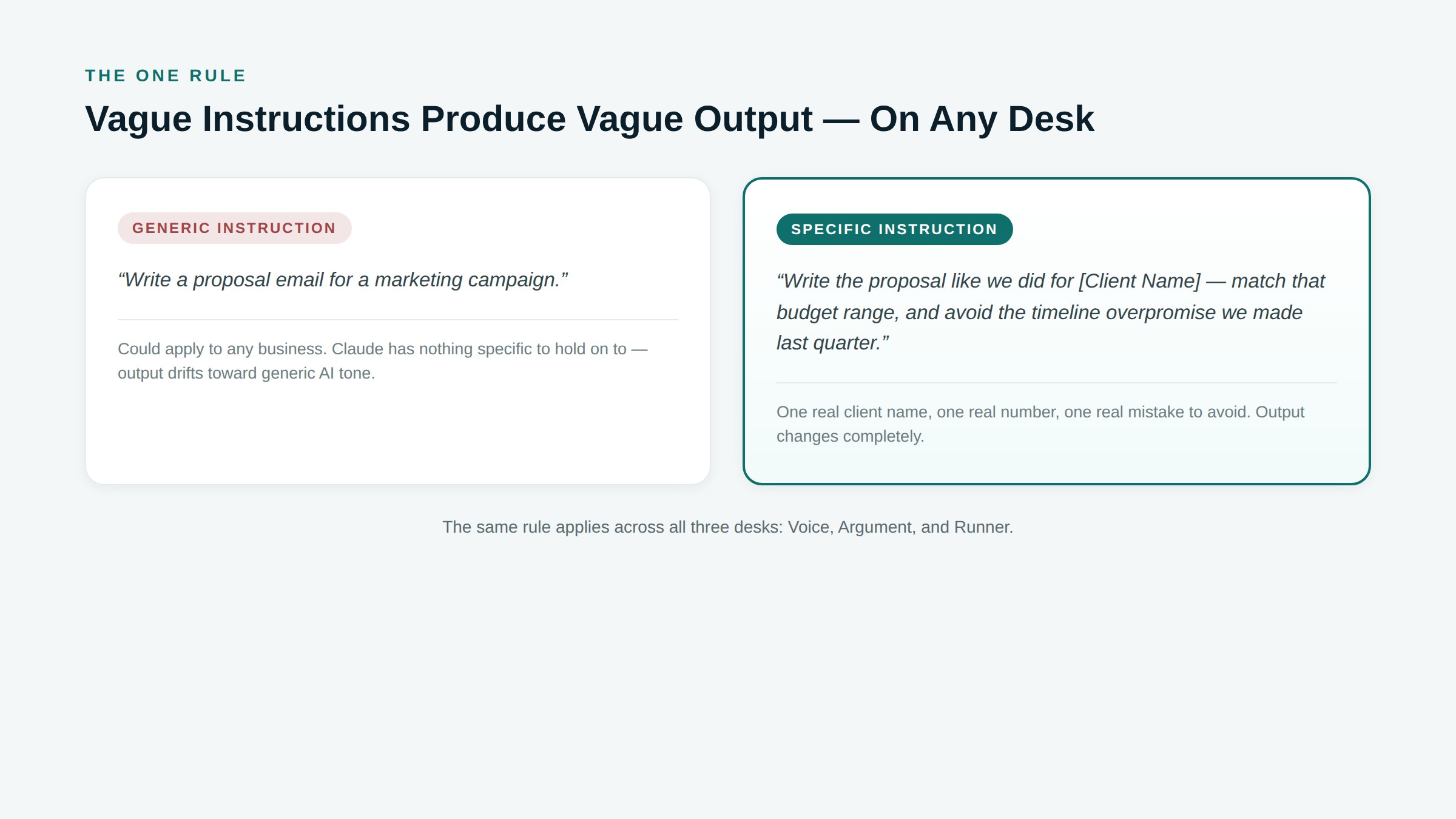
Structure alone does not guarantee useful output, and this is where the framework earns its credibility rather than reading as a tidy productivity slogan. The team is explicit that vague instructions produce vague output, regardless of which desk is doing the work. If an instruction could plausibly apply to any random business, the model has nothing specific to anchor to, and the result drifts back toward the same generic tone the whole system was built to avoid.
The fix is concrete rather than clever: add one real detail — an actual client name, a specific number, a past mistake the team genuinely does not want repeated — and the output shifts noticeably. Specificity, not additional configuration, is what separates a distinctive first draft from a forgettable one.
EXPERT PERSPECTIVE: Why Separation Beats Consolidation
The instinct to build one all-purpose AI workspace is understandable — it feels efficient to centralize everything in a single place. But that instinct runs against how large language models actually perform: they respond best to narrow, well-defined context, not to a single project juggling incompatible instruction sets for tone, argumentation and automation simultaneously.
Splitting a single messy workspace into three specialized ones is a deceptively small organizational change with an outsized effect, because it forces the team to define, in writing, what “good” looks like for each distinct function — the writing standard, the decision-testing standard, and the reporting standard — rather than leaving that definition implicit and inconsistent.
There is also a durability argument worth noting. A single generalist project tends to degrade as more instructions and files pile into it over time, each addition slightly diluting the others. Three narrow, well-maintained projects are easier to keep sharp, easier to hand off to a new team member, and easier to audit when output quality slips, because there is only one job to check per project rather than an entangled mix.
Expect this kind of role-based structuring to become a more common baseline practice as teams move past experimenting with AI tools and start building repeatable internal processes around them
— the difference between treating an AI workspace as a novelty and treating it as a piece of business infrastructure.
Key Takeaways
- A single, catch-all AI project tends to produce generic output because it lacks a clear, consistent context for any one task.
- The three-desk model splits work into separate, single-purpose projects: Voice, Argument, and Runner.
- The Voice Desk is trained on real past writing to match a company's actual tone, rather than generic AI phrasing.
- The Argument Desk simulates multiple conflicting perspectives to pressure-test a decision before it reaches a client or stakeholder.
- The Runner Desk automates recurring reporting tasks on a fixed schedule, removing dependence on someone remembering to run them.
- Vague instructions produce vague output regardless of structure; one specific, real detail meaningfully changes results.
- Zebra Techies Solution runs all three as fully separate Claude Projects rather than one combined workspace.
What This Means Going Forward
The three-desk approach is a useful reminder that getting more distinctive results from AI tools is often less about prompt engineering tricks and more about organizational discipline — deciding clearly what each workspace is for, feeding it real material instead of generic instructions, and resisting the urge to make one tool do everything. As more teams move from ad-hoc AI experimentation toward structured, repeatable workflows, frameworks like this one are likely to become a standard part of how agencies and internal operations teams onboard generative AI rather than a one-off tip worth trying.
-

Writen by Anirban Das