USA:
USA:  India:
 Four terms, four different layers of the AI agent stack — and confusing them means fixing a problem that was never actually broken.
By ZTS Infotech AI News Desk | Reporting based on ZTS Infotech's AI News Desk video analysis, published to the company's YouTube channel
.jpg)
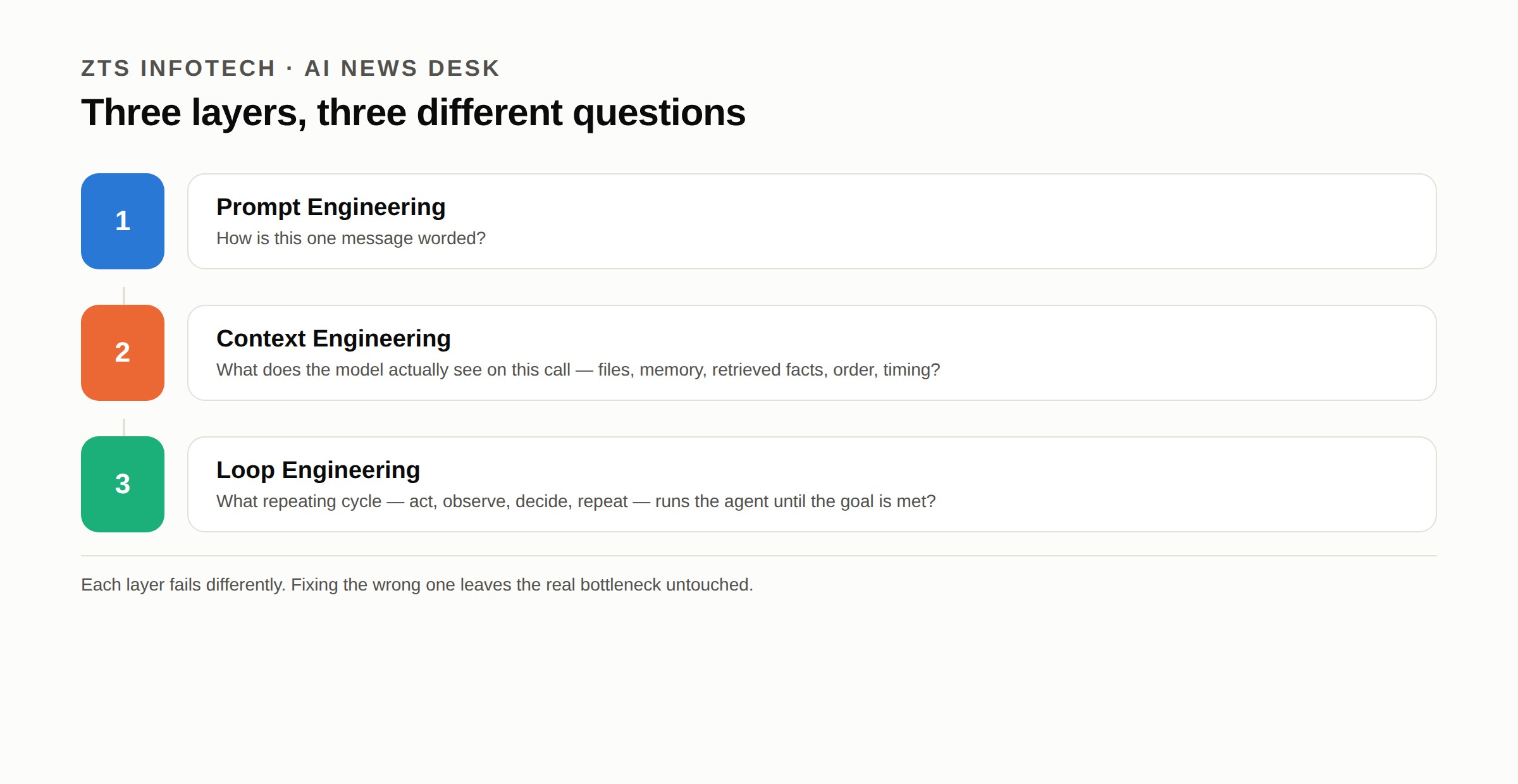
Four terms have entered the AI engineering vocabulary over the past three years, and most people building with AI still treat them as interchangeable jargon for the same basic idea. According to a new breakdown from ZTS Infotech's AI News Desk, that assumption is expensive. Prompt engineering, context engineering, and loop engineering describe three distinct layers of how an AI agent behaves, and diagnosing a problem at the wrong layer means fixing something that was never broken.
For any business running AI agents in production — customer service bots, internal copilots, automated research tools — that distinction is becoming the difference between a system that scales and one that quietly burns through budget while producing worse answers.
Prompt Engineering: Where the Conversation Started
Prompt engineering was the entire game in 2023: how do you word a single message to get the model to respond the way you want? It's a real skill, and it still matters — but it answers only one narrow question, the phrasing of one instruction, and says nothing about what information the model has access to or what happens across multiple steps of a task.
Context Engineering: What the Model Actually Sees
Context engineering asks a much bigger question: not how something is worded, but what the model sees on a given call — every file, every piece of memory, every retrieved fact, in what order and at what moment it enters the conversation. It's the entire information environment surrounding a single turn, not just the sentence at the top of it.
The Problem Anthropic Calls “Context Rot”
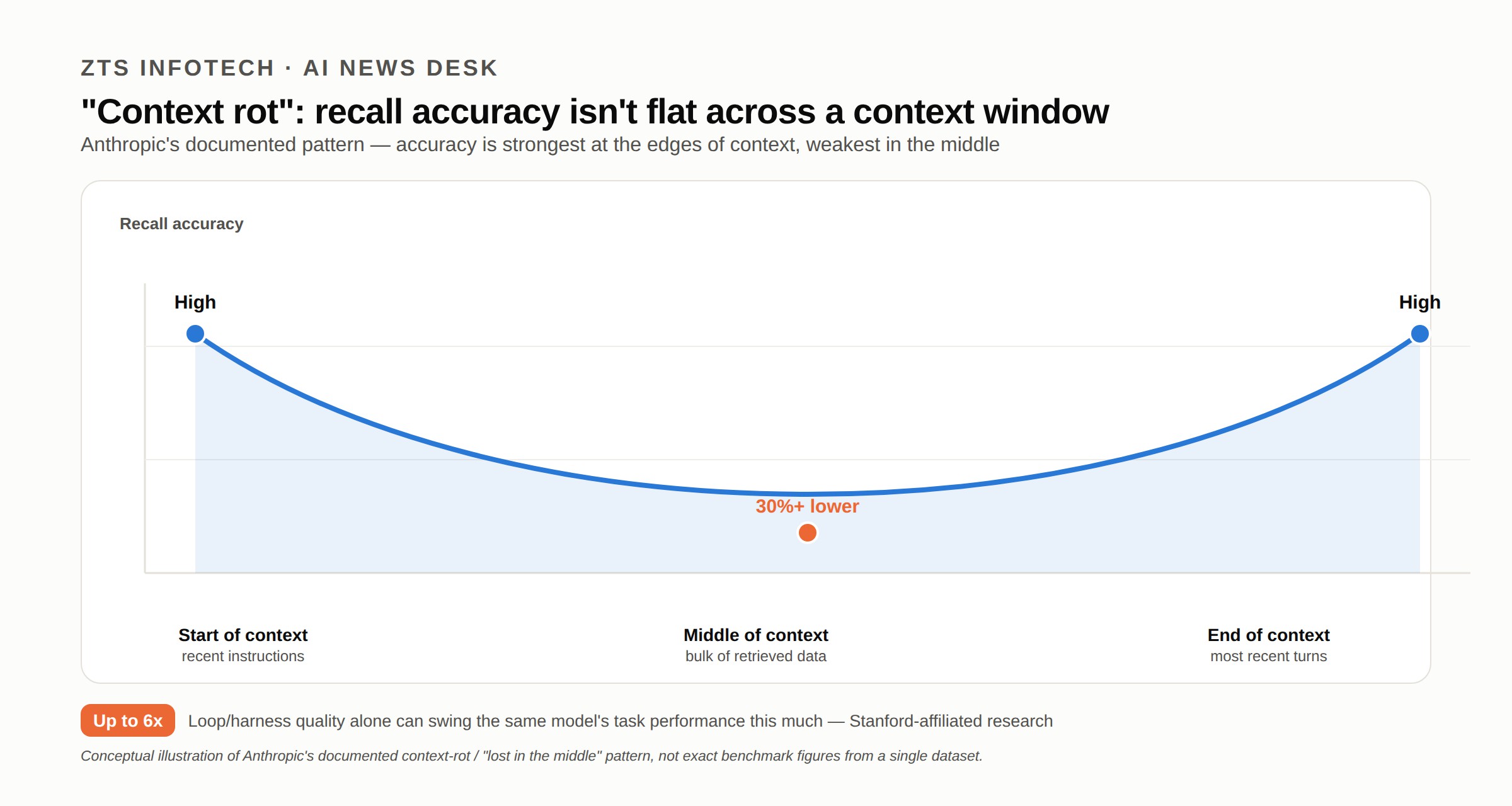
This layer became urgent for a specific reason. Anthropic's own engineering research has documented a phenomenon it calls context rot: as the token count in a context window grows, a model's ability to accurately recall information from that context actually declines. More data does not translate into more accuracy — past a certain point, it produces measurably worse performance. Anthropic describes models as working from a limited “attention budget” that every additional token draws down, with accuracy following a U-shaped curve: strongest at the start and end of a context window, weaker in the middle. It's a close analog to a person handed forty documents and told to summarize all of them at once.
Loop Engineering: The Cycle That Runs the Agent
Loop engineering answers a different question again — not what the model sees, but what repeating cycle keeps it working without a person typing every instruction by hand. That cycle is usually described as act, observe, decide, repeat, continuing until a defined goal is genuinely met, not until a developer runs out of patience.
The idea moved from niche to mainstream fast. A developer's post arguing that teams should design loops instead of prompting agents crossed two million views within days in mid-2026, turning “loop engineering” into a phrase product and engineering teams now argue over in planning meetings.
The Stanford Number Behind the Shift
The research backing this up is hard to dismiss. A Stanford-affiliated study on agent “harnesses” — the code and control logic wrapped around a model — found the exact same underlying model can perform up to six times better or worse purely based on the quality of the surrounding loop. The model never changed. Only the system directing it did.
How the Two Layers Relate — and Fail Differently
Put simply: context engineering decides what the model sees in a single turn. Loop engineering decides how many turns happen, in what sequence, and when the process stops. They are not competing ideas, and one cannot substitute for the other.
Get only one right, and the failure mode differs depending on which you skipped. Perfect context fed into a loop with no stopping condition burns through compute budget indefinitely. A well-designed loop feeding a model bloated, rotted context still produces poor output — just more efficiently, and often at greater volume.
Expert Perspective: Why This Distinction Changes How Agents Get Built
The practical consequence for any team deploying AI agents is that debugging requires knowing which layer actually broke. A team that assumes every underperforming agent needs “a better prompt” will spend cycles rewording instructions when the real issue is an unbounded loop or a context window stuffed with irrelevant retrieved documents. Equally, a team that keeps redesigning its control loop while ignoring what data reaches the model at each step will keep shipping a well-orchestrated system that reasons over garbage.
That's why serious engineering practice now evaluates these as genuinely separate disciplines rather than treating “better prompting” as a catch-all fix. Context problems and loop problems have different symptoms and different fixes — collapsing them into one bucket is exactly what leads teams to spend
weeks solving the wrong problem while the actual bottleneck goes untouched.
Key Takeaways
- Prompt, context, and loop engineering are three distinct layers of an AI agent's behavior, not interchangeable synonyms.
- Prompt engineering controls the wording of a single instruction — the dominant concern of 2023-era AI work.
- Context engineering controls the entire information environment a model sees on a call: files, memory, retrieved facts, order, timing.
- Anthropic's documented “context rot” shows accuracy can decline as context grows, following a U-shaped recall curve weakest in the middle.
- Loop engineering governs the act-observe-decide-repeat cycle that lets an agent run autonomously toward a defined goal.
- A Stanford-affiliated study found the same model can perform up to six times better or worse based solely on harness quality.
- Context and loop problems fail differently and need different fixes — misdiagnosing one wastes engineering time and budget.
Looking Ahead
As AI agents take on more autonomous, multi-step work inside real businesses, teams that treat prompt, context, and loop engineering as one blurry skill will keep chasing symptoms instead of causes. Those that don't will spend less time guessing and more time shipping agents that hold up under production load. Expect this three-layer framework — and the research behind context rot and harness quality — to become standard vocabulary for how technical teams scope, debug, and evaluate agentic AI systems through the rest of 2026.
-

Writen by Anirban Das