USA:
USA:  India:
Duplicate content rarely announces itself. There is no error message, no obvious broken page, no customer complaint — just a slow, quiet erosion of search visibility that most small business owners never trace back to its actual cause. According to Anirban Das of Zebra Techies Solution, speaking on the company's AI News Desk series, this is precisely what makes duplicate content one of the more dangerous technical SEO problems: it sits on a site for months, diluting ranking signals across near-identical pages, while the owner assumes their traffic decline is simply a matter of competition or algorithm volatility.
The good news, Das argues, is that catching it costs nothing. Zebra Techies Solution runs a two-step diagnostic — one free crawler-based tool and one self-built detector using an open AI model — against every client site each month. For marketing heads and business owners managing their own web presence, the same method is available today, without a subscription or an agency retainer. The part that still requires a human, and the part most guides skip entirely, is what to do once duplicate pages are actually found.
Why Duplicate Content Is a Silent Ranking Killer
When two or more pages on a site carry substantially the same title, meta description, or body content, search engines cannot confidently determine which page should rank. Rather than showing both, Google typically suppresses one or splits authority between them — meaning neither page performs as well as a single, consolidated version would. For a small business, that often shows up as flat or declining organic traffic with no obvious cause, because nothing on the site looks broken to a visitor.
Das frames this as an awareness problem as much as a technical one: business owners check for typos and broken links, but rarely check whether their own pages are quietly competing against each other in Google's index.
The Free Two-Step Detection Method
Step One: Full-Site Scanning with Open SEO Crawler
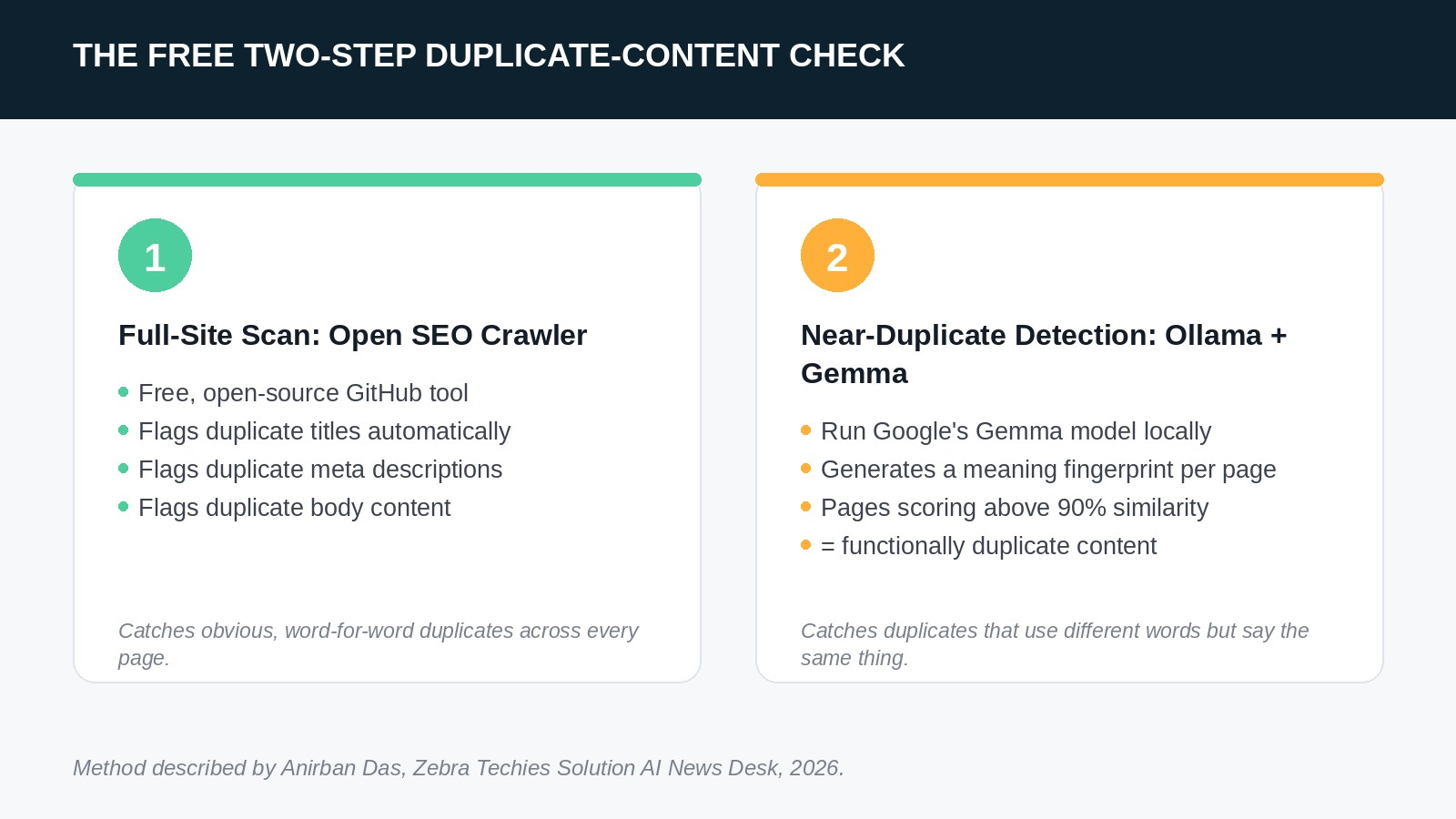
The first pass uses Open SEO Crawler, a free, open-source tool available on GitHub. It crawls every page on a website and automatically flags duplicate titles, duplicate meta descriptions, and duplicate body content. This catches the obvious cases — templated pages, copy-pasted product descriptions, or boilerplate text repeated across a site — and it does so without a paid SEO platform.
Step Two: Catching the Duplicates Basic Tools Miss
Crawler-based tools compare text directly, so they miss content that says the same thing in different words — a near-duplicate a competent human editor would still flag as redundant. To catch that layer, Das describes building a smarter, self-run detector: install Ollama locally, pull Google's open Gemma model, and use it to generate a numerical fingerprint of meaning for every page on the site. Two pages scoring above a 90% similarity on that fingerprint are treated as functionally duplicate, regardless of whether the wording matches.
This is the step that separates a basic audit from a genuinely thorough one. Meaning-based comparison catches the case a word-matching crawler cannot: two blog posts targeting the same keyword with completely different sentences, or a set of city-specific landing pages that swap in a place name and otherwise say nothing new
The Right Way to Fix It — Don't Delete Blindly
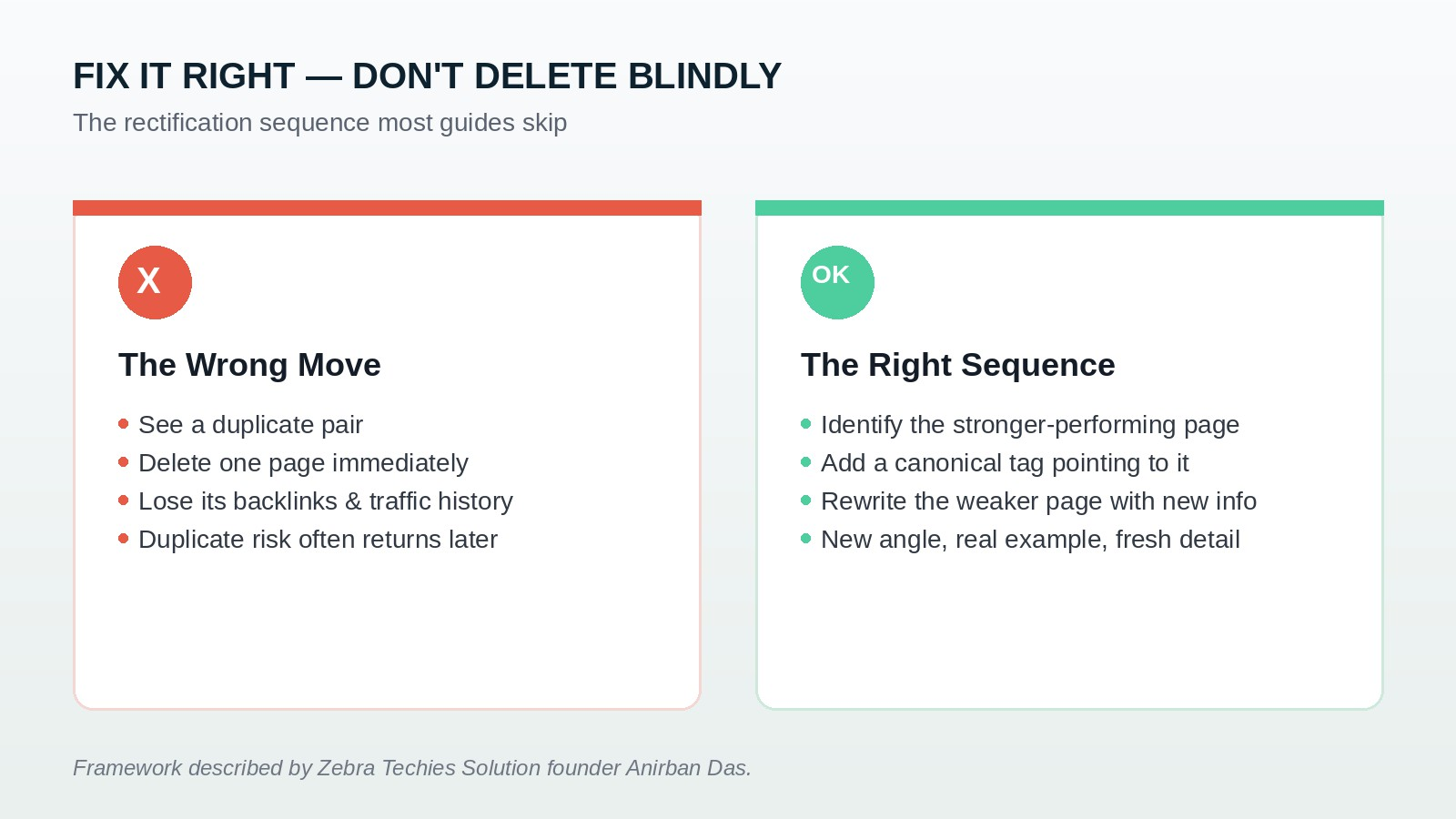
Finding duplicates is the easy half. Das is explicit that the immediate instinct — delete one of the offending pages — is the wrong first move. The correct sequence is to identify the stronger-performing page of the pair, apply a canonical tag pointing search engines to it, and then rewrite the weaker page with genuinely new information: a different angle, a real example, or a specific detail Google has not already indexed elsewhere on the site.
That distinction matters commercially. A page built from real traffic, backlinks, or conversions still carries value even if it is currently competing with a near-duplicate; deleting it outright throws that equity away. Canonicalizing and rewriting preserves it while resolving the conflict.
Where This Still Needs a Human
Das is careful to draw a boundary around what the tooling actually does. Free tools, he says, flag the problem accurately — both the crawler and the embedding-based detector are reliable at surfacing candidates. What they cannot do is make the judgment call: which page deserves to survive, and what would make the rewritten version genuinely, not superficially, different. That decision requires someone who understands the business, the audience, and the intent behind each page — not just its word count.
Expert Perspective: Why This Matters Now
What makes this approach notable isn't the individual tools — crawler-based duplicate detection has existed for years, and embedding models have been available to developers since well before 2026. It's the combination, run as a routine monthly process rather than a one-off audit. Most small business SEO problems aren't caused by not knowing what to fix; they're caused by nobody checking on a schedule until traffic has already dropped.
The embedding-based step also points to a broader shift worth watching: SEO auditing is moving from keyword and text matching toward meaning-based analysis, using the same class of AI models now embedded in search engines themselves. Businesses running only text-matching audits are, in effect, auditing their site with an older generation of the logic Google now uses to evaluate it — which means they will keep missing exactly the near-duplicates most likely to trigger a ranking penalty.
For marketing leaders, the practical implication is less about adopting any single tool and more about instituting the cadence: a monthly duplicate-content check should sit alongside broken-link monitoring
and site-speed tracking as baseline technical SEO hygiene, not an occasional agency deliverable.
Key Takeaways
- Duplicate content suppresses or splits ranking authority between pages, often producing a slow traffic decline with no obvious visible cause.
- Open SEO Crawler, a free open-source GitHub tool, catches obvious duplicates by scanning titles, meta descriptions, and body text across an entire site.
- A self-built detector using Ollama and Google's Gemma model can catch near-duplicates that say the same thing in different words, flagging any pair scoring above 90% semantic similarity.
- Never delete a duplicate page outright: apply a canonical tag to the stronger-performing page and rewrite the weaker one with genuinely new information.
- Free tools reliably flag duplicate candidates, but deciding which page should survive and what makes new content genuinely unique still requires human judgment.
- Zebra Techies Solution runs this two-step check for every client site every month, treating it as routine technical SEO hygiene rather than a one-off audit.
- SEO auditing is shifting toward meaning-based, embedding-driven analysis — the same class of model logic search engines themselves increasingly use to evaluate content.
Looking Ahead
Duplicate content will keep costing small businesses rankings for the simple reason that it is invisible until someone goes looking for it. The tools to find it, as Das demonstrates, are already free and require no specialist budget — an open-source crawler for the obvious cases, and a locally run embedding model for the ones that hide in plain sight. The differentiator going forward won't be access to these tools; it will be discipline: running the check monthly, treating each flagged pair as a judgment call rather than a delete button, and rewriting instead of erasing. Business leaders auditing their own technical SEO posture should expect this meaning-based, AI-assisted approach to become the standard baseline well before the end of 2026.
-

Writen by Anirban Das