USA:
USA:  India: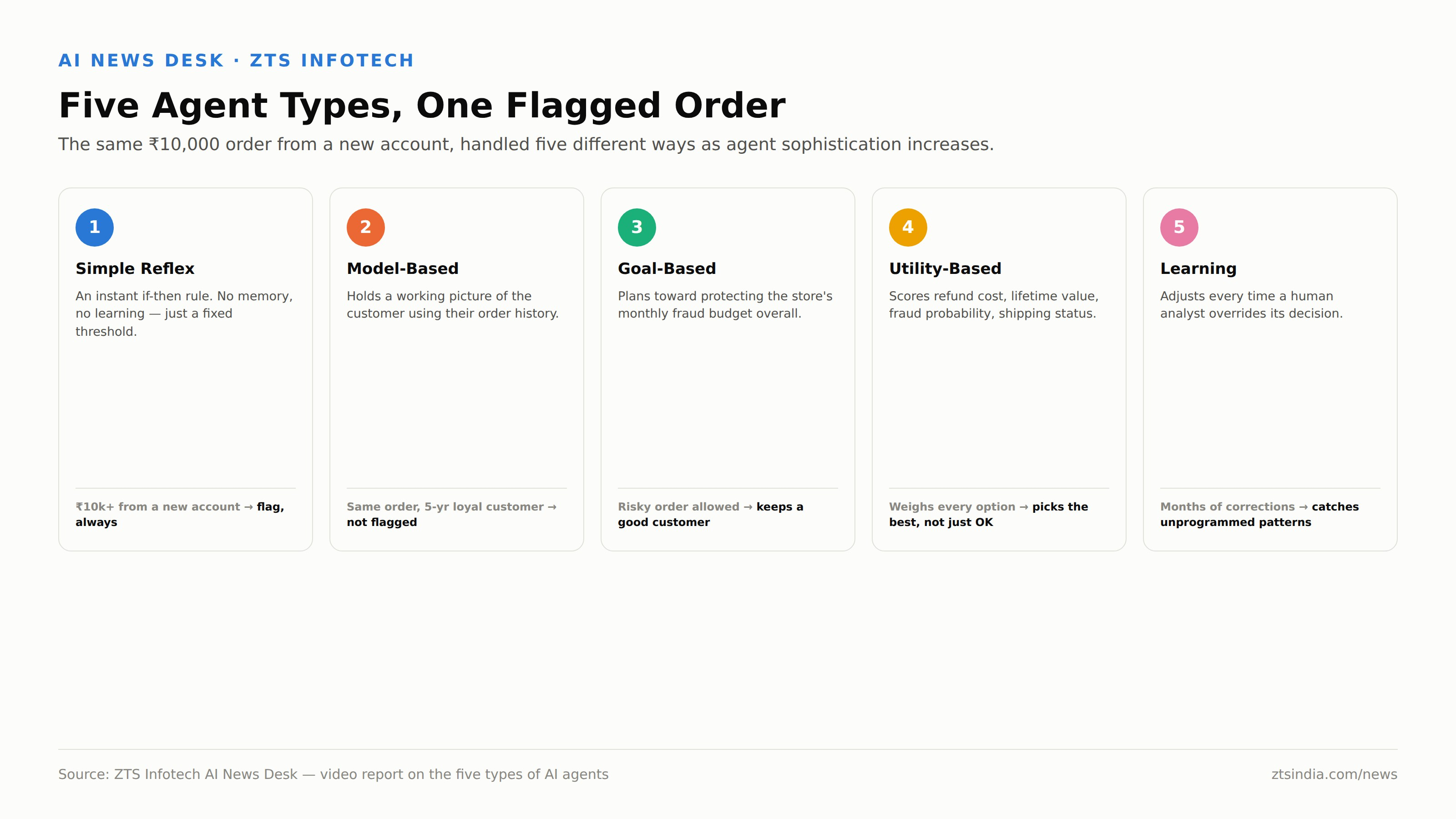
The Question Every AI Agent Pitch Skips: Which Kind, Exactly?
“AI agent” has become one of those phrases that means everything and therefore nothing in particular. A vendor pitch, a LinkedIn post, and an internal roadmap can all use the term to describe five genuinely different systems, with five genuinely different price tags and maintenance burdens attached. ZTS Infotech’s AI News Desk tackled that ambiguity directly, using a single, concrete business problem — a suspicious e-commerce order — and running it through all five recognized categories of AI agent to show how the right answer changes depending on what a business actually needs.
The scenario: an order over Rs. 10,000 comes in from an account with no prior history. Should it be flagged? The answer, it turns out, depends entirely on which kind of agent is doing the flagging.
Five Agents, One Order, Five Different Decisions
Simple Reflex: The Instant Rule
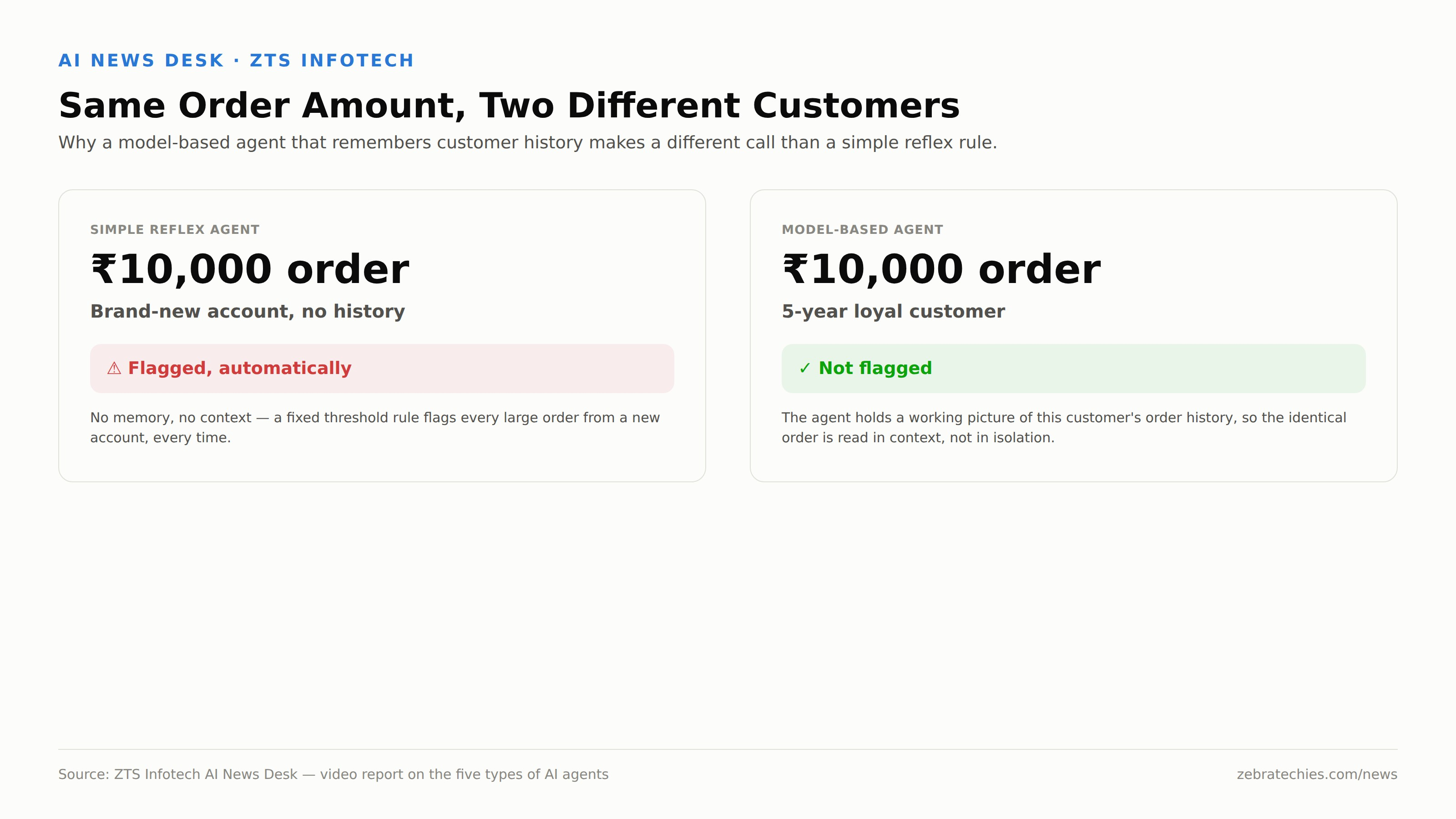
The simplest version runs on a flat if-then rule: an order over Rs. 10,000 from a brand-new account gets flagged, no exceptions, no memory of anything that happened before. It is cheap, fast, and genuinely correct for catching the obvious cases — a new account placing an unusually large order is a reasonable thing to flag by default.
Model-Based: The Agent That Remembers
The second version carries a working picture of the customer, drawing on their order history. The identical Rs. 10,000 order that would trip the simple reflex rule does not get flagged the same way when it comes from a five-year loyal customer, because the agent has context the first version never had.
Goal-Based: Planning Toward an Outcome
The third version stops evaluating orders in isolation. Its objective is protecting the store’s monthly fraud budget as a whole, which sometimes means accepting a slightly risky order today rather than alienating a good customer and pushing them toward a competitor. It is weighing a single transaction against a larger, ongoing outcome.
Utility-Based: Scoring Every Option
The fourth version does not choose between a binary block or allow. It scores multiple factors at once
— refund cost, customer lifetime value, fraud probability, whether shipping is already in progress — and picks whichever action produces the best overall outcome, not merely an acceptable one.
Learning: The Agent That Adjusts
The fifth version is the one most fraud teams eventually want. Every time a human analyst overrides its decision, it adjusts. Months into deployment, it is catching patterns no one explicitly programmed it to look for, learned entirely from the accumulated pattern of a team’s actual corrections.
Why Most Businesses Should Not Start at Version Five
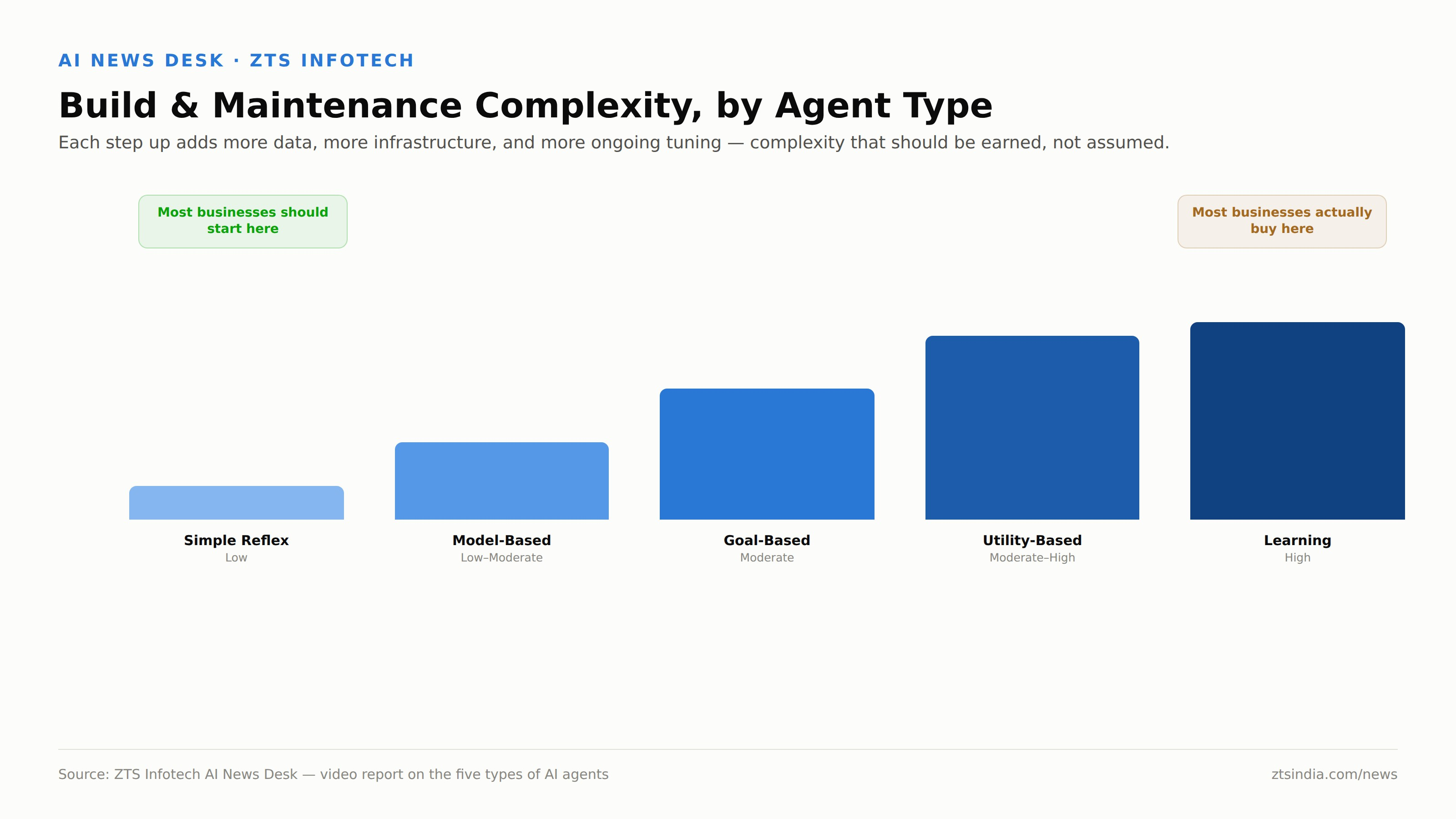
The instinct across most organizations evaluating AI agents is to reach straight for the most sophisticated version available — the learning agent that adapts and improves on its own sounds like the obvious endpoint. That instinct is usually a mistake. Most businesses jump directly to version five and pay for a level of complexity, data infrastructure, and ongoing tuning they do not yet need.
The honest starting point for most fraud-detection problems, and for most AI agent use cases generally, is version one or version two: cheap, fast, and genuinely sufficient for the volume and risk profile most businesses are actually dealing with. The upgrade path exists for a reason, but it is a path, not a starting line.
Matching Agent Sophistication to Actual Business Need
The deeper lesson generalizes well past fraud detection. Any AI agent evaluation should start with a plain question: what does this specific decision actually require? A rule that catches the obvious 80% of cases correctly, cheaply, and with full transparency into why it made a decision is often the better business choice than a black-box learning system that requires months of tuning and a dedicated team to maintain. Complexity should be earned by outgrowing the simpler version, not assumed from day one because it sounds more advanced.
Expert Perspective
What makes this framework useful is that it replaces a vague, marketing-driven question — “should we use AI agents?” — with a specific, answerable one: which of five well-defined categories does this particular decision call for? That reframing has real budget consequences. A simple reflex agent can often be built and deployed in days; a learning agent that improves from human feedback requires a feedback pipeline, a review process, and months of accumulated correction data before it outperforms a simpler system.
The businesses that get the most value from AI agents are rarely the ones that deploy the most sophisticated version first. They are the ones that correctly diagnose where their actual problem sits on this five-step ladder, ship the cheapest agent that clears the bar, and upgrade deliberately as the business, and the data, actually demands it. Treating agent sophistication as a dial to be turned up only when justified, rather than a status symbol to be maximized upfront, is the difference between an AI investment that pays for itself and one that quietly becomes a maintenance burden nobody planned for.
Key Takeaways
- AI agents fall into five recognized categories: simple reflex, model-based, goal-based, utility-based, and learning — each suited to a different level of decision complexity.
- The same Rs. 10,000 suspicious-order scenario produces a different, defensible decision at every level, from an instant flag to a learned, feedback-tuned judgment call.
- Simple reflex agents are cheap, fast, and genuinely correct for catching obvious cases with no memory or context required.
- Model-based agents add customer history so identical transactions are judged differently based on context.
- Goal-based and utility-based agents plan toward broader outcomes — a fraud budget, a customer’s lifetime value — rather than judging each transaction in isolation.
- Learning agents improve from human overrides over time, but require a feedback pipeline and months of data before they justify their added cost.
- Most businesses should start at version one or two and upgrade only once they genuinely outgrow it, rather than defaulting to the most sophisticated agent available.
Conclusion
The five-agent framework is less a technical taxonomy than a budgeting discipline: it forces a business to name, specifically, what its AI agent needs to know and decide before a single line of it gets built. As AI agents become a default line item in more technology roadmaps, the businesses that benefit will be the ones asking which of the five versions their problem actually requires, not the ones assuming the most advanced option is automatically the right one.
-

Writen by Anirban Das