USA:
USA:  India: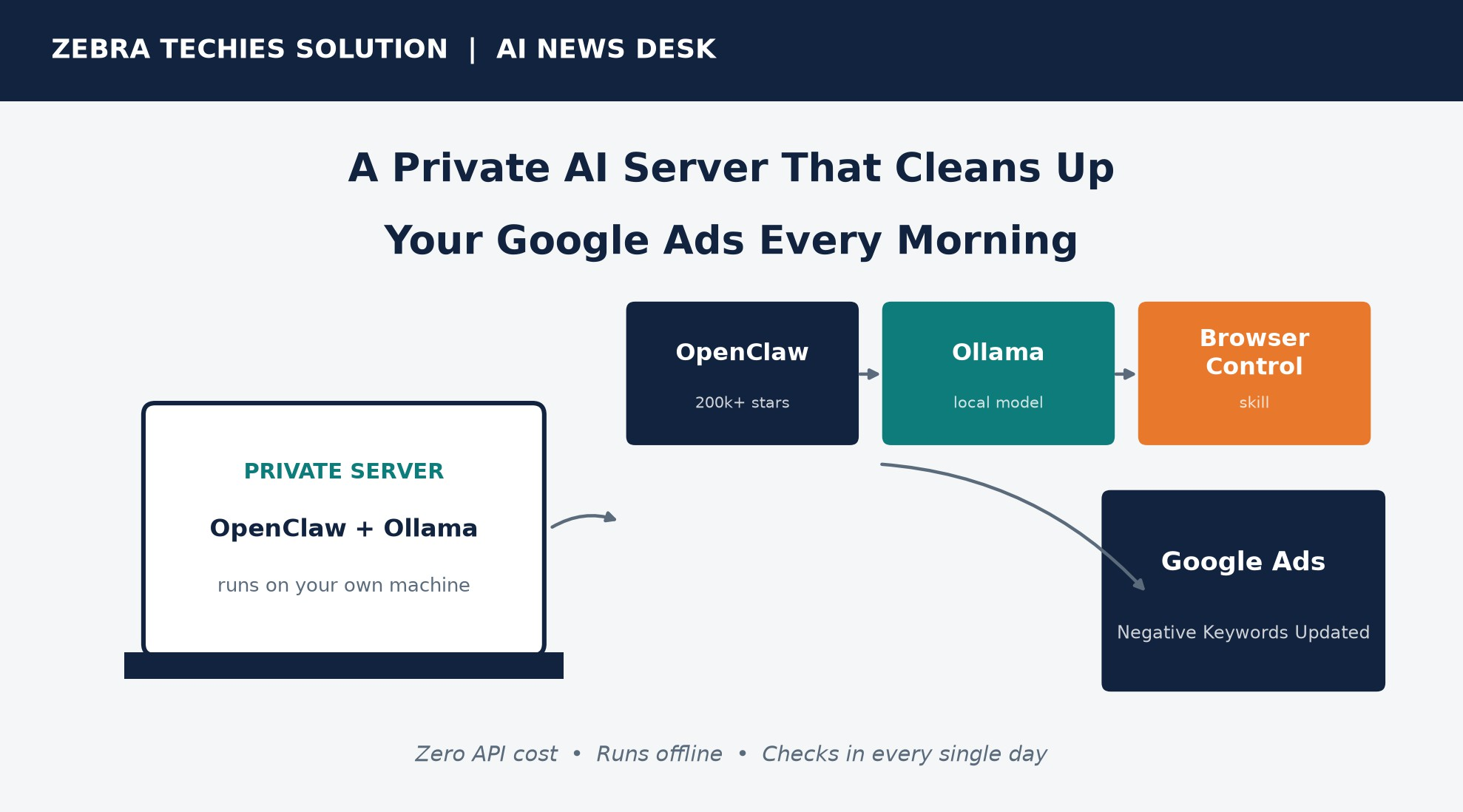
Most small business owners running Google Ads already know the drill: wasteful search terms creep into a campaign, negative keyword lists fall behind, and nobody on staff has the time to comb through a search terms report every single day. Zebra Techies Solution's latest AI News Update, presented by Anirban Das, addresses that exact gap with a tool most marketing teams have not yet heard of — and a price tag most cannot object to. It costs nothing to run.
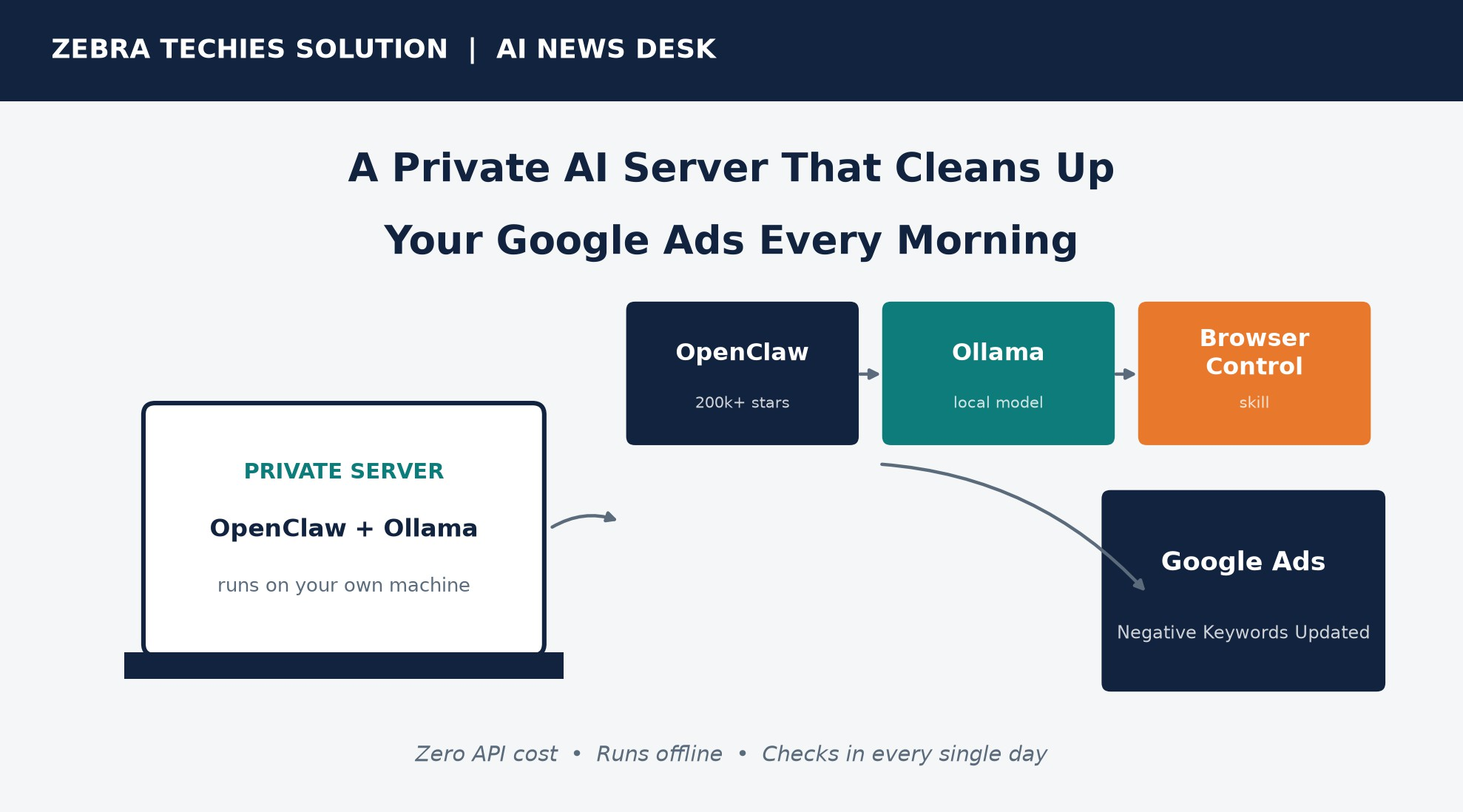
The tool is OpenClaw, a free, open-source assistant with more than 200,000 stars on GitHub, paired with Ollama, a local model runner that replaces a paid API subscription entirely. Together, Das explains, they form a private server that lives on a business's own computer and does one narrow, tedious job automatically: policing Google Ads negative keywords, every morning, without anyone logging in.
What OpenClaw Actually Is
OpenClaw is not marketed as a chatbot. It is built to run as a standing service on a business's own machine, which is the detail that matters most for a small business owner wary of handing account access to a third-party cloud tool. Nothing about the setup routes client data through an outside vendor's servers, and nothing about running it accrues a per-query bill. The trade-off, which the video addresses directly rather than glossing over, is that a free local model will not reason as sharply as a premium hosted one.
The Three-Step Setup
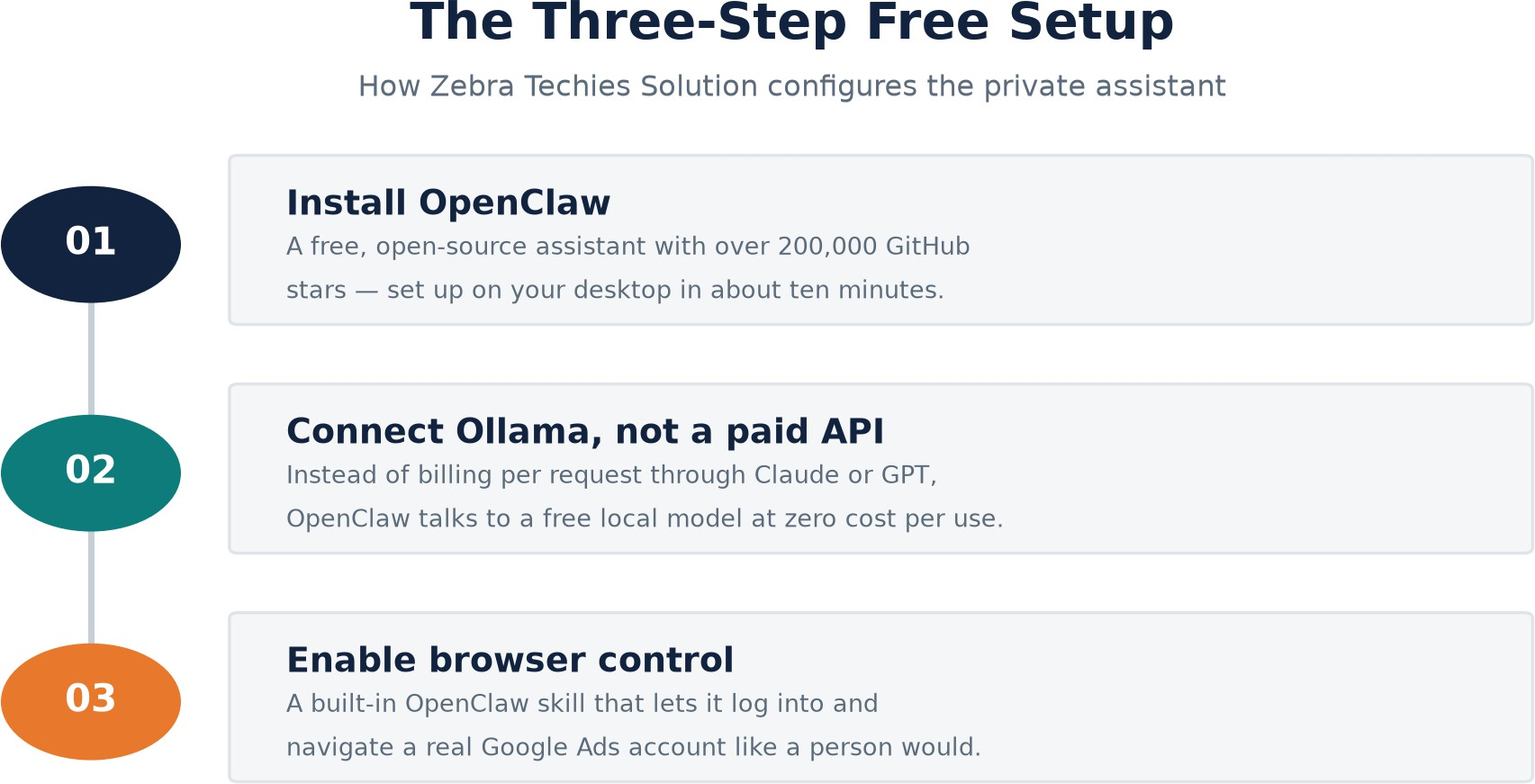
Getting from a blank machine to a working assistant takes three moves. Install OpenClaw using the setup command on its own website, a process Das puts at roughly ten minutes. Connect it to Ollama rather than a paid API such as Claude or GPT, which is what removes the recurring cost entirely. Then enable browser control, one of OpenClaw's built-in skills, which lets the assistant log into and click through a real Google Ads account the way a human operator would, rather than relying on an API integration that may not exist for every task.
The Daily Job: Watching Negative Keywords So Nobody Else Has To
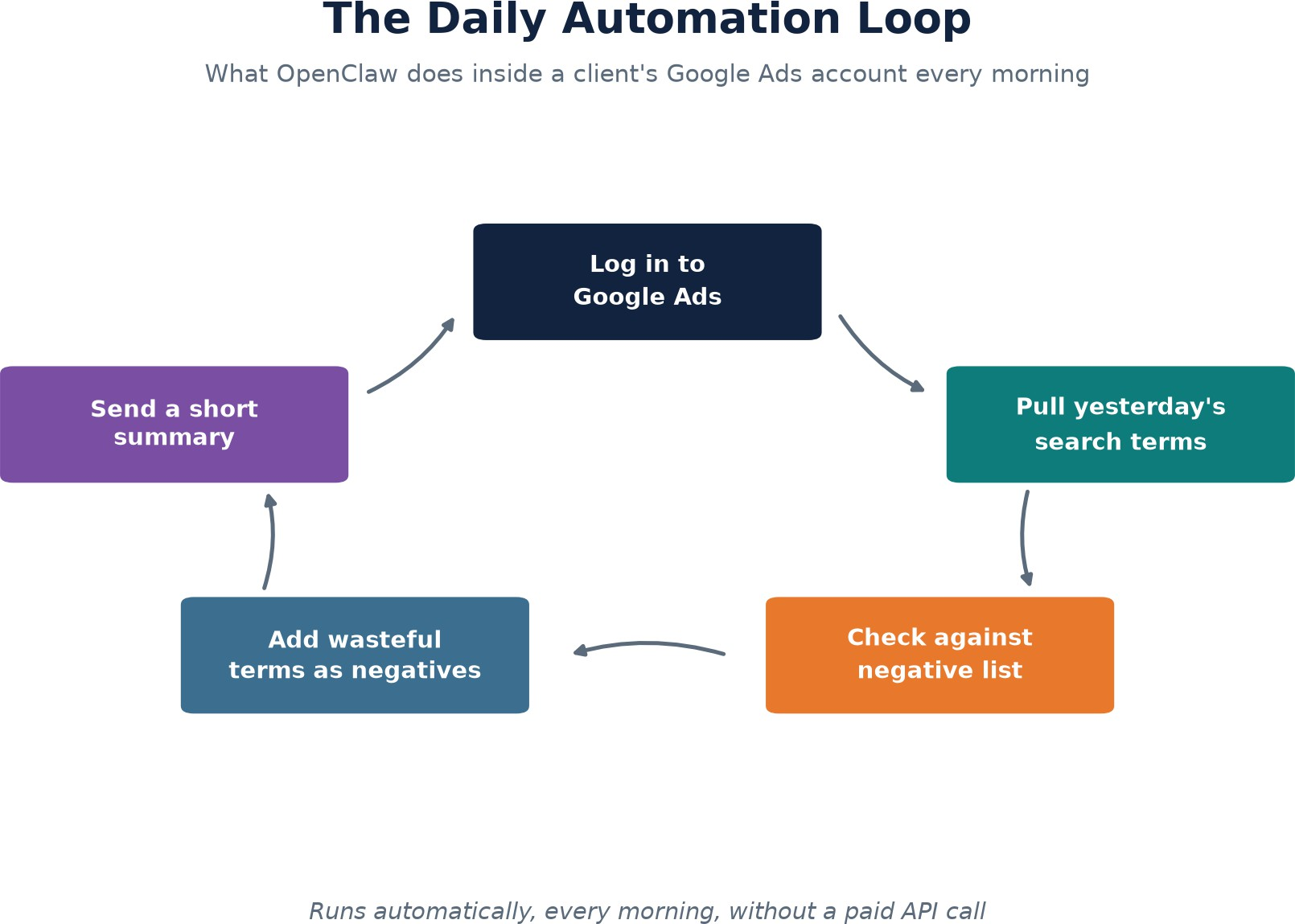
Once configured, the assistant runs a fixed routine every morning. It logs into the Google Ads account, pulls the previous day's search terms report, and checks each term against the account's existing negative keyword list. Anything wasteful or irrelevant that slipped through gets added as a new negative keyword automatically, and the business owner receives a short written summary of exactly what changed.
Negative keyword maintenance is a well-chosen first task for this kind of automation, and the reason is structural rather than incidental. It is repetitive, it follows a checkable rule rather than requiring creative judgment, and the cost of a rare mistake is a single search term rather than an entire campaign strategy. That combination is exactly where a local model's weaker reasoning is least likely to cause real damage, which is probably why Zebra Techies Solution chose to start here rather than with bid strategy or ad copy.
The Honest Limitation
Das does not oversell the setup. He states outright that local models are not as capable as the large paid ones, and he recommends reviewing everything the assistant adds for the first few weeks before trusting it to run unsupervised. That is a meaningfully different posture from most AI-automation pitches, which tend to promise a finished, hands-off system on day one. Here, the vendor is telling clients to keep a human in the loop until the tool has earned trust on their specific account.
Expert Perspective: A Sensible Entry Point for Budget-Constrained Automation
The business logic behind this offering is worth separating from the technology itself. Many small businesses want marketing automation but stall at the recurring cost of a subscription tool, especially one billed per API call against an account that may not spend enough on ads to justify the overhead. By building on free, local infrastructure, Zebra Techies Solution can offer a client real, working automation with no ongoing bill attached to the AI layer itself — only to the setup and support around it.
That has implications beyond this one use case. Search terms review is a narrow slice of what a Google Ads account manager does, but it is exactly the kind of narrow, rules-based, low-stakes task that a supervised local model can handle reliably today, even while it still lags premium hosted models on judgment-heavy work like bid strategy or creative testing. Expect agencies serving budget-conscious clients to look for more tasks that fit this same profile: repetitive, rule-checkable, and forgiving of an occasional error.There is also a trust dimension that will shape how fast this spreads. Handing an AI tool browser control inside a live ad account is a bigger ask than handing it a chat window, and agencies that adopt this approach will need to be transparent with clients about what the assistant can touch and what it cannot. Zebra Techies Solution's own recommendation to review its work for the first few weeks is a reasonable template for that conversation, and one competitors offering similar automation would do well to copy.
Key Takeaways
- Zebra Techies Solution is deploying OpenClaw, a free open-source assistant with 200,000+ GitHub stars, paired with the local model runner Ollama, to automate Google Ads upkeep for small business clients.
- The setup takes three steps: install OpenClaw, connect it to Ollama instead of a paid API, and enable
its built-in browser-control skill.
- Every morning, the assistant logs into Google Ads, pulls the prior day's search terms, checks them against the existing negative keyword list, and adds wasteful terms automatically.
- The entire workflow runs with zero API cost per use, since the model runs locally rather than through a
metered cloud subscription.
- Negative keyword cleanup was chosen deliberately: it is repetitive, rules-based, and low-risk if the model makes an occasional error.
- Zebra Techies Solution recommends reviewing the assistant's changes for the first few weeks rather
than trusting it unsupervised from day one.
- The approach gives budget-constrained small businesses real marketing automation without an ongoing AI subscription bill.
Conclusion
None of this replaces a skilled account manager, and Zebra Techies Solution is not claiming otherwise. What it demonstrates is a workable middle ground for businesses caught between doing nothing and paying for automation they cannot yet afford: a supervised, free, narrowly scoped assistant that handles one tedious job well and grows more trusted over time. As open-source tools like OpenClaw mature and local models close the gap with hosted ones, expect more of a small agency's routine account maintenance to move onto exactly this kind of stack.
-

Writen by Anirban Das