USA:
USA:  India: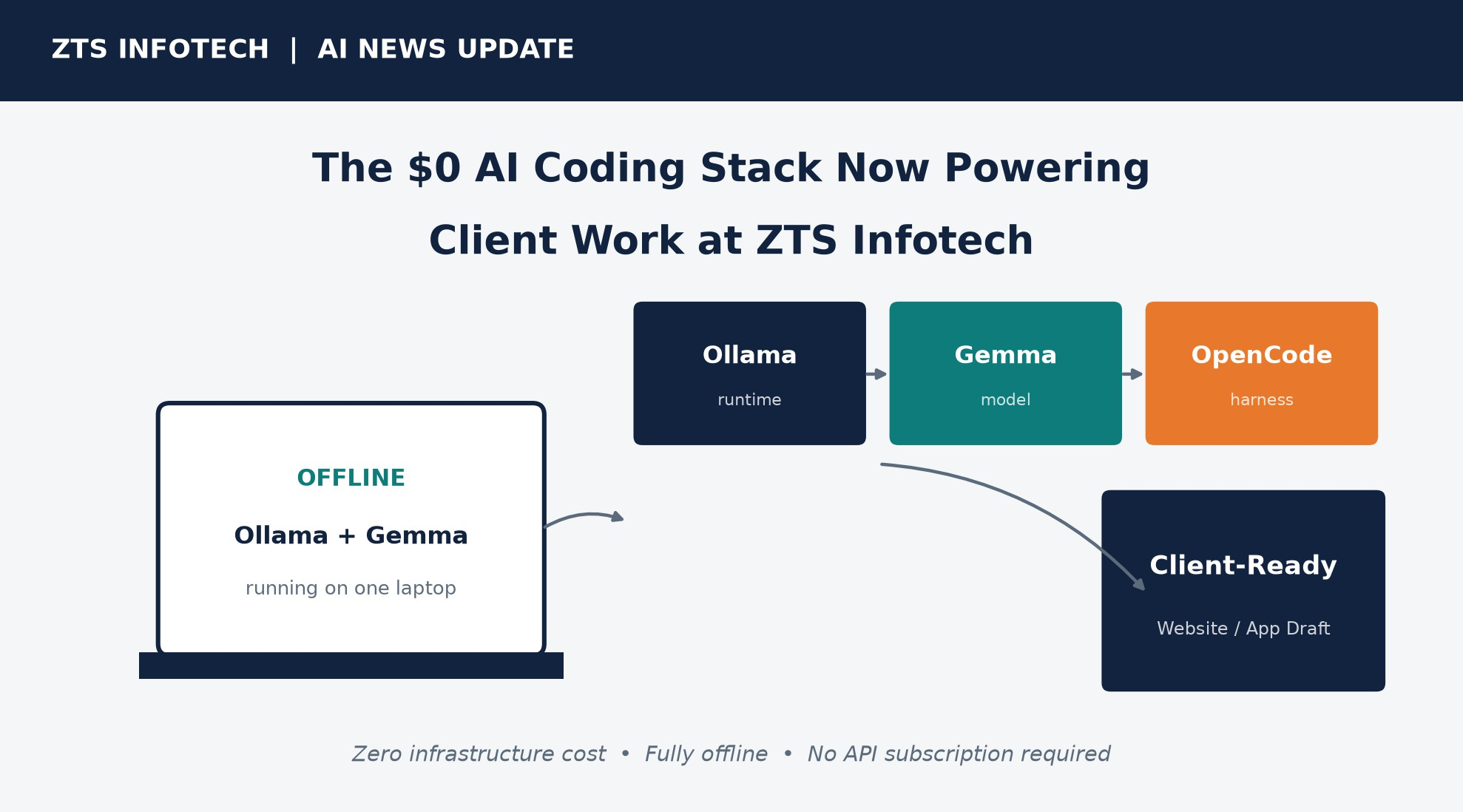
A short video from ZTS Infotech is circulating among small-agency operators for a reason that has nothing to do with production value: it lays out, in under two minutes, a coding workflow that costs nothing to run and does not require a subscription to Anthropic's Claude Code or OpenAI's Codex. Anirban Das, presenting under the company's AI News Update banner, walks through a stack of free tools — Ollama, Google's Gemma model, and the open-source OpenCode harness — that ZTS Infotech says now sits inside its actual client-delivery pipeline, not just its marketing material.
For business owners watching software costs climb alongside every new AI subscription tier, the pitch is straightforward: produce a working first draft of a client's site or app without paying per token, without an internet connection, and without waiting on a vendor's rate limits. Whether that draft is good enough to ship without human refinement is a separate question — and it is one the video answers with unusual candor.
What ZTS Infotech Actually Demonstrated
The video is structured as a build log rather than a sales pitch, and that format is part of what makes it worth paying attention to. Das walks through four discrete steps, each framed around cost and control rather than raw capability.
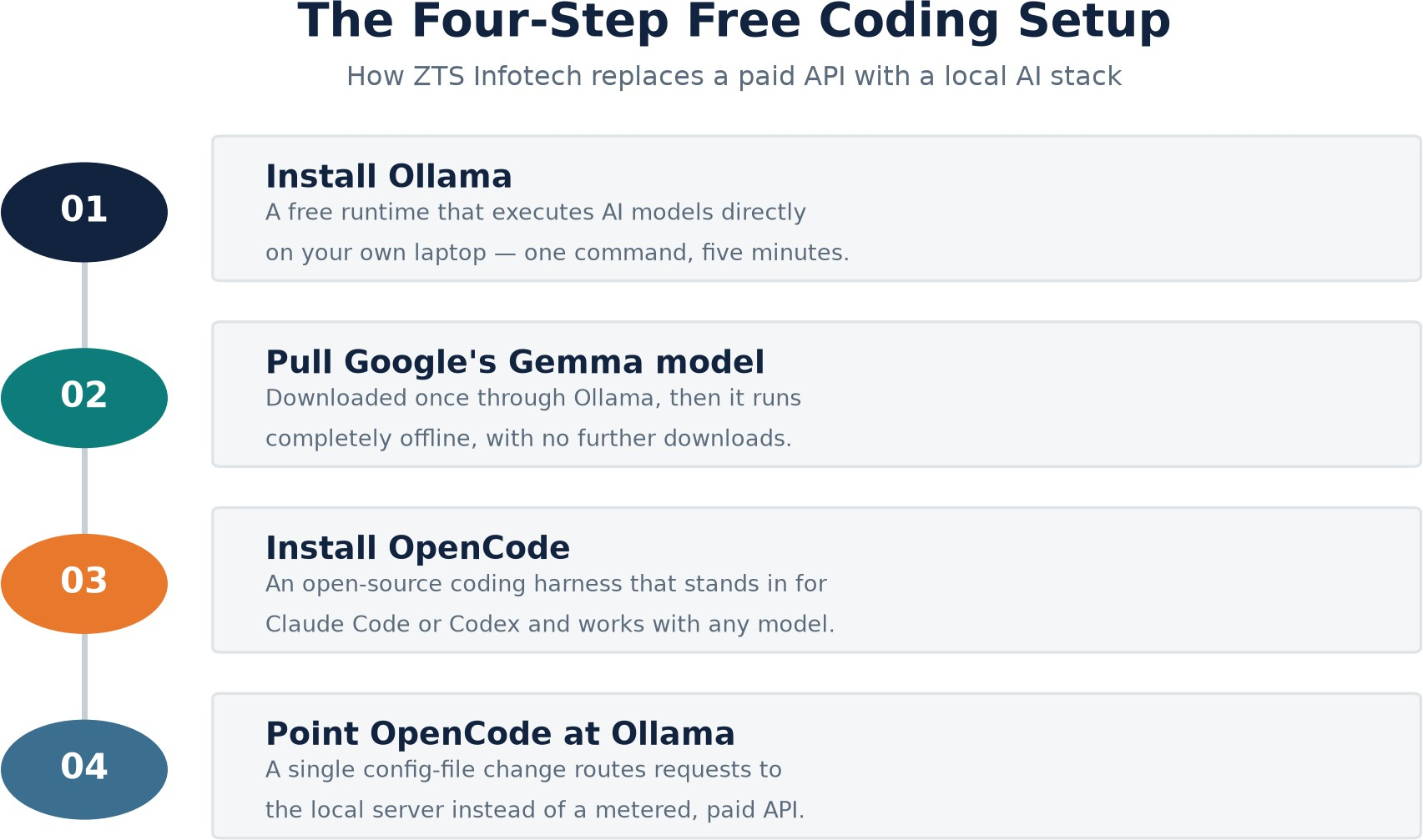
A Four-Step Local Setup
The first step installs Ollama, a runtime that lets AI models run directly on a laptop rather than through a hosted API. The second step pulls Google's Gemma model through that runtime — a one-time download that then operates entirely offline. The third step installs OpenCode, an open-source coding harness the video positions as a direct substitute for the Claude Code or Codex interface, with the distinction that it works with any underlying model rather than being tied to one vendor. The fourth step is a single configuration change that points OpenCode at the local Ollama server instead of a metered, paid endpoint.
Zero Marginal Cost, Fully Offline
The practical result is a coding agent that runs with no per-request billing and no dependency on network access once the model is downloaded. For a small agency, that removes two real cost centers at once: the monthly subscription fee for a hosted coding assistant, and the variable, usage-based cost that scales with how much exploratory work happens before a client contract is signed.
The Honest Capability Ceiling
What separates this video from typical AI-tool promotion is the caveat Das volunteers without being pressed on it. He states plainly that the local setup “will not outthink Claude Code or Codex on a genuinely hard architecture decision.” That is not a small concession. Architecture decisions — how a system is structured, how services talk to each other, how data flows through a product — are precisely the kind of work where a mistake compounds and where the reasoning depth of a frontier hosted model tends to matter most.
Instead, Das scopes the free stack's strength narrowly: a working landing page, a functional small-business website, a simple app prototype. He describes this, correctly, as “the exact category of work that fills most of a small agency's actual client pipeline.” That framing matters for anyone evaluating whether this approach applies to their own business. It is not a claim that free, local models have caught up to premium coding assistants. It is a claim that a large share of day-to-day agency work does not require that ceiling in the first place.
Turning a Free Tool Into a Billable Workflow
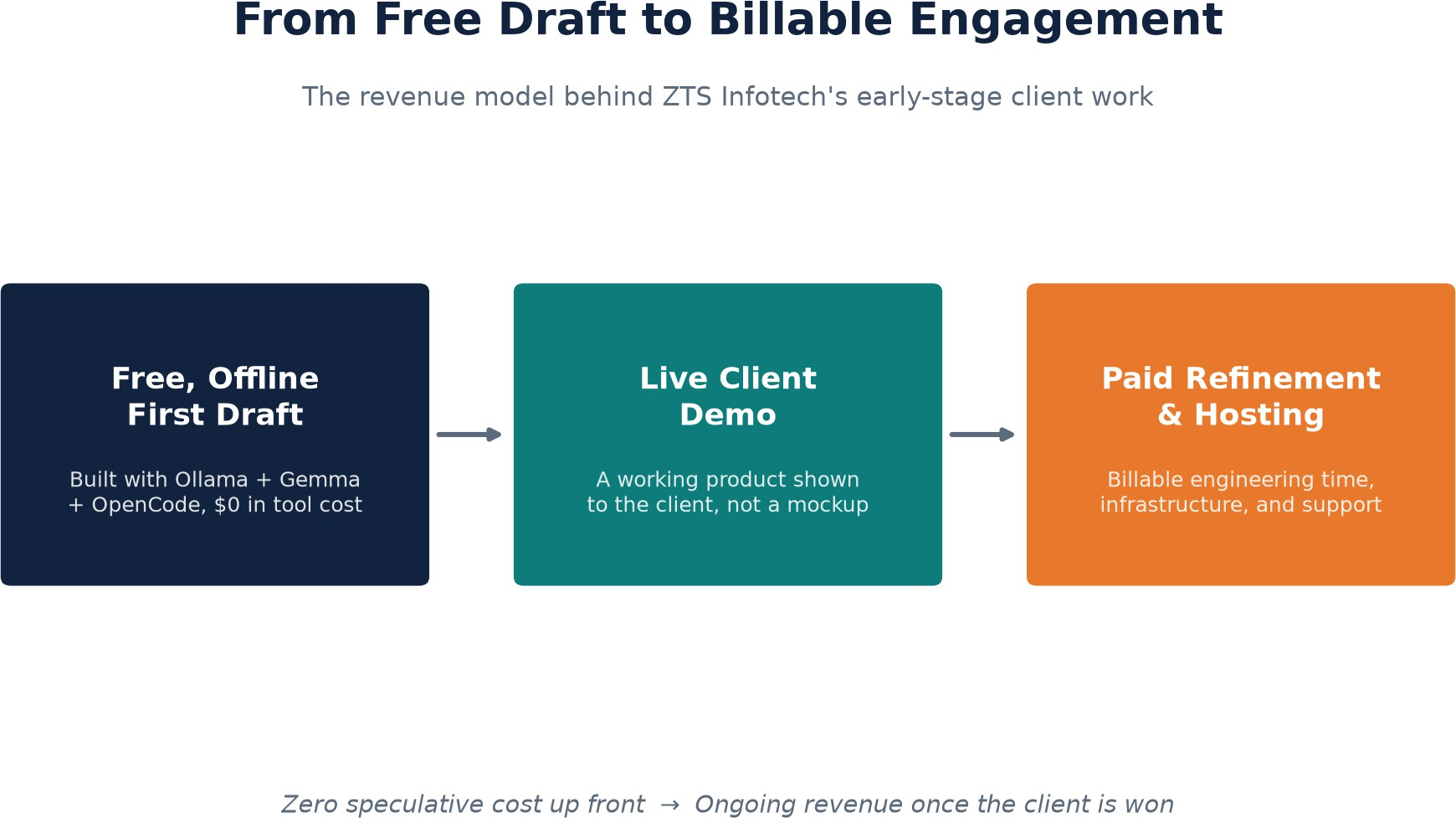
The more consequential part of the video, from a business standpoint, is not the tooling itself but how ZTS Infotech has folded it into client acquisition. According to Das, the agency now builds a client's first working draft completely offline, at zero infrastructure cost, and presents it as a real functioning product rather than a static mockup. Billable work begins afterward, in refinement, hosting, and ongoing support
— the parts of the engagement that require the agency's actual expertise.
Where the Model Fits in a Small Agency's Pipeline
This sequencing changes the economics of early-stage sales conversations. Prospective clients frequently ask for a demonstration before committing budget, and building that demonstration on a paid API or with billable staff hours is a cost an agency absorbs on every prospect, won or lost. Replacing that step with a local, offline build removes the speculative cost entirely, which gives an agency more room to pursue smaller or less certain opportunities without eroding margin on deals that do not close.
It also reframes what the client is actually paying for. Once a working draft already exists, the commercial conversation shifts away from “can you build this” and toward “how do we finish, host, and support this,” which is a more concrete and arguably easier conversation to close.
Expert Perspective: Why This Signals a Broader Shift
The significance of ZTS Infotech's approach extends beyond one agency's internal workflow. It is a visible data point in a trend that has been building quietly for months: local, open-weight models paired with open-source coding harnesses have crossed a usability threshold for scaffolding-level work, even if they remain behind frontier hosted models on harder reasoning tasks.
That distinction is likely to define how the market splits over the next year rather than how it consolidates around one approach. Expect a bifurcation: cheap or free local models handling first drafts, prototypes, and low-stakes scaffolding, while paid, hosted coding assistants continue to command a premium for architecture-level decisions, complex debugging, and work where the cost of an error outweighs the cost of a subscription. Agencies and internal engineering teams that recognize which category a given task falls into stand to capture the cost savings without absorbing the risk.
There is a competitive-pressure angle here too. As local stacks like Ollama, Gemma, and OpenCode become easier to assemble, vendors of hosted coding assistants face growing pressure at the lower end of the market, where users are paying largely for convenience rather than for capability they are actually using. That pressure is unlikely to touch the premium tier of the market, where enterprise reliability, support, and top-end reasoning performance remain the deciding factors, but it does put a ceiling on how aggressively entry-level subscription pricing can rise.
For agency owners and digital transformation leaders, the practical takeaway is less about any single tool named in the video and more about the pattern: treat AI coding cost as a spectrum, not a single line item, and match the tool to the stage of work rather than standardizing on one subscription for everything.
Key Takeaways
- ZTS Infotech now uses a free, offline stack — Ollama, Google's Gemma model, and the open-source OpenCode harness — to build client website and app drafts at zero infrastructure cost.
- The setup requires no subscription to Claude Code or Codex and, once the model is downloaded,
runs entirely without an internet connection.
- The company is explicit about the ceiling: the local stack cannot match hosted, subscription coding assistants on hard architecture decisions.
- It is well suited to landing pages, small-business websites, and simple app prototypes — the bulk of
typical small-agency client work.
- The commercial model separates a free first draft, used to win the client, from paid refinement, hosting, and ongoing support, which is where the agency now bills.
- This approach removes speculative cost from early sales conversations, letting agencies pursue more
prospects without raising per-lead cost.
- The trend points to a bifurcated AI-coding market: free local models for scaffolding-level work, premium hosted models retained for complex, high-stakes engineering.
Conclusion
The tools named in this video will keep evolving, and the specific model or harness an agency settles on six months from now may look different from what Das demonstrates today. What is unlikely to change is the underlying logic: the cost of producing a first draft is falling faster than the cost of finishing, hosting, and supporting a real product, and businesses that restructure their pricing and pipeline around that gap will hold an advantage over those that do not. Decision makers evaluating their own software vendors, whether as buyers or as builders, would do well to watch how quickly this pattern spreads beyond early adopters like ZTS Infotech.
-

Writen by Anirban Das