USA:
USA:  India: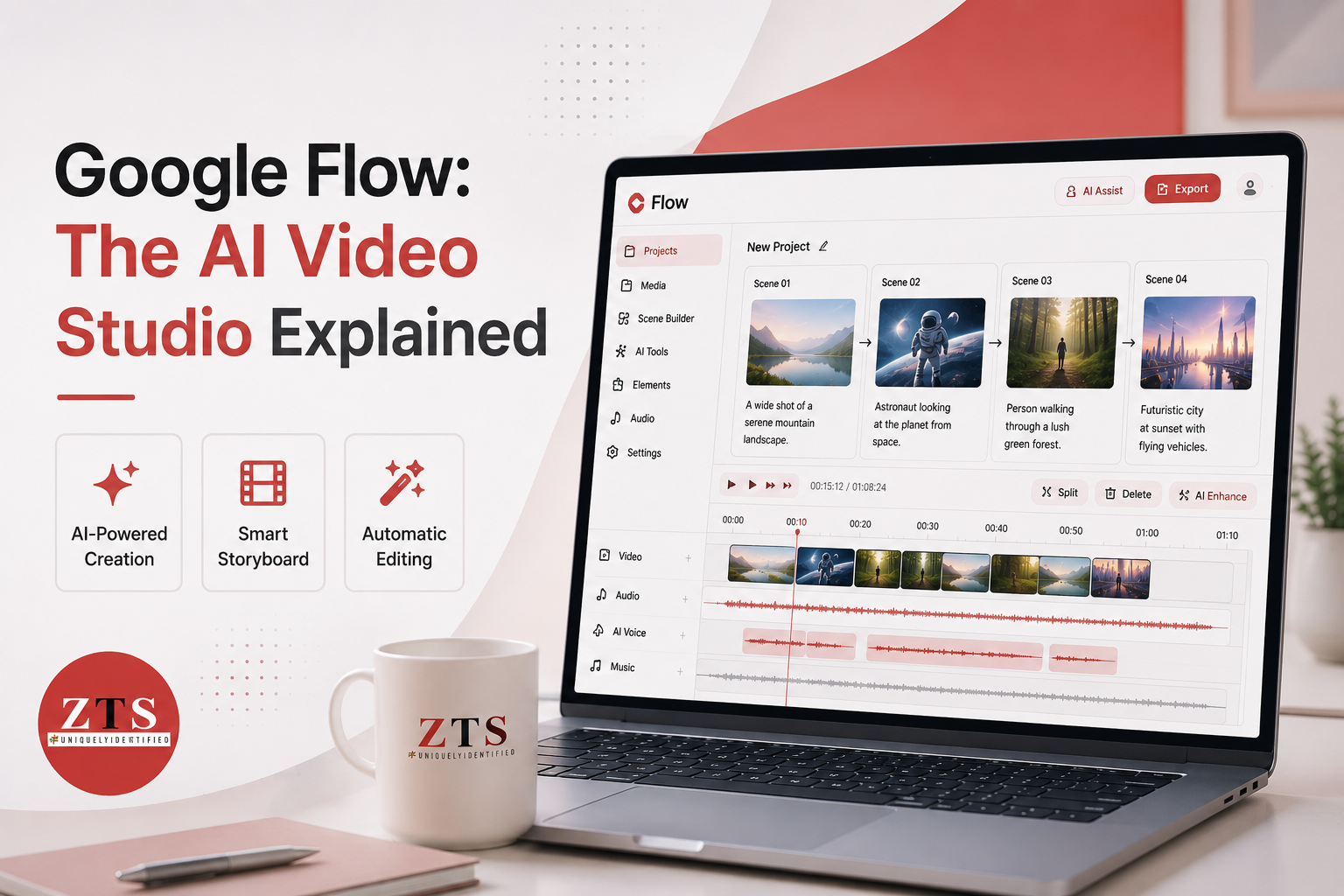
Google’s Flow now pairs Veo video generation with an AI agent that plans entire productions. Here’s what it means for marketing and content teams.
Marketing teams have spent the last two years watching AI video tools promise more than they deliver — a slick demo clip here, a three-second loop there, rarely anything a brand could put its name on. Google’s Flow is trying to close that gap, and its latest update makes the pitch more concrete: not just a generator that spits out a clip from a prompt, but a system built to plan, produce, and assemble an entire piece of content while remembering what the project is actually about.
For business owners and marketing leaders weighing where to put next year’s content budget, that distinction matters. A tool that generates a single clip is a novelty. A tool that can hold a project’s context across dozens of shots, keep a character or product consistent from scene to scene, and let a non-technical team member build a repeatable workflow without writing code, is a production tool — and production tools change how teams staff and budget creative work.
What Google Flow Actually Does
A Unified Creative Stack, Not a Single Feature
Flow brings together three of Google’s AI models under one interface: Veo 3.1 for text-to-video and image-to-video generation, including native audio, dialogue, and music synced to on-screen action; Imagen for high-fidelity still image generation, used to build the visual assets that feed into video sequences; and Gemini, providing the natural-language understanding that lets someone describe a scene in plain English rather than learning prompt syntax or editing software.
The most technically significant piece is a model Google calls Gemini Omni Flash, which merges Gemini’s reasoning with video generation and editing in a single system. Its distinguishing feature is conversational, multi-turn editing: rather than regenerating an entire clip from scratch every time a note comes in, the model understands what already exists in a scene and adjusts only what’s been asked to change, preserving character identity, voice, and continuity across revisions. For any team that has ever sat through a client’s fourth round of “just one more small change,” that alone is a meaningful shift in how AI video tools behave.
Flow Agent: A Project Memory, Not Just a Chatbot
Introduced in a June 2026 update, Flow Agent functions less like a chatbot and more like a standing production assistant. It retains context across an entire project, helping teams brainstorm concepts, structure a narrative, and generate content across multiple stages without having to re-explain the brief each time. Google has said Agent queries currently don’t draw down a user’s generation credits, though usage is subject to its own daily cap — a detail worth watching, since AI tools that start “free” often introduce metering once usage patterns settle.
Flow Tools and Scene Builder: Removing the Technical Bottleneck
Flow Tools lets users describe a workflow in natural language and have the system build a reusable tool around it — no scripting or configuration required. Paired with Scene Builder, which chains individual shots into a full sequence while maintaining consistent characters, settings, and pacing, the two features target the same problem from different angles: letting non-specialists produce multi-shot, brand-consistent content without hiring a technical operator for every project.
Availability and Real Limits
Flow has expanded to more than 140 countries since its initial rollout, with a free tier offering 100 starting credits and 50 replenished daily. That’s a meaningfully low barrier to testing the tool internally before committing budget. But availability isn’t uniform: in several EU markets, including Germany, France, Italy, and Spain, Veo 3.1 Pro and Scene Builder are currently restricted under the EU AI Act, though faster, lighter-weight generation and image tools still function. Teams operating across US and European markets should expect an uneven feature set depending on region — not a minor detail for any global brand planning a coordinated campaign.
Expert Perspective
The interesting story with Flow isn’t the video quality, which competitors are also improving quickly — it’s the shift from “generate a clip” to “manage a production.” Most AI video tools on the market today are single-shot generators bolted onto a chat interface. Flow’s bet is that the actual bottleneck in content production was never generation speed; it was coordination — keeping a character consistent across ten shots, remembering a brief across a week of revisions, giving a marketing coordinator the ability to build a repeatable workflow without pulling in a developer.
That has a direct budget implication. Agencies and in-house teams have historically priced video production around the labor of coordination as much as the labor of shooting or editing. If a tool can hold project memory and enforce consistency automatically, some of that coordination cost compresses. It doesn’t replace strategy, brand judgment, or the editorial decisions about what a piece of content should say — but it does change where a team’s time gets spent, shifting effort toward creative direction and away from production mechanics.
The EU restrictions are also worth watching beyond Flow specifically. They’re an early, concrete example of AI regulation shaping which product features are available where, rather than just whether a tool is legal to use. Marketing leaders running multi-region campaigns should expect this pattern — regionally uneven AI capability — to become a standard planning constraint over the next few years, not a temporary rollout quirk.
Key Takeaways
- Google Flow combines Veo 3.1 (video), Imagen (images), and Gemini (language understanding) into one creative interface, plus a new model called Gemini Omni Flash for conversational, multi-turn video editing.
- Flow Agent, added in June 2026, retains context across an entire project and can assist with brainstorming, structuring, and multi-stage content generation.
- Flow Tools allows teams to build custom, no-code creative workflows using plain-language descriptions.
- Scene Builder assembles individual shots into full sequences while preserving consistent characters and settings.
- Flow is available in 140+ countries, with a free tier offering 100 starting credits and 50 replenished daily.
- Veo 3.1 Pro and Scene Builder are currently restricted in several EU markets under the EU AI Act, creating uneven feature availability across regions.
- For marketing and content teams, the practical shift is from single-clip generation to project-level production management — with real implications for how creative work is staffed and budgeted.
Conclusion
Google Flow’s real pitch to business leaders isn’t that it makes video generation faster — plenty of tools do that already. It’s that it treats a piece of content as a project with memory, not a series of disconnected prompts, and it gives non-technical teams a way to build and reuse workflows without a developer in the loop. Whether that translates into lower production costs or simply a different allocation of creative time will depend on how well the tool performs outside a controlled demo. As Flow’s regional rollout and feature set continue to evolve, particularly under regulatory pressure in the EU, marketing and operations leaders should treat this as one to test early and evaluate deliberately, rather than adopt on the strength of a promotional walkthrough alone.
-

Writen by Anirban Das