USA:
USA:  India: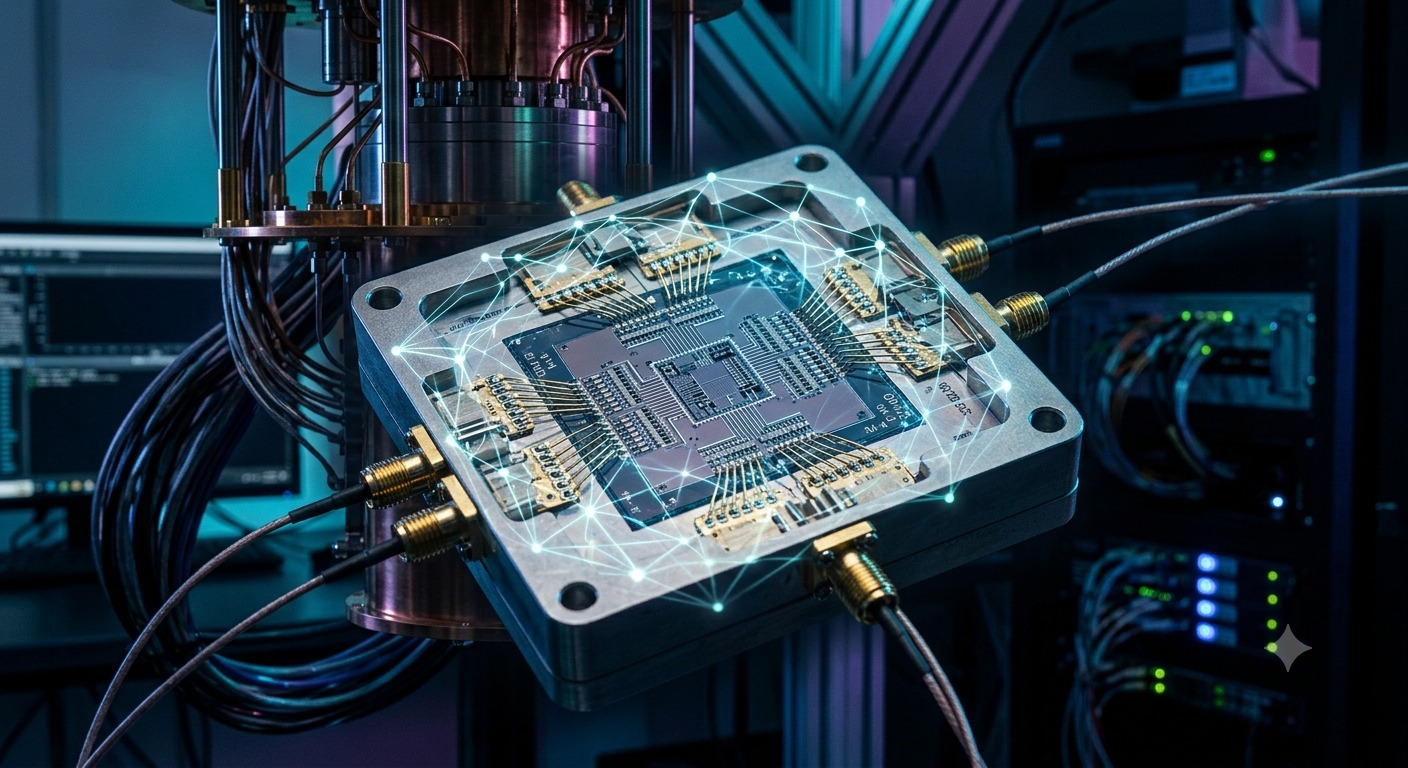
Quantum computers have carried a quiet, expensive flaw since the first working prototypes: their hardware drifts mid-calculation, and until now the only fix was to stop entirely, recalibrate every component, and start over. According to a new report from ZTS Infotech's AI News Desk, Google has closed that gap. The company's Willow chip now uses a reinforcement learning agent to correct hardware drift while a computation is still running, and the results — verified and published in the journal Nature — include the best error rates ever recorded on a quantum computer.
For business leaders who have treated quantum computing as a decade-away curiosity, this is a more concrete signal than most. Reliability, not raw qubit count, has long been the practical barrier between quantum computing and real commercial use. An AI system that keeps hardware accurate without ever pausing the calculation addresses that barrier directly, and it does so using a technique — reinforcement learning — that is already familiar from other business contexts.
The Problem Quantum Hardware Could Never Fully Escape
Quantum bits, or qubits, are extraordinarily sensitive to their physical environment, and their calibration drifts over time even under expert supervision. Historically, fixing that drift meant halting the entire computation, recalibrating every instrument, and restarting from scratch — a process the report compares to a surgeon stopping a six-hour operation to recalibrate surgical tools before continuing. That downtime has been an accepted cost of working with quantum hardware, not a solved problem, until this result.
How the Self-Correcting Loop Actually Works
The chip already generates thousands of tiny error signals every second, a byproduct of how quantum computers protect their own calculations. Google gave those signals a second job: a reinforcement learning agent, from the same family of AI that learned to beat humans at chess and Go, watches the signals continuously and makes thousands of small hardware corrections in real time, learning what is drifting and fixing it without ever stopping the run.
The comparison the report draws is a GPS that corrects your route while you keep driving, instead of forcing you to pull over and restart navigation. The destination does not change; the system simply keeps itself accurate for the whole journey.
The Numbers Behind the Breakthrough
The results, verified and published in Nature, were tested against hardware already calibrated by expert scientists — not a low bar. According to the report:
● The AI agent found an additional 20% error-rate improvement on top of fully expert-calibrated hardware.
● The system achieved the best logical error rates ever recorded on any quantum computer.
● Results scale independently of chip size, rather than degrading as hardware grows.
● The agent recovers from deliberately injected drift and maintains performance without human intervention.
Why This Matters Beyond the Physics Lab
Uptime is the quiet variable behind every enterprise technology roadmap, and quantum computing has been held back as much by unreliable hardware as by limited qubit counts. A system that corrects itself mid-run shortens the gap between quantum computing as a research exercise and quantum computing as a service businesses can actually schedule around — relevant to any leader tracking timelines for
drug discovery, materials science, logistics optimisation, or cryptographic risk planning.
Opportunities and Open Questions
The broader lesson extends past quantum hardware. An AI agent found a 20% improvement that trained physicists had missed on hardware they considered fully optimised — AI supplementing expert judgment rather than replacing it, in a domain where human intuition alone had reached its limit. That pattern is worth watching for any team wondering where reinforcement learning could apply closer to home. The open question is timing: this fixes one reliability barrier, not every barrier standing between today's quantum hardware and broad commercial deployment.
Expert Perspective
What makes this result notable is not that Google improved a chip — it is where the improvement came from. The gains were found by an AI agent operating on hardware that human experts had already calibrated as well as they knew how. That is a different claim than the usual AI headline about speed or scale; it is a claim about AI finding precision beyond expert reach, in real time, continuously, without
supervision. Businesses evaluating where AI genuinely changes outcomes, rather than simply automating existing workflows, should treat self-correcting systems like this as the more instructive category. The practical test for 2026 will not be whether quantum computers get faster, but whether they get boring — reliable enough that scheduling time on one stops requiring a contingency plan.
Key Takeaways
- Google's Willow chip now uses a reinforcement learning agent to correct quantum hardware drift while a computation is still running, ending the need to stop and recalibrate.
- Results were verified and published in Nature, a credible, peer-reviewed venue for the claim.
- The AI agent found a further 20% error-rate improvement on hardware already calibrated by expert scientists.
- The system recorded the best logical error rates ever measured on any quantum computer.
- Performance scales independently of chip size and recovers automatically from injected drift.
- The breakthrough targets reliability, historically as large a barrier to commercial quantum computing as raw qubit count.
- It is a concrete example of AI finding precision beyond expert judgment, not just automating existing work.
Conclusion
Quantum computing's path to commercial relevance has always run through reliability as much as raw power, and this result closes one of the field's oldest gaps without requiring bigger or more exotic hardware. It will not make quantum computers enterprise-ready overnight, but it removes a real operational obstacle and shows AI succeeding in a role many did not expect: quietly keeping complex physical systems accurate in real time. ZTS Infotech's AI News Desk will keep tracking where AI starts improving systems it previously could not touch, and this is a category worth watching through 2026.
-

Writen by Anirban Das