USA:
USA:  India:
Every few months, a piece of AI-tool controversy makes the rounds, gets amplified past the point of accuracy, and hardens into conventional wisdom long after the underlying issue has been resolved. Higgsfield, the AI video generation platform popular with e-commerce and social content teams, is the latest example. Earlier this year, users discovered terms of service language that appeared to grant the company sweeping rights over uploaded content and training data. The backlash was immediate and loud enough to travel well beyond AI circles.
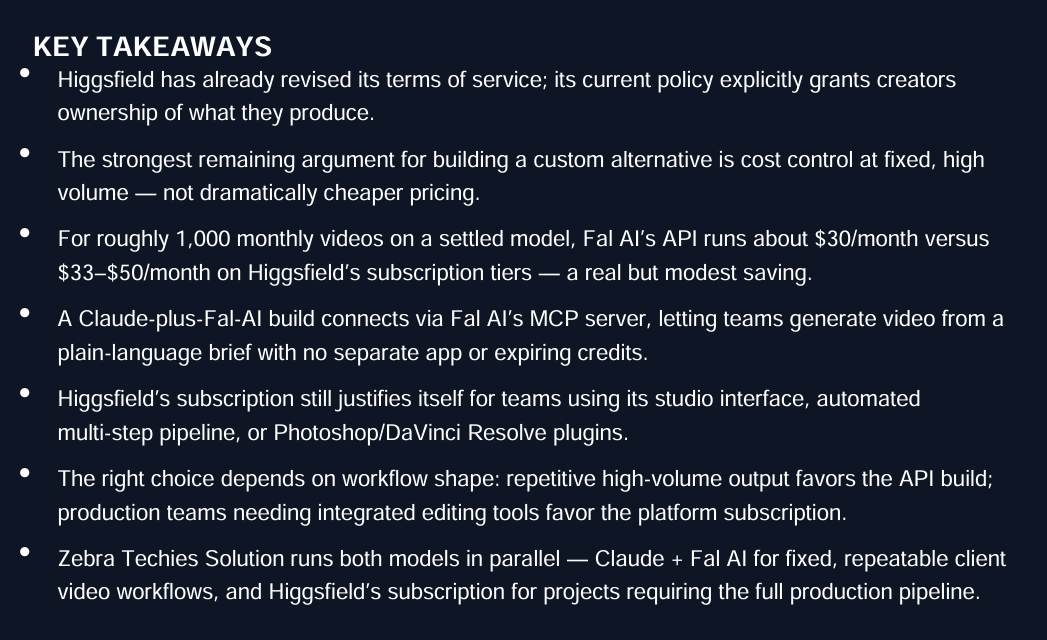
What most of that coverage missed is the follow-up: Higgsfield rewrote the terms. Its current policy is unambiguous — creators own what they make on the platform. For businesses that pulled back from Higgsfield strictly over the data-rights issue, that particular objection no longer holds up.
That doesn’t mean the conversation about building an alternative is over. It means the conversation businesses should actually be having is a different one entirely — and it has nothing to do with trust or ownership. It’s about unit economics at scale.
Why the “Build Your Own” Argument Persists Anyway
A version of this argument has been circulating in marketing and product-ops circles for months: skip the subscription platform, wire Claude directly into an API router like Fal AI, and generate the same output for a fraction of the price. It’s a compelling pitch, and it’s also, in its most common telling, overstated.
The honest version of the math only holds up under a specific condition: fixed, high-volume, repeatable output using a model the team has already standardized on. Picture a TikTok Shop seller producing the same style of product video roughly a thousand times a month, with no need to experiment across different generation models.
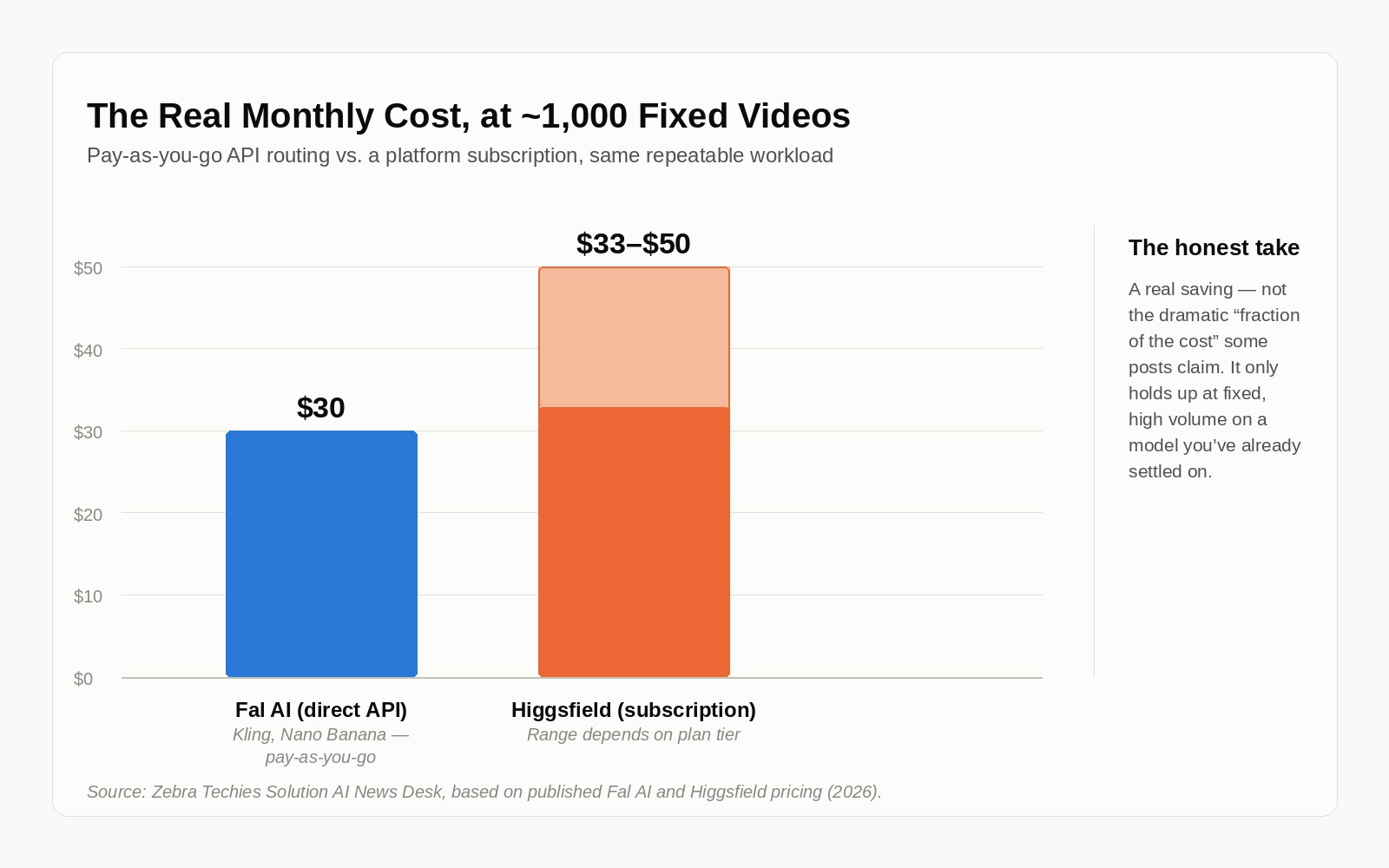
Under that scenario, routing requests through Fal AI’s pay-as-you-go API — which provides access to models including Kling and Nano Banana — runs approximately $30 a month for that volume. The equivalent workload through Higgsfield’s own subscription tiers costs between $33 and $50 a month, depending on plan level. That is a real, defensible saving. It is not the dramatic multiple that social-media claims tend to suggest — it’s a modest efficiency gain, and only for teams whose workflow is genuinely repetitive and high-volume enough to make the comparison meaningful.
How the Claude + Fal AI Workflow Actually Works
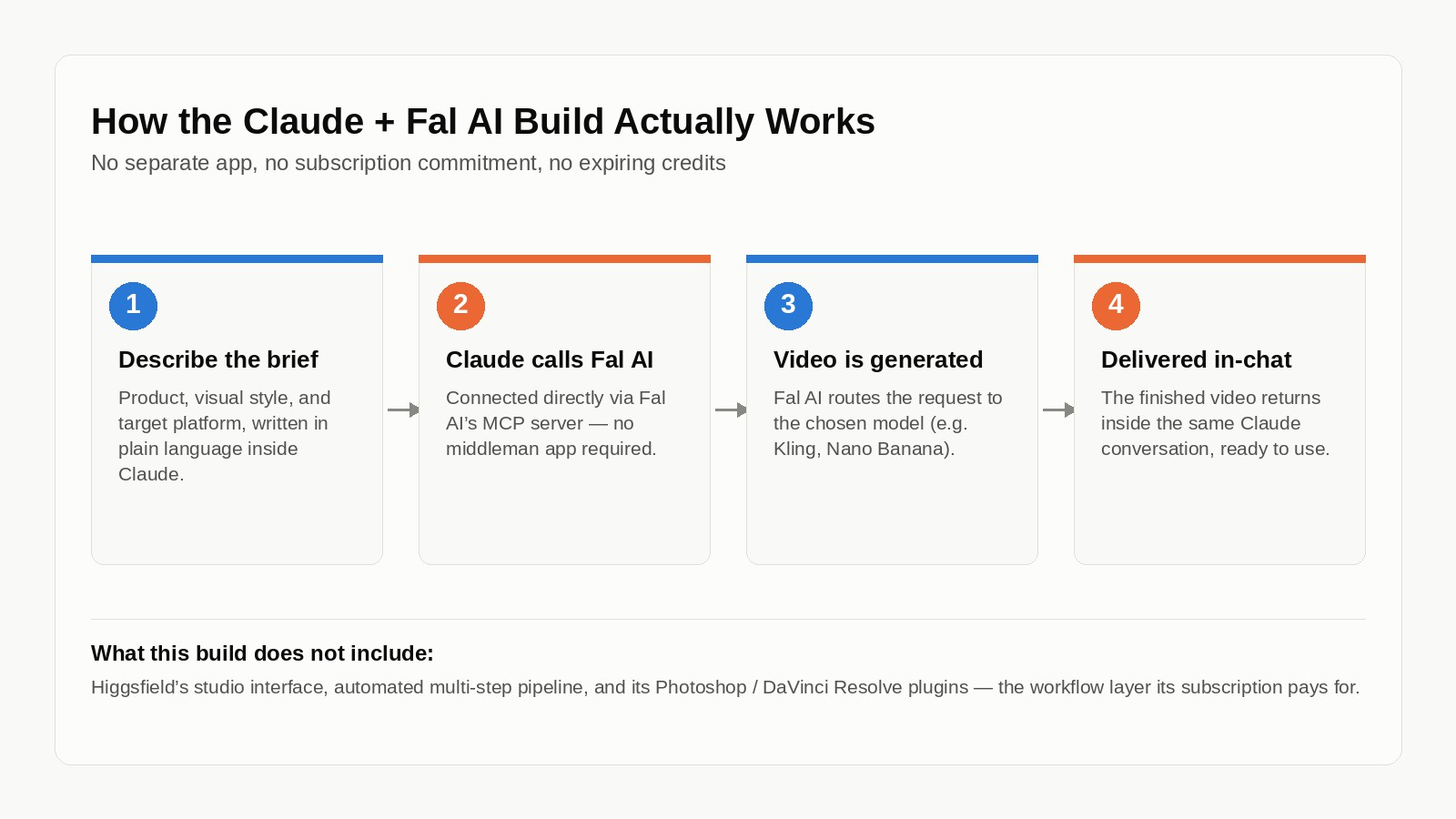
For teams that do fit that profile, the build itself is straightforward rather than exotic. Claude connects directly to Fal AI’s MCP (Model Context Protocol) server. A team member describes the video brief in plain language inside Claude — the product, the visual style, the platform it’s destined for. Claude then calls Fal AI’s API directly, triggers generation, and returns the finished asset inside the same conversation.
There’s no separate application to license, no recurring subscription commitment layered on top of usage, and no credit-expiration clock — a detail worth flagging, since Higgsfield’s own credits lapse after 90 days if unused. For a marketing operations team already comfortable working inside Claude, the workflow removes a tool from the stack rather than adding one.
The Trade-Off That Doesn’t Show Up in the Cost Comparison
None of this makes Higgsfield’s product redundant. Its studio interface, its agentic pipeline that chains multiple production steps automatically, and its native plugins for Photoshop and DaVinci Resolve represent real engineering investment that a bare API connection does not replicate. For production teams that lean on those integrations regularly — creative agencies moving assets between editing tools, for instance — the subscription earns its cost through the workflow layer alone, independent of the per-video math.
Building on Claude and Fal AI buys raw model access, direct cost control, and full ownership of the pipeline. It does not buy the orchestration and editing-suite integration that a dedicated platform has already built. Treating the two as interchangeable misreads what each is actually for.
Expert Perspective: What This Signals for AI Tool Strategy
The more durable story here isn’t about Higgsfield specifically — it’s about how quickly viral criticism of an AI vendor’s terms can outlive the terms themselves, while a separate, more mundane argument about total cost of ownership gets flattened into a simpler and more dramatic claim than the numbers support. Businesses evaluating AI production tools in the second half of 2026 are operating in a market where vendor terms change quickly, API routers have matured into credible alternatives to single-vendor subscriptions, and the “build vs. buy” decision increasingly comes down to workflow shape rather than headline pricing. The teams making the better call are the ones auditing their actual monthly volume and tool usage patterns before picking a side — not the ones reacting to a controversy that’s already been addressed, or a savings claim that’s already been inflated.
Looking Ahead
As AI video tools continue to mature and pricing structures shift, the businesses that benefit most will be the ones that keep re-testing their assumptions rather than repeating last quarter’s hot take. The data-rights controversy that once made headlines is settled; the cost conversation is not, and it will keep changing as both platforms and API pricing evolve. Decision-makers evaluating their next AI production stack should expect this comparison to look different again within a few months — and should build their evaluation process, not just their vendor list, accordingly.
-

Writen by Anirban