USA:
USA:  India:
 AI website automation services use intelligent agents and automated workflow pipelines to handle repetitive digital tasks, from lead routing and content updates to inventory syncing, cutting operational costs by 25–50% for businesses in Canada. According to McKinsey, companies that adopt intelligent automation report up to a 40% reduction in process-related costs within the first year.
Running a business in Canada today is expensive. Labour costs are rising. Customer expectations have never been higher. And most operations teams are stretched thin managing tasks that a smart automated system could handle around the clock.
That's where AI website automation services come in. More businesses in Toronto, especially in fast-moving hubs like Liberty Village, are now deploying AI workflow automation to cut overhead, accelerate operations, and create real room for growth.
This article breaks down exactly how it works and what kind of savings you can realistically expect.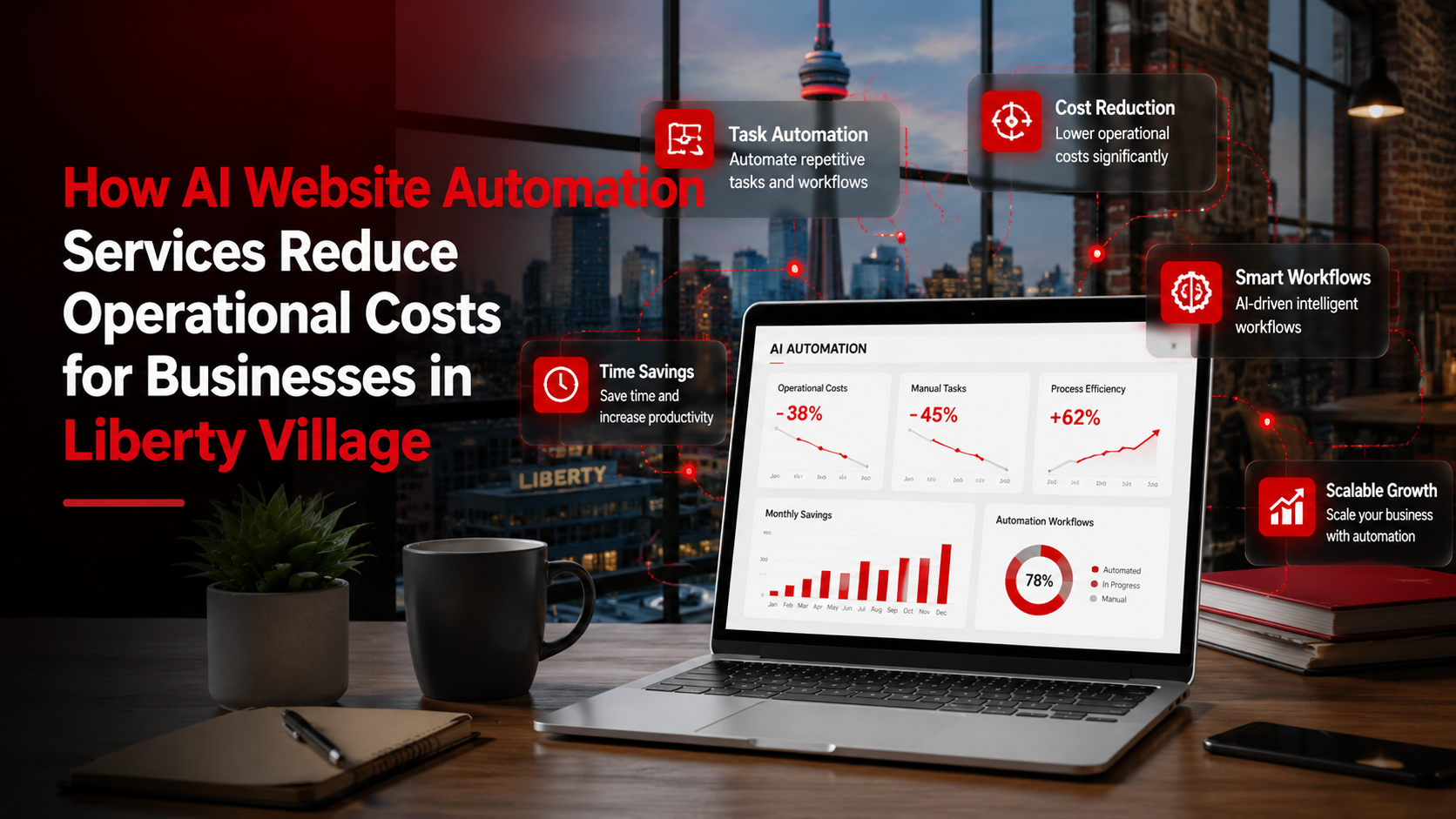
What Does AI Website Automation Actually Mean For Canadian Businesses?
AI website automation means using software systems powered by artificial intelligence to handle tasks on your website and within your business workflows, without any human involvement. Not basic rule-based scripts. Actual intelligent systems that learn from your data and make context-aware decisions.
Think about everything your team manages manually right now. Someone follows up on abandoned carts. Someone updates product inventory. Someone routes inbound leads to the right sales rep. Someone pulls weekly reports from five different tools and pastes the numbers into a spreadsheet.
AI automation handles all of that. For a Shopify merchant in Toronto, this might mean an AI agent that detects when a high-value customer hasn't purchased in 60 days and automatically triggers a personalized retention email. No human involved. No delay. For a WooCommerce store, it could mean inventory syncing in real time with a warehouse management system, eliminating stock discrepancies and the customer complaints that follow.
85% of customer service interactions will be managed without a human agent by 2025, according to Gartner. Canadian businesses that aren't automating now are already falling behind.
How Do AI Workflows And Intelligent Agents Reduce Manual Work?
AI workflows replace multi-step manual processes with automated pipelines that run continuously in the background. A traditional workflow looks like this: a customer fills out a form, someone gets an email notification, that person logs into a CRM, creates a contact, assigns it to a rep, then sends a welcome email. Every step depends on a human being available and paying attention.
An AI workflow compresses that entire chain into seconds. The form submission triggers an agent that scores the lead, assigns it based on territory and rep capacity, sends a personalized welcome message, and logs everything in the CRM. Automatically. While your team sleeps.
What Are AI Agents And How Do They Work Inside Business Systems?
AI agents are software programs that perceive data, make decisions, and take actions to complete goals, without waiting for human input. Unlike basic automation tools that follow rigid coded rules, AI agents adapt. They can read emails, interpret intent, pull data from multiple systems, and choose the most appropriate next step.
A practical example: a Liberty Village ecommerce startup uses an AI agent for customer service on their Shopify store. The agent handles order status queries, return requests, and product questions 24 hours a day. Only complex or high-value conversations get escalated to a human rep. Their support team handles 70% fewer tickets while customer satisfaction scores hold steady or improve.
30% reduction in average handle time reported by businesses using AI-powered service agents, alongside a 25% improvement in first contact resolution, per Salesforce Research.
How Much Can Canadian Businesses Actually Save Through Website Automation?
The savings depend on your current operations, but they are consistently significant across industries. Here is a realistic cost breakdown for a mid-size Canadian ecommerce business doing roughly $2M in annual revenue:
| Process | Manual cost/month | Automated cost/month | Monthly savings |
| Customer support (2 reps) | $7,000 | $1,500 | $5,500 |
| Inventory management | $3,500 | $800 | $2,700 |
| Lead routing & CRM updates | $2,000 | $400 | $1,600 |
| Reporting & analytics | $1,500 | $300 | $1,200 |
| Email & follow-up sequences | $1,200 | $250 | $950 |
| Total | $15,200 | $3,250 | $11,950/month |
Estimates based on industry benchmarks. Actual savings vary by business size and complexity.
That's over $140,000 in annual operational savings for a single business. And it doesn't include revenue gains from faster response times and fewer fulfilment errors.
45% of current work activities can be automated using existing or near-future technology, according to McKinsey's automation research. For Canadian SMEs, this represents an enormous opportunity to redirect budget toward growth instead of overhead.
What Processes Can AI Automate On a Business Website?
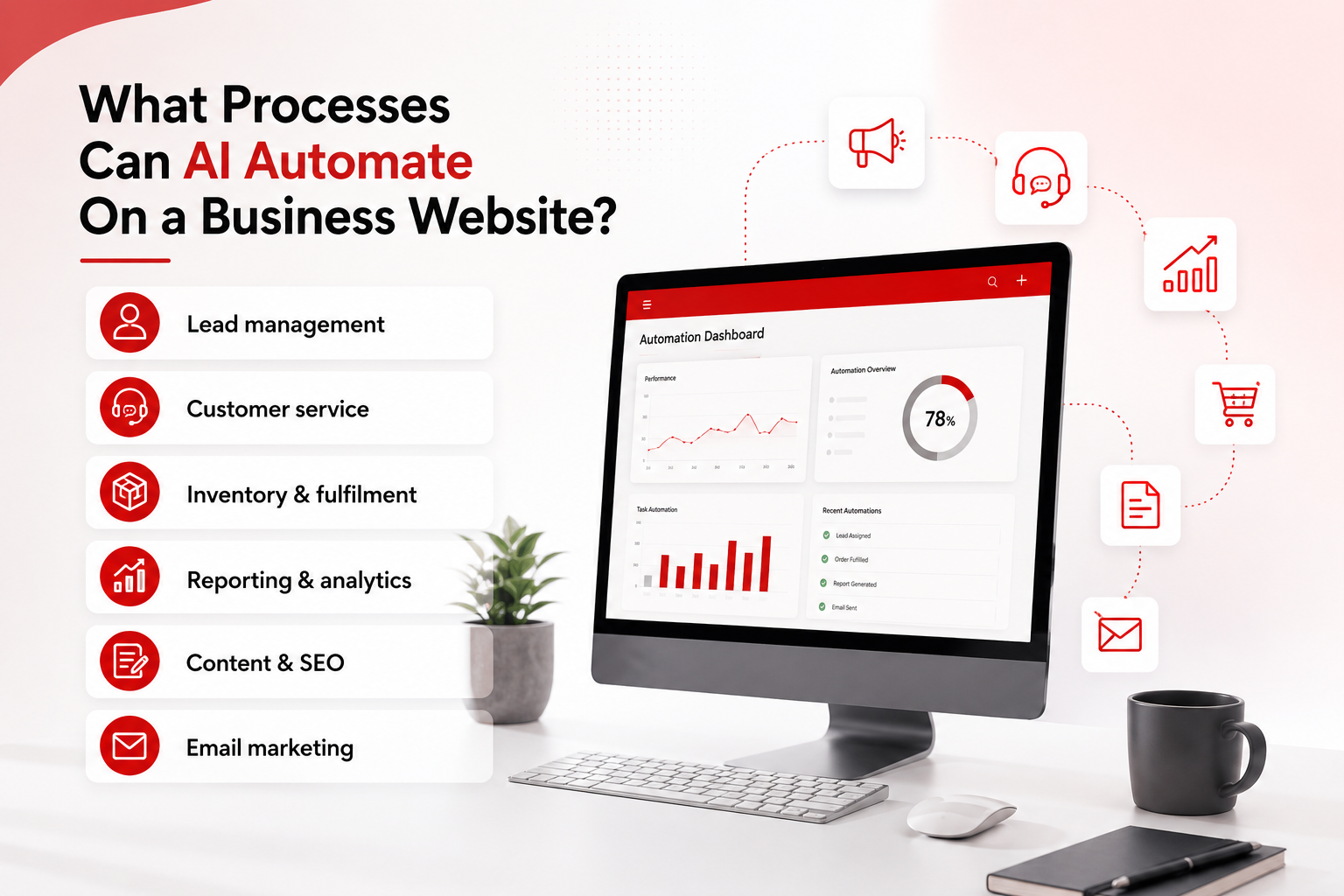
AI can automate more than most business owners realize. Here are the highest-impact automation areas for Shopify and WooCommerce businesses in Canada:
- Lead management
Capture, score, and auto-assign inbound leads. Send personalized follow-up sequences without any manual input.
- Customer service
Answer product questions, process returns, and escalate edge cases with full context already attached.
- Inventory & fulfilment
Sync stock across channels in real time. Trigger purchase orders automatically and flag fulfilment delays early.
- Reporting & analytics
Pull data from Shopify, Google Analytics, and Meta Ads into one dashboard automatically. Flag anomalies instantly.
- Content & SEO
Update product metadata, generate alt text, and schedule blog content with structured schema markup.
- Email marketing
Trigger personalized campaigns based on customer behaviour. Recover abandoned carts without anyone lifting a finger.
80% more leads generated at 33% of the cost by businesses that automate their marketing workflows, according to HubSpot's marketing data.
How Does AI Automation Improve Team Productivity?
Automation doesn't replace your team. It removes the work your team hates doing and shouldn't be doing in the first place. When you eliminate manual data entry, repetitive reporting, and routine customer queries from your team's workload, something real happens: people start working on higher-value problems.
| Activity | Before automation | After automation |
| Time spent on reporting | 6 hrs/week | 0.5 hrs/week |
| Lead response time | 4 to 24 hours | Under 2 minutes |
| Support tickets per rep/day | 80 to 100 | 25 to 30 |
| Inventory error rate | 12 to 18% | Under 2% |
| Campaign setup time | 3 to 5 days | 4 to 6 hours |
78% of businesses that implemented intelligent automation reported improved employee satisfaction because staff was freed from repetitive tasks, per Deloitte's Global RPA Survey.
Why Are Liberty Village And Toronto Startups Investing In AI Workflow Automation?
Toronto's startup scene, particularly in Liberty Village, is becoming one of Canada's most aggressive adopters of AI-powered operations. The reason is straightforward: competition. Scaling without automation means hiring people for every function. In Toronto, where tech talent salaries are highly competitive, that is expensive and slow.
AI workflow automation lets a 10-person startup operate with the systems of a 50-person company. Liberty Village businesses are using business process automation to compete with larger, better-funded competitors by being faster and more responsive than manual operations allow.
25% year-over-year growth in the Canadian ecommerce market between 2021 and 2024, according to Statista. That growth creates enormous pressure on operations. Businesses that automate now build infrastructure that scales with demand without proportional hiring.
25% year-over-year growth in the Canadian ecommerce market between 2021 and 2024, according to Statista. That growth creates enormous pressure on operations. Businesses that automate now build infrastructure that scales with demand without proportional hiring.
How does AI automation transform business operations over time?
The first win is cost reduction. The second win is speed. The third, and most powerful, win is compounding intelligence.
AI systems learn. A lead scoring model that has been running for six months is significantly smarter than one that launched last week. A customer service agent that has handled 10,000 queries understands edge cases and nuances that no human operator wrote into its initial rules. The longer your automation runs, the better your operations get, without any additional cost
| Timeframe | Primary gain | Business impact |
| Month 1 to 2 | Cost reduction | Support and operations overhead drops immediately |
| Month 3 to 6 | Speed improvement | Faster lead response, faster fulfilment, fewer errors |
| Month 6 to 12 | Intelligence gains | AI systems optimize themselves on real business data |
| Year 2+ | Compounding ROI | Mature systems operate at 3x the efficiency of early-stage automation |
3x the ROI seen by companies with mature automation programs compared to early-stage adopters, according to Forrester Research. The compounding effect of mature AI systems is the most underappreciated advantage in business automation today.
“The businesses winning in Canada's ecommerce market in 2025 are not the ones with the most staff. They are the ones with the smartest operations.”
Is AI Website Automation Right For Small Businesses?
Yes, and the window to act affordably has never been wider. The cost of AI automation tools has dropped significantly over the past three years. Today, a Shopify store doing $300,000 per year can automate lead capture, customer support, and email sequences for under $500 per month. The ROI becomes positive within the first quarter in most cases.
The key is starting with the highest-friction processes first. What takes the most time? What causes the most errors? Automate those first, measure the results, then expand from there. The AI-powered website automation for businesses that ZTS Infotech Pvt Ltd builds follows exactly this approach: start with measurable wins, then scale intelligently.
Frequently Asked Questions
1.What is website automation?
Website automation means using software to handle tasks on your website automatically, without human involvement. This includes lead routing, customer support, inventory updates, form processing, email sequences, and reporting. AI-powered automation goes further by adapting and improving based on real data over time.
2.How does AI reduce business operating costs?
AI reduces costs by replacing repetitive, manual tasks with automated workflows. This cuts labour hours, reduces human error, and accelerates operations, resulting in savings of 25–50% on operational costs for most businesses, according to McKinsey.
3.What are AI agents in web systems?
AI agents are software programs that perceive data, make decisions, and take actions autonomously. In web systems, they handle tasks like answering customer questions, scoring leads, routing support tickets, and processing transactions, all without human input.
4.How much can AI automation save a Canadian business?
Mid-size Canadian ecommerce businesses typically save between $5,000 and $15,000 per month after implementing automation across support, operations, and marketing. For a $2M revenue business, that can exceed $140,000 in annual savings.
5.Is AI automation suitable for small businesses?
Yes. Modern automation tools are affordable and scalable. A small Shopify store can start automating core workflows for under $500 per month and typically sees positive ROI within 60 to 90 days.
6.Can AI automate ecommerce operations?
Absolutely. AI automation is particularly effective for ecommerce, covering inventory syncing, abandoned cart recovery, customer service, order processing, returns management, and personalized marketing across Shopify and WooCommerce platforms.
7.How quickly can businesses see ROI from AI automation?
Most businesses see measurable ROI within 60 to 90 days of implementing core automation workflows. The fastest returns come from customer service automation and lead routing. Long-term ROI compounds as AI systems learn and optimize over time, per Forrester Research.
8.What workflows can AI automate right now?
Lead management, customer service, email marketing, inventory management, reporting, social media scheduling, product content updates, payment processing, and fulfilment alerts can all be automated with current AI tools available to Canadian businesses today.
Ready To Automate Your Business Ops?
ZTS Infotech Pvt Ltd builds custom AI website automation services designed specifically for Canadian businesses running on Shopify and WooCommerce. We don't sell generic software. We design intelligent workflow systems that fit the way your business actually operates and deliver measurable cost reductions from day one.
-

Writen by Anirban Das