USA:
USA:  India:
 .png)
Most engineering teams already know the tax of running multiple AI coding agents on one laptop: fan noise, memory pressure, and eventually closing one agent so another can keep up. A new open-source tool is challenging that assumption. Jcode, a coding agent harness built in Rust by independent developer Jeremy Huang, has picked up nearly 13,000 GitHub stars since launching, and its resource-usage numbers are dramatic enough that ZTS Infotech's engineering team put it to a real test on a live client build. The results — and the honest limitations that come with software still in active beta — are worth understanding before any business brings parallel AI agents into its own development workflow.
What Is Jcode, and Why It's Different
Jcode is free and MIT-licensed, meaning any business can use, modify, or redistribute it without licensing fees. It is built entirely in Rust, a systems programming language prized for speed and low memory overhead, and ships with a native terminal interface rather than a browser-based one. Unlike commercial coding assistants tied to a single model provider, jcode is model agnostic: developers connect it to Claude, GPT, Gemini, DeepSeek, Ollama, or any of more than 40 supported providers using their own API key.
That combination — free licensing, provider flexibility, and a lightweight runtime — is what put jcode on ZTS Infotech's radar. It is not a finished commercial product. It is an actively developed open-source project, and treating it otherwise would be a mistake.
The Performance Numbers That Got Our Attention
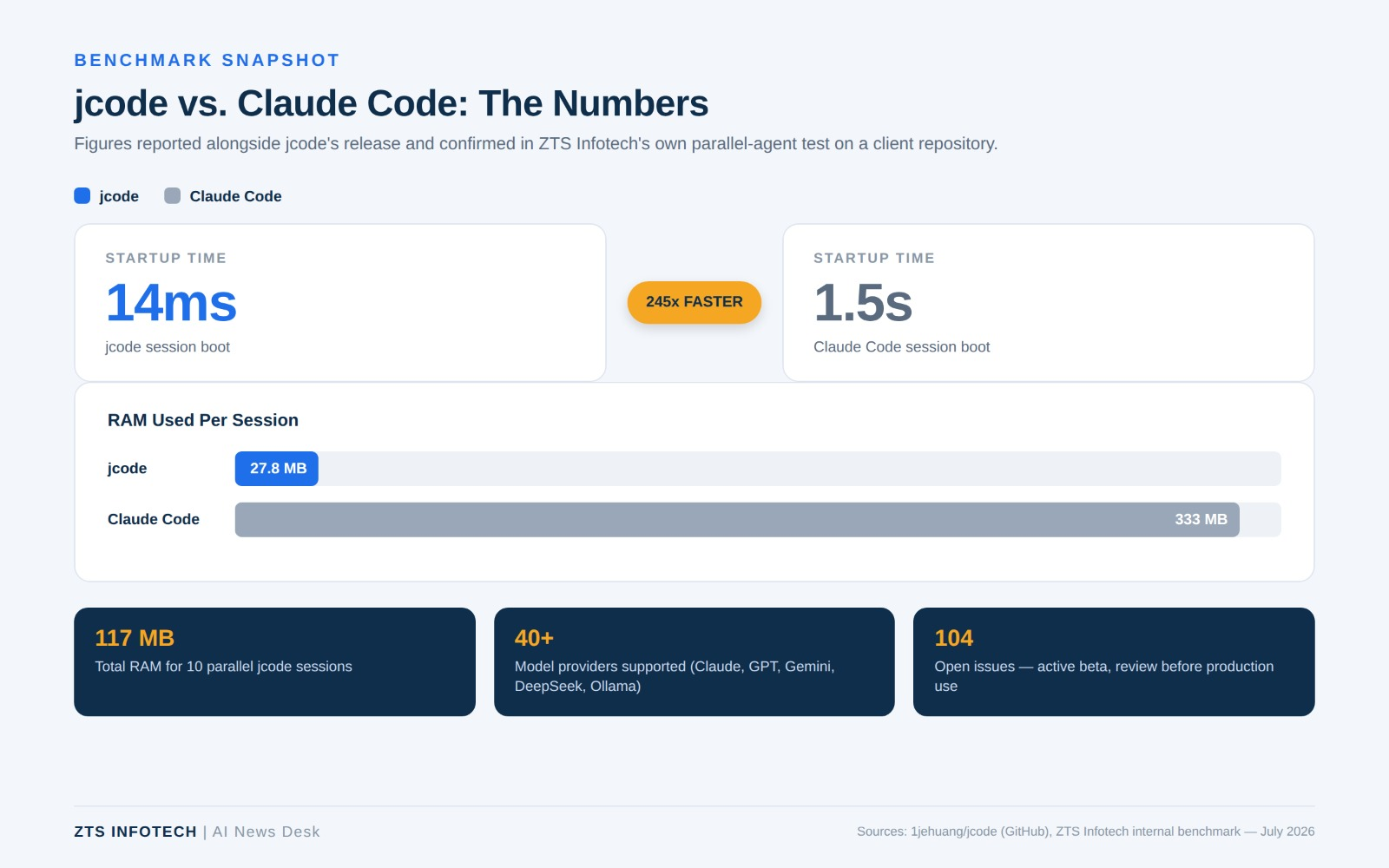
According to benchmarks shared alongside the tool, jcode starts in roughly 14 milliseconds, compared with about 1.5 seconds for Claude Code, Anthropic's own coding agent — a gap of roughly 245 times. Memory usage tells a similar story: a single jcode session uses about 27.8 megabytes of RAM, against roughly 333 megabytes for a comparable Claude Code session. Run ten jcode sessions at once and total memory consumption is reported at around 117 megabytes combined.
Two engineering features make that efficiency usable rather than just impressive on paper. Jcode includes built-in collision detection, so multiple agents working in the same repository do not overwrite each other's changes, and a semantic memory graph that persists context between sessions, so an agent does not start from zero every restart.
Putting It to Work: ZTS Infotech's HRMS Test
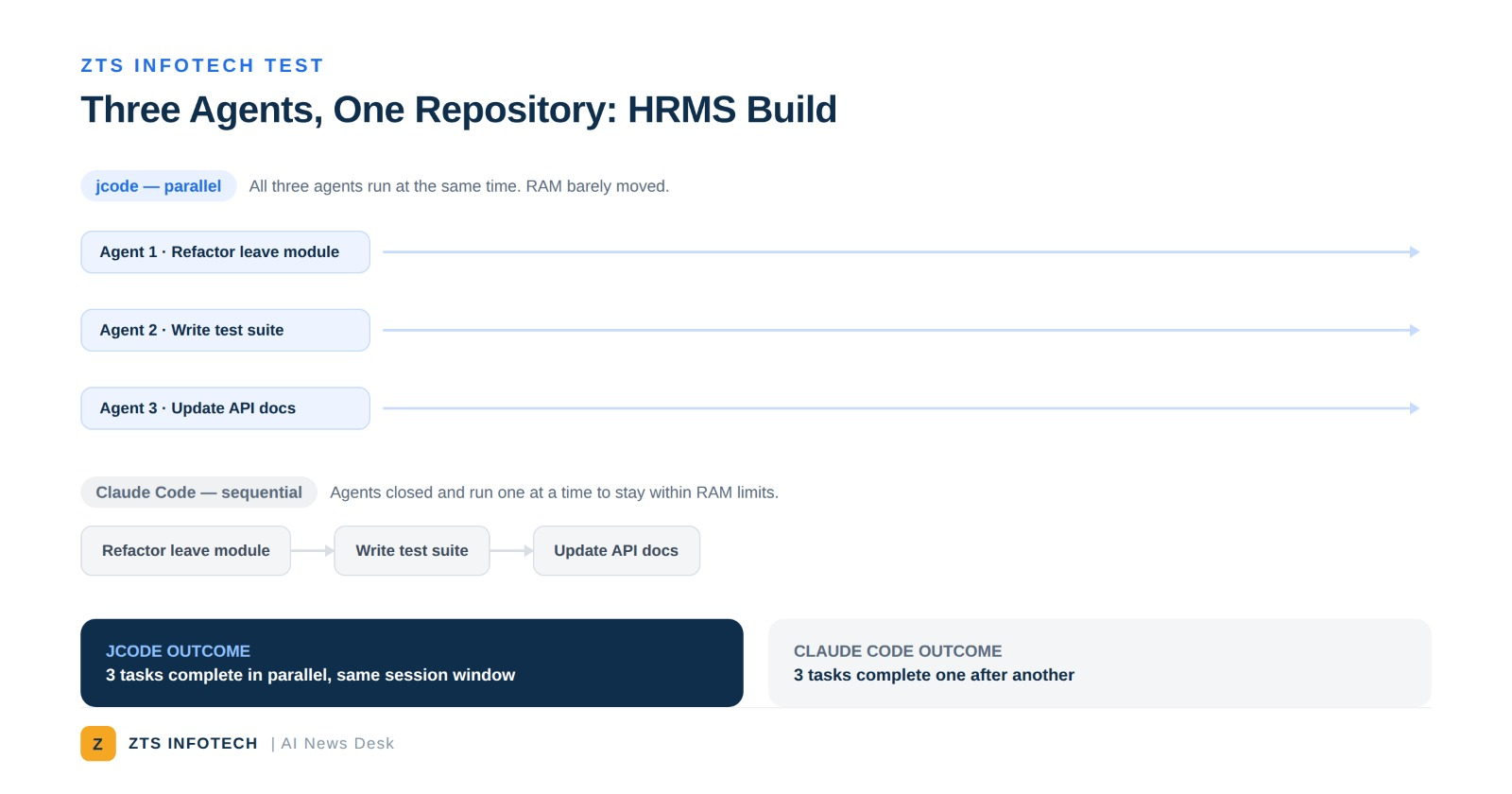
Numbers on a GitHub readme are one thing. ZTS Infotech's engineering team wanted to see whether they held up on real client work. The team ran three jcode agents simultaneously against the same repository for a client's HR management system: one agent refactoring the leave management module, a second writing the accompanying test suite, and a third updating the API documentation — all at the same time, on the same machine.
The team reports that RAM usage barely moved during the exercise. The same three-part workflow attempted on Claude Code required closing agents and working through the tasks sequentially rather than in parallel — the more familiar experience for teams already running AI coding assistants on standard developer hardware.
What This Means for Engineering Teams
For businesses that bill by project timeline or run lean engineering teams, the practical implications extend well beyond a single benchmark:
- Faster iteration without new hardware. Teams do not need higher-spec machines just to run multiple agents; existing laptops can handle parallel sessions that previously forced a choice between agents.
- Shorter delivery cycles. Parallel agents handling refactoring, tests, and docs at once compress timelines that were previously sequential — directly affecting client delivery schedules.
- Less vendor lock-in. Because jcode is model agnostic, teams can swap providers as pricing or capability changes without re-tooling their entire workflow.
Expert Perspective
The more interesting story here is not one tool's benchmark numbers — it's what those numbers signal about where the AI coding-agent market is headed. Commercial tools have largely competed on model
quality and feature breadth. Jcode's approach, a lightweight, provider-agnostic runtime, competes on a different axis: efficiency. If parallel-agent workflows become standard practice, resource overhead stops being a footnote and becomes a genuine differentiator between tools.
That should put pressure on commercial vendors to optimize their own runtimes, not just their models. It should also change how engineering leaders evaluate coding-agent tools going forward: startup time and memory footprint per session belong in the same evaluation criteria as accuracy and context window size, particularly for teams that want to scale parallel-agent workflows across a team rather than a single power user's laptop.
None of that changes the fact that jcode remains beta software with real open issues. Businesses should treat it as a sandbox candidate for internal testing and non-critical workflows for now, not a wholesale replacement for a production coding assistant.
Key Takeaways
- Jcode is a free, MIT-licensed, open-source AI coding agent harness built in Rust by independent developer Jeremy Huang, with close to 13,000 GitHub stars.
- It starts in about 14 milliseconds versus roughly 1.5 seconds for Claude Code — a reported 245x difference.
- A single jcode session uses about 27.8 MB of RAM versus roughly 333 MB for Claude Code; ten sessions together use around 117 MB.
- Built-in collision detection and a persistent semantic memory graph make multi-agent, multi-session workflows practical, not just fast on paper.
- ZTS Infotech ran three jcode agents in parallel on a live client HRMS repository with minimal RAM impact — the same workflow required sequential work on Claude Code.
- Jcode is model agnostic, connecting to Claude, GPT, Gemini, DeepSeek, Ollama, and more than 40 other providers.
- The project is in active beta with 104 open issues and should be evaluated in sandbox and internal-testing environments before any production use.
Conclusion
Open-source tooling built for efficiency rather than headline features has a way of reshaping expectations quietly, then all at once. Whether jcode itself becomes the standard or simply forces established vendors to rebuild their runtimes with resource efficiency in mind, engineering leaders now have a working example that parallel AI agent workflows do not have to mean upgrading hardware. ZTS Infotech has added jcode to its internal testing stack and will keep tracking its progress as it moves out of beta.
-

Writen by Anirban Das