USA:
USA:  India:
 Business owners in Dubai are becoming aware that the eCommerce market is developing faster than they expected, and because of this, there is a larger level of competition for online eye-balls than there has ever been before. A store that generates sales regularly will almost always generate sales based on the features of the store itself (development processes, features of the store & features available to satisfy the expectations of a consumer in the UAE) and not necessarily based on the product being sold.
If you are about to launch a new e-commerce website in the Dubai area, or you are performing an overly critical review of an existing e-commerce website and the review indicates that it is underperforming, this article provides some general features that will clearly identify high-conversion stores from underperforming ones. These features are not desirable; they will be considered, in particular, by the time this article is published in 2026: baseline e-commerce features in the UAE.
At ZTS Infotech Pvt. Ltd, we are an experienced e-commerce website development company and have audited & redeveloped many e-commerce stores located throughout the UAE, KSA, and the GCC region. The conclusions drawn from our audits are that a high percentage of the eCommerce stores that have converted provide the same underlying eCommerce store features that are currently considered desirable and that most of the eCommerce stores that have not generated sales do not have the same eCommerce store features.
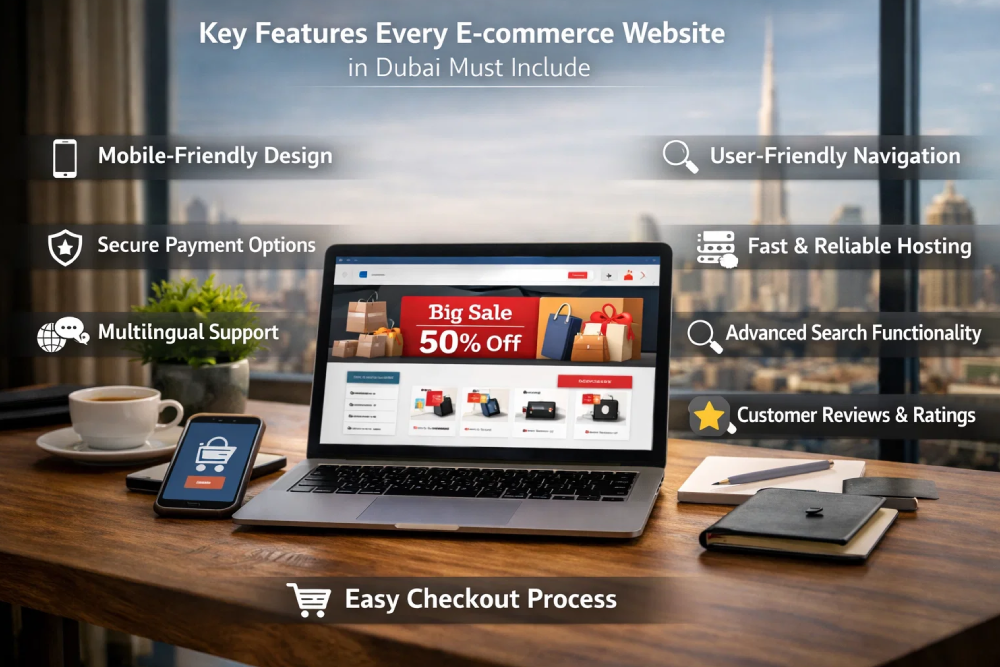
Mobile-First Architecture: Not a Mobile-Friendly Framework Afterthought
In the UAE, over 78% of eCommerce transactions are done on mobile devices; this current level of mobile usage isn't a trend — it's the entire way that consumers in the UAE have chosen to do their shopping. The architecture of a mobile-first site is designed primarily for mobile users; the entire user experience (UX) includes everything from navigation and product discovery to images to both the cart and checkout process. All aspects are designed first with mobile devices in mind, then adapted from there for use with desktops.
Creating a mobile-first eCommerce website, such as eCommerce in Dubai, is vastly different from having a desktop website and building a responsive style sheet attached to it. An eCommerce website in Dubai created using a mobile-first approach has the following characteristics:
• Accurate sizing and spacing of touch targets means that there is no room for errors when tapping on buttons during checkout
• Product images will load in no more than 1.5 seconds over a fourth-generation mobile data network (4G)
• The checkout process uses no more than three screens during the mobile checkout process
• "Sticky" add-to-cart buttons and bottom navigation bars will be used at appropriate points within the user experience to encourage conversions
• Checkout forms (shipping and billing address, credit/debit card) will be optimised for mobile keyboard input.
If you have an eCommerce website that was built more than two years ago without having been purposely rebuilt using a mobile-first approach, you will almost definitely have the biggest conversion leak of any of your eCommerce competitors.
Bilingual User Experience: Arabic and English with Appropriate RTL Implementation
There are more than 200 nationalities living in Dubai, and the main languages of business are Arabic and English. If an eCommerce company wants to sell anything in the United Arab Emirates, the company must have a bilingual business website.
To build a bilingual eCommerce business in Dubai’s Arabic and English languages, businesses must do more than just translate the product descriptions. Properly developing a bilingual eCommerce website in Dubai will also require:
• Switching the website, including navigation, product grid, cart, and checkout pages, between right-to-left (RTL) and left-to-right (LTR) layouts correctly,
• Ensuring cleanly rendered Arabic typefaces across all device formats (not just using computer-generated “placeholder” Arabic descriptions),
• Localising product descriptions, category names, and transactional e-mails to the UAE marketplace,
• Formatting currency amounts and date formats in Arabic presentation styles that conform to Arabic linguistic norms,
• Creating SEO-optimised slugs and metadata for the purposes of achieving organic visibility for searches done in Arabic.
If the RTL function is not executed properly, Arabic users will immediately see that and lose their trust in your business very quickly; therefore, if you want to commit your company to doing business as a bilingual e-commerce company in Dubai, you should consider working with a custom e-commerce development company that will develop your bilingual e-commerce website plugin. he architectural phase instead of trying to implement RLT functionality post-launch as a plug-in. UAE, Ration
UAE Payment Gateway Solutions — Fully Integrated Local and Regional Options
Payment friction is a leading problem around the world when it comes to people not completing orders on eCommerce websites. In the UAE, payment options vary from credit card to debit card, buy now pay later and cash on delivery; therefore, if you do not offer the right options or have a badly integrated checkout process, you are missing out on sales every single day.
If you want to create a successful eCommerce website for Dubai, then you must ensure that you have incorporated the following payment systems:
• Telr or PayTabs – both of these platforms are payment gateways that are widely used in the UAE, as they have a relationship with local acquiring banks and allow for a smooth payment process.
• Checkout.com or Stripe – both of these internet payment platforms allow international card payments to be processed at a reasonable cost.
• Tabby and Tamara are the current leading Buy Now Pay Later solutions in the UAE, which has become an expected payment option for consumers in the UAE.
• Cash on Delivery remains a popular option for many consumers in the UAE without access to a credit card or bank account.
• Apple Pay and Google Pay – both of these payment options allow consumers to complete purchases on their phones without any friction. This is especially important given the high number of mobile devices compared to the total population in the UAE.
• 3D Secure is a requirement for all card transactions in the UAE as per the UAE Central Bank.
Each of the payment gateways mentioned above has specific requirements for integration, webhook configuration and test environments. If you implement a gateway incorrectly or miss the 3DS compliance layer, there can be significant issues with failed transactions as well as regulatory issues associated with your business. Our eCommerce web developers in Dubai will configure each payment gateway correctly before launching the store to the public.
VAT Compliance and Integrated UAE Tax Configuration
In the UAE, value-added tax (or VAT) has been set at five per cent (5%) since 2018, and all e-commerce companies that are VAT registered must adhere to certain guidelines regarding the accurate display of tax-inclusive or tax-exclusive pricing, generating proper VAT-compliant receipts, and retaining audit-ready transaction records. These requirements are mandated by federal law as opposed to simply being an option.
From an e-commerce perspective, your store must have the correct logic in place to properly display VAT on product pages, in the shopping cart and through checkout. Furthermore, your order confirmation emails and invoice templates must contain the information required by the UAE Federal Tax Authority. In addition, your reporting exports must reconcile correctly for quarterly VAT filing.
Although some of the current e-commerce platforms may get some of this right, a professionally built e-commerce system in Dubai will get it completely right — saving you the headache and expense of going back and doing this retroactively.
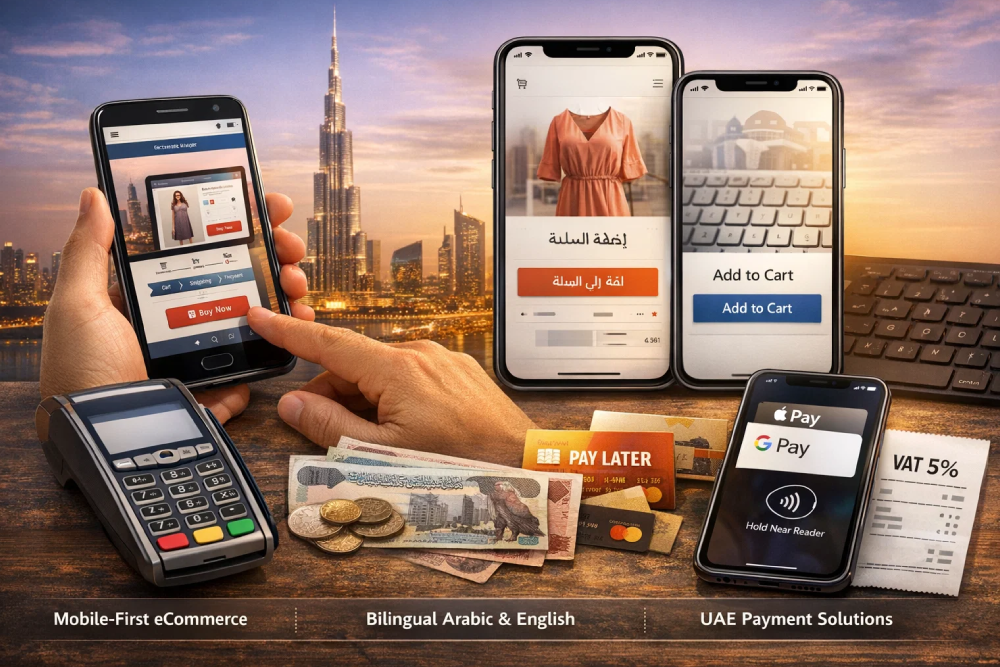
Performance-Optimized Architecture: Speed that Preserves Conversion and SEO
Google has established three primary ranking factors: LCP (Largest Contentful Paint) measures how quickly the site renders the main content; INP (Interaction to Next Paint) measures how long it takes for users to interact with the page before they can see more content; and CLS (Cumulative Layout Shift) measures how much of the content changes unexpectedly while scrolling. If an eCommerce website loads too slowly, it will suffer from two disadvantages — lower rankings in organic searches and higher bounce rates due to being impatient when visiting your store.
To create scalable eCommerce platforms in Dubai, the infrastructure must be optimised when built, not patched together with add-ons later on. Some performance aspects should be included in the initial design of a scalable e-commerce solution:
- An Image Optimisation pipeline (WebP/AVIF delivery + responsive image sizes + lazy loading)
- Critical CSS inlining while deferring JavaScript products that are not critical
- An Edge CDN for customers based in the UAE to ensure that their assets are delivered from a server located nearby
- An Efficient Database Query Structure for large product catalog
- Server-Side Rendering and/or Static Generation for product and category pages as necessary
- An App and Plug-In Audit – removing third-party scripts that contribute to render-blocking
An eCommerce website developed in Dubai by experienced eCommerce web developers should have a target LCP of under 2.5 seconds and a target CLS of less than 0.1 as standard or baseline delivery standards rather than aspirational delivery standards.
Features Driven by AI That Actually Enhance Business Results
AI e-commerce development in Dubai has transitioned from a luxury item to a must-have for businesses competing with one another. To succeed in the Dubai market in 2026, stores will leverage these products as practical business tools rather than simply as attention-getters. Implementing AI-based e-commerce technologies will increase conversions and average order values and improve customer retention.
The AI features that provide the most significant measurable returns on investment (ROI) in e-commerce are as follows:
- Intelligent product recommendations generated by analysing a customer's browsing and purchase history (rather than static blocks)
- AI-based search engines that understand the user via semantic meaning rather than keywords are particularly useful for bi-lingual Arabic/English
- Dynamic Pricing and Inventory Alert systems that allow you to automate alerts to let customers know when items are low in inventory/when items become available in inventory, creating a sense of urgency to purchase the item and recover potential lost revenue
- Conversational Commerce (Integrating the WhatsApp Business API and providing AI assistance to customers who are inquiring about their orders or need assistance)
- Predictive analytics (Identifying which segments of your customer base are most likely to make a purchase or not continue to shop with you, allowing you to target retention initiatives)
ZTS Infotech Pvt. Ltd integrates these types of products into our AI-powered e-commerce practice when they can provide measurable gains to the client's bottom line vs when they are just adding technology complexity without any reason to do so.
Checkout Flow and Conversion-Engineered Product Pages
In Dubai, advertising is costly; it's also very expensive to advertise using Google Ads, Meta and TikTok in highly competitive UAE categories with high CPCs. If you want to make these advertising costs worthwhile, you'll need a store that can convert visitors into buyers. In this part of the world, product pages that convert are as follows:
- High-quality images of each product that can be zoomed in on and have lifestyle images too
- Social proof on the website such as product ratings, reviews, and user-generated content, must be above the fold
- Urgency/scarcity displays, such as countdown clocks for promotions or low stock indicators, must be placed authentically not as a dark pattern
- Clear delivery promise with an ETA for different areas in the UAE
- Transparent functions are policy, as UAE consumers are very aware of and concerned with returning items
- Sticky add-to-cart functions are sticky in that they rest on the screen throughout navigation of the product page, which is especially important on mobile devices
The checkout process must also be simplified as much as possible; every unnecessary step or required field decreases conversion. Guest checkout must exist, and payment options must be easy and hassle-free to understand and navigate. Lastly, order confirmation must be instant and complete.
Data Protection Compliance and Security Infrastructure
The UAE has seen its consumers becoming more aware of the importance of security; consequently, the UAE has developed a new law called PDPL (Personal Data Protection Law), which sets out how businesses operating in the country must collect, store and process consumer data. According to this law, failure to comply presents regulatory risk; furthermore, if a consumer's data is breached, this will instantly result in that consumer losing confidence in the way that business operates, especially considering how rapidly reputation propagates throughout this region.
Each design of an eCommerce website to be developed by ZTS Infotech Pvt. Ltd for Dubai has to include the following:
SSL/TLS certificate configuration, including having HTTPS enabled on every page, including the checkout page.
PCI DSS compliance with respect to handling payment data (i.e., no card data is kept server-side).
In accordance with the PDPL data collection policy, providing clear instructions as to how data will be used and kept, retention policies and providing customers with privacy notices are all important.
Routine vulnerability scanning and security patches will be put in place as part of the overall security strategy.
Double authentication on the administrator access to the account and for all staff accounts is required.
Automated back-ups so that businesses can continue functioning after losing any amount of data through the aforementioned vulnerabilities.
Security cannot be an add-on feature; it must be part of the design from the beginning of any custom eCommerce development project.
Integration of Logistics and Shipping Configuration Particular to the UAE
Many Dubai eCommerce companies lose customers that they have worked to get through inadequate fulfilment processes. Problems, such as inaccurate delivery estimates, missed COD deliveries, and broken tracking links, reduce trust and generate negative feedback that will linger with the eCommerce brand for months.
An e-commerce platform created for Dubai should be designed to handle the UAE logistics framework, including:
- Aramex - using Aramex for real-time rate calculations, label creation and tracking integration
- Fetchr – using Fetchr's GPS-based delivery solutions, as they are uniquely suited to the UAE's addressing methodology
- Quick – to allow for express and same-day deliveries in and around Dubai and Abu Dhabi
- Empost – to enable GOV-linked deliveries throughout the UAE
- Use of multi-zone shipping rules to have different rates and timeframes across Dubai, Abu Dhabi, Northern Emirates and internationally
Providing your customers with real-time tracking visibility via the shopfront or WhatsApp notification has now become an expectation of the UAE and not just a differentiator, so build it in!
How ZTS Infotech Pvt. Ltd Provides These Features and How Much It Costs
An eCommerce website for your Dubai business is a big undertaking, so you can expect it to take longer than a weekend to complete. It should, however, also not take you a year to get completed. ZTS Infotech Pvt. Ltd provides structured value and pricing structures for businesses in Dubai looking to develop an online e-commerce site at various stages of growth.
Our entry-level web presence development packages start at AED 699. For businesses looking for a complete eCommerce solution (including payment gateway integration, a tax setup mod to work with the UAE, mobile-first website design, and performance improved through best practices), it will cost around AED 999. Services that include custom integrations and artificial intelligence systems on a Shopify Plus site or headless architecture are provided as a custom quote after discovery.
All projects that we work on will have a written scope, clear timelines, and post-launch support built into the contract – meaning no scope creep, no surprise billing, and no abandoned projects.
Get a Free Quote → ztsindia.com/service/ai-website-engineering-dubai

Build It Correctly the First Time
All items and features included in this guide are not a wish list for an upcoming version of your online store; they are the basic requirements needed to compete in Dubai’s eCommerce marketplace. An online store currently not offering a mobile-first design, multilingual user experience, integrated payment systems, or optimised performance will not have the potential for generating ongoing profits during the time it is live.
When building successful eCommerce websites in Dubai, we incorporate all of these elements as part of a complete solution delivered per your budgetary and scheduling requirements. Whether you are building a new website from scratch or rebuilding a poorly performing website, we are here to help you create a comprehensive plan for moving forward.
Frequently Asked Questions (FAQ)
What is the price of creating a fully functional e-commerce website in Dubai?
The price of developing an eCommerce website in Dubai can differ greatly based on which platform is used, what functionality will be included (if it's an enterprise-level solution), how many products you intend to sell online, &c. ZTS Infotech Pvt. Ltd offers affordable solutions beginning at 999 AED for complete, commercially viable Shopify stores that include the following: - UAE Payment Gateway Integration - Mobile First Design - Tax configuration (based on your business practice) - Pre-launch Quality Assurance Testing At the lowest tier, ZTS can create your eCommerce presence for as little as 699 AED. For custom eCommerce builds (including multi-vendor marketplaces, headless architectures and ERP integrations), we provide a project scope after conducting a discovery session because scoping based on real information results in better pricing than providing project costs without a complete project definition. When you're ready to engage, please feel free to reach out to us for a complimentary/no-obligation assessment of your project.
If my primary target market in Dubai is English-speaking consumers, does my eCommerce website still need to support Arabic?
Regardless of your primary language, Dubai has a strong business case for developing bilingual e-commerce. Even if your target market is primarily composed of English-speaking expatriates, many UAE consumers show an interest in browsing and buying products in Arabic. Also, Arabic SEO provides a second avenue for you to receive search traffic to your website, which many of your competitors have not optimised. Arabic search terms related to your eCommerce business will likely generate significant amounts of organic search traffic that can only be accessed by stores that offer their products in Arabic; English-only stores will be unable to access this source of search traffic. As such, you need to ensure that you have the proper architecture in place to support both English and Arabic stores without having to add these features later due to excessive construction costs.
How long does it take to create a fully functional eCommerce website in Dubai?
Regardless of your primary language, Dubai has a strong business case for developing bilingual e-commerce. Even if your target market is primarily composed of English-speaking expatriates, many UAE consumers show an interest in browsing and buying products in Arabic. Also, Arabic SEO provides a second avenue for you to receive search traffic to your website, which many of your competitors have not optimised. Arabic search terms related to your eCommerce business will likely generate significant amounts of organic search traffic that can only be accessed by stores that offer their products in Arabic; English-only stores will be unable to access this source of search traffic. As such, you need to ensure that you have the proper architecture in place to support both English and Arabic stores without having to add these features later due to excessive construction costs.
Final Thoughts
It takes more than just opening an online store to create a profitable e-commerce website in Dubai. To satisfy contemporary client expectations, businesses must prioritise mobile-first design, bilingual user experience, secure payment integrations, quick performance, and adherence to UAE rules. In a highly competitive industry, features like AI-driven personalisation, smooth checkout processes, and dependable logistics integrations help retailers stand out. Businesses can develop a scalable, secure, and conversion-focused e-commerce platform that draws clients, fosters trust, and propels steady growth in Dubai's quickly changing digital marketplace by putting these crucial components into place right away.
-

Writen by Anirban Das