USA:
USA:  India:
 .png)
Before the benchmarks and the parameter counts, a correction is worth making: Kimi K4, the model generating the most excitement in AI circles this month, has not been released. Moonshot AI is still sourcing the Nvidia chips it needs to train it. What has actually shipped — and what engineering and business leaders should be paying attention to right now — is Kimi K3, an open-weight model that is free to download, self-hostable, and already beating one of the industry's leading proprietary coding models on a widely watched benchmark. ZTS Infotech is testing it against real client codebases this week, and the early picture is worth understanding before the K4 headlines take over.
What Kimi K3 Actually Is
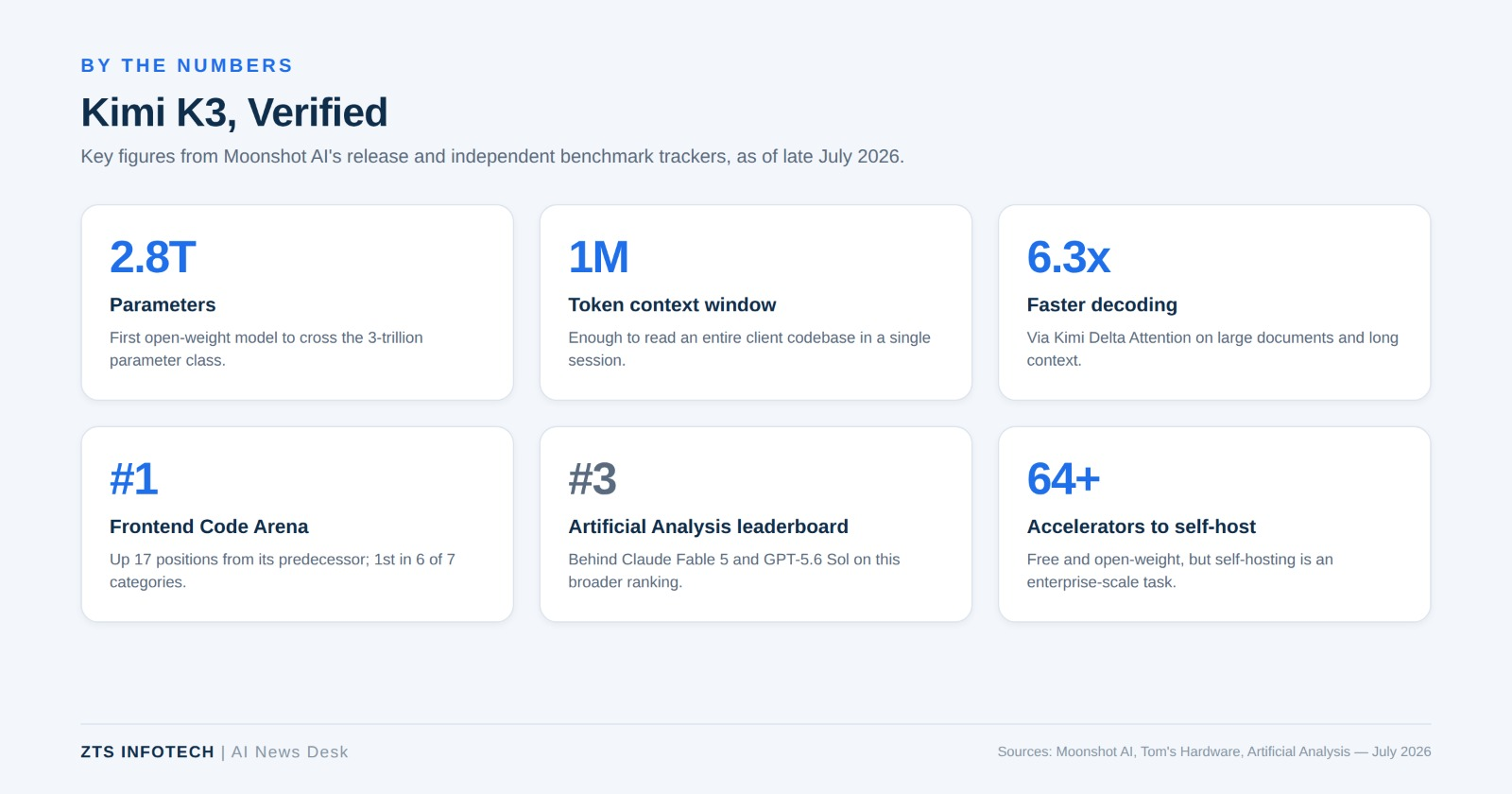
Kimi K3 is a 2.8 trillion parameter model from Chinese AI lab Moonshot AI, released July 16, 2026, with full open weights following on July 26. It is the first open-weight model to cross the 3-trillion parameter class by total parameter count, built on a Mixture-of-Experts architecture that activates only a small subset of its experts for any given request rather than running the entire model at once — a design choice that keeps inference more efficient than the raw parameter count suggests.
It is also free and downloadable, which matters for a specific kind of business decision: teams with strict data-residency or privacy requirements can, in principle, run K3 entirely on their own infrastructure instead of routing sensitive code or documents through a third-party API.
The Practical Feature: A Million-Token Context Window
K3 ships with a 1 million token context window. In practical terms, that means the model can read an entire client codebase — every file, every dependency — in a single session, without chunking the project into pieces or losing track of what it read minutes earlier. For engineering teams doing large-scale refactors, audits, or documentation work, that is a meaningfully different working style than juggling a smaller context window across multiple prompts.
The Technical Breakthrough Behind the Speed
The feature getting less attention than it deserves is Kimi Delta Attention, the mechanism behind K3's claimed 6.3x faster decoding on large documents. Rather than rescanning an entire document for every new query, the model is selective about which parts it rereads — closer to a librarian who remembers exactly which shelf they already checked than one who walks the full library again for every question. On long-document and long-codebase workloads, that selectivity is what turns a large context window from a theoretical spec into something usable at reasonable speed.
The Benchmark That Matters — With an Honest Caveat
On the Frontend Code Arena benchmark, K3 jumped 17 positions from its predecessor to rank number one, placing first in six of seven tested categories and outperforming Claude Fable 5, Anthropic's current flagship. That is a genuine result on a benchmark developers use to evaluate real front-end coding ability.
It is not, however, a claim that K3 leads every leaderboard outright. On the broader Artificial Analysis ranking, K3 debuted in third place, behind Claude Fable 5 and OpenAI's GPT-5.6 Sol. K3 leads on specific, practical coding evaluations while trailing the two leading closed models on broader aggregate benchmarks — both facts matter for anyone deciding which model fits a given workload.
What This Means for Businesses Evaluating AI Infrastructure
For engineering leaders weighing model choices beyond raw benchmark scores, several practical points stand out:
- Self-hosting is possible, but not casual. Running K3 locally requires 64 or more accelerators, putting true self-hosting within reach of large enterprises and specialized infrastructure providers, not most individual teams.
- Free weights don't mean free inference. Most businesses will access K3 through Kimi Code or the Kimi app rather than self-hosting, meaning hosting and inference costs still apply even though the model license itself carries no fee.
- Open-weight competition changes negotiating leverage. A frontier-scale open model that beats a proprietary competitor on any recognized benchmark strengthens the case businesses can make when negotiating pricing and terms with closed-model vendors.
Expert Perspective
The bigger story is not one benchmark table — it's the pace at which open-weight models are closing the gap with closed, proprietary frontier models. A year ago, a model beating a leading commercial coding assistant on any serious benchmark would have been the exception. K3 doing so on Frontend Code Arena while still landing third on a broader leaderboard is the more realistic signal: open-weight models are now competitive on specific, high-value tasks even where they haven't caught up everywhere.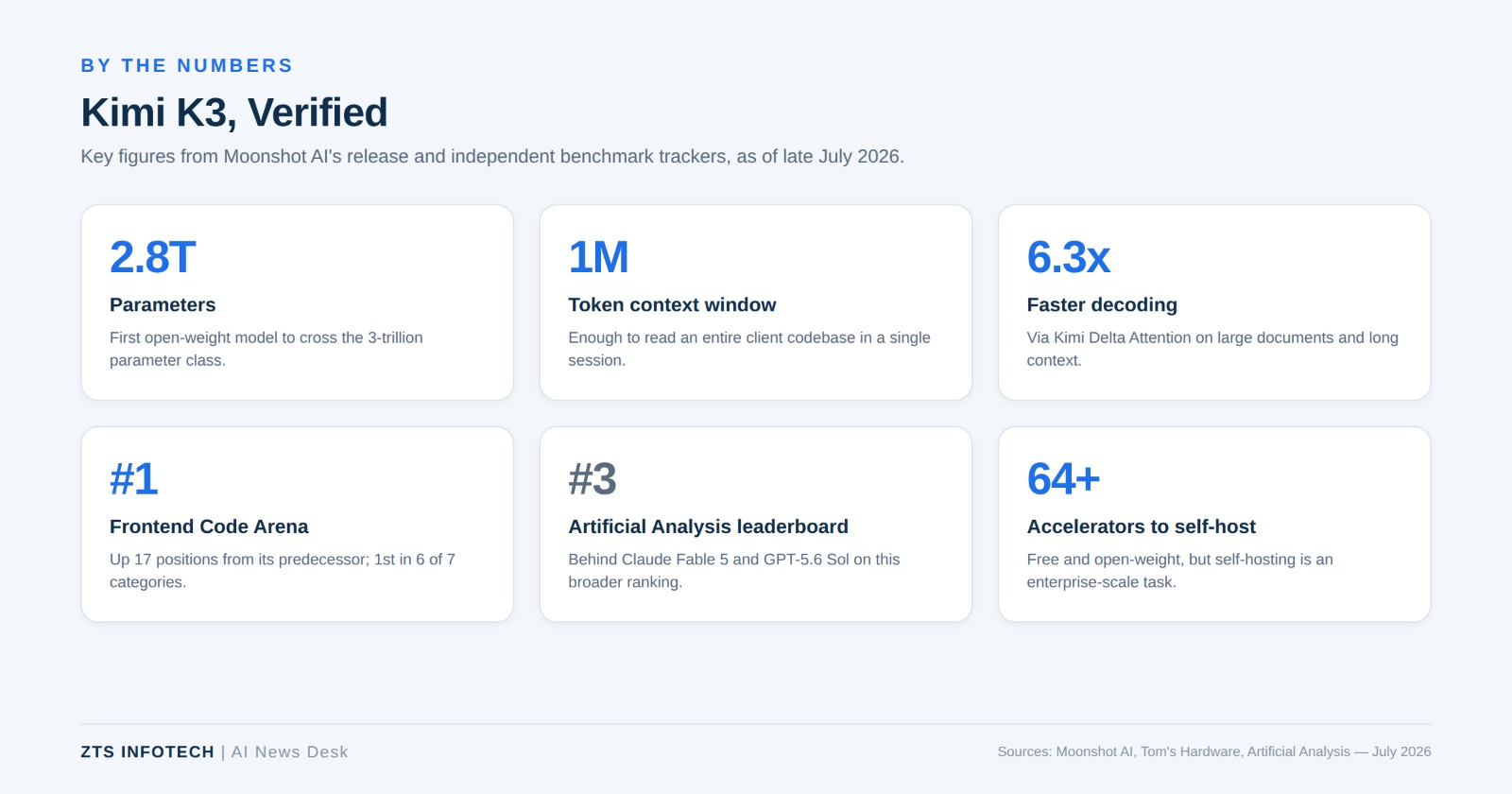
For business leaders, the practical takeaway is to stop treating 'which model is best' as a single-answer question. A team doing heavy front-end code review has a real reason to test K3 directly against its current tooling, while a team optimizing for broad reasoning may still find the closed leaders ahead. K4's eventual arrival, once Moonshot secures the compute it needs, will be worth watching for the same reason — each generation narrows a gap that used to look wider.
Key Takeaways
- Kimi K4 has not launched — Moonshot AI is still sourcing the Nvidia chips to train it. Kimi K3 is the model that actually shipped.
- K3 is a free, open-weight, 2.8 trillion parameter model — the first open-weight model to cross the 3-trillion parameter class.
- Its 1 million token context window lets it read an entire codebase in one session without chunking.
- Kimi Delta Attention delivers up to 6.3x faster decoding on large documents by selectively avoiding redundant rereads.
- K3 ranks first on the Frontend Code Arena benchmark, beating Claude Fable 5 in 6 of 7 categories — but ranks third on the broader Artificial Analysis leaderboard, behind Claude Fable 5 and GPT-5.6 Sol.
- Self-hosting requires 64 or more accelerators, putting it within reach of large enterprises rather than most individual teams.
- ZTS Infotech is testing Kimi K3 against real client codebases this week.
Conclusion
Kimi K3 is a genuine data point in a trend worth tracking closely: open-weight models are now winning specific, high-value benchmarks against the industry's leading closed models, even while trailing on broader rankings. That nuance matters more than a single headline number. Businesses evaluating AI tooling should test models against their actual workload rather than a leaderboard position, and keep an eye on Kimi K4 as Moonshot AI secures the compute to train it. ZTS Infotech will share results from its own K3 testing as they come in.
-

Writen by Anirban Das